
Professional Service Robots Market Report 2026
Global Outlook – By Type (UAV, Unmanned Ground Based Vehicles, Demining Robots, Defense Robot, Construction Robots, Other Types), By Offering (Hardware, Software), By Application (Oil And Gas, Construction And Building, Mining And Metallurgical, Defense And Military, Automotive, Medical, Logistics, Other Applications), By End-Use (Residential, Commercial, Industrial) – Market Size, Trends, Strategies, and Forecast to 2030
Professional Service Robots Market Overview
• Professional Service Robots market size has reached to $73.54 billion in 2025 • Expected to grow to $249.69 billion in 2030 at a compound annual growth rate (CAGR) of 27.7% • Growth Driver: The Surge In Automation Demand Boosts The Professional Service Robot Market • Market Trend: Product Innovative Fuels Professional Service Robot Market • North America was the largest region and fastest growing region.Market Gains By 2030 – Top Opportunities By Segment
Market Gain identifies the most promising market opportunities by highlighting the segments or products expected to generate the highest incremental revenue growth over the next five years.
What Is Covered Under Professional Service Robots Market?
Professional service robots refer to a robot that is used in a professional setting outside of the usual manufacturing floor scenario. They are comparable to industrial robots that are typically used in hazardous, demanding, menial, or repetitive tasks where automation technology surpasses manual labor. The main types of professional service robots are UAVs (Unmanned Aerial Vehicles), unmanned ground-based vehicles, demining robots, defense robots, construction robots, and others. An unmanned aerial vehicle (UAV) is a military aircraft that is guided autonomously, remotely, or both and carries sensors, offensive munitions, target designators, or electronic transmitters meant to interfere with or destroy enemy objectives. The offerings offered are hardware and software. These are used in various applications such as oil and gas, construction and building, mining and metallurgy, defense and military, automotive, medical, logistics, and others, and are used in residential, commercial, and industrial settings.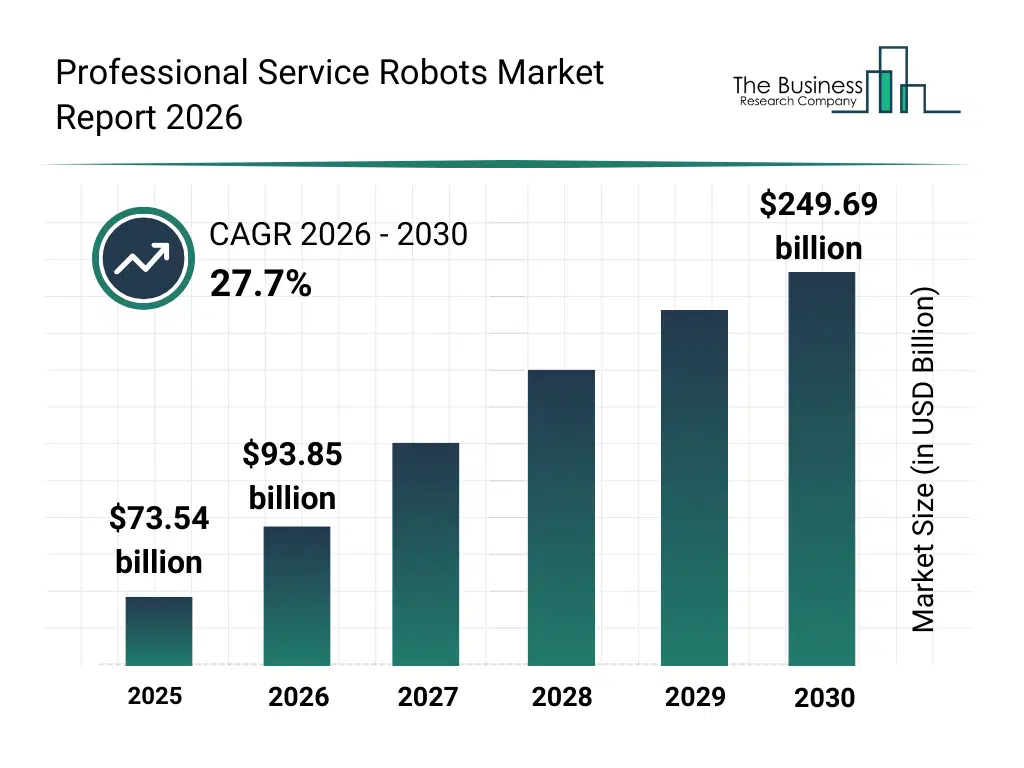
What Is The Professional Service Robots Market Size and Share 2026?
The professional service robots market size has grown exponentially in recent years. It will grow from $73.54 billion in 2025 to $93.85 billion in 2026 at a compound annual growth rate (CAGR) of 27.6%. The growth in the historic period can be attributed to advancements in robotics hardware capabilities, increasing automation needs outside manufacturing, rising labor safety concerns, early adoption in defense and mining sectors, declining sensor and actuator costs.What Is The Professional Service Robots Market Growth Forecast?
The professional service robots market size is expected to see exponential growth in the next few years. It will grow to $249.69 billion in 2030 at a compound annual growth rate (CAGR) of 27.7%. The growth in the forecast period can be attributed to increasing investments in autonomous service robotics, expansion of robotics in commercial applications, growing demand for productivity optimization, rising integration of ai and robotics software, increasing deployment in smart infrastructure projects. Major trends in the forecast period include increasing deployment of autonomous professional robots, rising use of robots in hazardous work environments, growing adoption of service robots in logistics and healthcare, expansion of ai-enabled human-robot collaboration, enhanced focus on multi-application robot platforms.
Global Professional Service Robots Market Segmentation
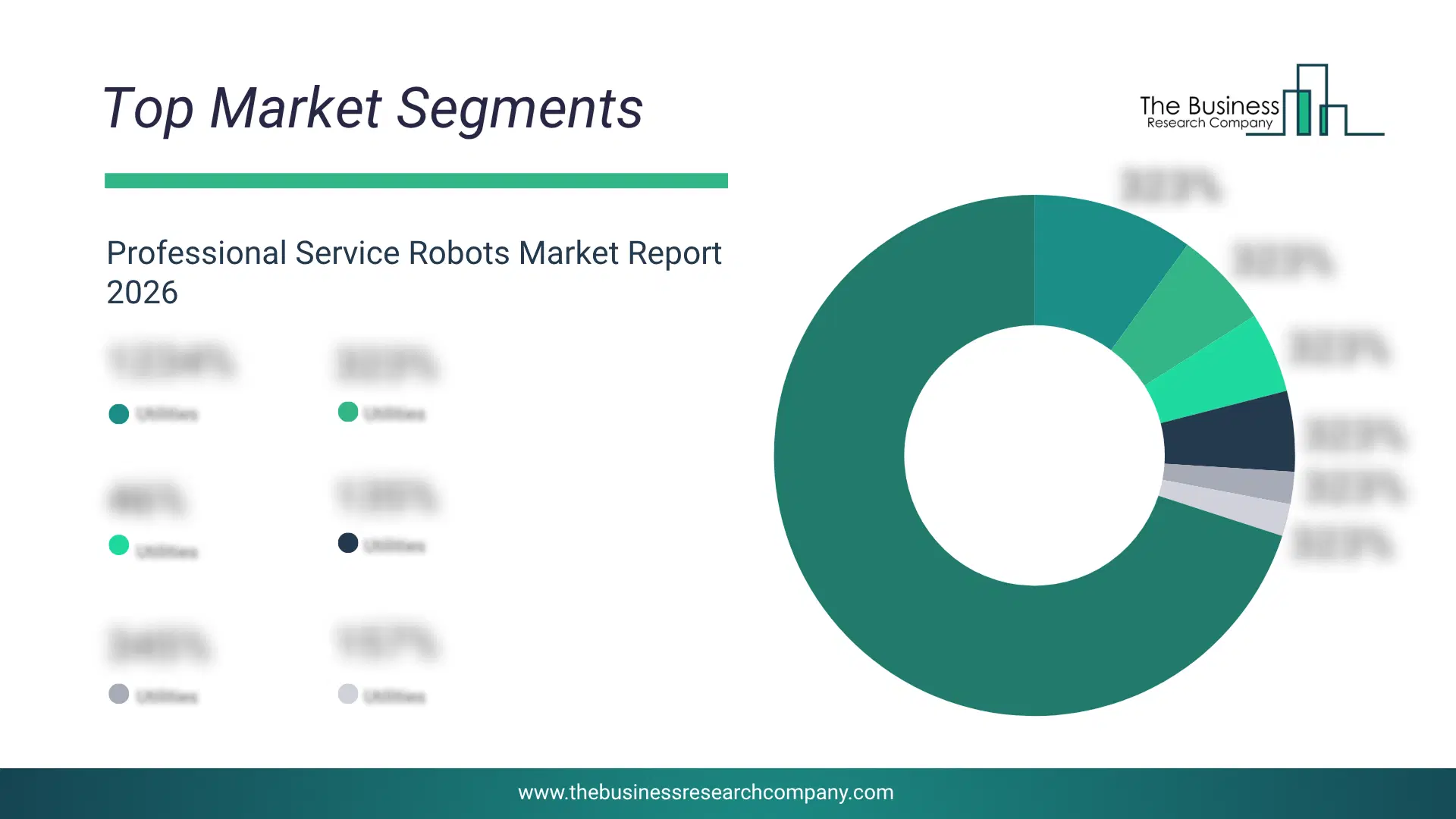
1) By Type: UAV, Unmanned Ground Based Vehicles, Demining Robots, Defense Robot, Construction Robots, Other Types 2) By Offering: Hardware, Software 3) By Application: Oil And Gas, Construction And Building, Mining And Metallurgical, Defense And Military, Automotive, Medical, Logistics, Other Applications 4) By End-Use: Residential, Commercial, Industrial Subsegments: 1) By UAV (Unmanned Aerial Vehicles): Fixed-Wing UAVs, Multi-Rotor UAVs, Hybrid UAVs 2) By Unmanned Ground Based Vehicles (UGVs): Wheeled UGVs, Tracked UGVs, Legged Robots 3) By Demining Robots: Manual Demining Robots, Remote-Controlled Demining Robots, Autonomous Demining Robots 4) By Defense Robots: Surveillance Robots, Explosive Ordnance Disposal (EOD) Robots, Combat Support Robots 5) By Construction Robots: Bricklaying Robots, Concrete Printing Robots, Demolition Robots 6) By Other Types: Agricultural Robots, Medical Robots, Hospitality Robots, Underwater Robots The top segments in the professional service robots market will be: • Unmanned Ground Based Vehicles will reach $112.19 Billion by 2030. • UAV will reach $64.84 Billion by 2030. • Defense Robot will reach $24.67 Billion by 2030. • Construction Robots will reach $19.54 Billion by 2030. • Other Types will reach $15.24 Billion by 2030.What Is The Driver Of The Professional Service Robots Market?
Increasing demand for automation across industries is expected to propel the growth of the professional service robot market going forward. Automation refers to technological applications in which human input is minimal. This encompasses information technology (IT), business process automation (BPA), automation, and personal applications such as home automation. Automation is becoming more common across various industries because it brings benefits such as enhanced production rates and productivity, more efficient use of materials, improved safety, shorter workweeks for labor, better product quality, and shorter manufacturing lead times. For instance, in September 2024, according to the International Federation of Robotics, a Germany-based non-profit organization to promote, strengthen, and protect the robotics industry worldwide, in 2023, robot installations in Canada rose by 37% to 4,311 units. Therefore, increasing demand for automation across industries drives the professional service robot industry.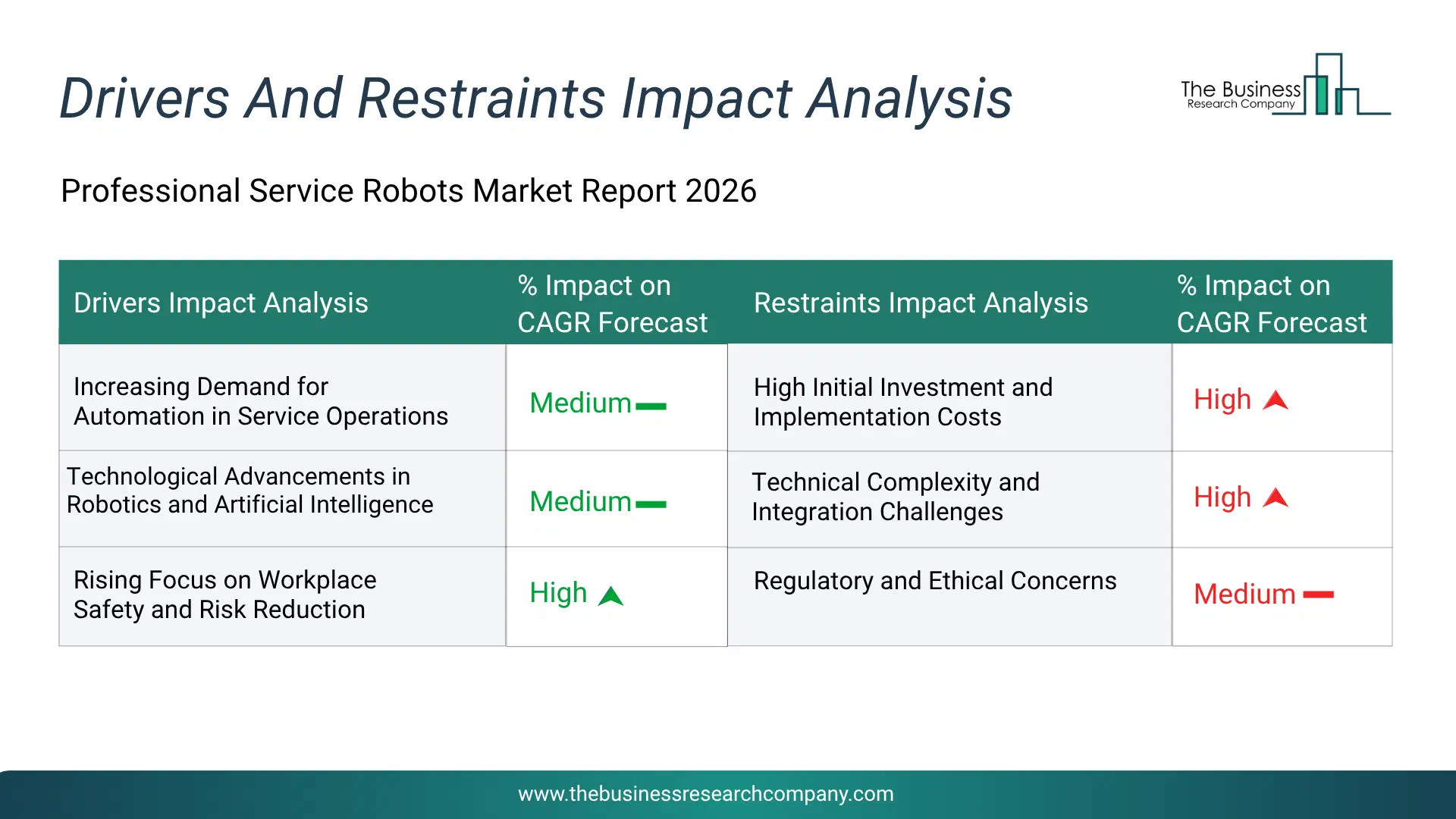
Infographic Chart Showing Key Market Drivers Analysis And Restraints For Professional Service Robots Market
The chart presents an impact analysis of key drivers and restraints, quantifying their relative influence on the market's growth rate and helping assess the balance between growth enablers and limiting factors. This chart offers a high-level perspective; the full report contains more detailed insights.
How Will The Drivers Impact Growth In The Global Professional Service Robots Market?
• Increasing Demand for Automation in Service Operations (Medium) – During the forecast period, the increasing demand for automation in service operations is expected to become a key growth driver for the professional service robots market by 2030. Organizations across sectors such as logistics, healthcare, defense, and construction are increasingly adopting robotic systems to streamline repetitive and labor-intensive tasks. Automation enables faster task execution, improved accuracy, and reduced dependency on manual labor, particularly in environments facing workforce shortages. Businesses are also leveraging service robots to enhance productivity and maintain consistent service quality in high-demand operations. As enterprises continue to prioritize efficiency and scalability, the integration of robotic solutions into service workflows is accelerating. • Technological Advancements in Robotics and Artificial Intelligence (Medium) – During the forecast period, technological advancements in robotics and artificial intelligence are expected to emerge as a major factor driving the expansion of the professional service robots market by 2030. Continuous improvements in AI algorithms, machine learning, computer vision, and autonomous navigation are significantly enhancing the capabilities of service robots. These advancements enable robots to perform complex tasks with higher precision, adaptability, and decision-making ability in dynamic environments. The integration of cloud computing and edge processing further strengthens real-time data analysis and operational efficiency. As innovation accelerates, service robots are becoming more versatile and capable across a wider range of applications. • Rising Focus on Workplace Safety and Risk Reduction (High) – During the forecast period, the rising focus on workplace safety and risk reduction is expected to act as a key growth catalyst for the professional service robots market by 2030. Industries such as mining, oil and gas, defense, and construction are increasingly deploying robots to perform hazardous tasks in dangerous environments, minimizing human exposure to risk. Service robots are being utilized for activities such as surveillance, inspection, bomb disposal, and heavy material handling, where safety concerns are critical. Regulatory compliance and growing awareness around occupational safety standards are further encouraging the adoption of robotic solutions. As organizations seek to enhance worker protection while maintaining operational efficiency, demand for service robots continues to rise.How Will The Restraints Impact Growth In The Global Professional Service Robots Market?
• High Initial Investment and Implementation Costs (Medium) – During the forecast period, high initial investment and implementation costs are significantly restricting the growth of the professional service robots market. The substantial capital required for robotic systems, installation, training, and integration with existing workflows is limiting adoption, particularly among small and medium-sized enterprises. • Technical Complexity and Integration Challenges (Medium) – During the forecast period, technical complexity and integration challenges are significantly restricting the growth of the professional service robots market. Difficulties in integrating robotic systems with legacy infrastructure, along with the need for specialized technical expertise, are slowing deployment and increasing operational barriers across multiple industries. • Regulatory and Ethical Concerns (High) – During the forecast period, regulatory and ethical concerns are significantly restricting the growth of the professional service robots market. Evolving safety regulations, liability issues, data privacy concerns, and ethical debates surrounding human-robot interaction are creating uncertainty and slowing large-scale adoption of service robotics solutions.Key Players In The Global Professional Service Robots Market
Major companies operating in the professional service robots market are Northrop Grumman Corporation, Boston Dynamics Inc., Daifuku Co. Ltd., Aethon Inc., Electrolux AB, Kuka AG, iRobot Corporation, Robert Bosch GMBH, Elbit Systems Ltd., Gecko Systems International Corporation, Yujin Robot Co. Ltd., Cyberdyne Inc., Ontario Drive & Gear Ltd., Softbank Robotics Group, Ryonic Robotics, Brokk AB, Husqvarna Group, Beijing Borui Intelligent Control Technology, Honeybee Robotics LLC, Pure Technologies Ltd., Hanool Robotics Crop., Diakont, Conjet AB, TopTec Spezialmaschinen GmbH, ULC Robotics International Limited, Giant Hydraulic Tech Co. Ltd., Intuitive Surgical Inc., JD.com Inc., Samsung Electronics Co. Ltd., SZ DJI Technology Co. Ltd., Kongsberg Maritime AS, DeLaval International AB, Exyn Technologies, XAG Co Ltd., Diligent Corporation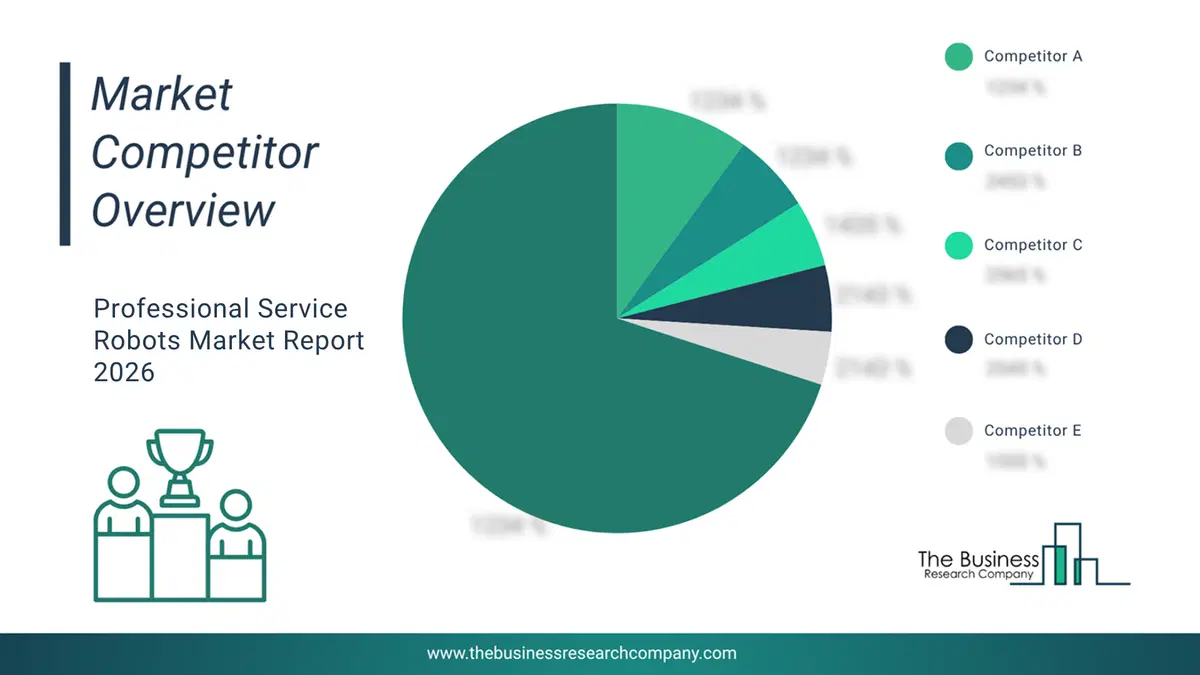
This chart is for illustrative purposes; the full report includes a detailed competitor analysis and comprehensive overview of the top 10 companies in the market.
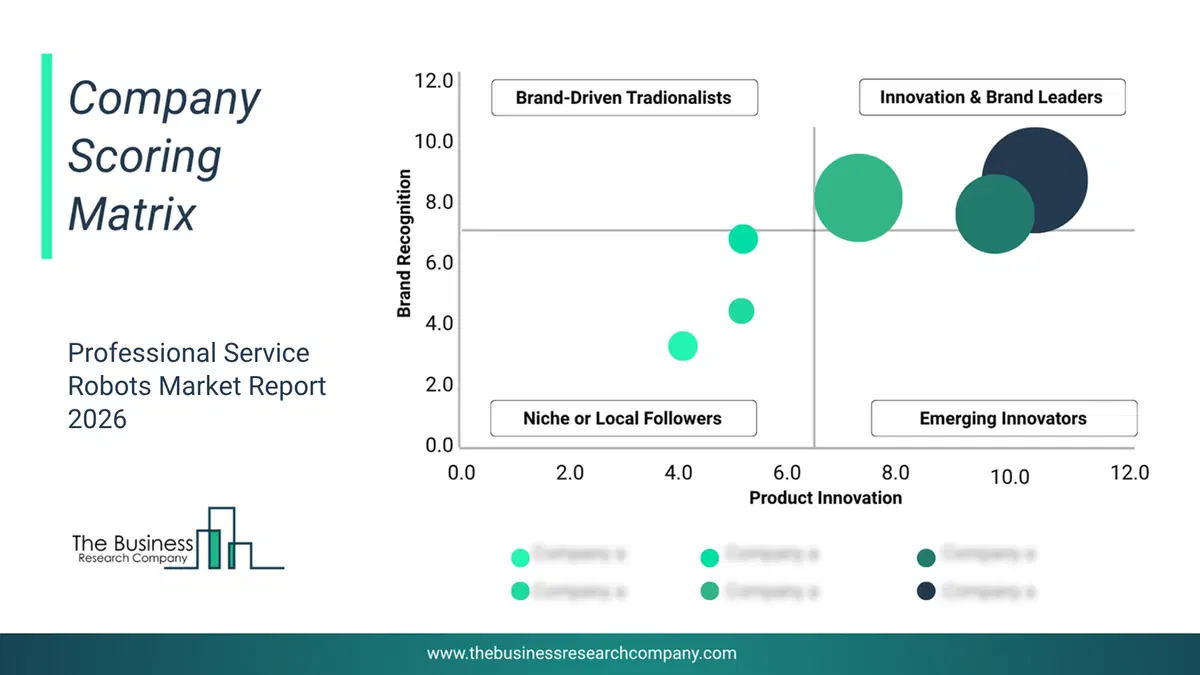
This chart maps companies by product innovation and brand strength, with bubble size indicating relative revenue, helping identify market leaders, challengers, and niche players. This is an illustrative chart; the full report provides a complete and accurate competitive analysis.
Global Professional Service Robots Market Trends and Insights
Major companies operating in the professional service robot market are developing innovative products such as AI-serving robots to meet larger customer bases, more sales, and increase revenue. AI-serving robots are robotic systems equipped with artificial intelligence (AI) capabilities that enable them to perform various service-oriented tasks. For instance, in May 2023, KT Corporation, a South Korea-based telecommunications company, launched two AI service robots with improved capabilities for weight detection and driving stability. One of the robots is equipped with a 10.1-inch display designed for marketing and promotional activities, making it well-suited for Korean restaurants that serve various side dishes and soups. The other robot features a 10.1-inch display specifically for displaying guidance messages, photos, and videos. KT has intentions to broaden the application of these service robots, extending beyond restaurants to include indoor golf courses, Internet cafes, and small parts factories.What Are Latest Mergers And Acquisitions In The Professional Service Robots Market?
In March 2023, Berkshire Grey Inc., a US-based provider of AI-enabled robotic solutions, merged with SoftBank Group Corp. to accelerate growth and expand its automation capabilities. With this merger, Berkshire Grey aims to accelerate its growth and enhance its AI-driven robotic solutions by leveraging SoftBank’s strategic support, creating greater value for stockholders and strengthening its ability to serve customers efficiently. SoftBank Group Corp. is a Japan-based investment holding company that invests in breakthrough technologies across AI, robotics, IoT, telecommunications, internet services, and clean energy.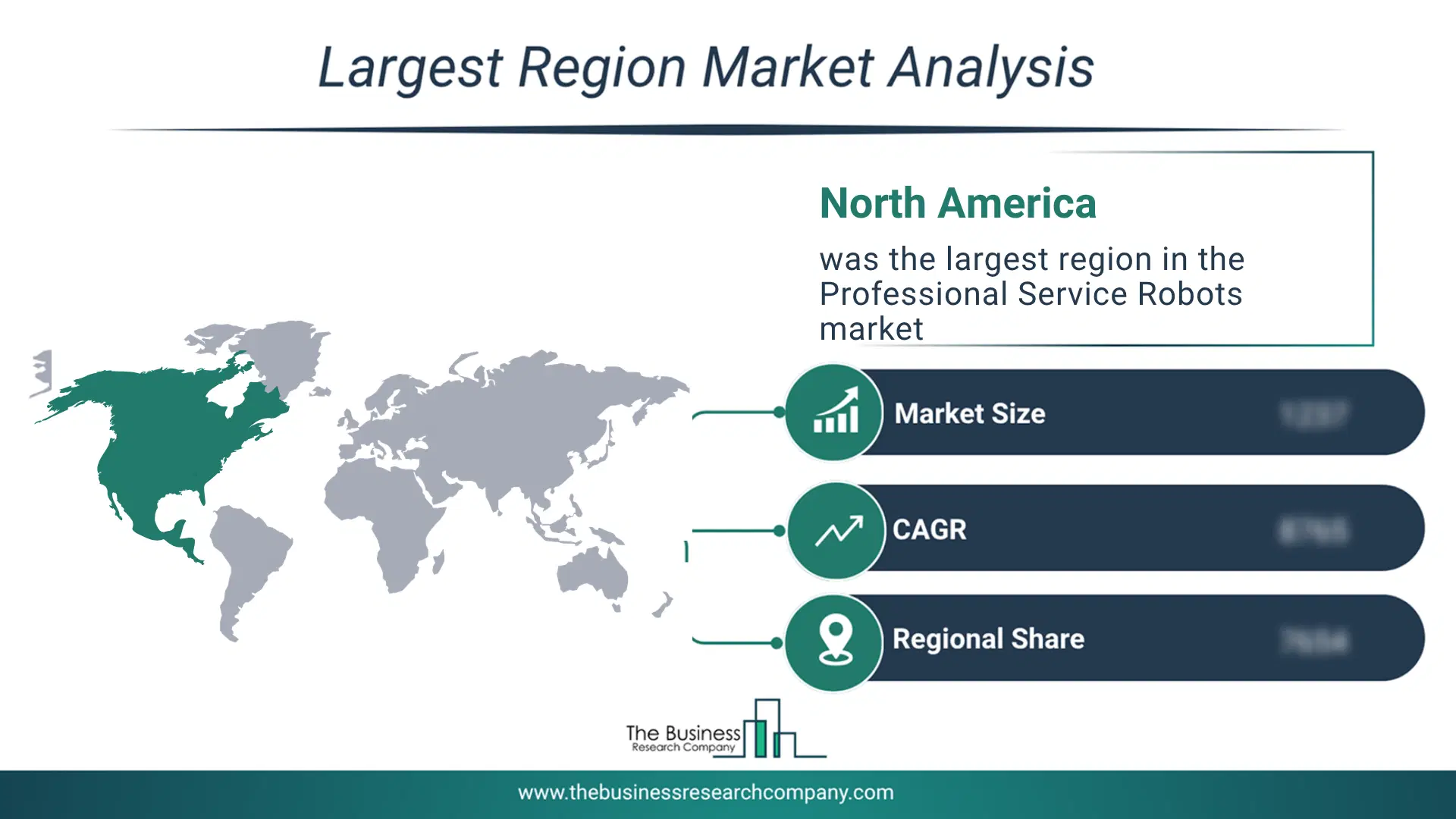
Regional Insights
North America was the largest region in the professional service robots market in 2025 and is expected to be the fastest-growing region in the forecast period. The regions covered in this market report are Asia-Pacific, South East Asia, Western Europe, Eastern Europe, North America, South America, Middle East, Africa. The countries covered in this market report are Australia, Brazil, China, France, Germany, India, Indonesia, Japan, Taiwan, Russia, South Korea, UK, USA, Canada, Italy, Spain.What Defines the Professional Service Robots Market?
The professional service robots market consists of sales of articulated robots, cartesian robots, SCARA robots, and delta robots. Values in this market are ‘factory gate’ values, that is, the value of goods sold by the manufacturers or creators of the goods, whether to other entities (including downstream manufacturers, wholesalers, distributors, and retailers) or directly to end customers. The value of goods in this market includes related services sold by the creators of the goods.How is Market Value Defined and Measured?
The market value is defined as the revenues that enterprises gain from the sale of goods and/or services within the specified market and geography through sales, grants, or donations in terms of the currency (in USD unless otherwise specified). The revenues for a specified geography are consumption values that are revenues generated by organizations in the specified geography within the market, irrespective of where they are produced. It does not include revenues from resales along the supply chain, either further along the supply chain or as part of other products.
This chart presents market attractiveness based on a quantitative evaluation of growth, competition, strategic alignment, and risk, offering a clear view of opportunity areas for decision-making. This chart is for illustrative purposes; the full report contains the complete analysis.

This chart highlights the Total Addressable Market (TAM) by estimating the maximum revenue opportunity using an assumption-driven approach, supporting strategic planning and opportunity sizing across markets. The chart is illustrative; the full report provides a more comprehensive analysis.
What Key Data and Analysis Are Included in the Professional Service Robots Market Report 2026?
The professional service robots market research report is one of a series of new reports from The Business Research Company that provides market statistics, including industry global market size, regional shares, competitors with the market share, detailed market segments, market trends and opportunities, and any further data you may need to thrive in the professional service robots industry. The market research report delivers a complete perspective of everything you need, with an in-depth analysis of the current and future state of the industry.Professional Service Robots Market Report Forecast Analysis
| Report Attribute | Details |
|---|---|
| Market Size Value In 2026 | $93.85 billion |
| Revenue Forecast In 2030 | $249.69 billion |
| Growth Rate | CAGR of 27.6% from 2026 to 2030 |
| Base Year For Estimation | 2025 |
| Actual Estimates/Historical Data | 2020-2025 |
| Forecast Period | 2026 - 2030 |
| Market Representation | Revenue in USD Billion and CAGR from 2026 to 2030 |
| Segments Covered | Type, Offering, Application, End-Use |
| Regional Scope | Asia-Pacific, Western Europe, Eastern Europe, North America, South America, Middle East, Africa |
| Country Scope | The countries covered in the report are Australia, Brazil, China, France, Germany, India, Indonesia, Japan, Taiwan, Russia, South Korea, UK, USA, Canada, Italy, Spain. |
| Key Companies Profiled | Northrop Grumman Corporation, Boston Dynamics Inc., Daifuku Co. Ltd., Aethon Inc., Electrolux AB, Kuka AG, iRobot Corporation, Robert Bosch GMBH, Elbit Systems Ltd., Gecko Systems International Corporation, Yujin Robot Co. Ltd., Cyberdyne Inc., Ontario Drive & Gear Ltd., Softbank Robotics Group, Ryonic Robotics, Brokk AB, Husqvarna Group, Beijing Borui Intelligent Control Technology, Honeybee Robotics LLC, Pure Technologies Ltd., Hanool Robotics Crop., Diakont, Conjet AB, TopTec Spezialmaschinen GmbH, ULC Robotics International Limited, Giant Hydraulic Tech Co. Ltd., Intuitive Surgical Inc., JD.com Inc., Samsung Electronics Co. Ltd., SZ DJI Technology Co. Ltd., Kongsberg Maritime AS, DeLaval International AB, Exyn Technologies, XAG Co Ltd., Diligent Corporation |
| Customization Scope | Request for Customization |
| Pricing And Purchase Options | Explore Purchase Options |