
Protein Stability Screening Platforms Market Report 2026
Global Outlook – By Protein Type (Monoclonal Antibodies, Recombinant Proteins, Vaccines And Antigens, Enzymes, Other Protein Types), By Technology (Differential Scanning Calorimetry, Differential Scanning Fluorimetry, Spectroscopy, Chromatography, Other Technologies), By Component Type (Instruments, Consumables, Software, Services), By Application (Drug Discovery, Biopharmaceutical Development, Protein Engineering, Academic Research, Other Applications), By End-User (Pharmaceutical & Biotechnology Companies, Academic And Research Institutes, Contract Research Organizations, Other End-Users) – Market Size, Trends, Strategies, and Forecast to 2030
Protein Stability Screening Platforms Market Overview
• Protein Stability Screening Platforms market size has reached to $1.44 billion in 2025 • Expected to grow to $2.29 billion in 2030 at a compound annual growth rate (CAGR) of 9.7% • Growth Driver: Rising Adoption Of Personalized Medicine Driving Growth In The Market Due To Advances In Genomics And Targeted Therapeutics • Market Trend: Innovative High-Throughput Tools Advancing Protein Stability And Biologics Research • North America was the largest region in 2025 and Asia-Pacific is the fastest growing region.What Is Covered Under Protein Stability Screening Platforms Market?
Protein stability screening platforms refer to technologies and systems designed to assess the physical and chemical stability of proteins under various conditions, including temperature, pH, and formulation environments. These platforms help in identifying optimal conditions for protein storage, formulation, and therapeutic development, ensuring efficacy and shelf life, and are crucial for biologics and pre-sterilized nested vial applications. The main protein types of protein stability screening platforms include monoclonal antibodies, recombinant proteins, vaccines and antigens, enzymes, and others. Monoclonal antibodies are laboratory-produced molecules designed to bind specifically to a single target antigen for diagnostics, research, or therapeutic use. The technologies include differential scanning calorimetry, differential scanning fluorimetry, spectroscopy, chromatography, and other technologies with various components that include instruments, consumables, software, and services. They find application in drug discovery, biopharmaceutical development, protein engineering, academic research, and other applications, serving end users including pharmaceutical & biotechnology companies, academic and research institutes, contract research organizations, and other end-users.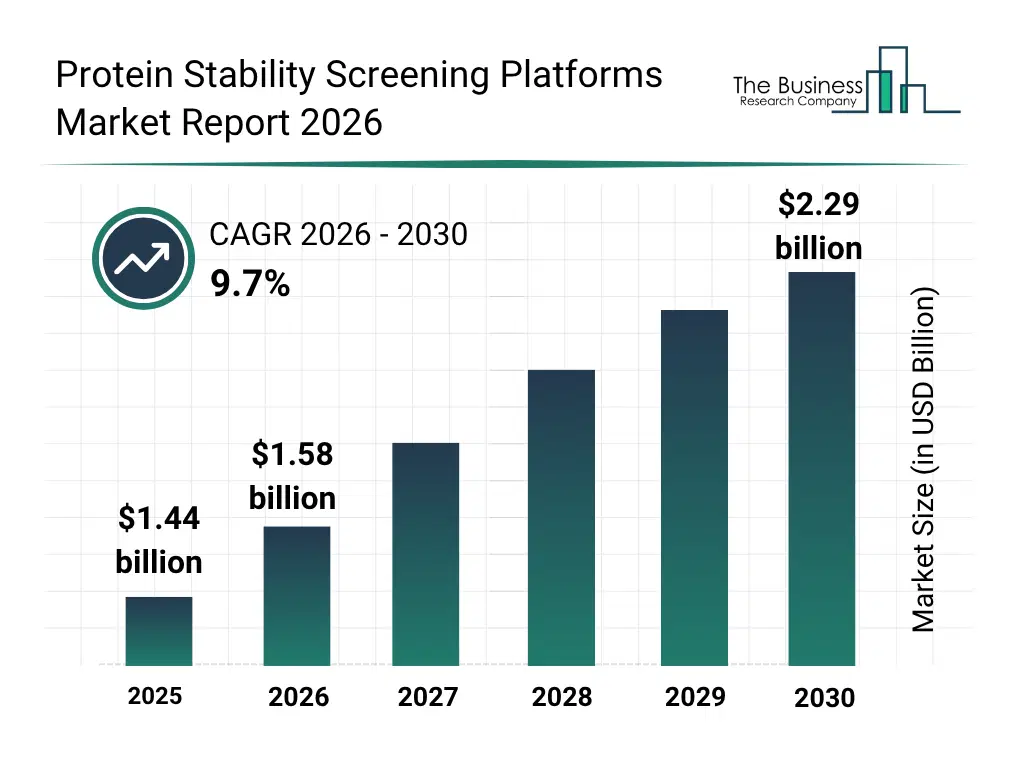
What Is The Protein Stability Screening Platforms Market Size and Share 2026?
The protein stability screening platforms market size has grown strongly in recent years. It will grow from $1.44 billion in 2025 to $1.58 billion in 2026 at a compound annual growth rate (CAGR) of 9.5%. The growth in the historic period can be attributed to rising demand for biologics, adoption of conventional stability testing methods, increasing investment in pharmaceutical r&d, growth of monoclonal antibody therapies, stringent regulatory requirements.What Is The Protein Stability Screening Platforms Market Growth Forecast?
The protein stability screening platforms market size is expected to see strong growth in the next few years. It will grow to $2.29 billion in 2030 at a compound annual growth rate (CAGR) of 9.7%. The growth in the forecast period can be attributed to adoption of ai-driven protein stability platforms, integration with iot-enabled lab systems, expansion of biopharmaceutical pipelines, demand for real-time monitoring, development of predictive modeling software. Major trends in the forecast period include high-throughput protein stability screening, automated formulation analysis, integration with laboratory information systems, real-time protein degradation monitoring, predictive shelf-life modeling.
Global Protein Stability Screening Platforms Market Segmentation
1) By Protein Type: Monoclonal Antibodies, Recombinant Proteins, Vaccines And Antigens, Enzymes, Other Protein Types 2) By Technology: Differential Scanning Calorimetry, Differential Scanning Fluorimetry, Spectroscopy, Chromatography, Other Technologies 3) By Component Type: Instruments, Consumables, Software, Services 4) By Application: Drug Discovery, Biopharmaceutical Development, Protein Engineering, Academic Research, Other Applications 5) By End-User: Pharmaceutical & Biotechnology Companies, Academic And Research Institutes, Contract Research Organizations, Other End-Users Subsegments: 1) By Monoclonal Antibodies: Human Monoclonal Antibodies, Chimeric Monoclonal Antibodies, Humanized Monoclonal Antibodies, Murine Monoclonal Antibodies 2) By Recombinant Proteins: Recombinant Human Proteins, Recombinant Animal Proteins, Recombinant Microbial Proteins, Recombinant Plant Proteins 3) By Vaccines and Antigens: Protein Subunit Vaccines, Conjugate Vaccines, Toxoid Vaccines, Virus Like Particle Vaccines 4) By Enzymes: Hydrolases, Oxidoreductases, Transferases, Lyases, Isomerases, Ligases 5) By Other Protein Types: Fusion Proteins, Cytokines, Hormones, Growth FactorsWhat Is The Driver Of The Protein Stability Screening Platforms Market?
The growing adoption of personalized medicine is expected to propel the growth of the protein stability screening platforms market. Personalized medicine involves tailoring medical treatments and healthcare decisions to an individual’s genetic, molecular, and clinical profile to improve therapeutic efficacy and safety. The expansion of personalized medicine is largely driven by advances in genomics and molecular diagnostics, which enable the identification of genetic variations and molecular markers that influence disease progression and drug response, supporting the development of more targeted therapies. Protein stability screening platforms play a critical role in personalized medicine by evaluating the stability, folding, and interaction behavior of proteins under varying conditions, which is essential for optimizing drug and biologic design. For instance, in February 2024, the Personalized Medicine Coalition, a U.S.-based non-profit organization, reported that in 2023 the U.S. Food and Drug Administration (FDA) approved 16 new personalized treatments for rare disease patients, up from six approvals in 2022. Therefore, the growing adoption of personalized medicine is driving the growth of the protein stability screening platforms industry.Key Players In The Global Protein Stability Screening Platforms Market
Major companies operating in the protein stability screening platforms market are Thermo Fisher Scientific Inc., GE Healthcare Life Sciences, Agilent Technologies Inc., Shimadzu Corporation, Bruker Corporation, Waters Corporation, Revvity Inc., Bio-Rad Laboratories Inc., Spectris plc., Malvern Panalytical Ltd., Promega Corporation, Unchained Labs Inc., NanoTemper Technologies GmbH, Creative Biostructure Inc., BMG LABTECH GmbH, Jasco Inc., Porvair Sciences Ltd., Zinsser Analytic GmbH, Jena Bioscience GmbH, Applied Photophysics Ltd., Enzo Life Sciences Inc.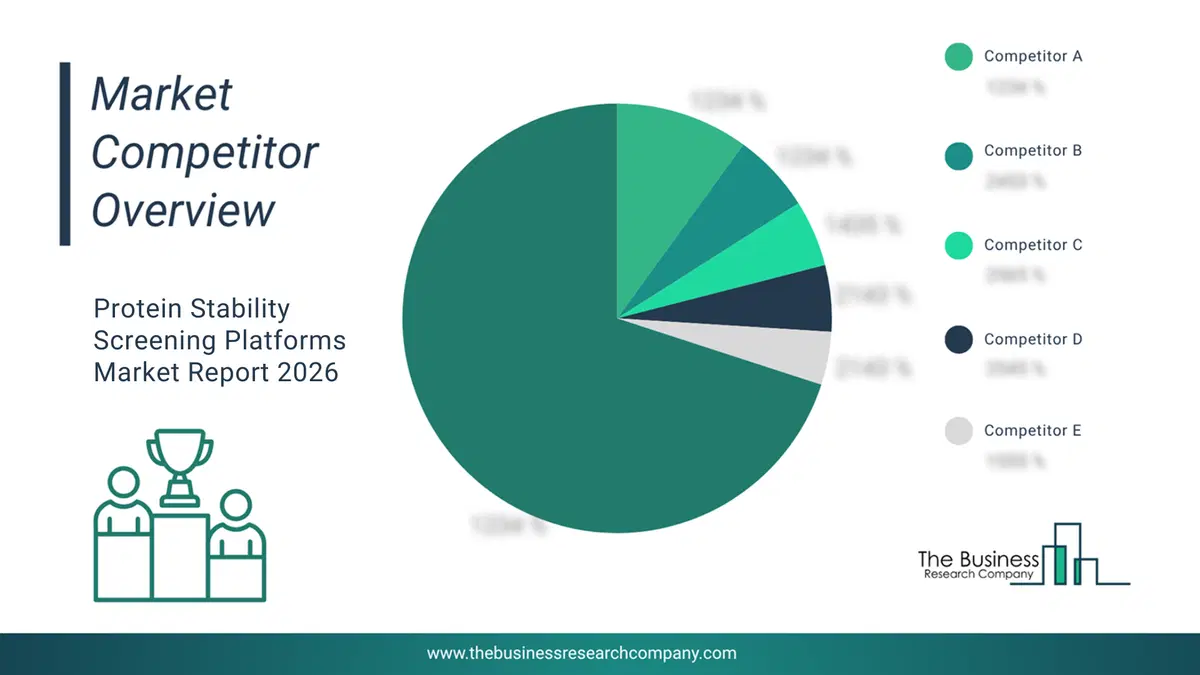
This chart is for illustrative purposes; the full report includes a detailed competitor analysis and comprehensive overview of the top 10 companies in the market.
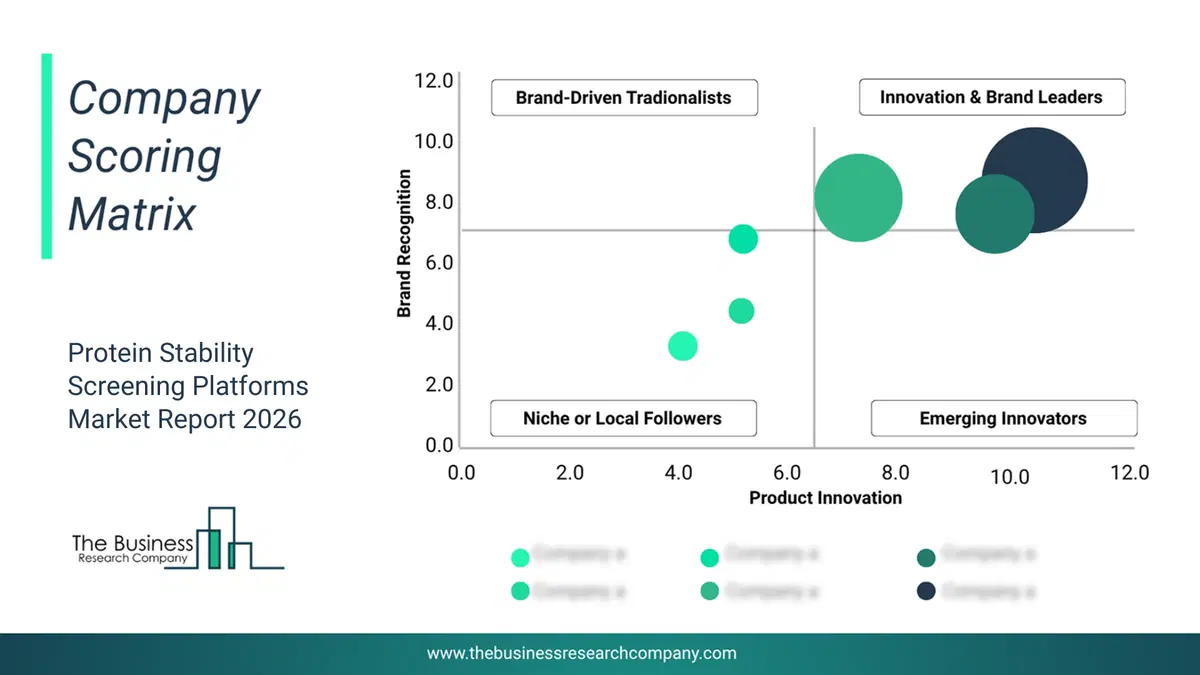
This chart maps companies by product innovation and brand strength, with bubble size indicating relative revenue, helping identify market leaders, challengers, and niche players. This is an illustrative chart; the full report provides a complete and accurate competitive analysis.
Global Protein Stability Screening Platforms Market Trends and Insights
Major companies operating in the protein stability screening platforms market are increasingly focusing on the development of innovative high-throughput tools that enable rapid assessment of protein stability, aggregation, and folding, accelerating biopharmaceutical development and formulation optimization. High-throughput tools refer to systems capable of performing large numbers of experiments or analyses in parallel, allowing researchers to efficiently generate robust datasets while reducing time and sample consumption. For instance, in January 2025, Unchained Labs Ltd., a U.S.-based life sciences tools company, launched Aunty, a platform designed to accelerate biologics and gene therapy research. The system integrates full-spectrum fluorescence with static and dynamic light scattering to simultaneously evaluate thermal, aggregation, and colloidal stability. It operates using minimal sample volumes of approximately 8 µL in a 96-well plate format, enabling efficient, high-throughput protein characterization during early-stage drug development.What Are Latest Mergers And Acquisitions In The Protein Stability Screening Platforms Market?
In October 2025, Nicoya Lifesciences Inc., a Canada-based life sciences company, acquired Applied Photophysics Inc. for an undisclosed amount. With this acquisition, Nicoya Lifesciences aims to enhance its drug discovery capabilities, expand its biophysical analysis offerings, and accelerate the development of innovative therapeutics. Applied Photophysics Inc. is a UK-based company specializing in high-precision biophysical instrumentation for protein characterization and molecular interaction analysis.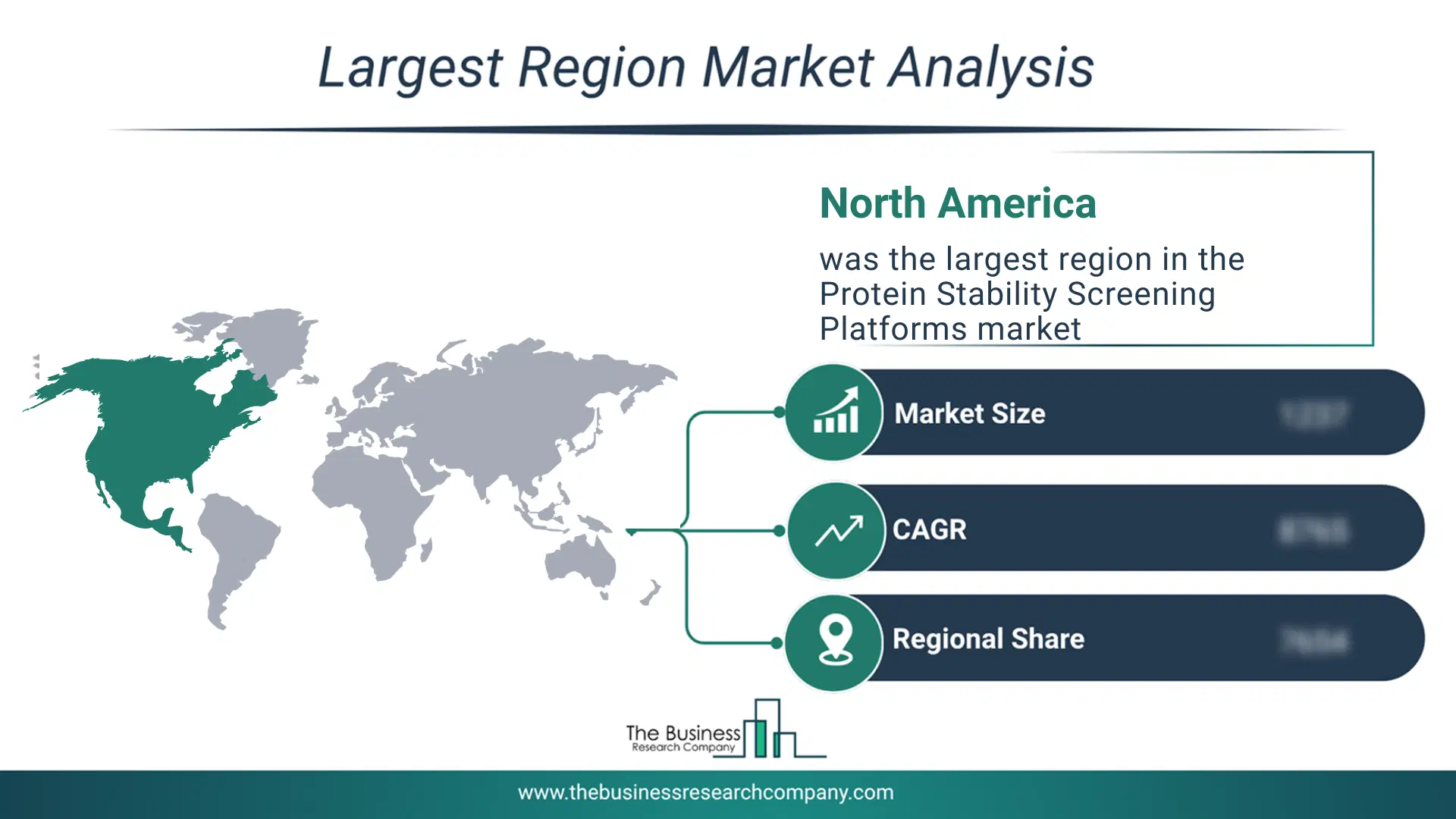
Regional Insights
North America was the largest region in the protein stability screening platforms market in 2025. Asia-Pacific is expected to be the fastest-growing region in the forecast period. The regions covered in this market report are Asia-Pacific, South East Asia, Western Europe, Eastern Europe, North America, South America, Middle East, Africa. The countries covered in this market report are Australia, Brazil, China, France, Germany, India, Indonesia, Japan, Taiwan, Russia, South Korea, UK, USA, Canada, Italy, Spain.What Defines the Protein Stability Screening Platforms Market?
The protein stability screening platforms market consists of revenues earned by entities by providing services such as thermal stability analysis, aggregation and degradation monitoring, and high-throughput screening. The market value includes the value of related goods sold by the service provider or included within the service offering. The Protein Stability Screening Platforms market also includes sales of Prometheus Panta, Prometheus NT.Plex, and differential scanning calorimeters. Values in this market are ‘factory gate’ values; that is, the value of goods sold by the manufacturers or creators of the goods, whether to other entities (including downstream manufacturers, wholesalers, distributors, and retailers) or directly to end customers. The value of goods in this market includes related services sold by the creators of the goods.How is Market Value Defined and Measured?
The market value is defined as the revenues that enterprises gain from the sale of goods and/or services within the specified market and geography through sales, grants, or donations in terms of the currency (in USD unless otherwise specified). The revenues for a specified geography are consumption values that are revenues generated by organizations in the specified geography within the market, irrespective of where they are produced. It does not include revenues from resales along the supply chain, either further along the supply chain or as part of other products.
This chart presents market attractiveness based on a quantitative evaluation of growth, competition, strategic alignment, and risk, offering a clear view of opportunity areas for decision-making. This chart is for illustrative purposes; the full report contains the complete analysis.

This chart highlights the Total Addressable Market (TAM) by estimating the maximum revenue opportunity using an assumption-driven approach, supporting strategic planning and opportunity sizing across markets. The chart is illustrative; the full report provides a more comprehensive analysis.
What Key Data And Analysis Are Included In The Protein Stability Screening Platforms Market Report 2026?
The protein stability screening platforms market research report is one of a series of new reports from The Business Research Company that provides market statistics, including industry global market size, regional shares, competitors with the market share, detailed market segments, market trends and opportunities, and any further data you may need to thrive in the protein stability screening platforms industry. The market research report delivers a complete perspective of everything you need, with an in-depth analysis of the current and future state of the industry.Protein Stability Screening Platforms Market Report Forecast Analysis
| Report Attribute | Details |
|---|---|
| Market Size Value In 2026 | $1.58 billion |
| Revenue Forecast In 2030 | $2.29 billion |
| Growth Rate | CAGR of 9.5% from 2026 to 2030 |
| Base Year For Estimation | 2025 |
| Actual Estimates/Historical Data | 2020-2025 |
| Forecast Period | 2026 - 2030 |
| Market Representation | Revenue in USD Billion and CAGR from 2026 to 2030 |
| Segments Covered | Protein Type, Technology, Component Type, Application, End-User |
| Regional Scope | Asia-Pacific, Western Europe, Eastern Europe, North America, South America, Middle East, Africa |
| Country Scope | The countries covered in the report are Australia, Brazil, China, France, Germany, India, Indonesia, Japan, Taiwan, Russia, South Korea, UK, USA, Canada, Italy, Spain. |
| Key Companies Profiled | Thermo Fisher Scientific Inc., GE Healthcare Life Sciences, Agilent Technologies Inc., Shimadzu Corporation, Bruker Corporation, Waters Corporation, Revvity Inc., Bio-Rad Laboratories Inc., Spectris plc., Malvern Panalytical Ltd., Promega Corporation, Unchained Labs Inc., NanoTemper Technologies GmbH, Creative Biostructure Inc., BMG LABTECH GmbH, Jasco Inc., Porvair Sciences Ltd., Zinsser Analytic GmbH, Jena Bioscience GmbH, Applied Photophysics Ltd., Enzo Life Sciences Inc. |
| Customization Scope | Request for Customization |
| Pricing And Purchase Options | Explore Purchase Options |