

Pulp And Paper Automation Market 2026
By Type (Paper Automation, Pulp Automation), By Product (Distributed Control Systems (DCS), Programmable Logic Controllers (PLCs), Supervisory Control And Data Acquisition (SCADA), Sensors And Transmitters, Flowmeters, Manufacturing Execution Systems (MES), Asset Performance Management (APM), Advanced Process Control (APC), Other Products), By Application (Pre-Press Printing, Print And Publication, Paper Mills Processing, Paper Packaging), By End-User (Paper, Pulp, Tissue, Board), And By Region, Opportunities And Strategies – Global Forecast To 2035
Pulp And Paper Automation Market Definition
Pulp and paper automation refers to the use of advanced control systems, sensors, and digital technologies to monitor, regulate, and optimize operations across pulp and paper manufacturing processes. It includes automation of processes such as pulping, bleaching, paper formation, drying, and finishing through distributed control systems (DCS), programmable logic controllers (PLC), and industrial IoT integration. The primary purpose of pulp and paper automation is to enhance production efficiency, ensure consistent product quality, and reduce energy and resource consumption. The pulp and paper automation market consists of sales by entities (organizations, sole traders and partnerships) of pulp and paper automation products that are used by industrial operators such as pulp mills, paper mills, tissue producers and board manufacturing units to improve operational efficiency, ensure product consistency, reduce energy consumption and comply with environmental standards. Automation is used throughout the production cycle from raw material processing and pulping to sheet formation, drying, finishing, packaging and sometimes even pre-press and printing operations.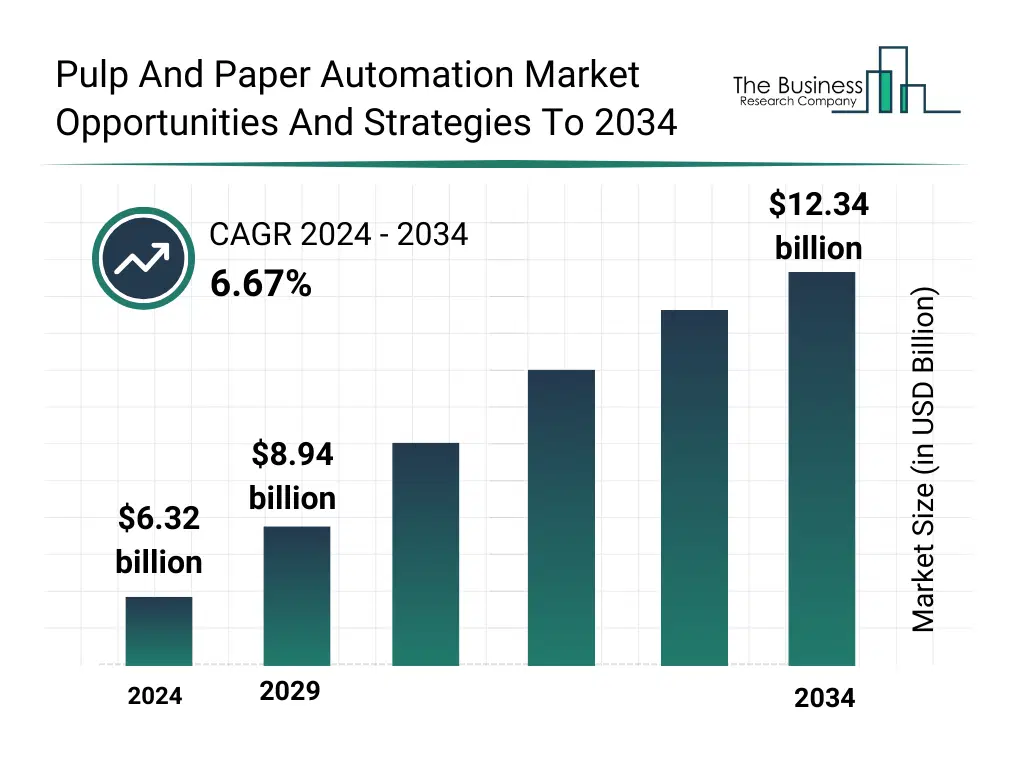
Pulp And Paper Automation Market Size
The global pulp and paper automation market reached a value of nearly $6,315.30 million in 2024, having grown at a compound annual growth rate (CAGR) of 5.22% since 2019. The market is expected to grow from $6,315.30 million in 2024 to $8,935.96 million in 2029 at a rate of 7.19%. The market is then expected to grow at a CAGR of 6.67% from 2029 and reach $12,343.86 million in 2034. Growth in the historic period resulted from the rise in packaging industry, growing adoption of industrial automation, stringent environmental and regulatory compliance and expansion of the pulp and paper manufacturing. Factors that negatively affected growth in the historic period were fluctuating raw material prices and supply chain disruptions and shortage of skilled workforce. Going forward, the modernization of aging pulp and paper mills, rise of sustainable and recycled paper production, government initiatives and growth in tissue and hygiene paper demand will drive the growth. Factors that could hinder the growth of the pulp and paper automation market in the future include high initial investment and implementation cost, integration challenges and impact of trade war and tariff.Pulp And Paper Automation Market Drivers
The key drivers of the pulp and paper automation market include: Modernization Of Aging Pulp And Paper Mills Modernization of aging pulp and paper mills is expected to be a key driver of the growth of the pulp and paper automation market in the forecast period. Many mills across North America, Europe and Asia-Pacific are replacing outdated distributed control systems (DCS) and programmable logic controllers (PLC) with advanced process automation, AI-based optimization and predictive maintenance platforms. This shift enables real-time process control, reduced downtime and better integration of digital twins and IoT (internet of things) solutions, essential for achieving operational excellence in older facilities. Consequently, modernization initiatives will accelerate investment in automation software, control systems and intelligent equipment across the pulp and paper value chain. The modernization of aging pulp and paper mills growth contribution during the forecast period in 2024 is 2.04%.Pulp And Paper Automation Market Restraints
The key restraints on the pulp and paper automation market include: High Initial Investment And Implementation Costs High initial investment and implementation costs are restricting the growth of the pulp and paper automation market during the forecast period. High upfront capital requirements for deploying advanced automation systems, such as distributed control systems (DCS), industrial IoT networks, AI-driven process control and robotics, will continue to restrain market growth, particularly for small and mid-sized paper mills. Modernizing legacy mills involves costly upgrades to digital infrastructure, specialized sensors and software licenses, along with staff retraining. Many mills, especially in developing economies, struggle to justify such large-scale investments due to tight profit margins and long ROI (return of investment) cycles. Consequently, the financial burden of automation adoption may delay digital transformation efforts and slow the pace of automation deployment across the global pulp and paper sector. Growth affected by high initial investment and implementation costs across regions during the forecast period in 2024 is -1.59%.Pulp And Paper Automation Market Trends
Major trends shaping the pulp and paper automation market include: Modernizing MES With Lightweight, Mill-Focused Execution Platforms Major companies in the pulp and paper automation sector are pushing toward next-generation MES (manufacturing execution system) platforms that are lighter, more modular, and tightly integrated into mill operations and planning systems. These MES solutions are purpose-built for pulp and paper, with small footprints, modern web connectivity, and real-time coordination, to support increased agility, traceability, and operational optimization. For instance, in October 2025, MAJIQ, a US-based computer software company, unveiled Ether, a lightweight, web-based MES designed specifically for the pulp and paper industry. The platform offers seamless integration with ERP systems, configurable user interfaces, reliable equipment connectivity, and flexible deployment (cloud or on-premises). Ether is positioned as a small-footprint MES optimized for managing manufacturing execution and quality in pulp and paper operations. Additionally in September 2025, ABB Group, a Switzerland-based multinational corporation specializing in automation and electrical technology, launched ABB Ability™ Plant Optimizer for Pulp Mills, a mill-wide optimization software that bridges the gap between MES, planning, and real-time operations. It enables coordination across the pulp process, from planning to execution, offers traceability of material flows, economic optimization, and decision support tied to MES goal. Shift Toward Modular And Scalable Automation Architectures In Paper Mills Companies operating in the pulp and paper automation market are increasingly adopting modular and scalable automation systems that combine programmable logic controllers (PLCs) and supervisory control and data acquisition (SCADA) functionalities to enhance operational flexibility and cost efficiency. For instance, in August 2025, Parason, an India-based pulp and paper equipment manufacturer, introduced scalable and modular automation solutions integrated with PLC and SCADA systems. The new setup provides real-time process control and monitoring, reduces downtime, and supports customized automation deployment for mills of different capacities. This initiative aligns with the company’s strategy to promote flexible automation adoption across the pulp and paper industry, optimizing production efficiency and sustainability performance.Opportunities And Recommendations In The pulp and paper automation Market
Opportunities – The top opportunities in the pulp and paper automation market segmented by product will arise in the distributed control systems (DCS) segment, which will gain $706.52 million of global annual sales by 2029. The top opportunities in the pulp and paper automation market segmented by application will arise in the paper mills processing segment, which will gain $1,858.47 million of global annual sales by 2029. The top opportunities in the pulp and paper automation market segmented by end-user will arise in the paper segment, which will gain $938.33 million of global annual sales by 2029. The top opportunities in the pulp and paper automation market segmented by type will arise in the paper automation segment, which will gain $1,540.72 million of global annual sales by 2029. The pulp and paper automation market size will gain the most in China at $501.78 million. Recommendations- To take advantage of the opportunities, The Business Research Company recommends the pulp and paper automation companies to focus on lightweight mes platforms integrated with mill planning and operations, focus on modular plc–scada automation for flexible mill operations, focus on model predictive control to optimize yield and resource use, focus on unified autonomous mill ecosystems for reliability and efficiency , focus on ai-enabled dcs platforms for mill-wide optimization and scale, focus on ai-enabled smart motor sensors for predictive maintenance, focus on smart, connected automation systems for real-time optimization, focus on iot-enabled consistency and moisture sensors for process precision, focus on asset performance management for growth, focus on pulp automation for market growth, focus on expanding distribution channels for market reach, focus on strategic pricing to enhance market competitiveness, focus on strategic pricing to enhance market competitiveness, focus on strategic pricing to enhance market competitiveness , focus on paper packaging for market expansion, focus on tissue for accelerated growth.
Pulp And Paper Automation Market Segmentation
The pulp and paper automation market is segmented by product, by application and by end-user.By Product –
The Pulp And Paper Automation market is segmented by product into:
- a) Distributed Control Systems (DCS)
- b) Programmable Logic Controllers (PLCs)
- c) Programmable Logic Controllers (PLCs)
- d) Sensors And Transmitters
- e) Flowmeters
- f) Manufacturing Execution Systems (MES)
- g) Asset Performance Management (APM)
- h) Advanced Process Control (APC)
- i) Other Products
By Application –
The Pulp And Paper Automation market is segmented by application into:
- a) Pre-Press Printing
- b) Print And Publication
- c) Paper Mills Processing
- d) Paper Packaging
By End-User –
The Pulp And Paper Automation market is segmented by end-user into:
- a) Paper
- b) Pulp
- c) Tissue
- d) Board
By Geography - The pulp and paper automation market is segmented by geography into:
- • China
- • India
- • Japan
- • Australia
- • Indonesia
- • South Korea
- • Bangladesh
- • Thailand
- • Vietnam
- • Malaysia
- • Singapore
- • Phillipines
- • Hong kong
- • New Zealand
- • USA
- • Canada
- • Mexico
- • Brazil
- • Argentina
- • Chile
- • Colombiia
- • Peru
- • France
- • Germany
- • UK
- • Italy
- • Spain
- • Austria
- • Belgium
- • Denmark
- • Finland
- • Ireland
- • Netherland
- • Norway
- • Portugal
- • Sweden
- • Switzerland
- • Russia
- • Czech Republic
- • Poland
- • Romania
- • Ukraine
- • Saudi Arabia
- • Israel
- • Iran
- • Turkey
- • UAE o Africa
- • Egypt
- • Nigeria
- • South Africa
-
o Asia Pacific