
Pulp Bleaching Agent Market Report 2026
Global Outlook – By Type (Hydrogen Peroxide, Chlorine Dioxide, Peracetic Acid, Other Types), By Chemical Elements (Totally Chlorine Free (TCF), Elemental Chlorine Free (ECF)), By Application (Chemical Pulp, Mechanical Pulp) – Market Size, Trends, Strategies, and Forecast to 2030
Pulp Bleaching Agent Market Overview
• Pulp Bleaching Agent market size has reached to $4.49 billion in 2025 • Expected to grow to $6.08 billion in 2030 at a compound annual growth rate (CAGR) of 6.2% • Growth Driver: The Growing Textile Industry Is Fueling The Growth Of The Market Due To Rising Demand For High-Quality Fabrics • Market Trend: Advancing Sustainability In Pulp Bleaching With Low-Carbon Hydrogen Peroxide • Asia-Pacific was the largest region in 2025 and North America is the fastest growing region.What Is Covered Under Pulp Bleaching Agent Market?
Pulp bleaching agents are chemicals used in paper manufacturing to whiten and enhance the brightness of pulp. They work by breaking down or altering the natural color of lignin and other impurities present in the pulp. This process enhances the paper’s quality, strength, and visual appeal, resulting in a cleaner and brighter final product. The main types of pulp bleaching agents are hydrogen peroxide, chlorine dioxide, peracetic acid, and others. Hydrogen peroxide is a chemical used in pulp bleaching to whiten and brighten pulp by removing or modifying lignin and other impurities. The chemical element categories are totally chlorine free (TCF) and elemental chlorine free (ECF) for multiple applications, including chemical pulp and mechanical pulp.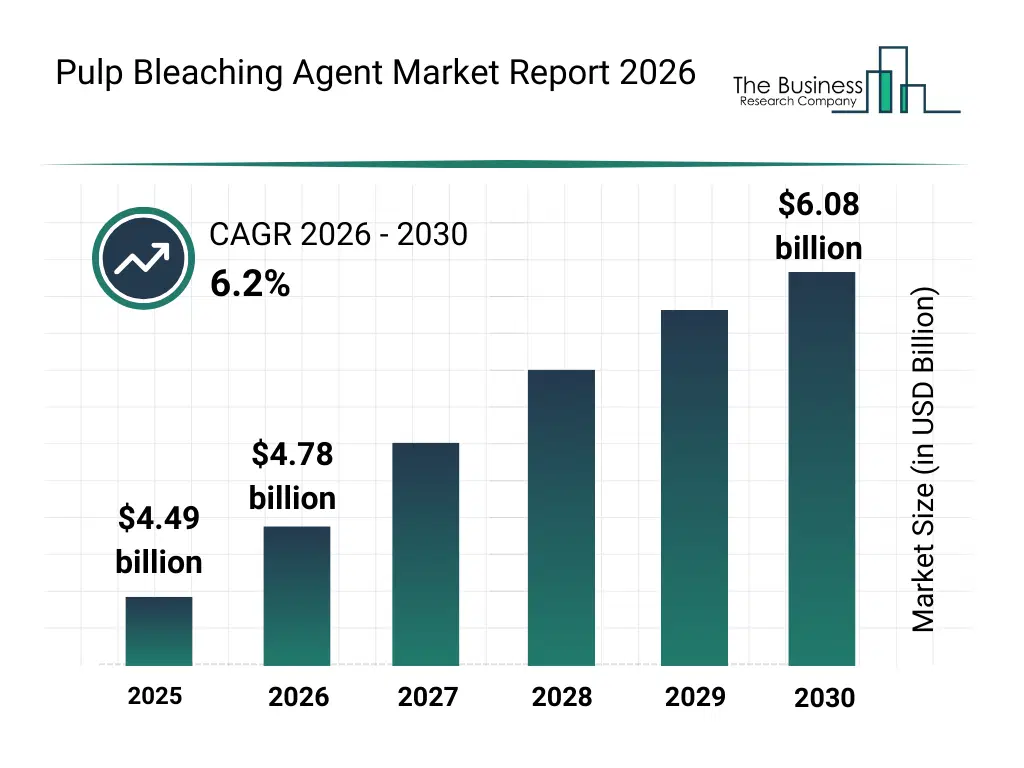
What Is The Pulp Bleaching Agent Market Size and Share 2026?
The pulp bleaching agent market size has grown strongly in recent years. It will grow from $4.49 billion in 2025 to $4.78 billion in 2026 at a compound annual growth rate (CAGR) of 6.5%. The growth in the historic period can be attributed to paper consumption growth, traditional chlorine bleaching usage, pulp mill capacity expansion, printing industry demand, chemical processing advancements.What Is The Pulp Bleaching Agent Market Growth Forecast?
The pulp bleaching agent market size is expected to see strong growth in the next few years. It will grow to $6.08 billion in 2030 at a compound annual growth rate (CAGR) of 6.2%. The growth in the forecast period can be attributed to environmental compliance mandates, sustainable paper production, recycling industry growth, advanced bleaching chemistry, digital paper quality control. Major trends in the forecast period include rising adoption of eco friendly bleaching chemicals, shift toward totally chlorine free processes, growing demand for high brightness paper, expansion of enzyme based bleaching, focus on process efficiency optimization.
Global Pulp Bleaching Agent Market Segmentation
1) By Type: Hydrogen Peroxide, Chlorine Dioxide, Peracetic Acid, Other Types 2) By Chemical Elements: Totally Chlorine Free (TCF), Elemental Chlorine Free (ECF) 3) By Application: Chemical Pulp, Mechanical Pulp Subsegments: 1) By Hydrogen Peroxide: Stabilized Hydrogen Peroxide, Solution Hydrogen Peroxide, Bleaching Grade Hydrogen Peroxide 2) By Chlorine Dioxide: Sodium Chlorite Derived Chlorine Dioxide, Acidified Sodium Chlorite (ASC), On-Site Generated Chlorine Dioxide 3) By Peracetic Acid: Industrial Grade Peracetic Acid, Stabilized Peracetic Acid, On-Site Generated Peracetic Acid 4) By Other Types: Ozone, Sodium Hypochlorite, Enzymatic Bleaching AgentsWhat Is The Driver Of The Pulp Bleaching Agent Market?
The growing textile industry is expected to propel the growth of the pulp bleaching agents market going forward. The textile industry encompasses the design, production, and distribution of fabric materials used in clothing, home furnishings, and technical applications. The textile industry is expanding primarily due to rising consumer demand for apparel and home textiles, driven by increasing disposable incomes and growing urbanization in emerging markets. The expansion of textile manufacturing boosts demand for pulp bleaching agents, as these chemicals are essential for producing high-quality white and colored fabrics by removing natural impurities from cellulosic fibers. For instance, in March 2025, according to the European Environment Agency, a Denmark-based government agency, in 2023, the European Union's textile and clothing sector employed around 1.3 million people across 197,000 companies and generated a turnover of $199.51 billion (EUR 170 billion), following 2022 exports of 4.0 million tons of finished textiles valued at $85.67 billion (EUR 73 billion). Therefore, the growing textile industry is driving the growth of the pulp bleaching agents industry.Key Players In The Global Pulp Bleaching Agent Market
Major companies operating in the pulp bleaching agent market are BASF SE, The Dow Chemical Company, Evonik Industries AG, Akzo Nobel N.V., Arkema S.A., Solvay S.A., Huntsman Corporation, Clariant AG, Mitsubishi Gas Chemical Company Inc., Nouryon Chemicals Holding B.V., Orica Limited, Hubei Xingfa Chemicals Group Co. Ltd., Luxi Chemical Group Co. Ltd., Kemira Oyj, Aditya Birla Chemicals (India) Ltd., Tianjin Chemical Industry Research Institute Co. Ltd., Jiangsu Zhongneng Chemical Co. Ltd., Hongye Holding Group Co. Ltd., Shouguang Xinsheng Chemical Co. Ltd., Suzhou MGC Suhua Peroxide Co. Ltd.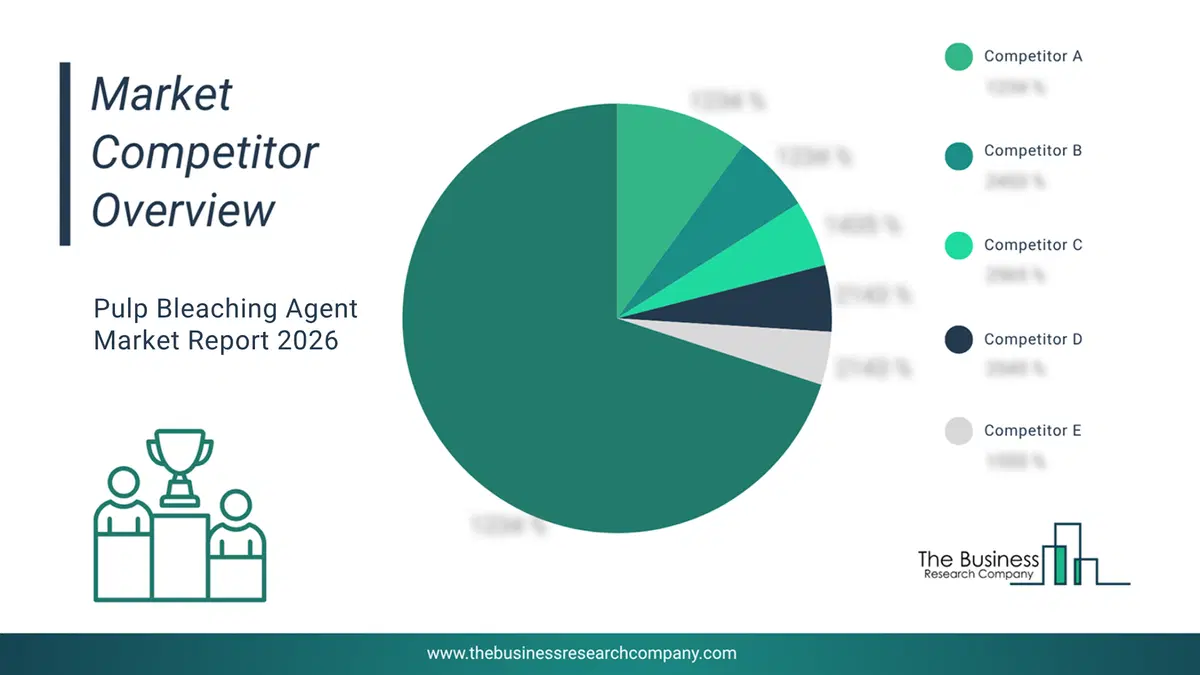
This chart is for illustrative purposes; the full report includes a detailed competitor analysis and comprehensive overview of the top 10 companies in the market.
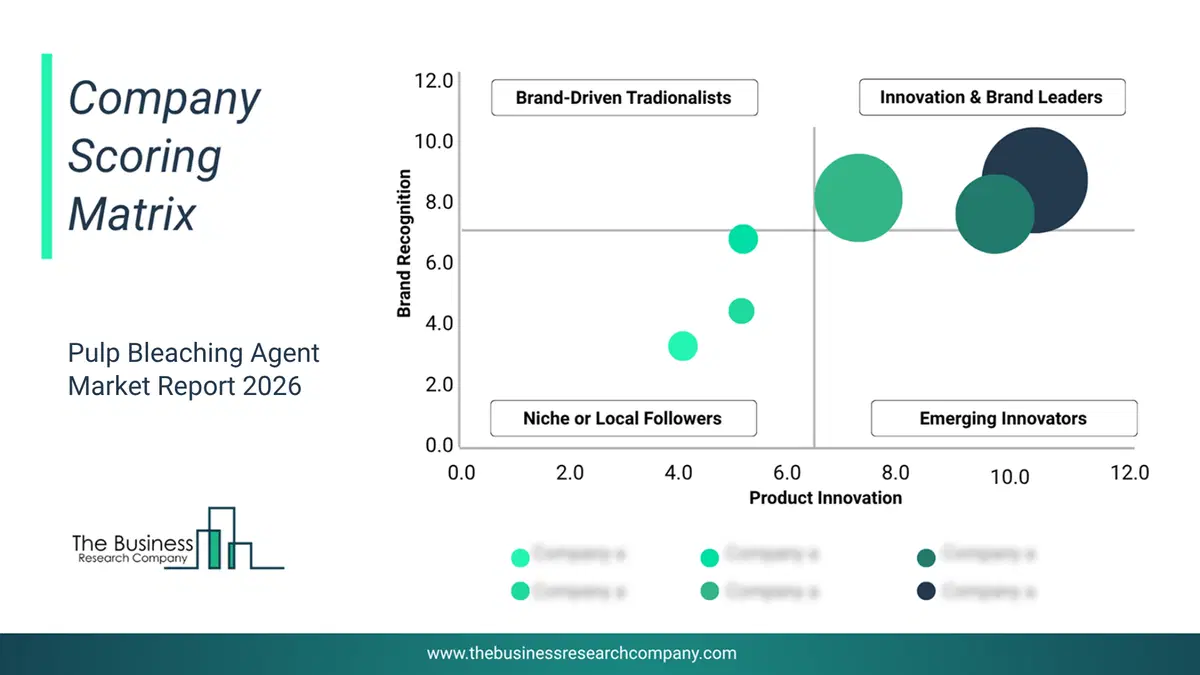
This chart maps companies by product innovation and brand strength, with bubble size indicating relative revenue, helping identify market leaders, challengers, and niche players. This is an illustrative chart; the full report provides a complete and accurate competitive analysis.
Global Pulp Bleaching Agent Market Trends and Insights
Major companies operating in the pulp bleaching agent market are focusing on developing ecofriendly products such as low-carbon hydrogen peroxide to enhance sustainability and reduce greenhouse gas emissions. Low-carbon hydrogen peroxide is produced using renewable energy sources and fossil-free hydrogen, significantly lowering its carbon footprint compared to traditional production methods. For instance, in March 2025, Nouryon, a Netherlands-based chemical manufacturer, launched Ek HP Puroxide, a low-carbon hydrogen peroxide product produced exclusively in Sweden using renewable electricity. This product is designed to help customers in the pulp and paper industry reduce their Scope 3 greenhouse gas emissions. It can cut carbon emissions by up to 90% compared to regular natural gas steam reforming processes. This innovation aligns with the growing demand for sustainable solutions in European industries.What Are Latest Mergers And Acquisitions In The Pulp Bleaching Agent Market?
In December 2023, Evonik Industries AG, a Germany-based chemicals company, acquired Thai Peroxide Company Limited for an undisclosed amount. The acquisition aims to strengthen its Active Oxygens portfolio in the fast-growing Asia-Pacific market. Also, the move enhances Evonik’s specialty hydrogen peroxide and peracetic acid offerings for high-demand industries such as electronics, while leveraging TPL’s expertise to improve customer proximity and sustainability. Thai Peroxide Company Limited is a Thailand-based manufacturer of hydrogen peroxide for the pulp and paper industry.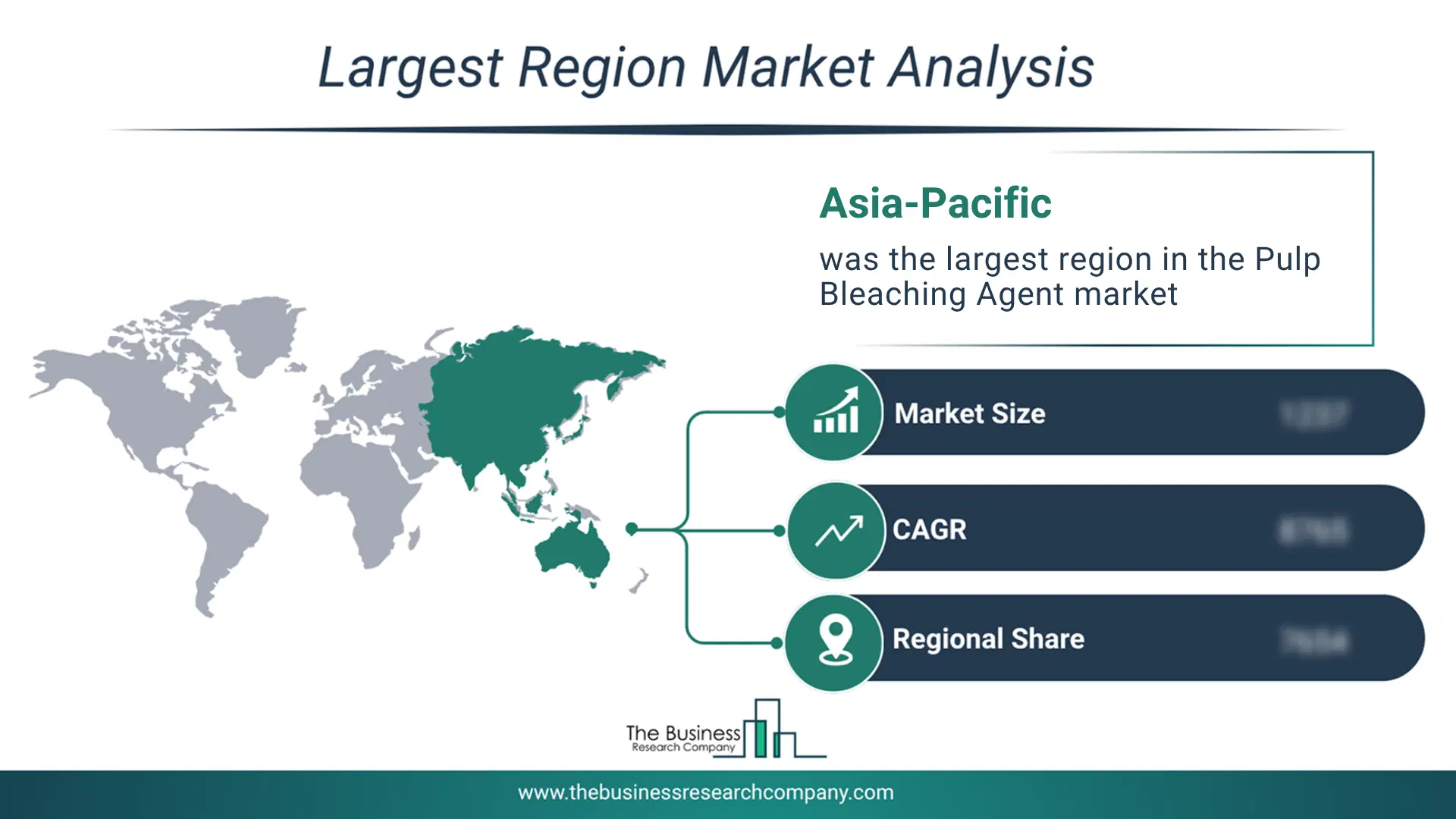
Regional Insights
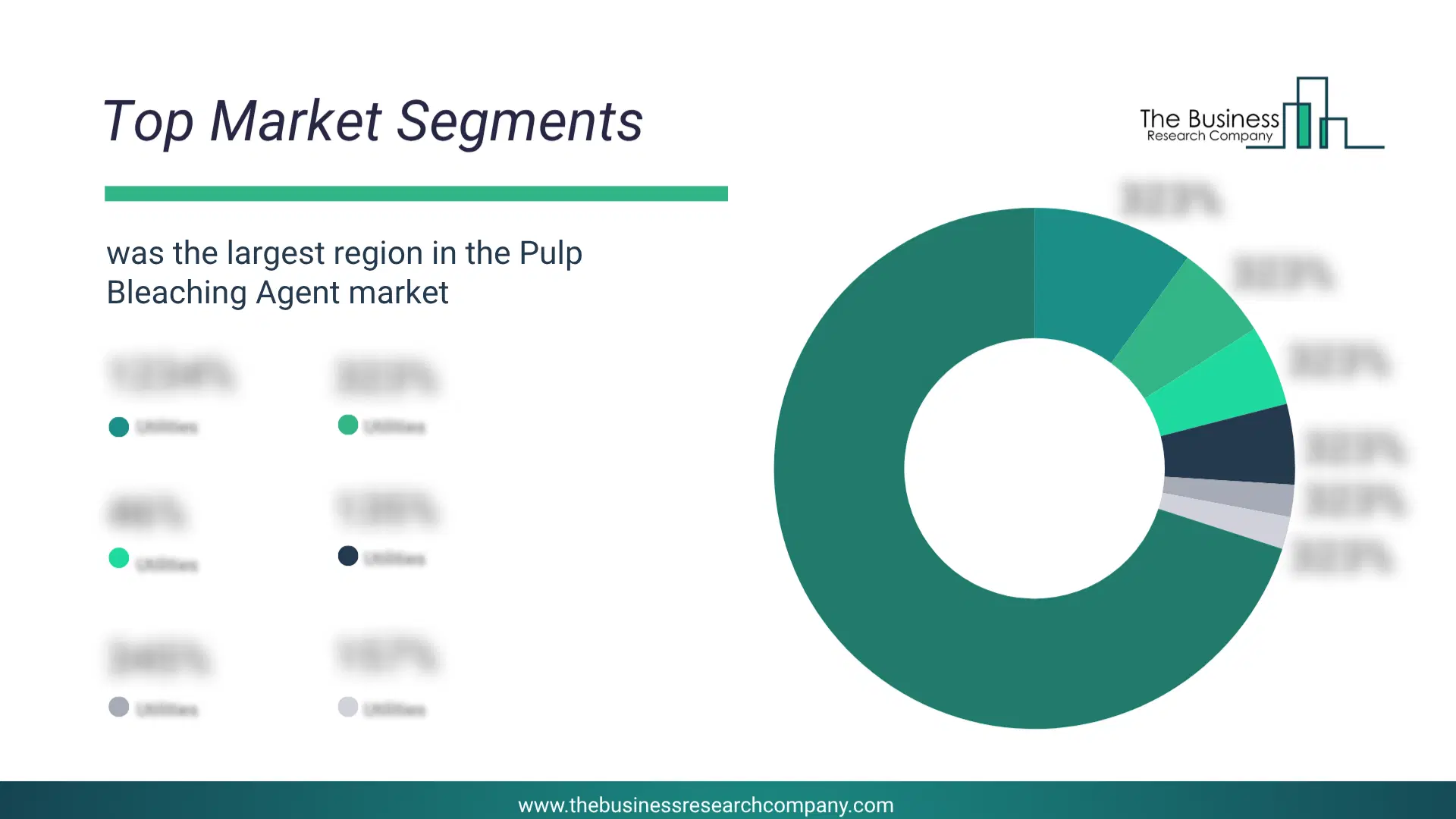
Asia-Pacific was the largest region in the pulp bleaching agents market in 2025. Asia-Pacific is expected to be the fastest-growing region in the forecast period. The regions covered in this market report are Asia-Pacific, South East Asia, Western Europe, Eastern Europe, North America, South America, Middle East, Africa The countries covered in this market report are Australia, Brazil, China, France, Germany, India, Indonesia, Japan, Taiwan, Russia, South Korea, UK, USA, Canada, Italy, SpainWhat Defines the Pulp Bleaching Agent Market?
The pulp bleaching agent market consists of sales of brightness enhancement additives, chlorine-free bleaching systems, sodium hypochlorite, oxygen-based bleaching chemicals, and enzymatic bleaching agents. Values in this market are ‘factory gate’ values, that is, the value of goods sold by the manufacturers or creators of the goods, whether to other entities (including downstream manufacturers, wholesalers, distributors, and retailers) or directly to end customers. The value of goods in this market includes related services sold by the creators of the goods.How is Market Value Defined and Measured?
The market value is defined as the revenues that enterprises gain from the sale of goods and/or services within the specified market and geography through sales, grants, or donations in terms of the currency (in USD unless otherwise specified). The revenues for a specified geography are consumption values that are revenues generated by organizations in the specified geography within the market, irrespective of where they are produced. It does not include revenues from resales along the supply chain, either further along the supply chain or as part of other products.
This chart presents market attractiveness based on a quantitative evaluation of growth, competition, strategic alignment, and risk, offering a clear view of opportunity areas for decision-making. This chart is for illustrative purposes; the full report contains the complete analysis.

This chart highlights the Total Addressable Market (TAM) by estimating the maximum revenue opportunity using an assumption-driven approach, supporting strategic planning and opportunity sizing across markets. The chart is illustrative; the full report provides a more comprehensive analysis.
What Key Data and Analysis Are Included in the Pulp Bleaching Agent Market Report 2026?
The pulp bleaching agent market research report is one of a series of new reports from The Business Research Company that provides market statistics, including industry global market size, regional shares, competitors with the market share, detailed market segments, market trends and opportunities, and any further data you may need to thrive in the pulp bleaching agent industry. The market research report delivers a complete perspective of everything you need, with an in-depth analysis of the current and future state of the industry.Pulp Bleaching Agent Market Report Forecast Analysis
| Report Attribute | Details |
|---|---|
| Market Size Value In 2026 | $4.78 billion |
| Revenue Forecast In 2030 | $6.08 billion |
| Growth Rate | CAGR of 6.5% from 2026 to 2030 |
| Base Year For Estimation | 2025 |
| Actual Estimates/Historical Data | 2020-2025 |
| Forecast Period | 2026 - 2030 |
| Market Representation | Revenue in USD Billion and CAGR from 2026 to 2030 |
| Segments Covered | Type, Chemical Elements, Application |
| Regional Scope | Asia-Pacific, Western Europe, Eastern Europe, North America, South America, Middle East, Africa |
| Country Scope | The countries covered in this market report are Australia, Brazil, China, France, Germany, India, Indonesia, Japan, Taiwan, Russia, South Korea, UK, USA, Canada, Italy, Spain |
| Key Companies Profiled | BASF SE, The Dow Chemical Company, Evonik Industries AG, Akzo Nobel N.V., Arkema S.A., Solvay S.A., Huntsman Corporation, Clariant AG, Mitsubishi Gas Chemical Company Inc., Nouryon Chemicals Holding B.V., Orica Limited, Hubei Xingfa Chemicals Group Co. Ltd., Luxi Chemical Group Co. Ltd., Kemira Oyj, Aditya Birla Chemicals (India) Ltd., Tianjin Chemical Industry Research Institute Co. Ltd., Jiangsu Zhongneng Chemical Co. Ltd., Hongye Holding Group Co. Ltd., Shouguang Xinsheng Chemical Co. Ltd., Suzhou MGC Suhua Peroxide Co. Ltd. |
| Customization Scope | Request for Customization |
| Pricing And Purchase Options | Explore Purchase Options |