
Purchase Price Variance Analytics Artificial Intelligence (AI) Market Report 2026
Global Outlook – By Component (Software, Services ), By Deployment Mode (On-Premises, Cloud), By Enterprise Size (Small and Medium Enterprises, Large Enterprises), By Application (Procurement, Supply Chain Management, Financial Analysis, Inventory Management, Other Applications), By End-User (Manufacturing, Retail, Healthcare, Automotive, Consumer Goods, Other End-Users) – Market Size, Trends, Strategies, and Forecast to 2030
Purchase Price Variance Analytics Artificial Intelligence (AI) Market Overview
• Purchase Price Variance Analytics artificial intelligence (AI) market size has reached to $2.27 billion in 2025 • Expected to grow to $7.11 billion in 2030 at a compound annual growth rate (CAGR) of 25.6% • Growth Driver: Rising Adoption Of AI Algorithms Fueling The Growth Of The Market Due To The Need For Smarter, Data-Driven Pricing Decisions • Market Trend: AI-Powered Procurement Applications Driving Cost Optimization And Real-Time Spend Intelligence • North America was the largest region in 2025 and Asia-Pacific is the fastest growing region.What Is Covered Under Purchase Price Variance Analytics Artificial Intelligence (AI) Market?
Purchase price variance analytics artificial intelligence (AI) refers to artificial intelligence–powered systems designed to measure, analyze, and explain the differences between the standard (budgeted or expected) purchase prices and the actual prices paid for materials or goods. These AI platforms automatically pull data from procurement systems, ERP platforms, supplier invoices, and market price feeds to identify patterns, cost deviations, and underlying causes of variance. It helps to enhance cost control and optimize procurement performance. The main components of purchase price variance analytics artificial intelligence (AI) include software and services. The software segment refers to AI‑powered analytics platforms, visualization tools, and integration modules used for purchase price variance analysis. These solutions are deployed through on-premises and cloud deployment modes and are adopted by enterprises of different sizes, including small and medium enterprises (SMEs) and large enterprises. The various applications involved are procurement, supply chain management, financial analysis, inventory management, and others and are used by several end-users such as manufacturing, retail, healthcare, automotive, consumer goods, and others.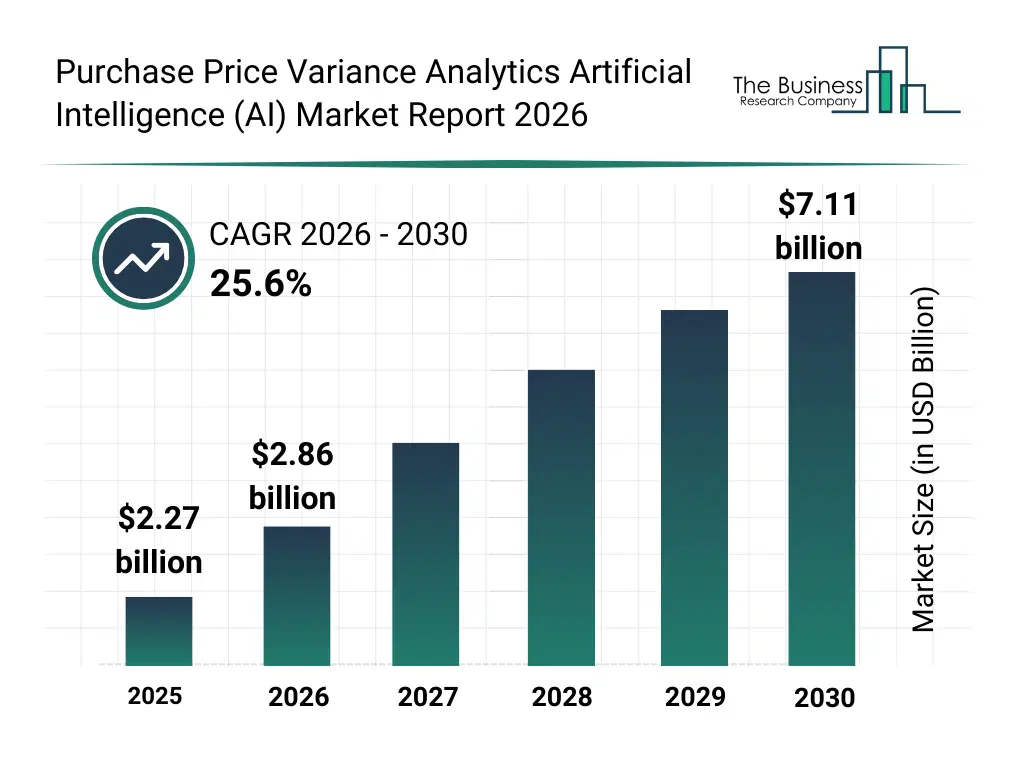
What Is The Purchase Price Variance Analytics Artificial Intelligence (AI) Market Size and Share 2026?
The purchase price variance analytics artificial intelligence (AI) market size has grown exponentially in recent years. It will grow from $2.27 billion in 2025 to $2.86 billion in 2026 at a compound annual growth rate (CAGR) of 25.9%. The growth in the historic period can be attributed to increasing focus on cost control in procurement, growing adoption of enterprise resource planning (ERP) and procurement digitalization, rising need for accurate supplier price tracking, increasing reliance on data-driven decision making, and expansion of global supply chains creating pricing complexity.What Is The Purchase Price Variance Analytics Artificial Intelligence (AI) Market Growth Forecast?
The purchase price variance analytics artificial intelligence (AI) market size is expected to see exponential growth in the next few years. It will grow to $7.11 billion in 2030 at a compound annual growth rate (CAGR) of 25.6%. The growth in the forecast period can be attributed to increasing demand for AI-enabled procurement automation, growing need for real-time price variance insights, rising adoption of predictive analytics for budgeting, and growing pressure for enhanced supplier negotiation intelligence. Major trends in the forecast period include technological advancements in AI-based price anomaly detection, innovations in autonomous procurement systems, technology developments in cloud native procurement analytics, research and development in explainable AI for procurement, and technological upgrades in real-time external market data integration.
Global Purchase Price Variance Analytics Artificial Intelligence (AI) Market Segmentation
1) By Component: Software, Services 2) By Deployment Mode: On-Premises, Cloud 3) By Enterprise Size: Small and Medium Enterprises, Large Enterprises 4) By Application: Procurement, Supply Chain Management, Financial Analysis, Inventory Management, Other Applications 5) By End-User: Manufacturing, Retail, Healthcare, Automotive, Consumer Goods, Other End-Users Subsegments: 1) By Software: Predictive Analytics, Reporting And Dashboards, Data Integration Tools, Machine Learning Models, Spend Analysis Solutions 2) By Services: Consulting Services, Implementation Services, Support And Maintenance, Training And Education, Managed ServicesWhat Is The Driver Of The Purchase Price Variance Analytics Artificial Intelligence (AI) Market?
The rising adoption of AI algorithms is expected to propel the growth of the purchase price variance analytics artificial intelligence (AI) market going forward. AI algorithms refer to the structured sets of rules, mathematical models, or computational procedures that enable machines to learn from data, make decisions, recognize patterns, and perform tasks that typically require human intelligence. As companies generate more data than ever before, they are increasingly adopting AI algorithms to quickly analyze information and support smarter, real-time business decisions. AI algorithms enhance price variance analytics by automatically spotting pricing anomalies, uncovering cost influences, and predicting pricing trends to support smarter and more profitable decision-making. For instance, in March 2025, according to the Office for National Statistics, a US-based government department, the AI adoption grew from 9% in 2023 to 22% in 2024. Therefore, the rising adoption of AI algorithms is driving the growth of the purchase price variance analytics artificial intelligence (AI) industry.Key Players In The Global Purchase Price Variance Analytics Artificial Intelligence (AI) Market
Major companies operating in the purchase price variance analytics artificial intelligence (AI) market are Oracle Corporation, SAP SE, JAGGAER Inc., Workday Inc., GEP plc, Keelvar Systems Limited, Coupa Software Inc., Basware Oyj, Zycus Inc., Ivalua Inc., Tipalti Inc., Simfoni Limited, Corcentric Inc., Aera Technology Inc., Proactis Holdings Limited, Tradeshift Inc., Sievo Ltd., BirchStreet Systems Inc., Rillion Software Inc., Procurify Technologies Inc., SpendHQ Inc., Fairmarkit Inc., Vroozi Inc., Precoro Inc., Rosslyn Data Technologies Ltd.
This chart is for illustrative purposes; the full report includes a detailed competitor analysis and comprehensive overview of the top 10 companies in the market.
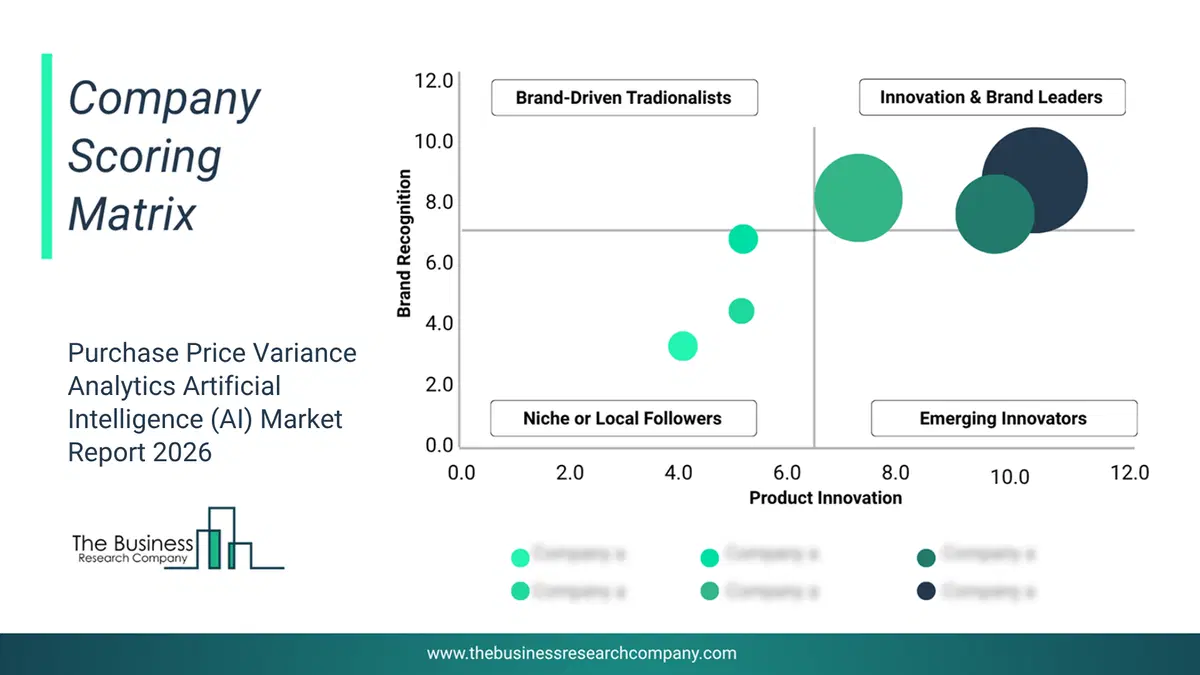
This chart maps companies by product innovation and brand strength, with bubble size indicating relative revenue, helping identify market leaders, challengers, and niche players. This is an illustrative chart; the full report provides a complete and accurate competitive analysis.
Global Purchase Price Variance Analytics Artificial Intelligence (AI) Market Trends and Insights
Major companies operating in the purchase price variance analytics artificial intelligence (AI) market are focusing on developing innovative solutions, such as AI-powered procurement applications, to automatically analyze procurement data in real time, detect anomalies in price and terms, reduce cost leakages, and improve strategic sourcing and supplier negotiation outcomes. An AI-powered procurement application refers to a digital solution that uses artificial intelligence to automate purchasing workflows, analyze spending data, and enhance decision-making across the procurement process. For instance, in August 2025, Simfoni Inc., a US-based technology company, launched the Strategic Spend Hub (SSH) as the first native procurement application built on Snowflake's AI Data Cloud, ushering in AI-powered, data-driven procurement capabilities. This unified platform integrates spend analytics, sourcing, and management, featuring conversational AI for natural language queries via "Talk With Your Data" to deliver instant insights and visualizations; always-on opportunity discovery that analyzes savings, risks, and market shifts 24/7 using internal and external data, and closed-loop execution tools like push-to-task, push-to-source, and integrations with eRFX, Slack, Outlook, and ERP systems for end-to-end savings tracking.What Are Latest Mergers And Acquisitions In The Purchase Price Variance Analytics Artificial Intelligence (AI) Market?
In February 2023, Thoma Bravo, a US-based provider of software-focused private equity investment and value-creation services, acquired Coupa Software for approximately $8.0 billion. With this acquisition, Thoma Bravo aims to accelerate Coupa’s growth and innovation in AI-driven spend management and analytics, enhancing its capabilities in areas such as purchase price variance analysis, cost optimization, and intelligent procurement. Coupa Software is a US-based provider of a cloud-based business spend management, offers AI-driven analytics that help manage and identify.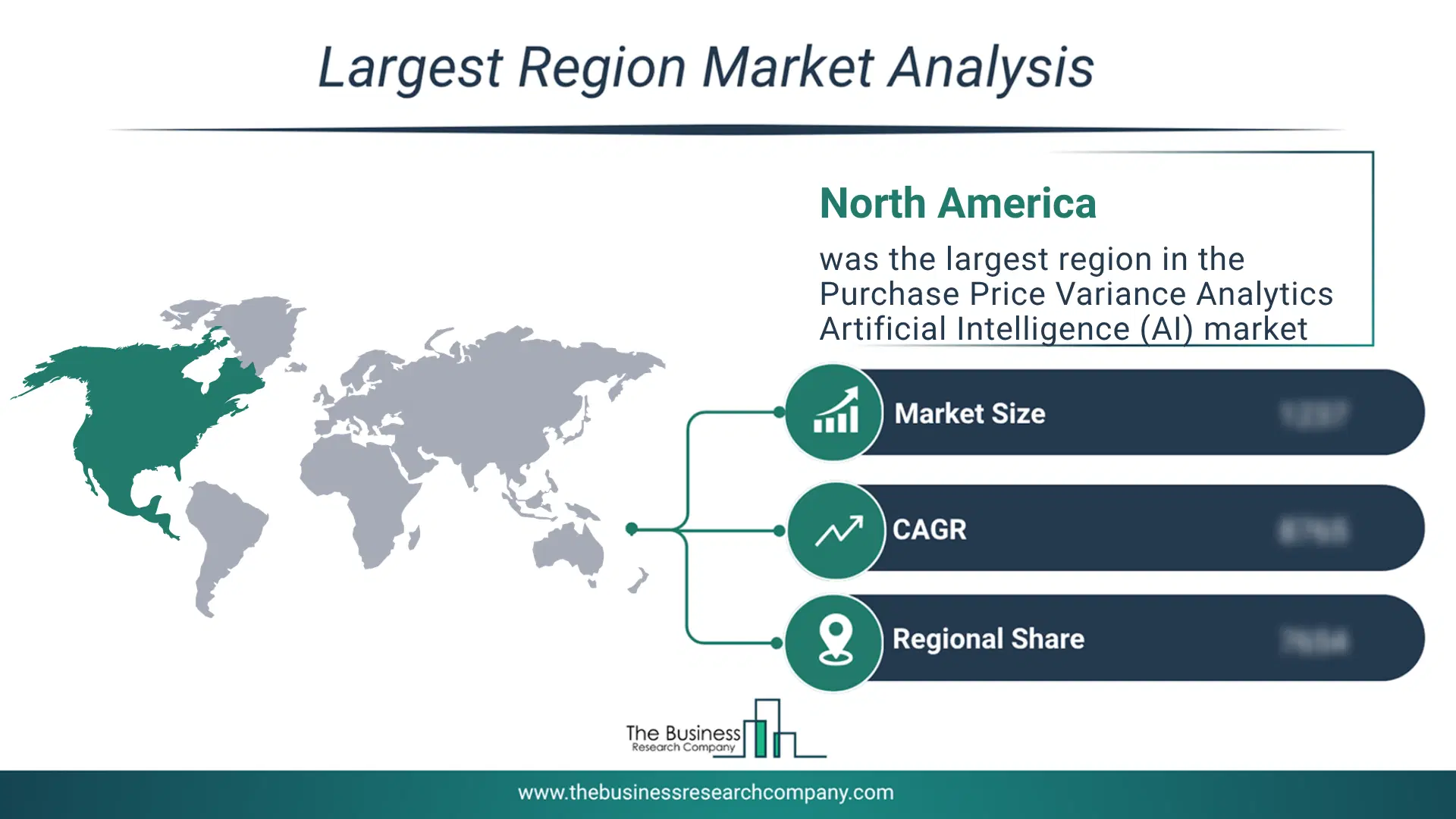
Regional Insights
North America was the largest region in the purchase price variance analytics artificial intelligence (AI) market in 2025. Asia-Pacific is expected to be the fastest-growing region in the forecast period. The regions covered in this market report are Asia-Pacific, South East Asia, Western Europe, Eastern Europe, North America, South America, Middle East, Africa. The countries covered in this market report are Australia, Brazil, China, France, Germany, India, Indonesia, Japan, Taiwan, Russia, South Korea, UK, USA, Canada, Italy, Spain.What Defines the Purchase Price Variance Analytics Artificial Intelligence (AI) Market?
The purchase price variance analytics artificial intelligence (AI) market consists of revenues earned by entities by providing services such as AI-driven price monitoring, automated variance detection, real-time procurement analytics, supplier performance analysis, spend optimization insights, and predictive cost forecasting. The market value includes the value of related goods sold by the service provider or included within the service offering. The purchase price variance analytics artificial intelligence (AI) market also includes sales of automated procurement analytics tools, variance dashboards, cost-intelligence modules, ERP-integrated PPV analytics add-ons, and cloud-based AI procurement optimization solutions. Values in this market are ‘factory gate’ values, that is the value of goods sold by the manufacturers or creators of the goods, whether to other entities (including downstream manufacturers, wholesalers, distributors and retailers) or directly to end customers. The value of goods in this market includes related services sold by the creators of the goods.How is Market Value Defined and Measured?
The market value is defined as the revenues that enterprises gain from the sale of goods and/or services within the specified market and geography through sales, grants, or donations in terms of the currency (in USD unless otherwise specified). The revenues for a specified geography are consumption values that are revenues generated by organizations in the specified geography within the market, irrespective of where they are produced. It does not include revenues from resales along the supply chain, either further along the supply chain or as part of other products.
This chart presents market attractiveness based on a quantitative evaluation of growth, competition, strategic alignment, and risk, offering a clear view of opportunity areas for decision-making. This chart is for illustrative purposes; the full report contains the complete analysis.

This chart highlights the Total Addressable Market (TAM) by estimating the maximum revenue opportunity using an assumption-driven approach, supporting strategic planning and opportunity sizing across markets. The chart is illustrative; the full report provides a more comprehensive analysis.
What Key Data and Analysis Are Included in the Purchase Price Variance Analytics Artificial Intelligence (AI) Market Report 2026?
The purchase price variance analytics artificial intelligence (ai) market research report is one of a series of new reports from The Business Research Company that provides market statistics, including industry global market size, regional shares, competitors with the market share, detailed market segments, market trends and opportunities, and any further data you may need to thrive in the purchase price variance analytics artificial intelligence (ai) industry. The market research report delivers a complete perspective of everything you need, with an in-depth analysis of the current and future state of the industry.Purchase Price Variance Analytics Artificial Intelligence (AI) Market Report Forecast Analysis
| Report Attribute | Details |
|---|---|
| Market Size Value In 2026 | $2.86 billion |
| Revenue Forecast In 2030 | $7.11 billion |
| Growth Rate | CAGR of 25.6% from 2026 to 2030 |
| Base Year For Estimation | 2025 |
| Actual Estimates/Historical Data | 2020-2025 |
| Forecast Period | 2026 - 2030 |
| Market Representation | Revenue in USD Billion and CAGR from 2026 to 2030 |
| Segments Covered | Component, Deployment Mode, Enterprise Size, Application, End-User |
| Regional Scope | Asia-Pacific, Western Europe, Eastern Europe, North America, South America, Middle East, Africa |
| Country Scope | The Countries Covered In This Market Report Are Australia, Brazil, China, France, Germany, India, Indonesia, Japan, Taiwan, Russia, South Korea, Uk, Usa, Canada, Italy, Spain. |
| Key Companies Profiled | Oracle Corporation, SAP SE, JAGGAER Inc., Workday Inc., GEP plc, Keelvar Systems Limited, Coupa Software Inc., Basware Oyj, Zycus Inc., Ivalua Inc., Tipalti Inc., Simfoni Limited, Corcentric Inc., Aera Technology Inc., Proactis Holdings Limited, Tradeshift Inc., Sievo Ltd., BirchStreet Systems Inc., Rillion Software Inc., Procurify Technologies Inc., SpendHQ Inc., Fairmarkit Inc., Vroozi Inc., Precoro Inc., Rosslyn Data Technologies Ltd. |
| Customization Scope | Request for Customization |
| Pricing And Purchase Options | Explore Purchase Options |