
Quantization Tools For Artificial Intelligence (AI) Market Report 2026
Global Outlook – By Tool Type (Post-Training Quantization, Quantization-Aware Training, Mixed Precision Quantization, Other Tool Types), By Deployment Mode (On-Premises, Cloud-Based), By Organization Size (Large Enterprises, Small And Medium-Sized Enterprises (SMEs)), By Application (Computer Vision, Natural Language Processing, Speech Recognition, Autonomous Systems, Other Applications), By End-User (Banking, Financial Services, and Insurance, Healthcare, Automotive, Retail, Information Technology And Telecommunications, Other End-Users) – Market Size, Trends, Strategies, and Forecast to 2030
Quantization Tools For Artificial Intelligence (AI) Market Overview
• Quantization Tools For Artificial Intelligence (AI) market size has reached to $0.92 billion in 2025 • Expected to grow to $2.2 billion in 2030 at a compound annual growth rate (CAGR) of 19.2% • Growth Driver: Surge In Increasing AI Compute And Energy Costs Fueling The Growth Of The Market Due To Rising Data Center Electricity Demand • Market Trend: NVIDIA Introduced TensorRT-LLM To Accelerate Mixed-Precision Quantized Inference For Large-Scale AI Workloads • North America was the largest region in 2025 and Asia-Pacific is the fastest growing region.What Is Covered Under Quantization Tools For Artificial Intelligence (AI) Market?
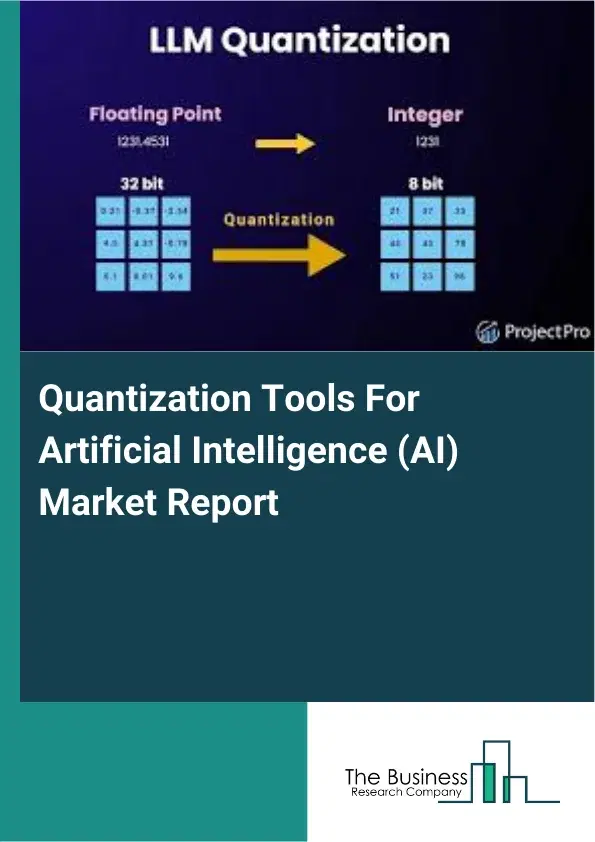
Quantization tools for artificial intelligence (AI) refer to technologies that convert AI model parameters and computations from high-precision formats to lower-precision representations. This process reduces model size and computational requirements while maintaining acceptable accuracy. It also helps to improve inference speed, lower energy consumption, and enable efficient deployment on edge and resource-constrained devices. The main tool types of quantization tools for artificial intelligence include post-training quantization, quantization-aware training, mixed precision quantization, and other tool types. Post-training quantization refers to tools that reduce the precision of a trained artificial intelligence model’s weights and activations to optimize performance and reduce memory and compute requirements without retraining the model. The systems are deployed through on-premises and cloud-based models and are adopted across organizations of different sizes, including large enterprises and small and medium-sized enterprises. The applications include computer vision, natural language processing, speech recognition, autonomous systems, and other applications, with usage across end users such as banking, financial services and insurance, healthcare, automotive, retail, information technology and telecommunications, and other end users.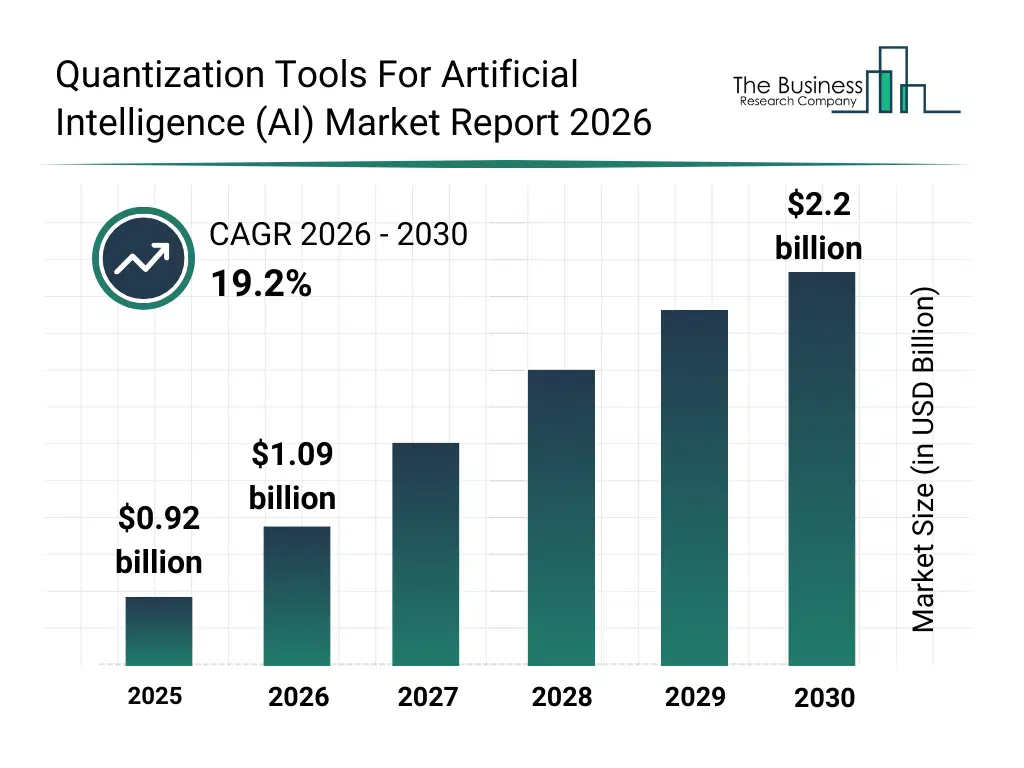
What Is The Quantization Tools For Artificial Intelligence (AI) Market Size and Share 2026?
The quantization tools for artificial intelligence (AI) market size has grown rapidly in recent years. It will grow from $0.92 billion in 2025 to $1.09 billion in 2026 at a compound annual growth rate (CAGR) of 19.0%. The growth in the historic period can be attributed to growth in deep learning model sizes, rising gpu and accelerator costs, expansion of edge computing use cases, need for faster inference speeds, increase in AI deployment across industries.What Is The Quantization Tools For Artificial Intelligence (AI) Market Growth Forecast?
The quantization tools for artificial intelligence (AI) market size is expected to see rapid growth in the next few years. It will grow to $2.2 billion in 2030 at a compound annual growth rate (CAGR) of 19.2%. The growth in the forecast period can be attributed to growth in edge device AI deployment, rising demand for energy efficient ai, expansion of on device inference, increasing custom AI chip development, higher enterprise AI optimization spending. Major trends in the forecast period include growing adoption of model compression pipelines, rising demand for edge AI optimization, expansion of hardware specific quantization, increase in low precision inference frameworks, integration of automated quantization workflows.
Global Quantization Tools For Artificial Intelligence (AI) Market Segmentation
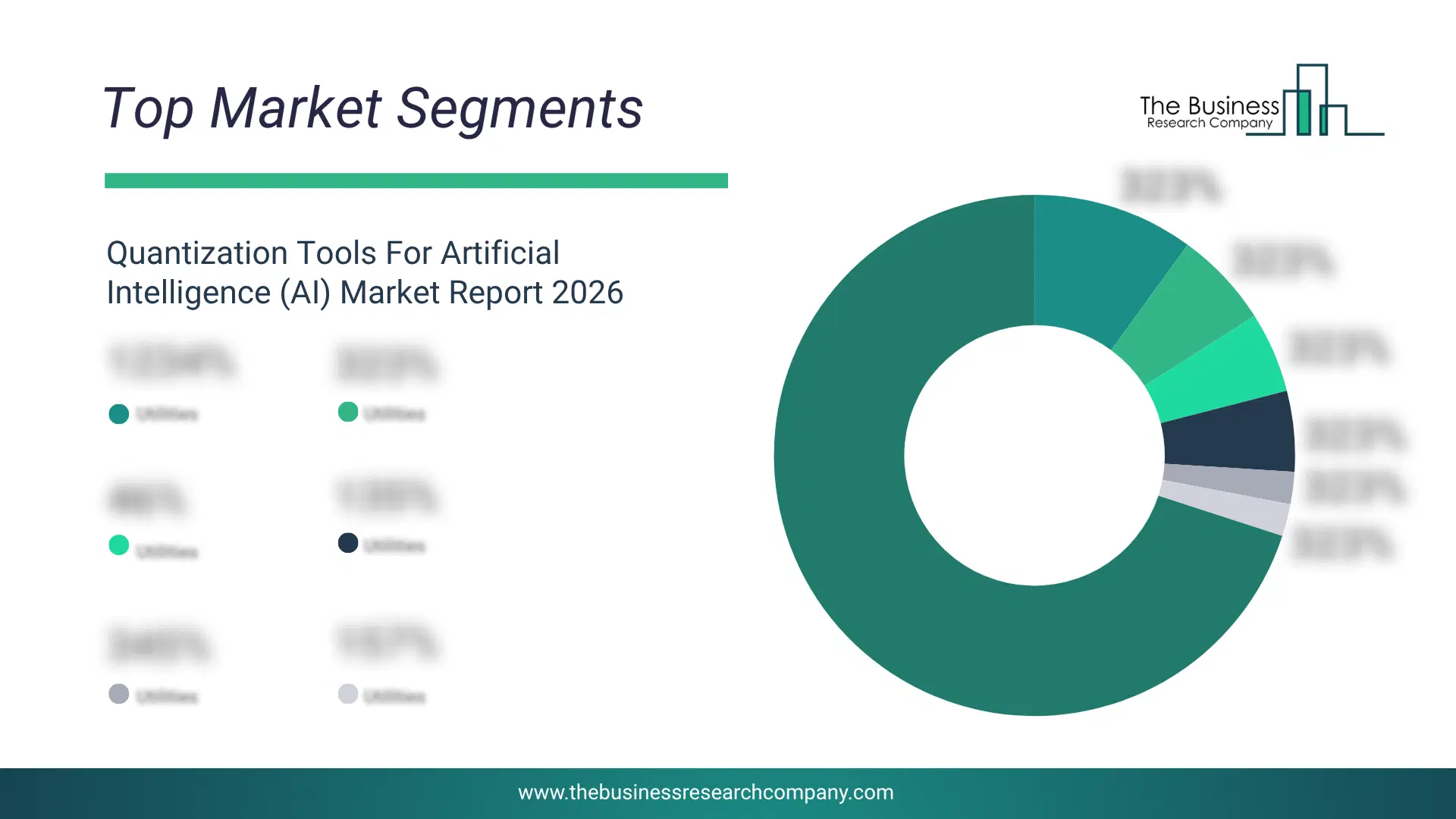
1) By Tool Type: Post-Training Quantization; Quantization-Aware Training; Mixed Precision Quantization; Other Tool Types 2) By Deployment Mode: On-Premises; Cloud-Based 3) By Organization Size: Large Enterprises; Small And Medium-Sized Enterprises (SMEs) 4) By Application: Computer Vision; Natural Language Processing; Speech Recognition; Autonomous Systems; Other Applications 5) By End-User: Banking, Financial Services, and Insurance; Healthcare; Automotive; Retail; Information Technology And Telecommunications; Other End-Users Subsegments: 1) By Post-Training Quantization: Weight Quantization; Activation Quantization; Bias Quantization 2) By Quantization-Aware Training: Static Quantization; Dynamic Quantization; Per-Layer Quantization 3) By Mixed Precision Quantization: Floating Point Sixteen; Bfloat Sixteen; Tensor Core Optimized 4) By Other Tool Types: Hybrid Quantization; Custom Precision Quantization; Loss-Aware QuantizationWhat Is The Driver Of The Quantization Tools For Artificial Intelligence (AI) Market?
The increasing AI compute and energy costs are expected to propel the growth of the quantization tools for the artificial intelligence (AI) market going forward. AI compute and energy costs refer to the rising expenditures associated with powering and cooling the high-performance computing infrastructure required to train and deploy advanced AI models. These costs are increasing as large-scale AI models rely heavily on energy-intensive GPU and accelerator-based infrastructure, significantly raising electricity consumption and operational expenses. Quantization tools for the artificial intelligence (AI) help mitigate these rising costs by reducing model precision with minimal impact on accuracy, thereby lowering computational requirements and power consumption during AI inference and deployment. As a result, quantization enables organizations to deploy AI models more efficiently at scale while managing infrastructure and energy expenses. For instance, according to Sherwood, a US-based company, AI-related data center power demand grew approximately three times year over year, increasing from 0.2 gigawatts (GW) in 2023 to 0.6 GW in 2024 and an estimated ~1.9 GW in 2025, representing an overall increase of nearly 9.5 times over the period. This rapid growth in power demand underscores the escalating cost pressures associated with AI compute. Therefore, the increasing AI compute and energy costs are expected to drive the growth of the quantization tools for the artificial intelligence (AI) market.Key Players In The Global Quantization Tools For Artificial Intelligence (AI) Market
Major companies operating in the quantization tools for artificial intelligence (AI) market are Intel Corporation, NVIDIA Corporation, Arm Holdings plc, Alibaba Cloud Computing Ltd., Microsoft Corporation, Samsung Electronics Co. Ltd., Meta Platforms Inc., Huawei Technologies Co. Ltd., Tencent Cloud Computing (Beijing) Co. Ltd., International Business Machines Corporation, Qualcomm Technologies Inc., Baidu Inc., Synopsys Inc., Mythic Inc., Edge Impulse Inc., Hailo Technologies Ltd., Neural Magic Inc., Deeplite Inc., fast.AI Inc., bitsandbytes, GreenWaves Technologies SAS, AutoGPTQ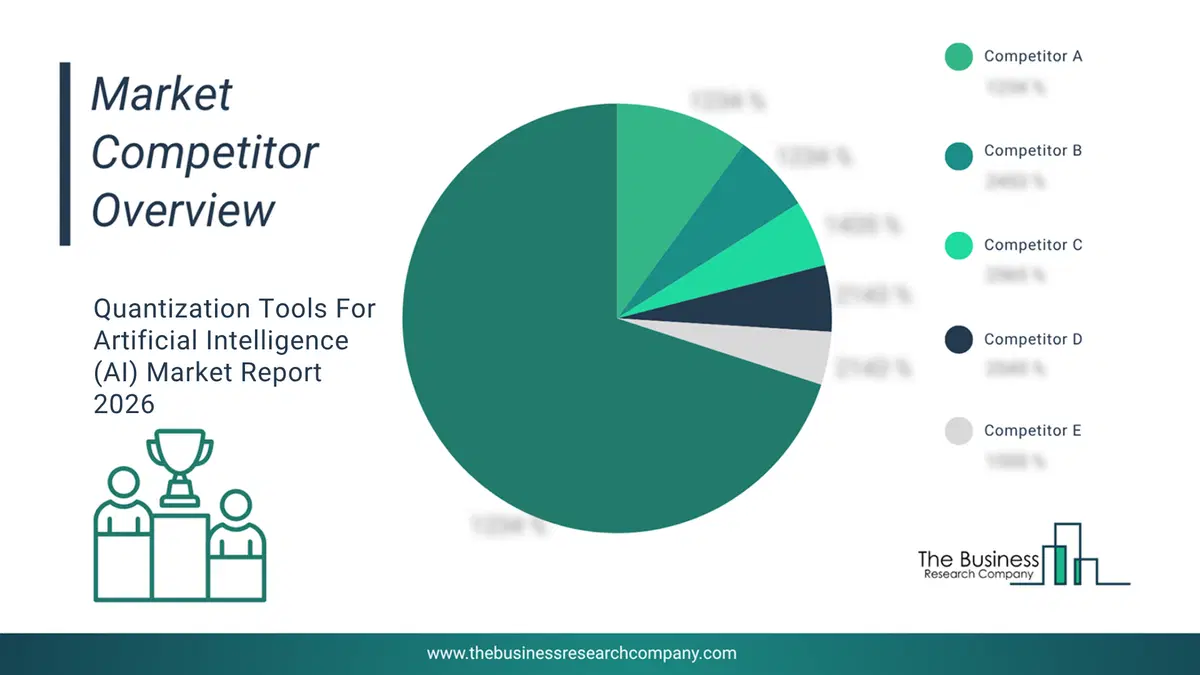
This chart is for illustrative purposes; the full report includes a detailed competitor analysis and comprehensive overview of the top 10 companies in the market.
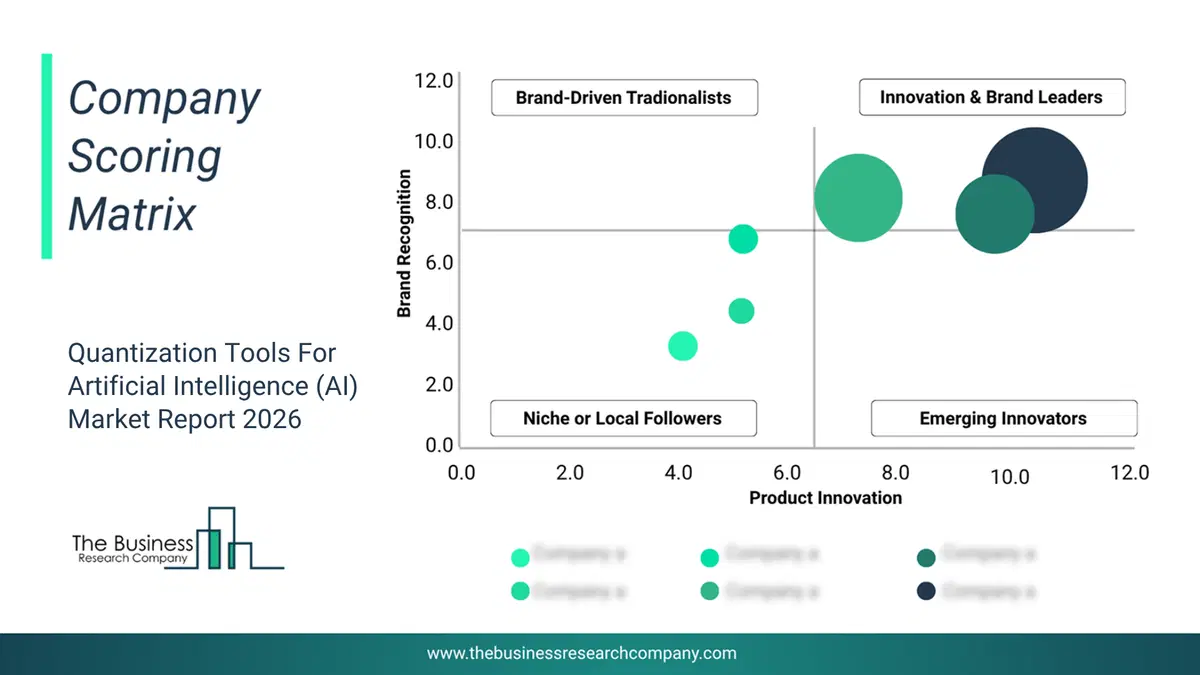
This chart maps companies by product innovation and brand strength, with bubble size indicating relative revenue, helping identify market leaders, challengers, and niche players. This is an illustrative chart; the full report provides a complete and accurate competitive analysis.
Global Quantization Tools For Artificial Intelligence (AI) Market Trends and Insights
Major companies operating in the quantization tools for the artificial intelligence (AI) market are increasingly advancing mixed-precision quantization techniques, including FP8–INT8 mixed-precision quantization, to gain a competitive advantage in large-scale inference optimization. Mixed-precision quantization combines 8-bit floating-point and 8-bit integer arithmetic to accelerate AI inference while preserving model accuracy, enabling latency-sensitive, high-throughput digital platforms such as prescription delivery and other regulated digital health services to support faster order validation, real-time demand forecasting, route optimization, and personalized recommendations under strict cost, scalability, and compliance constraints. For instance, in September 2023, NVIDIA, a U.S.-based semiconductor and AI computing company, introduced TensorRT-LLM, an open-source inference optimization library designed to accelerate large language model (LLM) serving on NVIDIA GPUs, including Ampere, Lovelace, and Hopper (H100). TensorRT-LLM integrates the TensorRT deep learning compiler with highly optimized kernels, pre- and post-processing, and multi-GPU and multi-node communication to deliver high-throughput, low-latency inference.What Are Latest Mergers And Acquisitions In The Quantization Tools For Artificial Intelligence (AI) Market?
In July 2023, NVIDIA Corporation, a US-based provider of GPU-accelerated computing platforms, artificial intelligence hardware and software, data center solutions, and edge AI technologies, acquired OmniML for an undisclosed amount. With this acquisition, NVIDIA aimed to strengthen its edge AI and generative AI stack by integrating advanced model optimization and quantization capabilities that enable efficient deployment of AI models on resource-constrained devices. OmniML is a US-based provider of AI model optimization technologies, including quantization, compression, and performance tuning tools designed to run deep learning models efficiently on edge and embedded systems.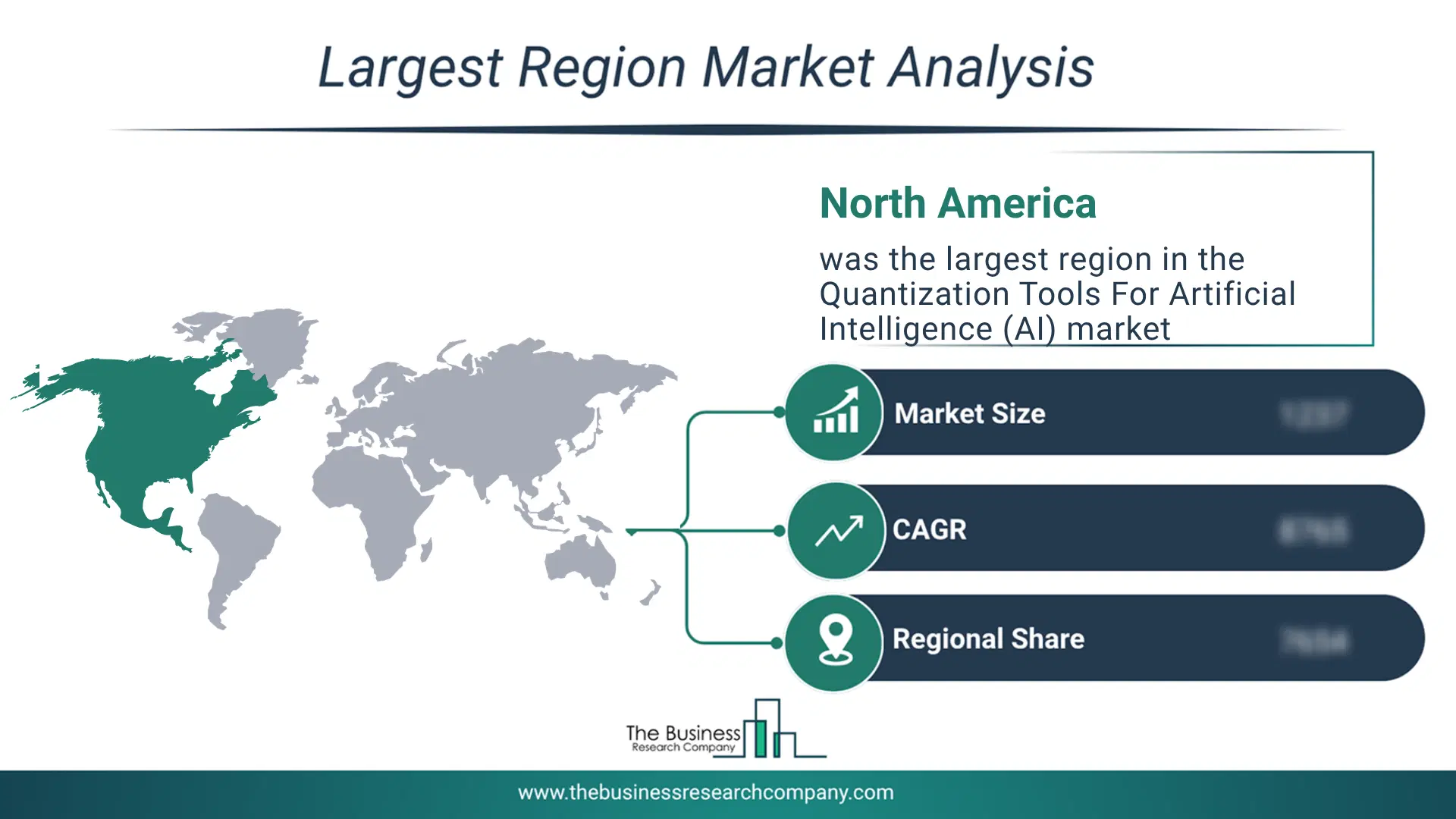
Regional Insights
North America was the largest region in the quantization tools for artificial intelligence (AI) market in 2025. Asia-Pacific is expected to be the fastest-growing region in the forecast period. The regions covered in this market report are Asia-Pacific, South East Asia, Western Europe, Eastern Europe, North America, South America, Middle East, Africa. The countries covered in this market report are Australia, Brazil, China, France, Germany, India, Indonesia, Japan, Taiwan, Russia, South Korea, UK, USA, Canada, Italy, Spain.What Defines the Quantization Tools For Artificial Intelligence (AI) Market?
The quantization tools for artificial intelligence (AI) market includes revenues earned by entities by providing services such as model quantization consulting, quantization strategy development, model optimization and compression services, inference performance tuning, hardware-specific quantization, and maintenance and support services. The market value includes the value of related goods sold by the service provider or included within the service offering. Only goods and services traded between entities or sold to end consumers are included. The quantization tools for artificial intelligence(AI) market also include sales of quantization toolkits, quantization-aware training frameworks, model compression platforms, inference optimization engines, hardware accelerator quantization tools, and automated quantization pipelines. Values in this market are ‘factory gate’ values, that is the value of goods sold by the manufacturers or creators of the goods, whether to other entities (including downstream manufacturers, wholesalers, distributors and retailers) or directly to end customers. The value of goods in this market includes related services sold by the creators of the goods.How is Market Value Defined and Measured?
The market value is defined as the revenues that enterprises gain from the sale of goods and/or services within the specified market and geography through sales, grants, or donations in terms of the currency (in USD unless otherwise specified). The revenues for a specified geography are consumption values that are revenues generated by organizations in the specified geography within the market, irrespective of where they are produced. It does not include revenues from resales along the supply chain, either further along the supply chain or as part of other products.
This chart presents market attractiveness based on a quantitative evaluation of growth, competition, strategic alignment, and risk, offering a clear view of opportunity areas for decision-making. This chart is for illustrative purposes; the full report contains the complete analysis.

This chart highlights the Total Addressable Market (TAM) by estimating the maximum revenue opportunity using an assumption-driven approach, supporting strategic planning and opportunity sizing across markets. The chart is illustrative; the full report provides a more comprehensive analysis.
What Key Data and Analysis Are Included in the Quantization Tools For Artificial Intelligence (AI) Market Report 2026?
The quantization tools for artificial intelligence (ai) market research report is one of a series of new reports from The Business Research Company that provides market statistics, including industry global market size, regional shares, competitors with the market share, detailed market segments, market trends and opportunities, and any further data you may need to thrive in the quantization tools for artificial intelligence (ai) industry. The market research report delivers a complete perspective of everything you need, with an in-depth analysis of the current and future state of the industry.Quantization Tools For Artificial Intelligence (AI) Market Report Forecast Analysis
| Report Attribute | Details |
|---|---|
| Market Size Value In 2026 | $1.09 billion |
| Revenue Forecast In 2030 | $2.2 billion |
| Growth Rate | CAGR of 19.2% from 2026 to 2030 |
| Base Year For Estimation | 2025 |
| Actual Estimates/Historical Data | 2020-2025 |
| Forecast Period | 2026 - 2030 |
| Market Representation | Revenue in USD Billion and CAGR from 2026 to 2030 |
| Segments Covered | Tool Type, Deployment Mode, Organization Size, Application, End-User |
| Regional Scope | Asia-Pacific, Western Europe, Eastern Europe, North America, South America, Middle East, Africa |
| Country Scope | The Countries Covered In This Market Report Are Australia, Brazil, China, France, Germany, India, Indonesia, Japan, Taiwan, Russia, South Korea, Uk, Usa, Canada, Italy, Spain. |
| Key Companies Profiled | Intel Corporation, NVIDIA Corporation, Arm Holdings plc, Alibaba Cloud Computing Ltd., Microsoft Corporation, Samsung Electronics Co. Ltd., Meta Platforms Inc., Huawei Technologies Co. Ltd., Tencent Cloud Computing (Beijing) Co. Ltd., International Business Machines Corporation, Qualcomm Technologies Inc., Baidu Inc., Synopsys Inc., Mythic Inc., Edge Impulse Inc., Hailo Technologies Ltd., Neural Magic Inc., Deeplite Inc., fast.AI Inc., bitsandbytes, GreenWaves Technologies SAS, AutoGPTQ |
| Customization Scope | Request for Customization |
| Pricing And Purchase Options | Explore Purchase Options |