
Quantum-Artificial Intelligence (AI) Financial Fraud Simulator Market Report 2026
Global Outlook – By Component (Software, Hardware, Services), By Deployment Mode (On-Premises, Cloud), By Organization Size (Small And Medium Enterprises, Large Enterprises), By End-User (Banking, Financial Services And Insurance (BFSI), Government, Retail, Information Technology (IT) And Telecommunications, Other End-Users) – Market Size, Trends, Strategies, and Forecast to 2030
Quantum-Artificial Intelligence (AI) Financial Fraud Simulator Market Overview
• Quantum-Artificial Intelligence (AI) Financial Fraud Simulator market size has reached to $2.34 billion in 2025 • Expected to grow to $8.74 billion in 2030 at a compound annual growth rate (CAGR) of 30.1% • Growth Driver: Rising Number Of Cyber Threats Fueling The Growth Of The Market Due To Increasing Incidence Of Malicious Attacks On Digital Assets • North America was the largest region in 2025 and Asia-Pacific is the fastest growing region.What Is Covered Under Quantum-Artificial Intelligence (AI) Financial Fraud Simulator Market?
A quantum-artificial intelligence (AI) financial fraud simulator ris an advanced system that leverages quantum computing and AI algorithms to model, predict, and test financial fraud scenarios in real time. Its primary purpose is to identify potential vulnerabilities, simulate sophisticated fraudulent activities, and enhance detection strategies for banks, fintechs, and financial institutions. The main components of quantum-artificial intelligence (AI) financial fraud simulator are software, hardware, and services. Software refers to the digital programs and algorithms that run fraud detection operations using quantum computing and artificial intelligence. It can be deployed via on-premises or cloud on various organization sizes, including small and medium enterprises and large enterprises. The key end users include banking, financial services and insurance (BFSI), government, retail, information technology (IT), telecommunications, and others.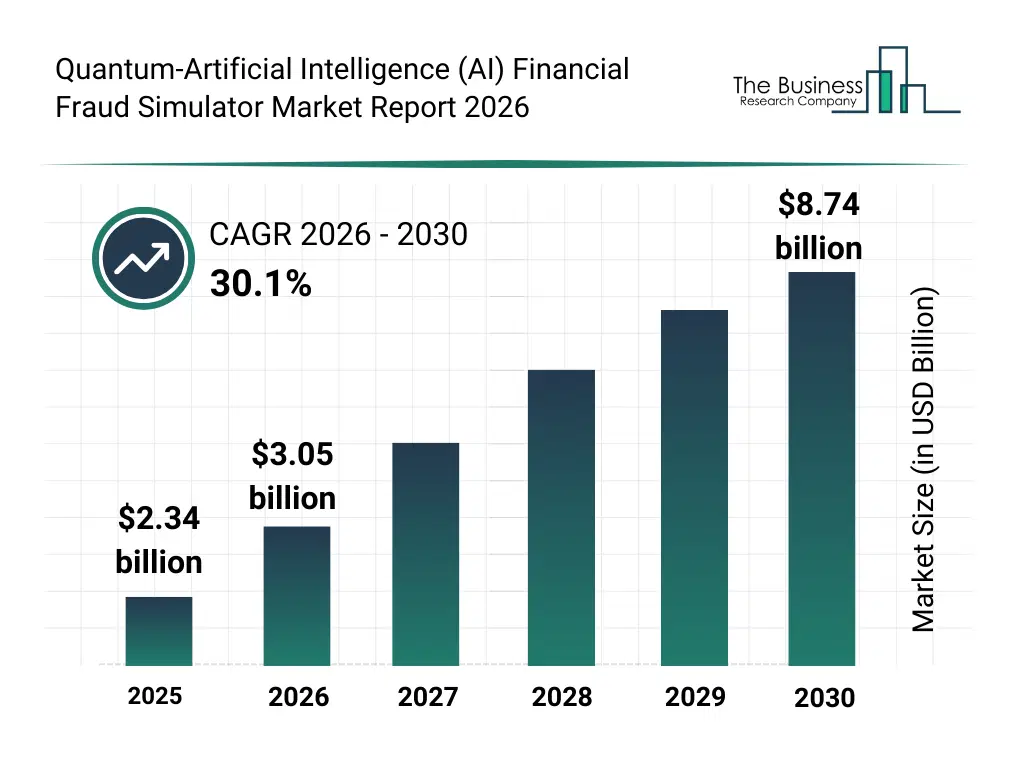
What Is The Quantum-Artificial Intelligence (AI) Financial Fraud Simulator Market Size and Share 2026?
The quantum-artificial intelligence (ai) financial fraud simulator market size has grown exponentially in recent years. It will grow from $2.34 billion in 2025 to $3.05 billion in 2026 at a compound annual growth rate (CAGR) of 30.3%. The growth in the historic period can be attributed to increasing digital payment fraud incidents, expansion of online banking channels, rising financial cybercrime sophistication, adoption of advanced fraud analytics, growing regulatory compliance requirements.What Is The Quantum-Artificial Intelligence (AI) Financial Fraud Simulator Market Growth Forecast?
The quantum-artificial intelligence (ai) financial fraud simulator market size is expected to see exponential growth in the next few years. It will grow to $8.74 billion in 2030 at a compound annual growth rate (CAGR) of 30.1%. The growth in the forecast period can be attributed to increasing investments in quantum computing adoption, rising demand for proactive fraud prevention tools, expansion of fraud simulation-as-a-service models, growing integration of ai and quantum analytics, increasing focus on real-time fraud resilience. Major trends in the forecast period include increasing expansion of real-time fraud simulation platforms, growing adoption of quantum-based scenario modeling, increasing use of ai-driven fraud stress testing, rising integration of predictive fraud analytics, enhanced focus on proactive fraud defense.
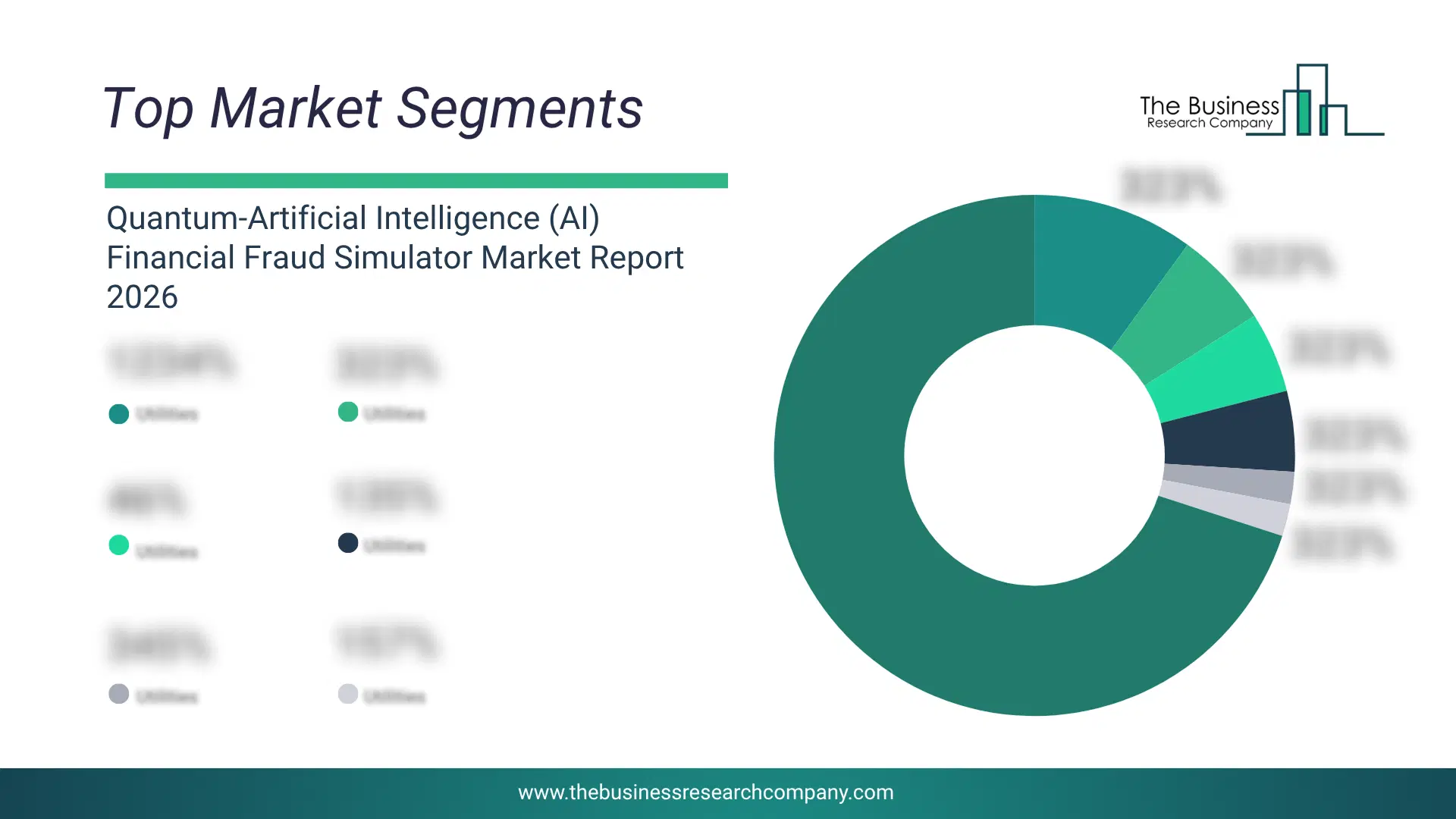
Global Quantum-Artificial Intelligence (AI) Financial Fraud Simulator Market Segmentation
1) By Component: Software, Hardware, Services 2) By Deployment Mode: On-Premises, Cloud 3) By Organization Size: Small And Medium Enterprises, Large Enterprises 4) By End-User: Banking, Financial Services And Insurance (BFSI), Government, Retail, Information Technology (IT) And Telecommunications, Other End-Users Subsegments: 1) By Software: Fraud Detection Software, Risk And Compliance Management Software, Data Analytics And Visualization Tools, Machine Learning And Artificial Intelligence (AI) Algorithms, Quantum Computing Platforms, Simulation And Modeling Software, Cloud-Based Fraud Simulation Software, Predictive Analytics Solutions 2) By Hardware: Quantum Computers, High-Performance Servers, Data Storage Systems, Networking Infrastructure, Graphics Processing Unit (GPUs) And Tensor Processing Unit (TPUs), Security Appliances, Specialized Quantum Chips, Edge Devices 3) By Services: Consulting Services, Integration And Deployment Services, Managed Security Services, Training And Education Services, Support And Maintenance Services, Risk Assessment And Advisory, Cloud Hosting And Infrastructure Services, Fraud Simulation-As-A-Service (FSaaS)What Are The Drivers Of The Quantum-Artificial Intelligence (AI) Financial Fraud Simulator Market?
The rising number of cyber threats is expected to propel the growth of the quantum-artificial intelligence (AI) financial fraud simulator market going forward. Cyber threats refer to any malicious attempts by individuals or groups to damage, disrupt, or gain unauthorized access to computer systems, networks, or digital information. The rising incidence of cyber threats is due to the growing centralization of digital asset storage, as it creates single points of failure that are highly attractive to hackers. Quantum-artificial intelligence (AI) financial fraud simulators help address cyber threats by combining quantum computing and AI to analyze vast amounts of financial data in real time. They enhance cybersecurity ecosystems by identifying anomalous patterns and predicting potential fraud, reducing financial risks, and improving the efficiency of threat detection and prevention. For instance, in July 2024, according to Check Point Software Technologies Ltd., an Israel-based cybersecurity company, cyberattacks on corporate networks are rising, with a 30% increase in weekly attacks in the second quarter of 2024 compared to the same period in 2023 and a 25% rise from the first quarter of 2024. Therefore, the rising number of cyber threats is driving the growth of the quantum-artificial intelligence (AI) financial fraud simulator industry. The increasing adoption of cloud-based solutions is expected to propel the growth of the quantum-artificial intelligence (AI) financial fraud simulator market going forward. Cloud-based services are internet-delivered solutions that allow users to access data, applications, or computing resources remotely, without relying on on-site infrastructure. Cloud-based services are increasing due to scalability and flexibility, as they allow businesses to easily adjust resources on demand without heavy upfront infrastructure costs. Cloud-based solutions enable quantum-AI financial fraud simulators by providing scalable computing power and on-demand resources, making them suitable for handling complex fraud detection tasks. They enhance accessibility by allowing real-time monitoring and updates from any location, improving security, efficiency, and adaptability for financial institutions. For instance, in December 2023, according to Eurostat Luxembourg-based government agency, in 2023, 45.2 % of EU enterprises purchased cloud?computing services. Therefore, the increasing adoption of cloud-based solutions is driving the growth of the quantum-artificial intelligence (AI) financial fraud simulator industry.Key Players In The Global Quantum-Artificial Intelligence (AI) Financial Fraud Simulator Market
Major companies operating in the quantum-artificial intelligence (ai) financial fraud simulator market are Amazon Web Services Inc., Accenture plc, International Business Machines Corporation, Fujitsu Limited, NVIDIA Corporation, Infosys Limited, Infosys Limited, AdvanThink S.A., Unisys Corporation, PsiQuantum Corporation, Sandbox AQ Inc., Quantinuum Inc., Hakkoda Inc., 1QB Information Technologies Inc., Pasqal SAS, IonQ Inc., Multiverse Computing S.L., Q-CTRL Pty Ltd., Saarthee.ai, Classiq Technologies Ltd.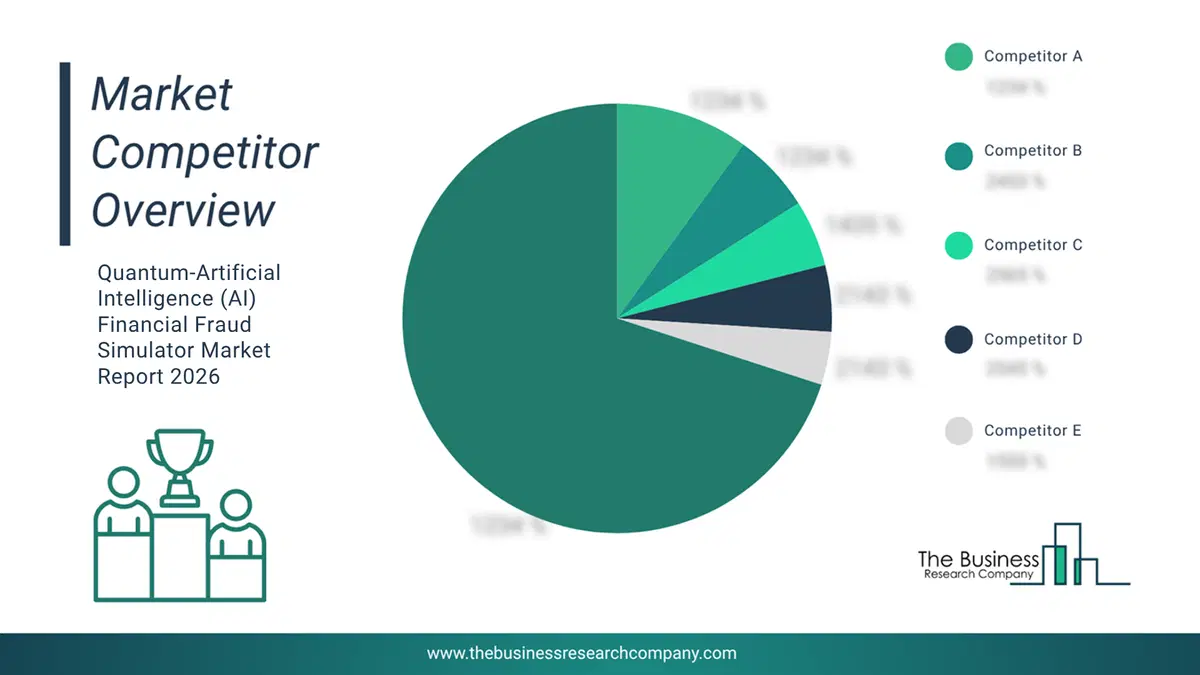
This chart is for illustrative purposes; the full report includes a detailed competitor analysis and comprehensive overview of the top 10 companies in the market.
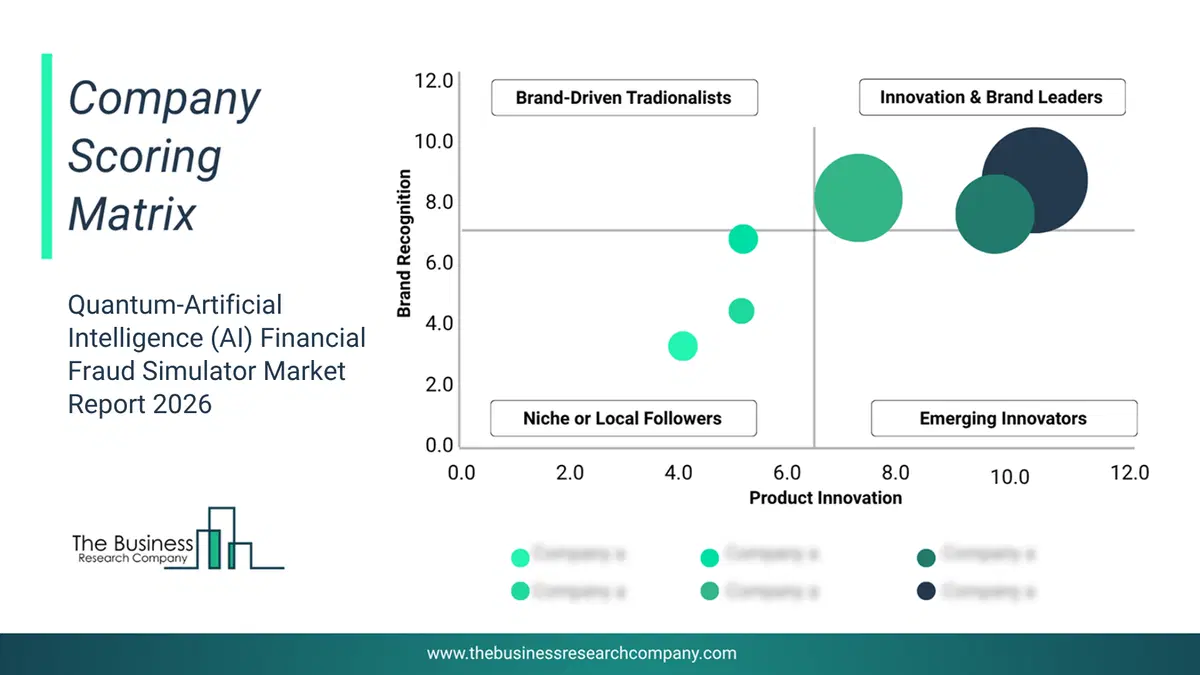
This chart maps companies by product innovation and brand strength, with bubble size indicating relative revenue, helping identify market leaders, challengers, and niche players. This is an illustrative chart; the full report provides a complete and accurate competitive analysis.
What Are Latest Mergers And Acquisitions In The Quantum-Artificial Intelligence (AI) Financial Fraud Simulator Market?
In June 2025, AdvanThink SAS, a France-based AI-driven fraudtech company, partnered with Quandela SAS to explore quantum AI for payment fraud detection. This partnership aims to integrate quantum AI into payment fraud detection, enhancing speed, accuracy, and efficiency in real-time fraud prevention. Quandela SAS is a France-based quantum photonics company that specializes in the development of photonic quantum computing solutions.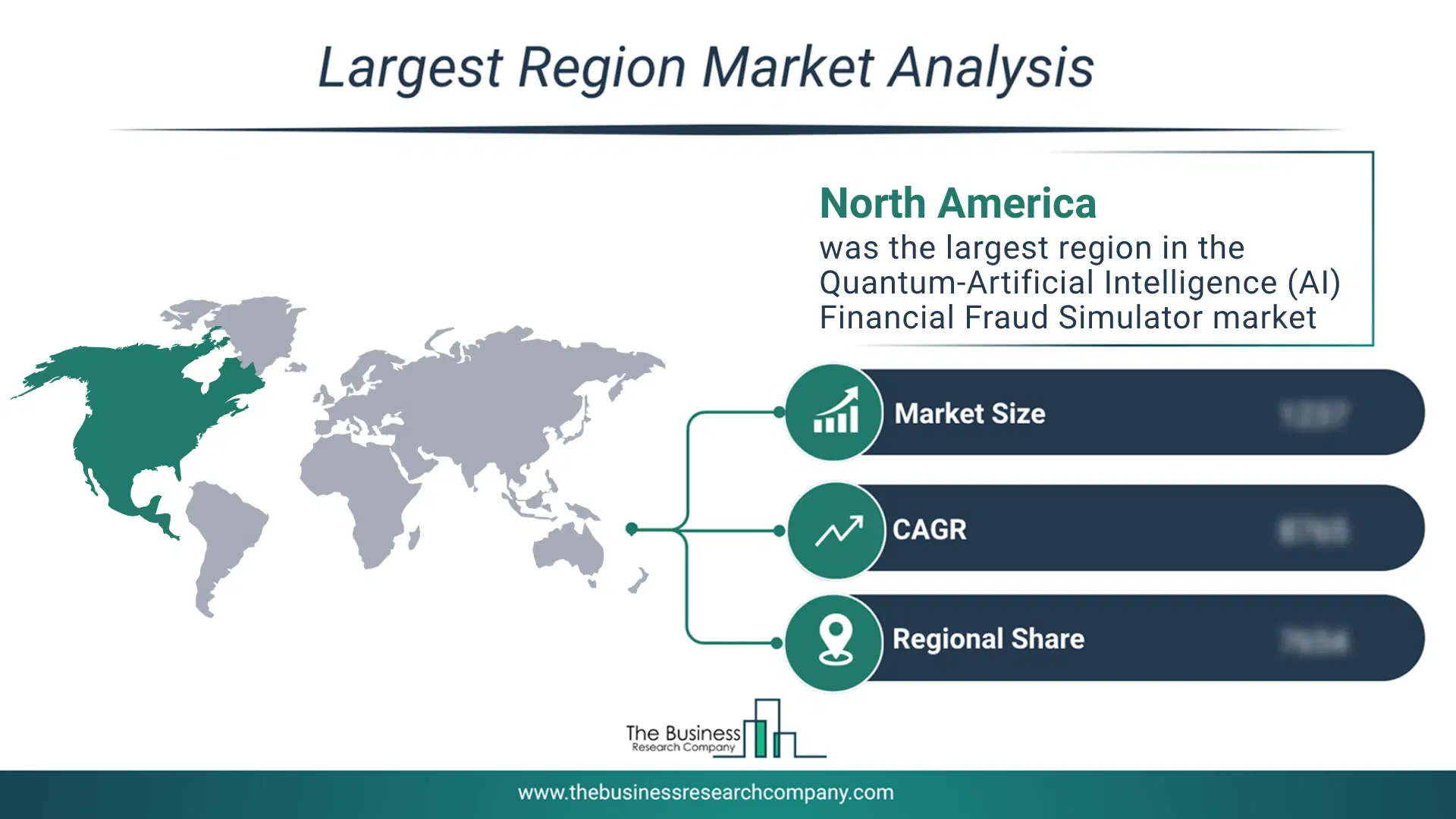
Regional Outlook
North America was the largest region in the quantum-artificial intelligence (AI) financial fraud simulator market in 2025. Asia-Pacific is expected to be the fastest-growing region in the forecast period. The regions covered in this market report are Asia-Pacific, South East Asia, Western Europe, Eastern Europe, North America, South America, Middle East, Africa. The countries covered in this market report are Australia, Brazil, China, France, Germany, India, Indonesia, Japan, Taiwan, Russia, South Korea, UK, USA, Canada, Italy, Spain.What Defines the Quantum-Artificial Intelligence (AI) Financial Fraud Simulator Market?
The quantum-artificial intelligence (AI) financial fraud simulator market includes revenues earned by entities by providing services, such as fraud detection and prediction, anomaly and pattern analysis, risk assessment, scenario simulation, and regulatory compliance support. The market value includes the value of related goods sold by the service provider or included within the service offering. The quantum-artificial intelligence (AI) financial fraud simulator market also includes sales of synthetic fraud dataset generators, quantum cryptography simulation tools, multi-modal fraud sensor devices, artificial intelligence (AI) quantum hybrid forensic investigation kits, and fraudulent pattern clustering and visualization tools. Values in this market are ‘factory gate’ values, that is, the value of goods sold by the manufacturers or creators of the goods, whether to other entities (including downstream manufacturers, wholesalers, distributors, and retailers) or directly to end customers. The value of goods in this market includes related services sold by the creators of the goods.How is Market Value Defined and Measured?
The market value is defined as the revenues that enterprises gain from the sale of goods and/or services within the specified market and geography through sales, grants, or donations in terms of the currency (in USD unless otherwise specified). The revenues for a specified geography are consumption values that are revenues generated by organizations in the specified geography within the market, irrespective of where they are produced. It does not include revenues from resales along the supply chain, either further along the supply chain or as part of other products.
This chart presents market attractiveness based on a quantitative evaluation of growth, competition, strategic alignment, and risk, offering a clear view of opportunity areas for decision-making. This chart is for illustrative purposes; the full report contains the complete analysis.

This chart highlights the Total Addressable Market (TAM) by estimating the maximum revenue opportunity using an assumption-driven approach, supporting strategic planning and opportunity sizing across markets. The chart is illustrative; the full report provides a more comprehensive analysis.
What Key Data and Analysis Are Included in the Quantum-Artificial Intelligence (AI) Financial Fraud Simulator Market Report 2026?
The quantum-artificial intelligence (ai) financial fraud simulator market research report is one of a series of new reports from The Business Research Company that provides market statistics, including Market Report 2026?global market size, regional shares, competitors with the market share, detailed market segments, market trends and opportunities, and any further data you may need to thrive in the quantum-artificial intelligence (ai) financial fraud simulator Market Report 2026? The market research report delivers a complete perspective of everything you need, with an in-depth analysis of the current and future state of the Market Report 2026?Quantum-Artificial Intelligence (AI) Financial Fraud Simulator Market Report Forecast Analysis
| Report Attribute | Details |
|---|---|
| Market Size Value In 2026 | $3.05 billion |
| Revenue Forecast In 2030 | $8.74 billion |
| Growth Rate | CAGR of 30.3% from 2026 to 2030 |
| Base Year For Estimation | 2025 |
| Actual Estimates/Historical Data | 2020-2025 |
| Forecast Period | 2026 - 2030 |
| Market Representation | Revenue in USD Billion and CAGR from 2026 to 2030 |
| Segments Covered | Component, Deployment Mode, Organization Size, End-User |
| Regional Scope | Asia-Pacific, Western Europe, Eastern Europe, North America, South America, Middle East, Africa |
| Country Scope | The countries covered in the report are Australia, Brazil, China, France, Germany, India, Indonesia, Japan, Taiwan, Russia, South Korea, UK, USA, Canada, Italy, Spain. |
| Key Companies Profiled | Amazon Web Services Inc., Accenture plc, International Business Machines Corporation, Fujitsu Limited, NVIDIA Corporation, Infosys Limited, Infosys Limited, AdvanThink S.A., Unisys Corporation, PsiQuantum Corporation, Sandbox AQ Inc., Quantinuum Inc., Hakkoda Inc., 1QB Information Technologies Inc., Pasqal SAS, IonQ Inc., Multiverse Computing S.L., Q-CTRL Pty Ltd., Saarthee.ai, Classiq Technologies Ltd. |
| Customization Scope | Request for Customization |
| Pricing And Purchase Options | Explore Purchase Options |