
Quantum Clocks Market Report 2026
Global Outlook – By Technology (Atomic Clocks, Optical Clocks, Optical Lattice Clocks, Trapped Ion Clocks, Cesium Beam Clocks, Rubidium Clocks, Hydrogen Maser Clocks, Quantum Network Clocks), By Deployment (Stationary, Portable, Networked), By Application (Telecommunications, Global Positioning System (GPS), Timekeeping Standards, Research), By End-Use Industry (Aerospace, Defense, Telecommunications, Government And Public Sector, Research Institutions And Academia, Commercial Enterprises) – Market Size, Trends, Strategies, and Forecast to 2030
Quantum Clocks Market Overview
• Quantum Clocks market size has reached to $0.94 billion in 2025 • Expected to grow to $2.6 billion in 2030 at a compound annual growth rate (CAGR) of 22.6% • Growth Driver: The Rise In Research And Development (R&D) Investments In Quantum Technologies Driving The Growth Of The Market Due To Increasing Demand For High-Performance Quantum Solutions • Market Trend: Next-Generation Portable Timekeeping Achieves Unprecedented Precision • North America was the largest region in 2025 and Asia-Pacific is the fastest growing region.What Is Covered Under Quantum Clocks Market?
Quantum clocks are highly precise timekeeping devices that use the quantum properties of atoms, such as energy level transitions, to measure time with extreme accuracy. They surpass traditional atomic clocks by reducing errors caused by environmental factors, enabling measurements precise to billionths or even trillionths of a second. The main technologies of quantum clocks include atomic clocks, optical clocks, optical lattice clocks, trapped ion clocks, cesium beam clocks, rubidium clocks, hydrogen maser clocks, and quantum network clocks. Atomic clocks refer to highly precise timekeeping devices that use the vibration frequencies of atoms as their reference, ensuring exceptional accuracy and stability for advanced synchronization needs. They are deployed as stationary, portable, and networked and find applications in telecommunications, global positioning system (GPS), timekeeping standards, and research, serving end-use industries such as aerospace, defense, telecommunications, government and public sector, research institutions and academia, and commercial enterprises.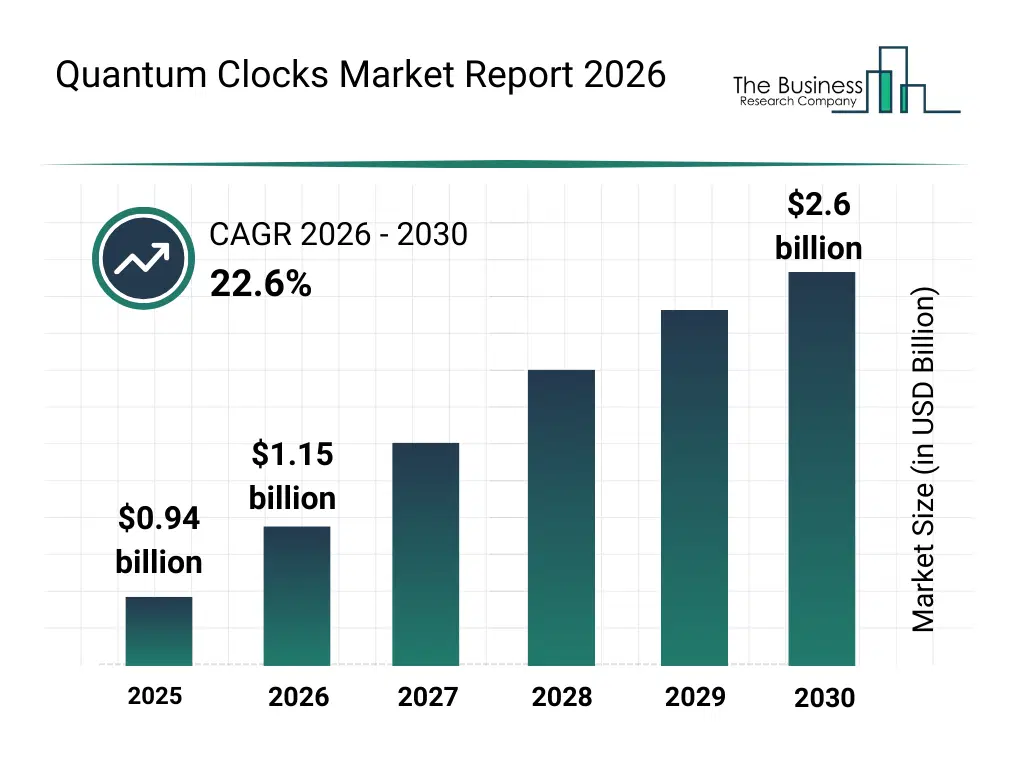
What Is The Quantum Clocks Market Size and Share 2026?
The quantum clocks market size has grown exponentially in recent years. It will grow from $0.94 billion in 2025 to $1.15 billion in 2026 at a compound annual growth rate (CAGR) of 22.4%. The growth in the historic period can be attributed to rising demand for precise timekeeping in telecommunications, adoption of atomic clocks in research institutions, growth in gps infrastructure, increasing defense and aerospace applications, technological advances in rubidium and cesium clocks.What Is The Quantum Clocks Market Growth Forecast?
The quantum clocks market size is expected to see exponential growth in the next few years. It will grow to $2.6 billion in 2030 at a compound annual growth rate (CAGR) of 22.6%. The growth in the forecast period can be attributed to increasing deployment of optical lattice clocks, rising adoption of quantum network clocks, growing demand for ultra-stable hydrogen maser clocks, expansion of space-grade clock applications, integration of quantum clocks in next-gen telecommunications and gps systems. Major trends in the forecast period include increasing adoption of chip-scale atomic clocks, rising demand for portable and networked quantum clocks, growing integration with gps and telecommunications networks, expansion of ultra-precise timekeeping in research applications, rising focus on space-grade and defense quantum clocks.
Global Quantum Clocks Market Segmentation
1) By Technology: Atomic Clocks, Optical Clocks, Optical Lattice Clocks, Trapped Ion Clocks, Cesium Beam Clocks, Rubidium Clocks, Hydrogen Maser Clocks, Quantum Network Clocks 2) By Deployment: Stationary, Portable, Networked 3) By Application: Telecommunications, Global Positioning System (GPS), Timekeeping Standards, Research 4) By End-Use Industry: Aerospace, Defense, Telecommunications, Government And Public Sector, Research Institutions And Academia, Commercial Enterprises Subsegments: 1) By Atomic Clocks: Fountain Atomic Clocks, Beam Atomic Clocks, Chip-Scale Atomic Clocks, Miniature Atomic Clocks 2) By Optical Clocks: Single-Ion Optical Clocks, Neutral Atom Optical Clocks, Cavity-Stabilized Optical Clocks, Laser-Cooled Optical Clocks 3) By Optical Lattice Clocks: Strontium Lattice Clocks, Ytterbium Lattice Clocks, Calcium Lattice Clocks, Magnesium Lattice Clocks 4) By Trapped Ion Clocks: Ytterbium Trapped Ion Clocks, Aluminum Trapped Ion Clocks, Beryllium Trapped Ion Clocks, Calcium Trapped Ion Clocks 5) By Cesium Beam Clocks: Laboratory Cesium Clocks, Transportable Cesium Clocks, High-Stability Cesium Clocks, Space-Grade Cesium Clocks 6) By Rubidium Clocks: Passive Rubidium Clocks, Compact Rubidium Clocks, High-Precision Rubidium Clocks, Portable Rubidium Clocks 7) By Hydrogen Maser Clocks: Active Hydrogen Maser Clocks, Passive Hydrogen Maser Clocks, Space Hydrogen Maser Clocks, Ultra-Stable Hydrogen Maser Clocks 8) By Quantum Network Clocks: Fiber-Connected Quantum Clocks, Satellite Quantum Clocks, Entanglement Quantum Clocks, Distributed Quantum ClocksWhat Is The Driver Of The Quantum Clocks Market?
The rising research and development (R&D) investments in quantum technologies are expected to propel the growth of the quantum clocks market going forward. Research and development investments in quantum technologies refer to the allocation of financial, human, and technological resources by organizations or governments to advance the study, creation, and commercialization of quantum-based technologies such as Quantum Computing, quantum communication, and quantum sensing. Rising investment in research and development in quantum technologies are primarily driven by the increasing demand for high-performance computing, as industries and research institutions seek faster, more powerful computational capabilities to solve complex problems beyond the reach of classical computers. Research and development (R&D) investments in quantum technologies drive advancements in quantum clocks by enhancing their precision, stability, and miniaturization, enabling next-generation timekeeping for scientific, industrial, and navigation applications. For instance, in March 2025, according to the European Centre for International Political Economy (ECIPE), a Belgium-based non-profit policy research institute, in 2024, global investments in Quantum Technology reached a cumulative $15 billion, with contributions from over 30 countries. Therefore, the rising research and development (R&D) investments in quantum technologies are driving the growth of the quantum clocks industry.Key Players In The Global Quantum Clocks Market
Major companies operating in the quantum clocks market are Safran Electronics And Defense, Leonardo Società per Azioni S.p.A., Microchip Technology Incorporated, Teledyne Scientific And Imaging LLC, Keysight Technologies Incorporated, Taitien Electronics Co. Limited, QuantX Laboratories, NKT Photonics A/S, Frequency Electronics Incorporated, Infleqtion Inc, TOPTICA Photonics SE, Oscilloquartz SA, M Squared Lasers Limited., AccuBeat Limited, Rolex Quantum SA, Chronos Technology Limited., Rydberg Technologies Inc, Menlo Systems GmbH, IQD Frequency Products Limited, and Aquark Technologies Ltd.
This chart is for illustrative purposes; the full report includes a detailed competitor analysis and comprehensive overview of the top 10 companies in the market.
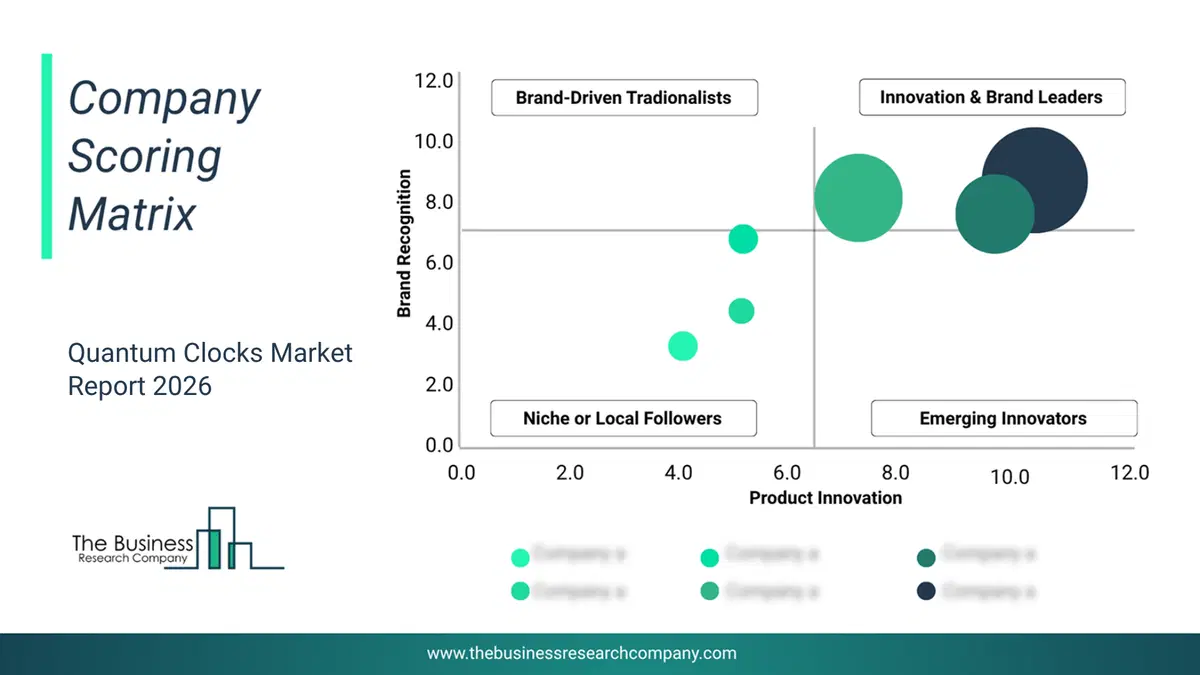
This chart maps companies by product innovation and brand strength, with bubble size indicating relative revenue, helping identify market leaders, challengers, and niche players. This is an illustrative chart; the full report provides a complete and accurate competitive analysis.
Global Quantum Clocks Market Trends and Insights
Major companies operating in the quantum clocks market are focusing on developing innovative solutions such as, portable high precision timekeeping devices to enhance accuracy, stability, and industrial deploy ability. Portable high precision timekeeping devices are compact, transportable clocks that maintain extremely accurate and stable time measurements outside of laboratory settings. For instance, in November 2025, TOPTICA Photonics SE, a Germany-based quantum technology company, launched TOPTICLOCK, the world's first commercial optical quantum clock using a single laser-cooled, trapped Yb⁺ ion to achieve unprecedented precision in timekeeping. The system delivers ultra-stable optical frequency output and can provide low-noise radiofrequency and pulse-per-second signals when integrated with an optical frequency comb. This innovation bridges laboratory-grade quantum timekeeping with industrial applications, enabling precise synchronization for telecommunications, navigation, and scientific research.What Are Latest Mergers And Acquisitions In The Quantum Clocks Market?
In October 2025, IonQ Inc., a US-based quantum computing company, acquired Vector Atomic for an undisclosed amount. Through this acquisition, IonQ expanded its technological capabilities to include advanced quantum sensing and precision timing systems, strengthening its integrated quantum stack and accelerating its entry into the quantum clocks and navigation market. Vector Atomic Inc. is a US-based company that specializes in optical atomic clocks, which leverage quantum technology for ultra-precise timekeeping at picosecond and femtosecond levels.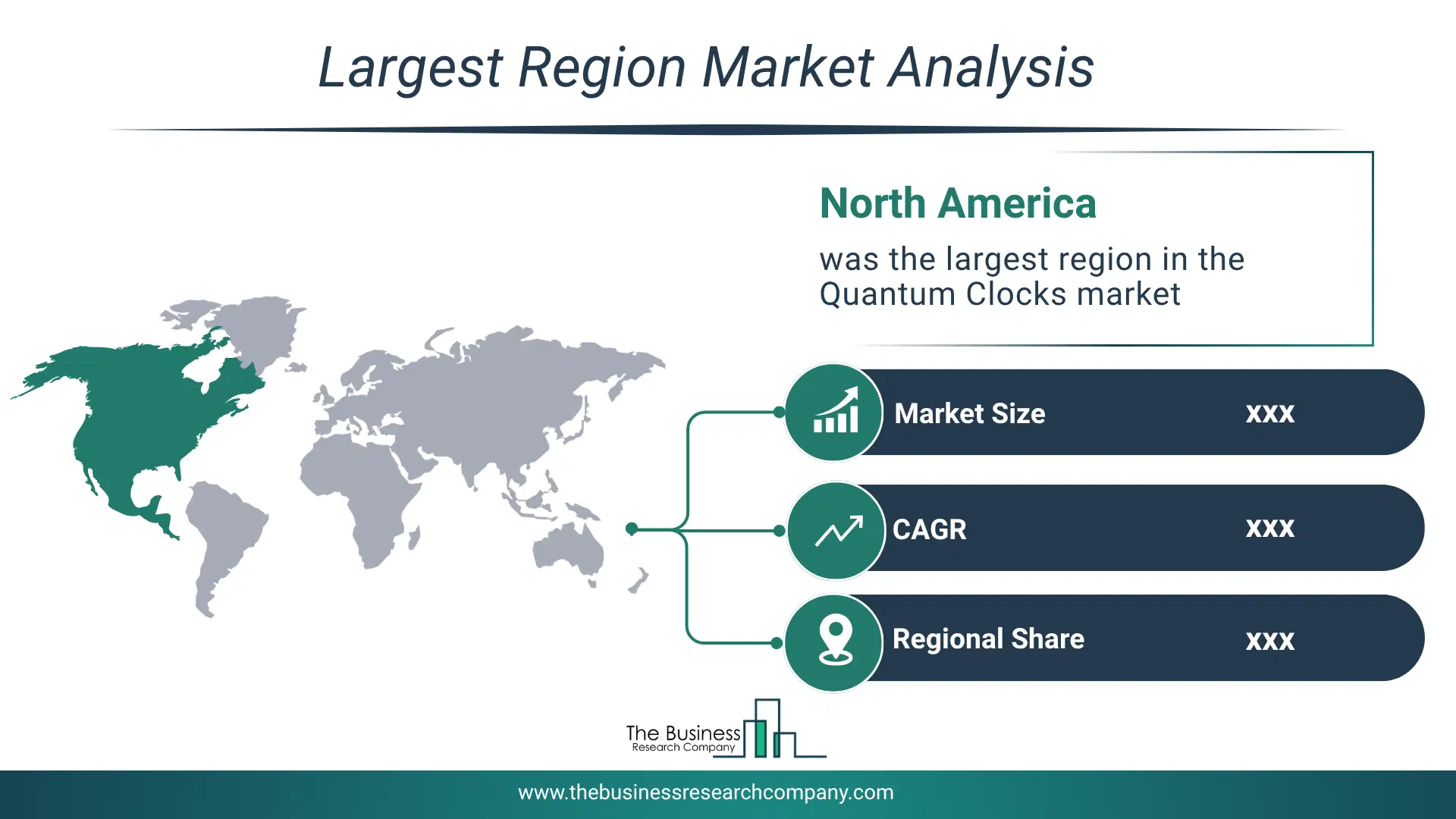
Regional Insights
North America was the largest region in the quantum clocks market in 2025. Asia-Pacific is expected to be the fastest-growing region in the forecast period. The regions covered in this market report are Asia-Pacific, South East Asia, Western Europe, Eastern Europe, North America, South America, Middle East, Africa. The countries covered in this market report are Australia, Brazil, China, France, Germany, India, Indonesia, Japan, Taiwan, Russia, South Korea, UK, USA, Canada, Italy, Spain.What Defines the Quantum Clocks Market?
The quantum clocks market consists of sales of atomic clocks, optical lattice clocks, chip-scale atomic clocks, hydrogen masers, and rubidium clocks. Values in this market are ‘factory gate’ values, that is the value of goods sold by the manufacturers or creators of the goods, whether to other entities (including downstream manufacturers, wholesalers, distributors and retailers) or directly to end customers. The value of goods in this market includes related services sold by the creators of the goods.How is Market Value Defined and Measured?
The market value is defined as the revenues that enterprises gain from the sale of goods and/or services within the specified market and geography through sales, grants, or donations in terms of the currency (in USD unless otherwise specified). The revenues for a specified geography are consumption values that are revenues generated by organizations in the specified geography within the market, irrespective of where they are produced. It does not include revenues from resales along the supply chain, either further along the supply chain or as part of other products.
This chart presents market attractiveness based on a quantitative evaluation of growth, competition, strategic alignment, and risk, offering a clear view of opportunity areas for decision-making. This chart is for illustrative purposes; the full report contains the complete analysis.

This chart highlights the Total Addressable Market (TAM) by estimating the maximum revenue opportunity using an assumption-driven approach, supporting strategic planning and opportunity sizing across markets. The chart is illustrative; the full report provides a more comprehensive analysis.
What Key Data and Analysis Are Included in the Quantum Clocks Market Report 2026?
The quantum clocks market research report is one of a series of new reports from The Business Research Company that provides quantum clocks market statistics, including quantum clocks industry global market size, regional shares, competitors with a quantum clocks market share, detailed quantum clocks market segments, market trends and opportunities, and any further data you may need to thrive in the quantum clocks industry. This quantum clocks market research report delivers a complete perspective of everything you need, with an in-depth analysis of the current and future scenario of the industry.Quantum Clocks Market Report Forecast Analysis
| Report Attribute | Details |
|---|---|
| Market Size Value In 2026 | $1.15 billion |
| Revenue Forecast In 2030 | $2.6 billion |
| Growth Rate | CAGR of 22.4% from 2026 to 2030 |
| Base Year For Estimation | 2025 |
| Actual Estimates/Historical Data | 2020-2025 |
| Forecast Period | 2026 - 2030 |
| Market Representation | Revenue in USD Billion and CAGR from 2026 to 2030 |
| Segments Covered | Technology, Deployment, Application, End-Use Industry |
| Regional Scope | Asia-Pacific, Western Europe, Eastern Europe, North America, South America, Middle East, Africa |
| Country Scope | The countries covered in the report are Australia, Brazil, China, France, Germany, India, Indonesia, Japan, Taiwan, Russia, South Korea, UK, USA, Canada, Italy, Spain. |
| Key Companies Profiled | Safran Electronics And Defense, Leonardo Società per Azioni S.p.A., Microchip Technology Incorporated, Teledyne Scientific And Imaging LLC, Keysight Technologies Incorporated, Taitien Electronics Co. Limited, QuantX Laboratories, NKT Photonics A/S, Frequency Electronics Incorporated, Infleqtion Inc, TOPTICA Photonics SE, Oscilloquartz SA, M Squared Lasers Limited., AccuBeat Limited, Rolex Quantum SA, Chronos Technology Limited., Rydberg Technologies Inc, Menlo Systems GmbH, IQD Frequency Products Limited, and Aquark Technologies Ltd. |
| Customization Scope | Request for Customization |
| Pricing And Purchase Options | Explore Purchase Options |