
Quantum Computing Software Market Report 2026
Global Outlook – By Component (Solution, Services), By Technology (Superconducting Qubits, Trapped Ions, Quantum Annealing, Other Technologies), By Deployment (Cloud, On-Premises), By Application (Optimization, Machine Learning, Simulation, Other Applications), By End-User (Aerospace And Defense, Banking, Financial Services And Insurance (BFSI), Healthcare, Automotive, Energy And Power, Chemical, Government, Other End-Users) – Market Size, Trends, Strategies, and Forecast to 2030
Quantum Computing Software Market Overview
• Quantum Computing Software market size has reached to $0.62 billion in 2025 • Expected to grow to $1.68 billion in 2030 at a compound annual growth rate (CAGR) of 21.2% • Growth Driver: Rising Investments In Quantum Computing Startups In Driving Growth In The Quantum Computing Market • Market Trend: Driving Innovation In The Quantum Computing Software Market • North America was the largest region in 2025.What Is Covered Under Quantum Computing Software Market?
Quantum computing software comprises a suite of tools, languages, and frameworks tailored for harnessing the principles of quantum mechanics to develop algorithms and simulate quantum systems. It executes computations on quantum hardware, encompassing quantum programming languages, simulators, development environments, and error correction solutions. The main types of components of quantum computing software are solution, services. A solution refers to a complete package or system designed to address a specific problem or need. In the context of quantum computing, solutions can involve algorithms, software frameworks, and hardware configurations tailored to solve particular computational challenges. The various technologies include superconducting qubits, trapped ions, quantum annealing, others deployed through cloud, on-premises. These are used in various applications such as optimization, machine learning, simulation, others and also by various end-users such as aerospace and defense, banking, financial services and insurance (BFSI), healthcare, automotive, energy and power, chemical, government, and others.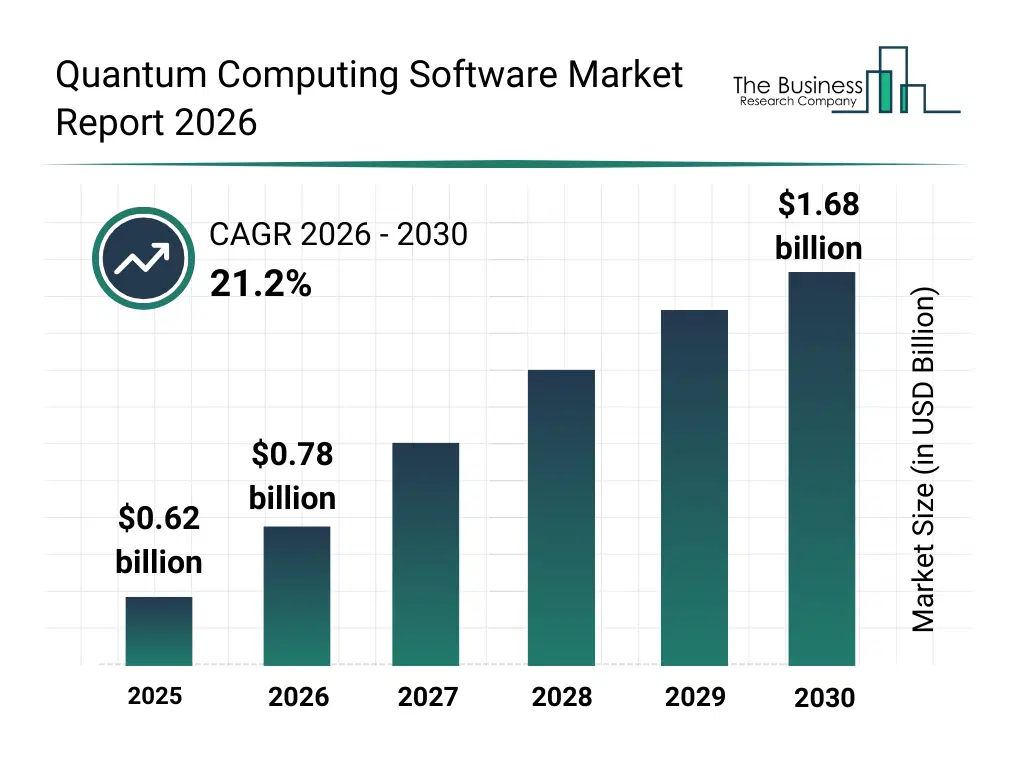
What Is The Quantum Computing Software Market Size and Share 2026?
The quantum computing software market size has grown exponentially in recent years. It will grow from $0.62 billion in 2025 to $0.78 billion in 2026 at a compound annual growth rate (CAGR) of 25.2%. The growth in the historic period can be attributed to increasing availability of early quantum hardware, growth of academic quantum research, rising interest in algorithm experimentation, expansion of open-source quantum tools, increasing enterprise software prototyping.What Is The Quantum Computing Software Market Growth Forecast?
The quantum computing software market size is expected to see exponential growth in the next few years. It will grow to $1.68 billion in 2030 at a compound annual growth rate (CAGR) of 21.2%. The growth in the forecast period can be attributed to increasing enterprise adoption of quantum-as-a-service, rising demand for scalable quantum software platforms, expansion of industry-specific quantum applications, growing integration with classical cloud environments, increasing investment in quantum developer ecosystems. Major trends in the forecast period include expansion of quantum programming frameworks, rising adoption of cloud-based quantum development platforms, growing focus on quantum error correction software, increasing demand for hybrid quantum-classical algorithms, enhanced emphasis on developer-friendly quantum toolkits.

Global Quantum Computing Software Market Segmentation
1) By Component: Solution, Services 2) By Technology: Superconducting Qubits, Trapped Ions, Quantum Annealing, Other Technologies 3) By Deployment: Cloud, On-Premises 4) By Application: Optimization, Machine Learning, Simulation, Other Applications 5) By End-User: Aerospace And Defense, Banking, Financial Services And Insurance (BFSI), Healthcare, Automotive, Energy And Power, Chemical, Government, Other End-Users Subsegments: 1) By Solution: Quantum Algorithms, Quantum Programming Languages, Quantum Simulation Software, Quantum Cloud Platforms, Quantum Machine Learning Software, Quantum Cryptography Software, Quantum Error Correction Software, Quantum Computing Middleware, Quantum Software Development Kits, Quantum Cloud Integration Tools 2) By Services: Quantum Software Development Services, Quantum Algorithm Development And Optimization Services, Quantum Cloud Computing As A Service, Quantum Consulting And Advisory Services, Quantum System Integration And Customization, Quantum Software Maintenance And Support, Quantum Education And Training Services, Quantum Simulation As A Service, Quantum Computing Application Development ServicesWhat Is The Driver Of The Quantum Computing Software Market?
The rising investments in quantum computing startups are expected to propel the growth of the quantum computing software market going forward. Quantum computing startups specialize in developing and commercializing quantum computing technology. The increasing investments in quantum computing startups are due to government support and the potential for disruptive innovation. The growing investments in quantum computing startups stem from its revolutionary potential to unlock new commercial opportunities and generate economic value across various industries. For instance, in May 2025, according to Quantum Economic Development Consortium a US-based, house Science Committee, it was reported that venture capital invested nearly $2.6 billion globally into the quantum industry in 2024, to a new high of nearly $2.6 billion after a dip in 2023. with U.S.-based quantum companies raising about $1.7 billion. Therefore, the rising investments in quantum computing startups are driving the growth of the quantum computing software industry.Key Players In The Global Quantum Computing Software Market
Major companies operating in the quantum computing software market are Alphabet Inc., Microsoft Corporation, Huawei Technology Co. Ltd., Amazon Web Services Inc., Accenture PLC, International Business Machines Corporation, Oracle Corporation, Honeywell International Inc., SAP SE, Salesforce.com Inc., Fujitsu Ltd., 1QB Information Technologies Inc., Zapata Computing Inc., Rigetti Computing Inc., QC Ware Corp., D-Wave Quantum Systems Inc., Cambridge Quantum Computing Ltd., Riverlane Limited, Algorithmiq Inc., Strangeworks Inc., Phasecraft Limited, Entropica Labs Pte. Ltd., ProteinQure Inc., Quantum Circuits Inc.
This chart is for illustrative purposes; the full report includes a detailed competitor analysis and comprehensive overview of the top 10 companies in the market.

This chart maps companies by product innovation and brand strength, with bubble size indicating relative revenue, helping identify market leaders, challengers, and niche players. This is an illustrative chart; the full report provides a complete and accurate competitive analysis.
Global Quantum Computing Software Market Trends and Insights
Major companies operating in the quantum computing software market are focused on technological advancements such as cloud-based quantum computing services, to gain a competitive edge. Cloud-based quantum computing provides enterprise customers access to hybrid quantum computing capabilities, including quantum-powered AI, optimization, and machine learning. For instance, in March 2024, Oracle Corporation, a US-based technology company, launched a cloud quantum enterprise software service. This will enable customers to explore new industrial use cases of hybrid quantum computing, which combines classical high-performance and quantum computing to deliver powerful processing capabilities. The service will use Oracle Cloud Infrastructure (OCI), powered by Nvidia A100 Tensor Core GPU clusters and the Nvidia CUDA Quantum open-source hybrid quantum computing platform.What Are Latest Mergers And Acquisitions In The Quantum Computing Software Market?
In May 2025, IonQ Inc., a US-based trapped-ion quantum computing company, acquired Quantique (IDQ) for an undisclosed amount. Through this acquisition, IonQ aims to strengthen its quantum-safe networking portfolio by integrating IDQ’s quantum key distribution (QKD) systems, quantum random-number generators (QRNGs), and single-photon detection technologies, while adding approximately 300 granted and pending patents to increase its total intellectual property portfolio to over 900 patents. ID Quantique SA is a Switzerland-based provider of quantum-safe cybersecurity and quantum sensing solutions, including advanced QKD and quantum-detection systems.
Regional Insights
North America was the largest region in the quantum computing software market in 2025. The regions covered in this market report are Asia-Pacific, South East Asia, Western Europe, Eastern Europe, North America, South America, Middle East, Africa. The countries covered in this market report are Australia, Brazil, China, France, Germany, India, Indonesia, Japan, Taiwan, Russia, South Korea, UK, USA, Canada, Italy, Spain.What Defines the Quantum Computing Software Market?
The quantum computing software market includes revenues earned by entities by subscription-based models, licensing fees, consulting services, cloud-based access to quantum computing resources, and customized solutions. The market value includes the value of related goods sold by the service provider or included within the service offering. Only goods and services traded between entities or sold to end consumers are included.How is Market Value Defined and Measured?
The market value is defined as the revenues that enterprises gain from the sale of goods and/or services within the specified market and geography through sales, grants, or donations in terms of the currency (in USD unless otherwise specified). The revenues for a specified geography are consumption values that are revenues generated by organizations in the specified geography within the market, irrespective of where they are produced. It does not include revenues from resales along the supply chain, either further along the supply chain or as part of other products.
This chart presents market attractiveness based on a quantitative evaluation of growth, competition, strategic alignment, and risk, offering a clear view of opportunity areas for decision-making. This chart is for illustrative purposes; the full report contains the complete analysis.

This chart highlights the Total Addressable Market (TAM) by estimating the maximum revenue opportunity using an assumption-driven approach, supporting strategic planning and opportunity sizing across markets. The chart is illustrative; the full report provides a more comprehensive analysis.
What Key Data and Analysis Are Included in the Quantum Computing Software Market Report 2026?
The quantum computing software market research report is one of a series of new reports from The Business Research Company that provides market statistics, including industry global market size, regional shares, competitors with the market share, detailed market segments, market trends and opportunities, and any further data you may need to thrive in the quantum computing software industry. The market research report delivers a complete perspective of everything you need, with an in-depth analysis of the current and future state of the industry.Quantum Computing Software Market Report Forecast Analysis
| Report Attribute | Details |
|---|---|
| Market Size Value In 2026 | $0.78 billion |
| Revenue Forecast In 2030 | $1.68 billion |
| Growth Rate | CAGR of 21.2% from 2026 to 2030 |
| Base Year For Estimation | 2025 |
| Actual Estimates/Historical Data | 2020-2025 |
| Forecast Period | 2026 - 2030 |
| Market Representation | Revenue in USD Billion and CAGR from 2026 to 2030 |
| Segments Covered | Component, Technology, Deployment, Application, End-User |
| Regional Scope | Asia-Pacific, Western Europe, Eastern Europe, North America, South America, Middle East, Africa |
| Country Scope | The Countries Covered In This Market Report Are Australia, Brazil, China, France, Germany, India, Indonesia, Japan, Taiwan, Russia, South Korea, Uk, Usa, Canada, Italy, Spain. |
| Key Companies Profiled | Alphabet Inc., Microsoft Corporation, Huawei Technology Co. Ltd., Amazon Web Services Inc., Accenture PLC, International Business Machines Corporation, Oracle Corporation, Honeywell International Inc., SAP SE, Salesforce.com Inc., Fujitsu Ltd., 1QB Information Technologies Inc., Zapata Computing Inc., Rigetti Computing Inc., QC Ware Corp., D-Wave Quantum Systems Inc., Cambridge Quantum Computing Ltd., Riverlane Limited, Algorithmiq Inc., Strangeworks Inc., Phasecraft Limited, Entropica Labs Pte. Ltd., ProteinQure Inc., Quantum Circuits Inc. |
| Customization Scope | Request for Customization |
| Pricing And Purchase Options | Explore Purchase Options |