
Quantum Dot Market Report 2026
Global Outlook – By Material ( Cadmium Selenide (CdSe), Cadmium Sulfide (CdS), Cadmium Telluride (CdTe), Indium Arsenide (InAs), Silicon (Si), Other Material), By Vertical ( Consumer, Commercial, Telecommunications, Healthcare, Defense, Other Verticals), By Application ( Medical Devices, Displays, Solar Cells, Photodetectors Sensors, Lasers, LED Lights, Batteries & Energy Storage Systems, Transistors, Other Applications) – Market Size, Trends, Strategies, and Forecast to 2030
Quantum Dot Market Overview
• Quantum Dot market size has reached to $11.92 billion in 2025 • Expected to grow to $42.53 billion in 2030 at a compound annual growth rate (CAGR) of 29.1% • Growth Driver: Rising Demand For Consumer Electronics Drives Growth Of Quantum Dot Market • Market Trend: Launch of Advanced Quantum Dot-Integrated MicroLED Display Technology by Mojo Vision • North America was the largest region in 2025 and Asia-Pacific is the fastest growing region.Market Gains By 2030 – Top Opportunities By Segment
Market Gain identifies the most promising market opportunities by highlighting the segments or products expected to generate the highest incremental revenue growth over the next five years.
What Is Covered Under Quantum Dot Market?
Quantum dots are defined as tiny semiconductor particles or nanoscale crystals of a semiconducting material that have unique optical and electronic properties. As energy is applied to these particles, they emit light of various colors, which can be changed by tuning the shape, material composition, and size of the quantum dots. Quantum dots are widely used in displays, including televisions, and smartphones. The components of the quantum dot market covered by material include cadmium selenide (CdSe); cadmium sulfide (CdS), cadmium telluride (CdTe), indium arsenide (InAs), silicon (Si) and others. These are divided into verticals that include consumer, commercial, telecommunications, healthcare, and defense. These are used in various applications that include medical devices, displays, solar cells, photodetectors sensors, lasers, led lights, batteries, energy storage systems,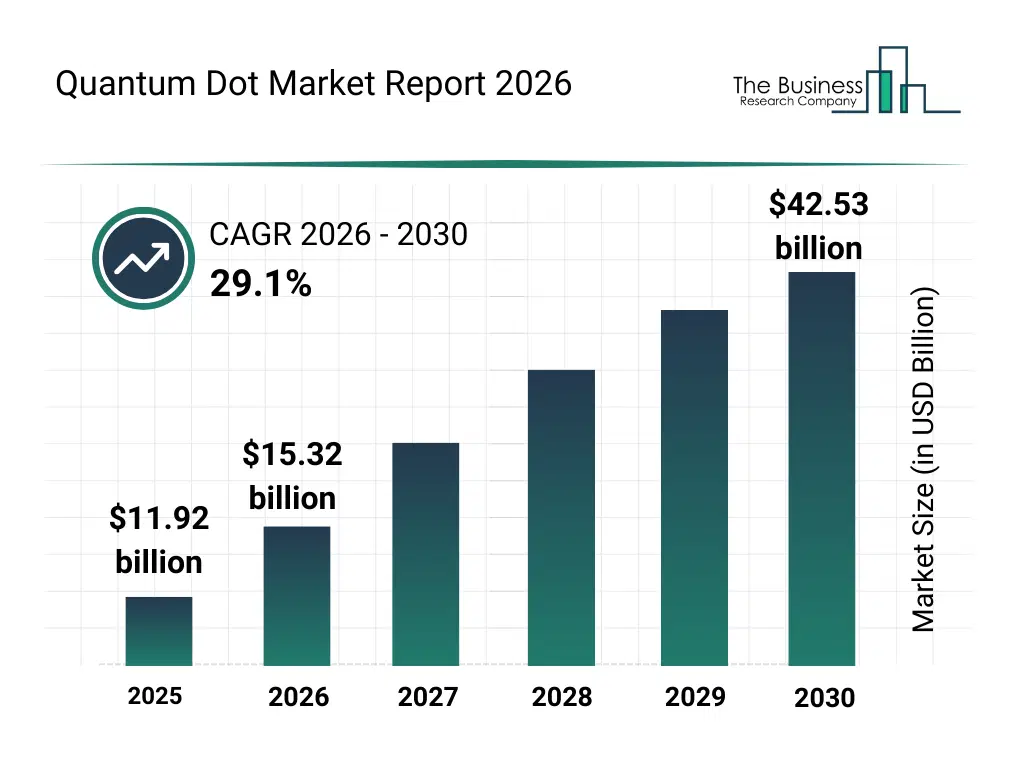
What Is The Quantum Dot Market Size 2026 And Growth Rate?
The quantum dot market size has grown exponentially in recent years. It will grow from $11.92 billion in 2025 to $15.32 billion in 2026 at a compound annual growth rate (CAGR) of 28.5%. The growth in the historic period can be attributed to early use in display backlighting, growth in semiconductor nanocrystal research, adoption in photodetector applications, increased utilization in solar cell development, reliance on laboratory-scale quantum synthesis.What Is The Quantum Dot Market Growth Forecast?
The quantum dot market size is expected to see exponential growth in the next few years. It will grow to $42.53 billion in 2030 at a compound annual growth rate (CAGR) of 29.1%. The growth in the forecast period can be attributed to rising demand for ultra-high-definition displays, expansion of quantum dot medical imaging, development of quantum-based energy storage, growth in optical communication applications, increasing use of eco-friendly cadmium-free quantum dots. Major trends in the forecast period include advancement of quantum dot display manufacturing, expansion of automated nanomaterial production, development of ar/vr-enabled quantum imaging, integration of AI-based quantum optimization, growth of sustainable quantum material processing.
Global Quantum Dot Market Segmentation
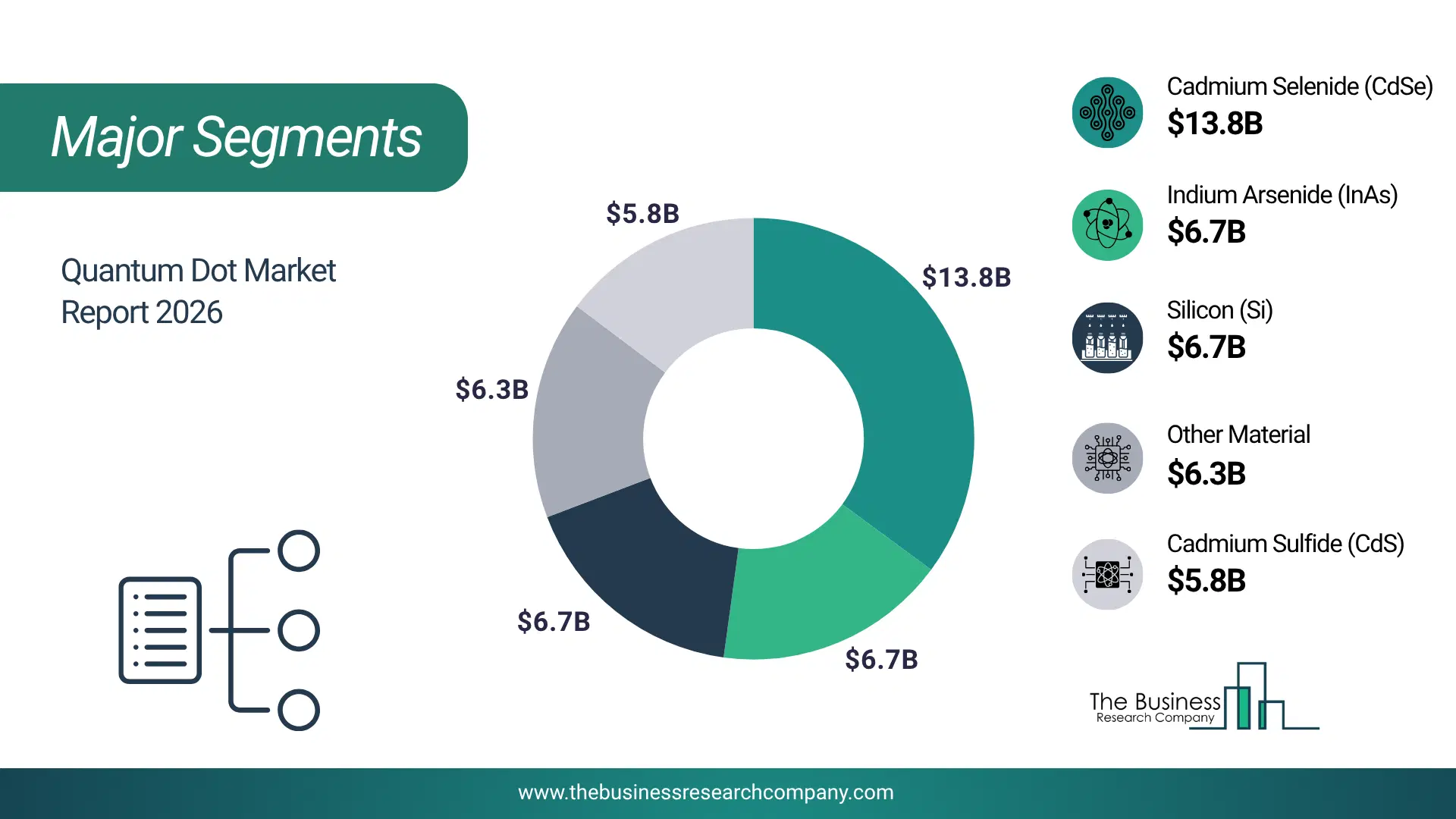
1) By Material: Cadmium Selenide (CdSe), Cadmium Sulfide (CdS), Cadmium Telluride (CdTe), Indium Arsenide (InAs), Silicon (Si), Other Material 2) By Vertical: Consumer, Commercial, Telecommunications, Healthcare, Defense, Other Verticals 3) By Application: Medical Devices, Displays, Solar Cells, Photodetectors Sensors, Lasers, LED Lights, Batteries & Energy Storage Systems, Transistors, Other Applications Subsegments: 1) By Cadmium Selenide (CdSe): Nanocrystals, Nanoparticles 2) By Cadmium Sulfide (CdS): Quantum Dots, Thin Films 3) By Cadmium Telluride (CdTe): Quantum Dots, Thin Films 4) By Indium Arsenide (InAs): Quantum Dots, Nanowires 5) By Silicon (Si): Quantum Dots, Nanocrystals 6) By Other Materials: Lead Sulfide (PbS) Quantum Dots, Lead Selenide (PbSe) Quantum Dots, Other Emerging Quantum Dots The top segments in the quantum dot market will be: • Cadmium Selenide (CdSe) will reach $13.78 billion by 2030. • Indium Arsenide (InAs) will reach $6.62 billion by 2030. • Silicon (Si) will reach $6.62 billion by 2030. • Other Material will reach $6.21 billion by 2030. • Cadmium Sulfide (CdS) will reach $5.72 billion by 2030.What Is The Driver Of The Quantum Dot Market?
Rising demand for consumer electronics is expected to boost the growth of the quantum dots market. Consumer electronics refers to any electronic product designed for daily, non-commercial, or professional use by consumers. Consumer electronics are increasingly incorporating quantum dots, which are tiny semiconductor particles that emit light at specific wavelengths, resulting in brighter and more vibrant colors. Quantum dots enhance consumer electronics by improving display quality with brighter colors, higher contrast, and energy efficiency, enabling manufacturers to offer more vivid and immersive viewing experiences. For instance, in November 2024, according to the Mobility Report of Ericsson, a Sweden-based telecommunications company, global smartphone subscriptions reached approximately 6,930 million in 2023 and increased to about 7,130 million by the end of 2024. Therefore, rising demand for consumer electronics is driving the growth of the quantum dot industry.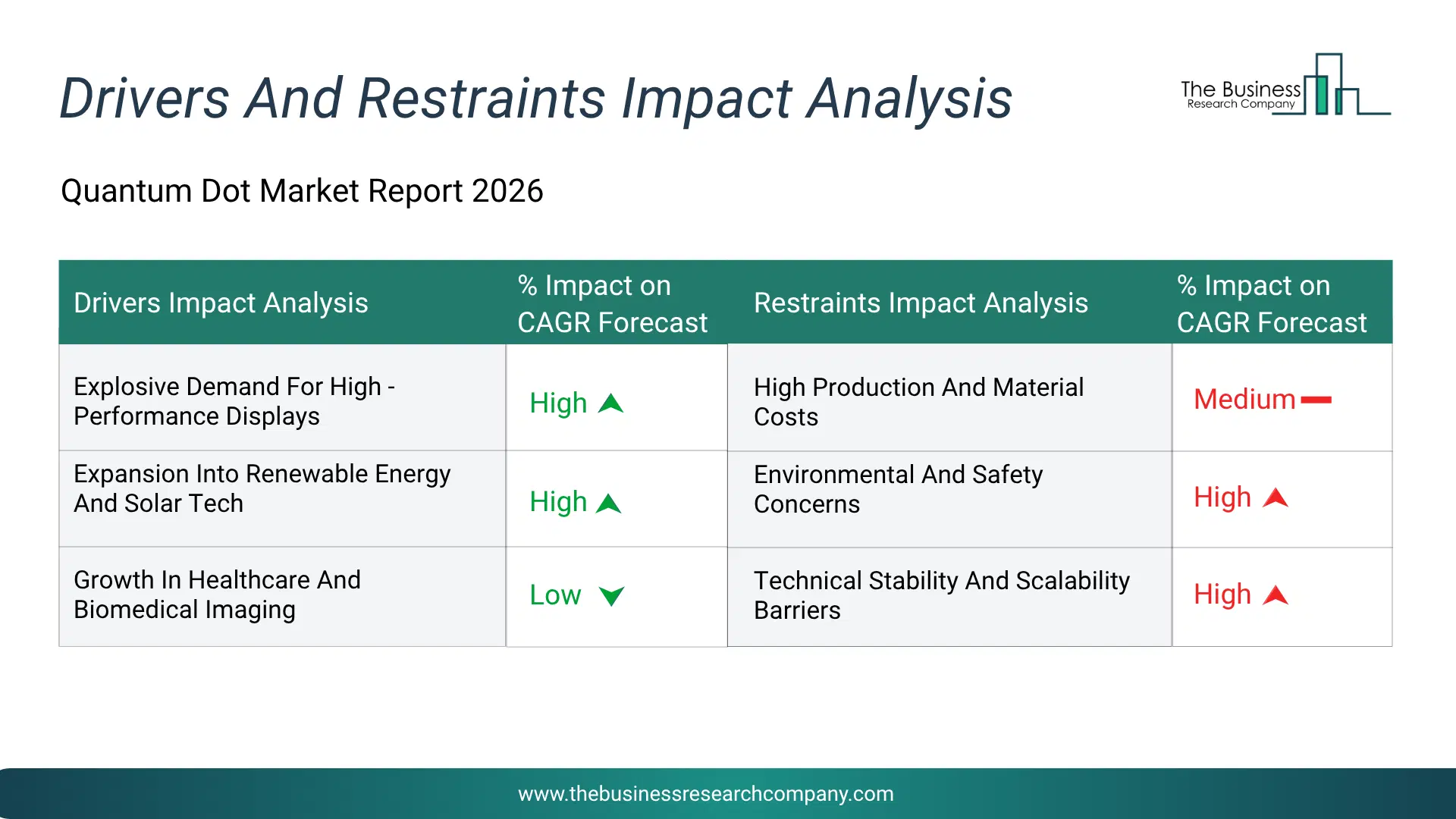
Infographic Chart Showing Key Market Drivers Analysis And Restraints For Quantum Dot Market
The chart presents an impact analysis of key drivers and restraints, quantifying their relative influence on the market's growth rate and helping assess the balance between growth enablers and limiting factors. This chart offers a high-level perspective; the full report contains more detailed insights.
How Will The Drivers Impact Growth In The Global Quantum Dot Market?
• Explosive Demand For High -Performance Displays (High) – During the forecast period, the explosive demand for high -performance displays is expected to become a key growth driver for the quantum dot market by 2030. Quantum dots are increasingly critical in next generation display technologies, particularly qled and quantum dot enhanced lcd panels, due to their ability to deliver high brightness, wider color gamut, improved contrast, and lower energy consumption relative to traditional displays. This demand is driven by consumer preferences for premium tvs, monitors, laptops, and mobile devices with ultra -high definition (4k or 8k) quality. Leading electronics manufacturers are rapidly integrating quantum dot films and filters, making display adoption one of the largest and most impactful growth vectors for the market. • Expansion Into Renewable Energy And Solar Tech (High) – During the forecast period, the expansion into renewable energy and solar tech is expected to emerge as a major factor driving the expansion of the quantum dot market by 2030. Quantum dot materials are increasingly being researched and deployed in solar cells and photovoltaic technologies due to their broad light absorption, tunable bandgap properties, and potential to boost energy conversion efficiency. With global emphasis on clean energy solutions, the integration of quantum dots in next generation solar panels offers a significant new use case that complements consumer electronics. This renewable energy application is expected to become a strategic growth pillar for the market over the next decade. • Growth In Healthcare And Biomedical Imaging (Low) – During the forecast period, the growth in healthcare and biomedical imaging is expected to act as a key growth catalyst for the quantum dot market by 2030. The optical properties of quantum dots, such as tunable emission wavelengths, high photostability, and brightness, make them strong candidates for cutting edge biomedical applications like bio imaging, targeted drug delivery, diagnostics, and medical sensing. This sector’s expansion provides diversification beyond consumer electronics and lighting, enabling adoption in high growth healthcare markets. Investments in precision medicine and advanced diagnostics are increasingly channelling quantum dot technology into clinical research and commercial use.How Will The Restraints Impact Growth In The Global Quantum Dot Market?
• High Production And Material Costs (Medium) – During the forecast period, the producing quantum dots remains cost intensive due to complex synthesis processes, expensive precursors (like indium, cadmium, selenium), and precision manufacturing requirements. These high costs limit scalability and can suppress adoption, especially in price sensitive segments or regions with lower average selling prices for consumer devices. Until cost effective production methods are widely commercialized, this restraint will continue to dampen growth potential. • Environmental And Safety Concerns (High) – During the forecast period, the many traditional quantum dots still rely on cadmium or other heavy metals, which pose environmental and health hazards. Regulatory restrictions in key markets (europe, north america) have tightened, compelling manufacturers to shift toward cadmium free alternatives. Although this transition is ultimately positive, it introduces additional r and d costs, development delays, and performance trade offs, thereby slowing market acceleration in certain segments. • Technical Stability And Scalability Barriers (High) – During the forecast period, the quantum dot materials can face stability issues, such as performance degradation under moisture, heat, or oxygen exposure, which complicates integration into long life electronic or industrial products. Furthermore, maintaining consistent quality in mass production (size uniformity, optical properties) remains a manufacturing challenge. These technical hurdles can limit commercialization and deter wider adoption, particularly in applications demanding robust reliability.Key Players In The Global Quantum Dot Market
Major companies operating in the quantum dot market are Crystalplex Corporation, InVisage Technologies, LG Display Co. Ltd., Nanoco Group plc, NanoPhotonica Inc., Nanosys Inc., Navillum Nanotechnologies, Nexxus Lighting Inc., NN-Labs LLC, Ocean NanoTech, Osram Licht AG, QD Laser Inc., Quantum Materials Corp., Samsung Electronics Co. Ltd., Sony Corporation, Merck Group, Nano Elements Source LLC, Techinstro and Intelligent Materials Private Limited, Silicofeller, Thermo Fisher Scientific Inc.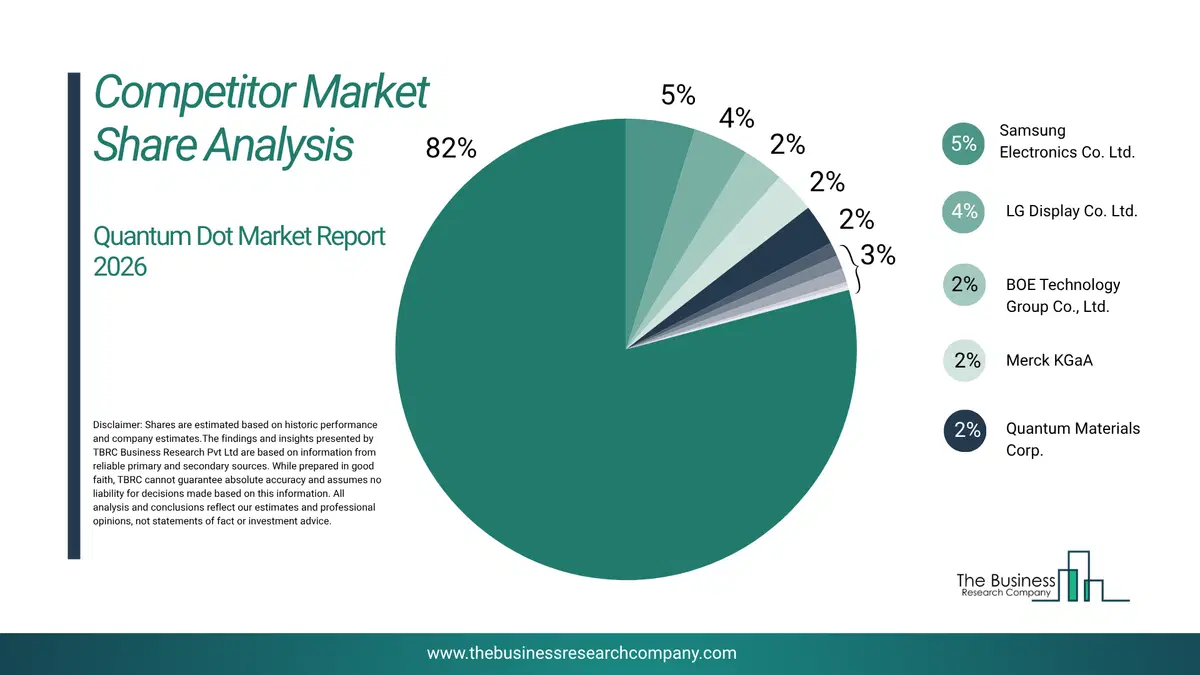
This chart is for illustrative purposes; the full report includes a detailed competitor analysis and comprehensive overview of the top 10 companies in the market.
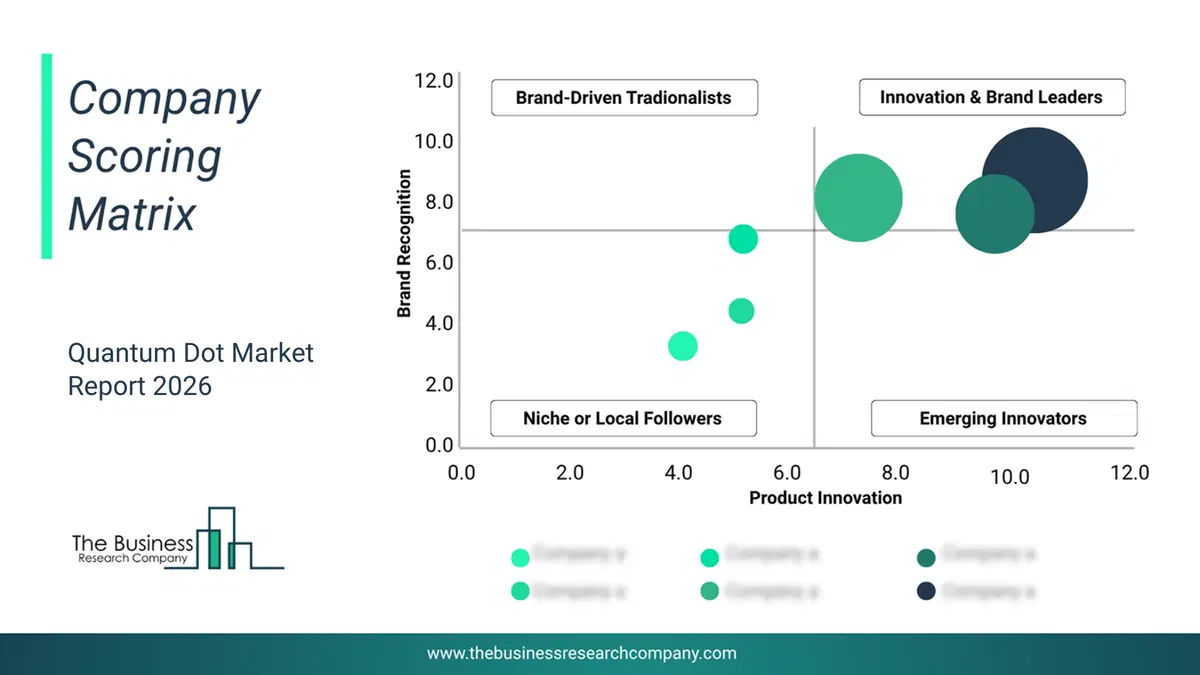
This chart maps companies by product innovation and brand strength, with bubble size indicating relative revenue, helping identify market leaders, challengers, and niche players. This is an illustrative chart; the full report provides a complete and accurate competitive analysis.
Global Quantum Dot Market Trends and Insights
Major companies operating in the quantum dots market are developing strategic partnerships to work together on a new generation of low-cost solution-printed microLED and quantum dot materials for advanced displays. A strategic partnership is a collaborative relationship between two or more commercial enterprises, typically formalized by one or more business contracts. For instance, in January 2024, Mojo Vision, a U.S.-based display-technology company, launched a single-panel RGB microLED display with proprietary quantum-dot integration. The innovation features red and green sub-pixels based on 1.3 µm-diameter quantum dots and blue sub-pixels as native microLEDs of 1.3 µm diameter, and it is built on a scalable 200-/300-mm wafer process aimed at wearable and smart-glasses applications.What Are Latest Mergers And Acquisitions In The Quantum Dot Market?
In September 2023, Shoei Chemical, Inc., a Japanese-based advanced materials manufacturer, acquired all the assets associated with the Nanosys quantum dot business for an undisclosed amount. This acquisition is expected to strengthen its position as a key player in the advanced materials industry. Nanosys is a US-based nanotechnology company.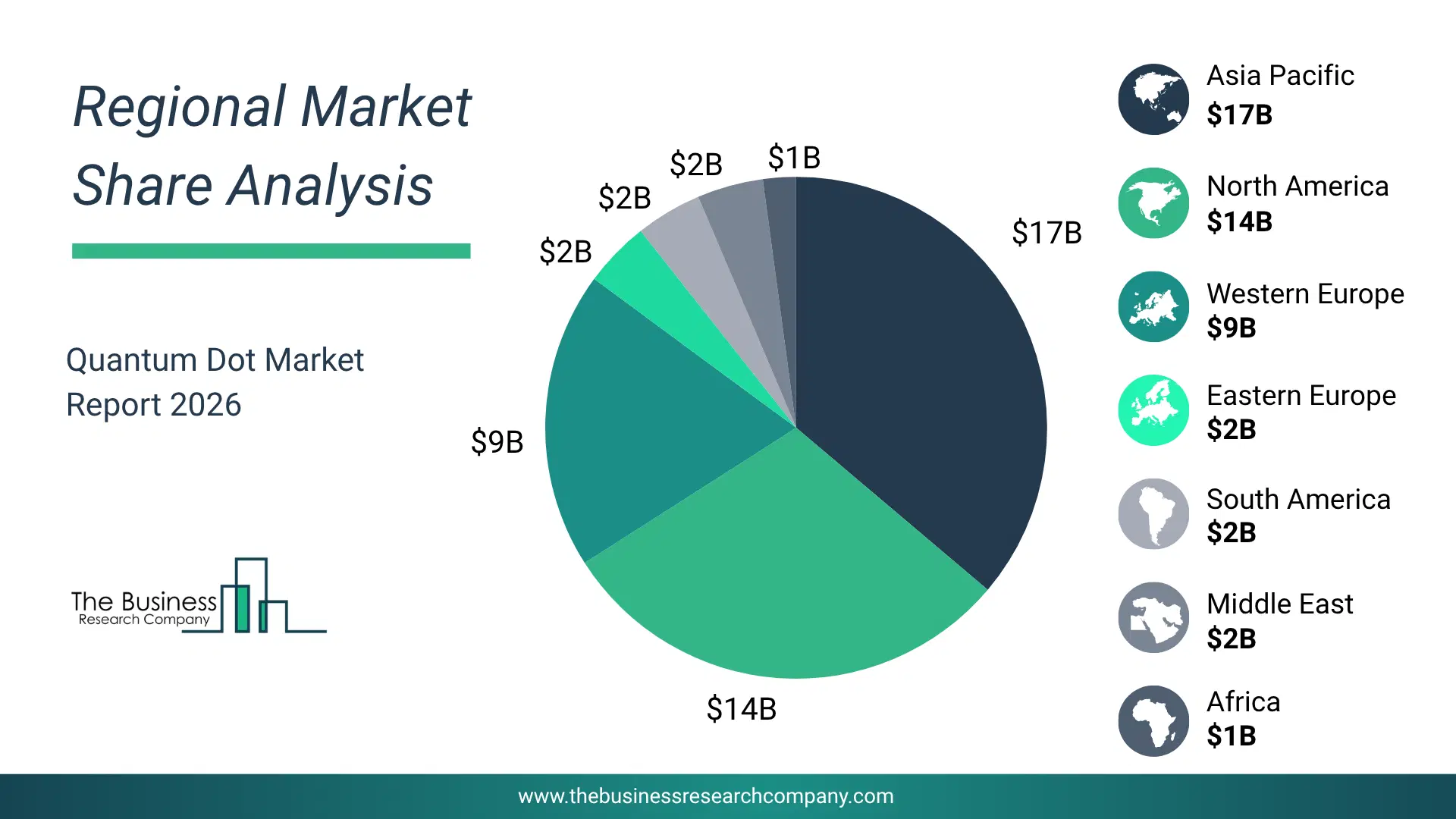
Regional Outlook
North America was the largest region in the quantum dots market in 2025. Asia-Pacific is expected to be the fastest growing region in the quantum dots market share. The regions covered in this market report are Asia-Pacific, South East Asia, Western Europe, Eastern Europe, North America, South America, Middle East, Africa. The countries covered in this market report are Australia, Brazil, China, France, Germany, India, Indonesia, Japan, Taiwan, Russia, South Korea, UK, USA, Canada, Italy, Spain.What Defines the Quantum Dot Market?
The quantum dots market consists of sales of cadmium selenide (CdSe) quantum dots, cadmium sulfide (CdS) quantum dots, silicon (Si) quantum dots, indium arsenide (InAs) quantum dots, and other quantum dots. Values in this market are ‘factory gate’ values, that is the value of goods sold by the manufacturers or creators of the goods, whether to other entities (including downstream manufacturers, wholesalers, distributors and retailers) or directly to end customers. The value of goods in this market includes related services sold by the creators of the goods.How is Market Value Defined and Measured?
The market value is defined as the revenues that enterprises gain from the sale of goods and/or services within the specified market and geography through sales, grants, or donations in terms of the currency (in USD unless otherwise specified). The revenues for a specified geography are consumption values that are revenues generated by organizations in the specified geography within the market, irrespective of where they are produced. It does not include revenues from resales along the supply chain, either further along the supply chain or as part of other products.
This chart presents market attractiveness based on a quantitative evaluation of growth, competition, strategic alignment, and risk, offering a clear view of opportunity areas for decision-making. This chart is for illustrative purposes; the full report contains the complete analysis.

This chart highlights the Total Addressable Market (TAM) by estimating the maximum revenue opportunity using an assumption-driven approach, supporting strategic planning and opportunity sizing across markets. The chart is illustrative; the full report provides a more comprehensive analysis.
What Key Data and Analysis Are Included in the Quantum Dot Market Report 2026?
The quantum dot market research report is one of a series of new reports from The Business Research Company that provides market statistics, including industry global market size, regional shares, competitors with the market share, detailed market segments, market trends and opportunities, and any further data you may need to thrive in the quantum dot industry. The market research report delivers a complete perspective of everything you need, with an in-depth analysis of the current and future state of the industry.Quantum Dot Market Report 2026 Market Report Forecast Analysis
| Report Attribute | Details |
|---|---|
| Market Size Value In 2026 | $15.32 billion |
| Revenue Forecast In 2030 | $42.53 billion |
| Growth Rate | CAGR of 29.1% from 2026 to 2030 |
| Base Year For Estimation | 2025 |
| Actual Estimates/Historical Data | 2020-2025 |
| Forecast Period | 2026 - 2030 |
| Market Representation | Revenue in USD Billion and CAGR from 2026 to 2030 |
| Segments Covered | Material, Vertical, Application |
| Regional Scope | Asia-Pacific, Western Europe, Eastern Europe, North America, South America, Middle East, Africa |
| Country Scope | The countries covered in the report are Australia, Brazil, China, France, Germany, India, ... |
| Key Companies Profiled | Crystalplex Corporation, InVisage Technologies, LG Display Co. Ltd., Nanoco Group plc, NanoPhotonica Inc., Nanosys Inc., Navillum Nanotechnologies, Nexxus Lighting Inc., NN-Labs LLC, Ocean NanoTech, Osram Licht AG, QD Laser Inc., Quantum Materials Corp., Samsung Electronics Co. Ltd., Sony Corporation, Merck Group, Nano Elements Source LLC, Techinstro and Intelligent Materials Private Limited, Silicofeller, Thermo Fisher Scientific Inc. |
| Customization Scope | Request for Customization |
| Pricing And Purchase Options | Explore Purchase Options |