
Quantum Photonics Market Report 2026
Global Outlook – By Component (Systems, Services), By Application (Quantum Communication, Quantum Sensing And Metrology, Quantum Computing), By End-Use (Space Research, Government And Defense, Telecommunication, Healthcare And Pharmaceutical, Transportation And Logistics, Environment) – Market Size, Trends, Strategies, and Forecast to 2030
Quantum Photonics Market Overview
• Quantum Photonics market size has reached to $0.79 billion in 2025 • Expected to grow to $3.32 billion in 2030 at a compound annual growth rate (CAGR) of 32.3% • Growth Driver: The Impact Of Growing Medical Imaging And Diagnostics On The Quantum Photonics Market • Market Trend: Advancements in Next-Generation Quantum Photonic Chip Technologies • North America was the largest region in 2025 and Asia-Pacific is the fastest growing region.What Is Covered Under Quantum Photonics Market?
Quantum photonics refers to the field of study and application that combines quantum mechanics with photonics, the science and technology of generating, manipulating, and detecting photons, the fundamental particles of light. Photons encode, process, and transmit quantum information in quantum photonics. The main components of quantum photonics are systems and services. Quantum photonics system refers to the hardware and software solutions required to deploy quantum technologies. It is used for various applications including quantum communication, quantum sensing and metrology, and quantum computing by space research, government and defense, telecommunication, healthcare and pharmaceutical, transportation and logistics, and environment end users.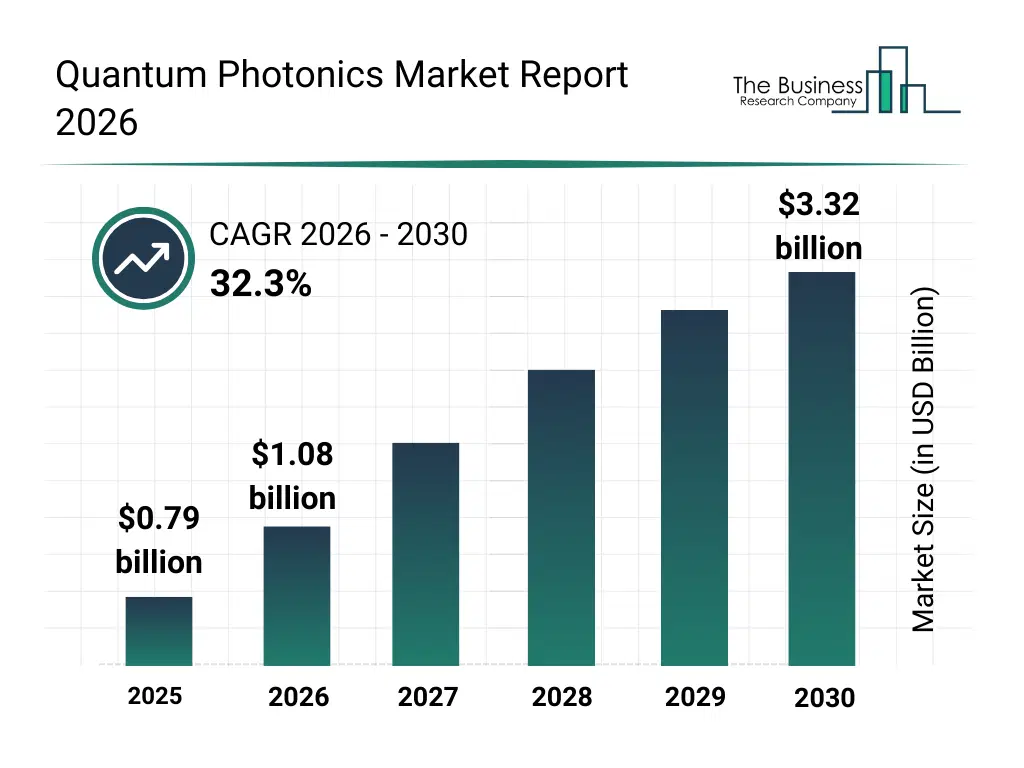
What Is The Quantum Photonics Market Size and Share 2026?
The quantum photonics market size has grown exponentially in recent years. It will grow from $0.79 billion in 2025 to $1.08 billion in 2026 at a compound annual growth rate (CAGR) of 36.4%. The growth in the historic period can be attributed to advancements in photonic chip fabrication, early adoption of quantum optics technologies, government-backed photonics research programs, growth in telecom optical infrastructure, increased demand for precision sensing.What Is The Quantum Photonics Market Growth Forecast?
The quantum photonics market size is expected to see exponential growth in the next few years. It will grow to $3.32 billion in 2030 at a compound annual growth rate (CAGR) of 32.3%. The growth in the forecast period can be attributed to increasing investments in photonic quantum computing, expansion of quantum communication networks, rising demand for quantum sensing in navigation and metrology, growing defense and space applications, continued miniaturization of photonic components. Major trends in the forecast period include increasing integration of photonic quantum processors, rising deployment of quantum communication systems, growing adoption of integrated photonics platforms, expansion of quantum sensing applications, enhanced focus on scalable photonic architectures.
Global Quantum Photonics Market Segmentation
1) By Component: Systems, Services 2) By Application: Quantum Communication, Quantum Sensing And Metrology, Quantum Computing 3) By End-Use: Space Research, Government And Defense, Telecommunication, Healthcare And Pharmaceutical, Transportation And Logistics, Environment Subsegments: 1) By Systems: Quantum Light Sources (Single-Photon Sources, Entangled Photon Sources), Quantum Photodetectors, Quantum Communication Systems (Quantum Key Distribution Systems), Quantum Imaging Systems, Quantum Sensors (For Metrology, Navigation), Integrated Quantum Photonics Systems, Photonic Quantum Processors 2) By Services: Quantum Photonics Consulting Services, Quantum Photonics System Integration, Quantum Research And Development Services, Quantum Network Design And Optimization Services, Testing And Calibration Services For Quantum PhotonicsWhat Is The Driver Of The Quantum Photonics Market?
The growing applications in medical imaging and diagnostics are expected to propel the growth of the quantum photonics market going forward. Medical imaging and diagnostics refer to the techniques and processes used to create images of the human body for diagnostic and treatment purposes. The increasing demand for early disease detection and precise treatment planning is leading to growing applications in medical imaging and diagnostics. Quantum photonics enhances medical imaging and diagnostics by providing higher-resolution imaging, increased sensitivity for detecting biomarkers, and the development of advanced imaging modalities, ultimately improving diagnostic accuracy and patient outcomes. For instance, in November 2023, according to National Health Service (NHS) England, an UK-based government health service, 45.0 million imaging tests were reported in the year to March 2023, compared with 44.0 million in the previous year, representing a 2.2% increase; additionally, NHS England reported 46.6 million imaging tests in the 12 months from September 2023 to August 2024, reinforcing the continued rise in diagnostic imaging activity. Therefore, the growing applications in medical imaging and diagnostics are driving the growth of the quantum photonics industry.Key Players In The Global Quantum Photonics Market
Major companies operating in the quantum photonics market are Nippon Telegraph and Telephone Corporation, IBM, Toshiba Corporation, NEC Corporation, Thorlabs Inc., PsiQuantum Corp., Xanadu, Aosense Inc., ID Quantique, ORCA Computing Limited, M Squared Lasers Limited, Nu Quantum, QuintessenceLabs Pty Ltd., Quandela, MagiQ Technologies Inc., Menlo Systems, Qubitekk Inc., QuiX Quantum Holding BV, Quside Technologies, Crypta Labs Limited, Quantum Xchange Inc., Qnami, Quantopticon Ltd., Nu Quantum
This chart is for illustrative purposes; the full report includes a detailed competitor analysis and comprehensive overview of the top 10 companies in the market.
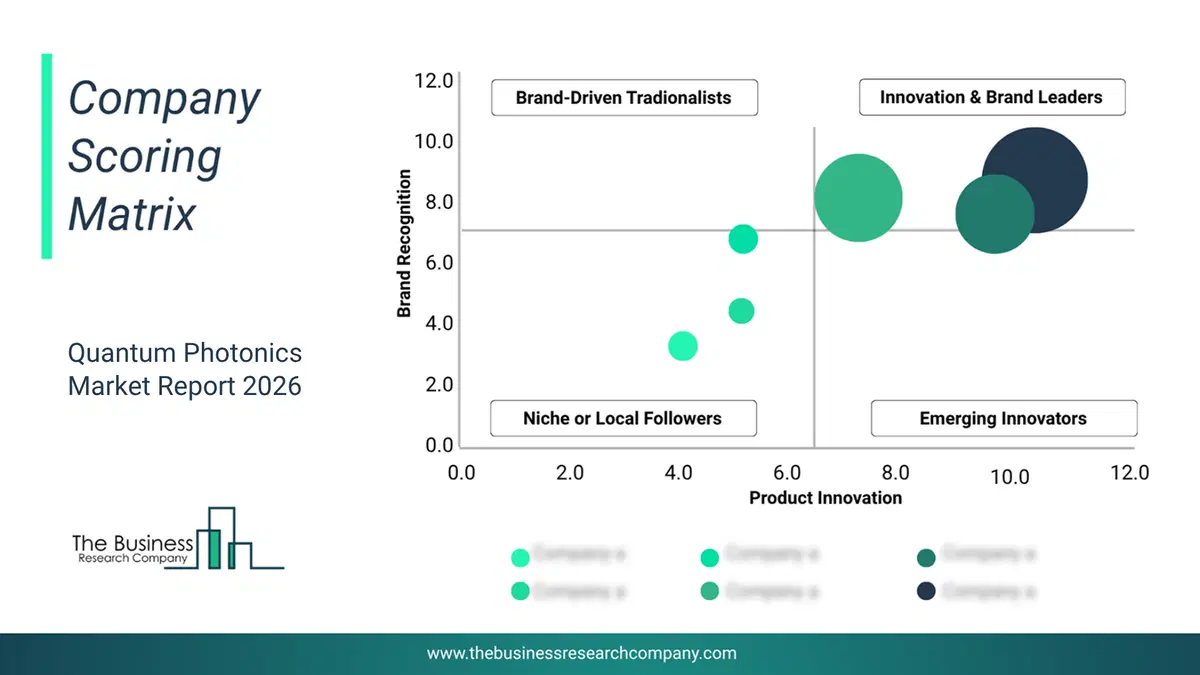
This chart maps companies by product innovation and brand strength, with bubble size indicating relative revenue, helping identify market leaders, challengers, and niche players. This is an illustrative chart; the full report provides a complete and accurate competitive analysis.
Global Quantum Photonics Market Trends and Insights
Major companies operating in the quantum photonics market are focusing on developing advanced technologies such as, next generation photonic chip technologies to enhance quantum processing capabilities, increase qubit stability, and accelerate the commercialization of quantum systems. These next-generation photonic chips are designed to improve photon manipulation, strengthen multi-qubit entanglement performance, and support scalable quantum architectures for computing and sensing applications. For instance, in November 2024, the Electronics and Telecommunications Research Institute (ETRI), a South-Korea-based information, communications, and electronics technologies company, unveiled an 8-photon qubit photonic integrated-circuit chip, capable of controlling eight photons and demonstrating 6-qubit entanglement, marking a significant advancement in integrated photonic quantum platforms.What Are Latest Mergers And Acquisitions In The Quantum Photonics Market?
In January 2024, Infleqtion, a US-based company developing quantum-enabled products, acquired SiNoptiq Inc. and Morton Photonics Inc. for an undisclosed amount. These acquisitions accelerate Infleqtion's initiatives for chip-scale integration of lasers and photonic and atomic systems. This advancement is crucial for the commercialization of quantum products, including sensors and quantum computers. SiNoptiq is a US-based company developing silicon photonics. Morton Photonics is a US-based company that specializes in developing advanced silicon photonics-based components and sub-system technologies.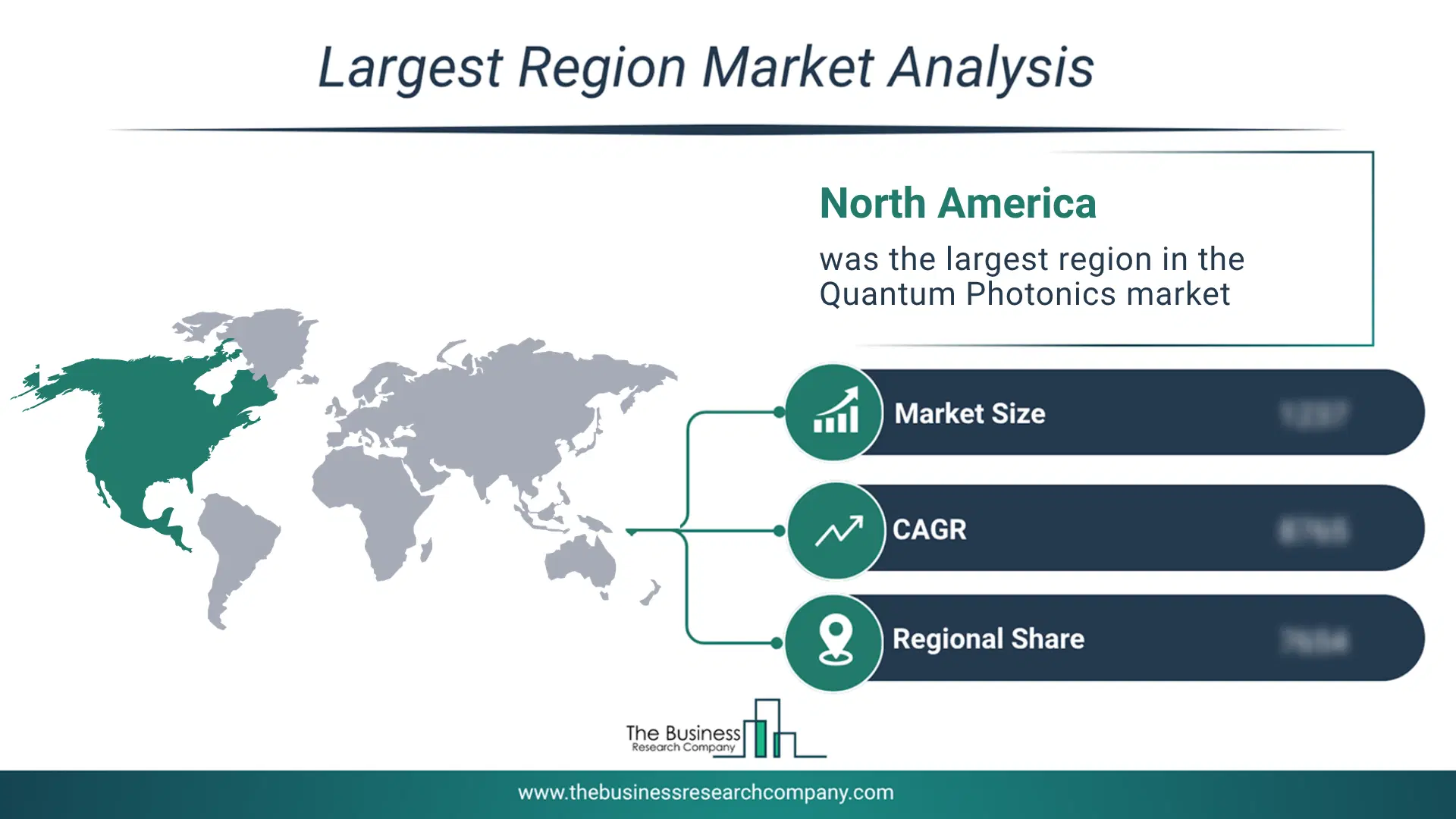
Regional Insights
North America was the largest region in the quantum photonics market in 2025. Asia-Pacific is expected to be the fastest-growing region in the forecast period. The regions covered in this market report are Asia-Pacific, South East Asia, Western Europe, Eastern Europe, North America, South America, Middle East, Africa. The countries covered in this market report are Australia, Brazil, China, France, Germany, India, Indonesia, Japan, Taiwan, Russia, South Korea, UK, USA, Canada, Italy, Spain.What Defines the Quantum Photonics Market?
The quantum photonics market consists of revenues earned by entities by providing services such as consulting, research and development, system integration, testing, certification, training, maintenance, cloud access, security, application development, and quantum network services. The market value includes the value of related goods sold by the service provider or included within the service offering. The quantum photonics market also includes sales of quantum computers, quantum sensors, quantum communication devices, quantum key distribution systems, single-photon sources, quantum memories, and quantum simulators. Values in this market are ‘factory gate’ values, that is the value of goods sold by the manufacturers or creators of the goods, whether to other entities (including downstream manufacturers, wholesalers, distributors and retailers) or directly to end customers. The value of goods in this market includes related services sold by the creators of the goods.How is Market Value Defined and Measured?
The market value is defined as the revenues that enterprises gain from the sale of goods and/or services within the specified market and geography through sales, grants, or donations in terms of the currency (in USD unless otherwise specified). The revenues for a specified geography are consumption values that are revenues generated by organizations in the specified geography within the market, irrespective of where they are produced. It does not include revenues from resales along the supply chain, either further along the supply chain or as part of other products.
This chart presents market attractiveness based on a quantitative evaluation of growth, competition, strategic alignment, and risk, offering a clear view of opportunity areas for decision-making. This chart is for illustrative purposes; the full report contains the complete analysis.

This chart highlights the Total Addressable Market (TAM) by estimating the maximum revenue opportunity using an assumption-driven approach, supporting strategic planning and opportunity sizing across markets. The chart is illustrative; the full report provides a more comprehensive analysis.
What Key Data and Analysis Are Included in the Quantum Photonics Market Report 2026?
The quantum photonics market research report is one of a series of new reports from The Business Research Company that provides market statistics, including industry global market size, regional shares, competitors with the market share, detailed market segments, market trends and opportunities, and any further data you may need to thrive in the quantum photonics industry. The market research report delivers a complete perspective of everything you need, with an in-depth analysis of the current and future state of the industry.Quantum Photonics Market Report Forecast Analysis
| Report Attribute | Details |
|---|---|
| Market Size Value In 2026 | $1.08 billion |
| Revenue Forecast In 2030 | $3.32 billion |
| Growth Rate | CAGR of 32.3% from 2026 to 2030 |
| Base Year For Estimation | 2025 |
| Actual Estimates/Historical Data | 2020-2025 |
| Forecast Period | 2026 - 2030 |
| Market Representation | Revenue in USD Billion and CAGR from 2026 to 2030 |
| Segments Covered | Component, Application, End-Use |
| Regional Scope | Asia-Pacific, Western Europe, Eastern Europe, North America, South America, Middle East, Africa |
| Country Scope | The Countries Covered In This Market Report Are Australia, Brazil, China, France, Germany, India, Indonesia, Japan, Taiwan, Russia, South Korea, Uk, Usa, Canada, Italy, Spain. |
| Key Companies Profiled | Nippon Telegraph and Telephone Corporation, IBM, Toshiba Corporation, NEC Corporation, Thorlabs Inc., PsiQuantum Corp., Xanadu, Aosense Inc., ID Quantique, ORCA Computing Limited, M Squared Lasers Limited, Nu Quantum, QuintessenceLabs Pty Ltd., Quandela, MagiQ Technologies Inc., Menlo Systems, Qubitekk Inc., QuiX Quantum Holding BV, Quside Technologies, Crypta Labs Limited, Quantum Xchange Inc., Qnami, Quantopticon Ltd., Nu Quantum |
| Customization Scope | Request for Customization |
| Pricing And Purchase Options | Explore Purchase Options |