
Quantum-Resistant Firmware Over-The-Air Market Report 2026
Global Outlook – By Security Algorithm (Lattice-Based Cryptography, Multivariate Cryptography, Hash-Based Cryptography, Code-Based Cryptography, Other Security Algorithms), By Device Type (Smartphones, Connected Vehicles, Industrial Equipment, Wearables, Other Device Types), By Deployment Mode (On-Premises, Cloud-Based), By Application (Automotive, Consumer Electronics, Industrial Internet Of Things (IoT), Healthcare, Aerospace And Defense, Other Applications), By End-User (Original Equipment Manufacturer (OEMs), Service Providers, Enterprises, Other End-Users) – Market Size, Trends, Strategies, and Forecast to 2030
Quantum-Resistant Firmware Over-The-Air Market Overview
• Quantum-Resistant Firmware Over-The-Air market size has reached to $1.76 billion in 2025 • Expected to grow to $7.58 billion in 2030 at a compound annual growth rate (CAGR) of 33.9% • Growth Driver: Rising Cybersecurity Risks Driving The Growth Of The Market Due To Growing Need For Secure Device Updates • Market Trend: Safeguarding Confidential Information With AES 256-Bit Acceleration • North America was the largest region in 2025 and Asia-Pacific is the fastest growing region.What Is Covered Under Quantum-Resistant Firmware Over-The-Air Market?
Quantum-resistant firmware over-the-air is a way to update a device’s software wirelessly to keep it safe from new, powerful computers. It helps protect devices from future hacking threats. The updates happen automatically without needing to connect the device with cables. This keeps devices secure and working well over time. The main security algorithms of quantum-resistant firmware over-the-air (FOTA) are lattice-based cryptography, multivariate cryptography, hash-based cryptography, code-based cryptography, and others. Lattice-based cryptography refers to an advanced post-quantum security method that leverages the complexity of lattice mathematical problems to safeguard firmware updates transmitted wirelessly, ensuring resistance against quantum computing threats. These solutions are applied across device types such as smartphones, connected vehicles, industrial equipment, wearables, and others, and are deployed in on-premises and cloud-based modes. Key applications span automotive, consumer electronics, industrial IoT, healthcare, aerospace and defense, and others, with end-users including original equipment manufacturers (OEMs), service providers, enterprises, and others.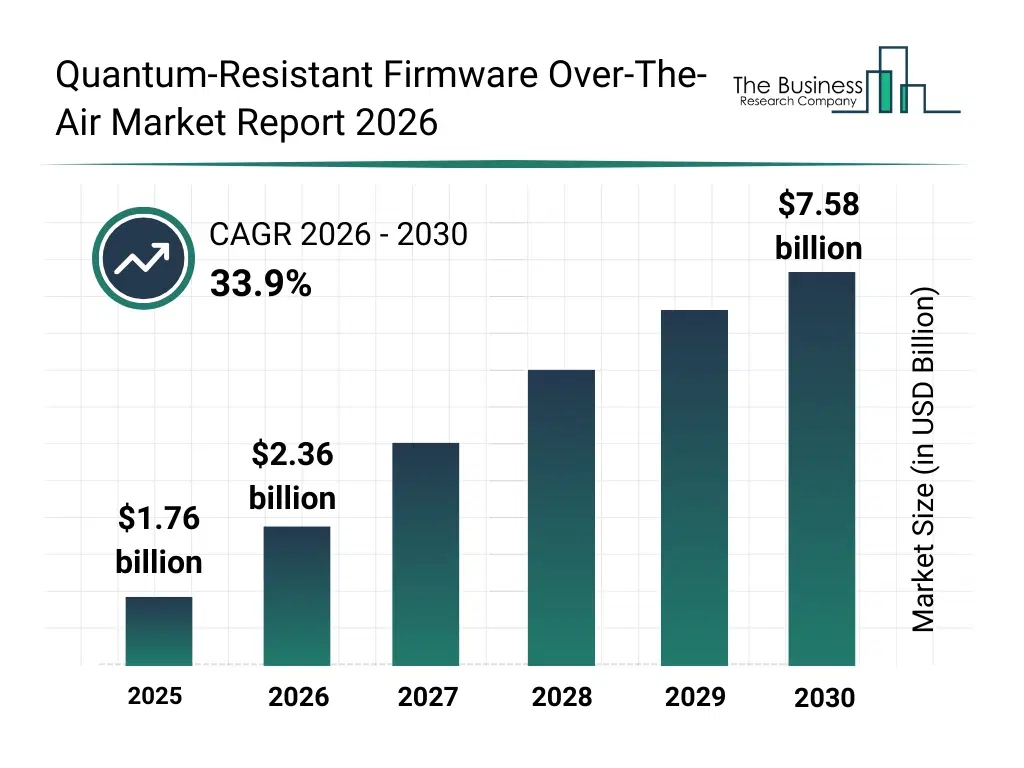
What Is The Quantum-Resistant Firmware Over-The-Air Market Size and Share 2026?
The quantum-resistant firmware over-the-air market size has grown exponentially in recent years. It will grow from $1.76 billion in 2025 to $2.36 billion in 2026 at a compound annual growth rate (CAGR) of 34.2%. The growth in the historic period can be attributed to growth in connected devices, increasing firmware security vulnerabilities, adoption of ota update mechanisms, expansion of iot ecosystems, rising cybersecurity threats.What Is The Quantum-Resistant Firmware Over-The-Air Market Growth Forecast?
The quantum-resistant firmware over-the-air market size is expected to see exponential growth in the next few years. It will grow to $7.58 billion in 2030 at a compound annual growth rate (CAGR) of 33.9%. The growth in the forecast period can be attributed to emergence of quantum computing threats, demand for post-quantum cryptography, growth of connected vehicles and smart devices, stricter security regulations, increasing focus on long-term device security. Major trends in the forecast period include quantum-resistant firmware authentication, secure over-the-air update automation, post-quantum cryptographic key management, resilient device lifecycle security, scalable firmware update infrastructure.
Global Quantum-Resistant Firmware Over-The-Air Market Segmentation
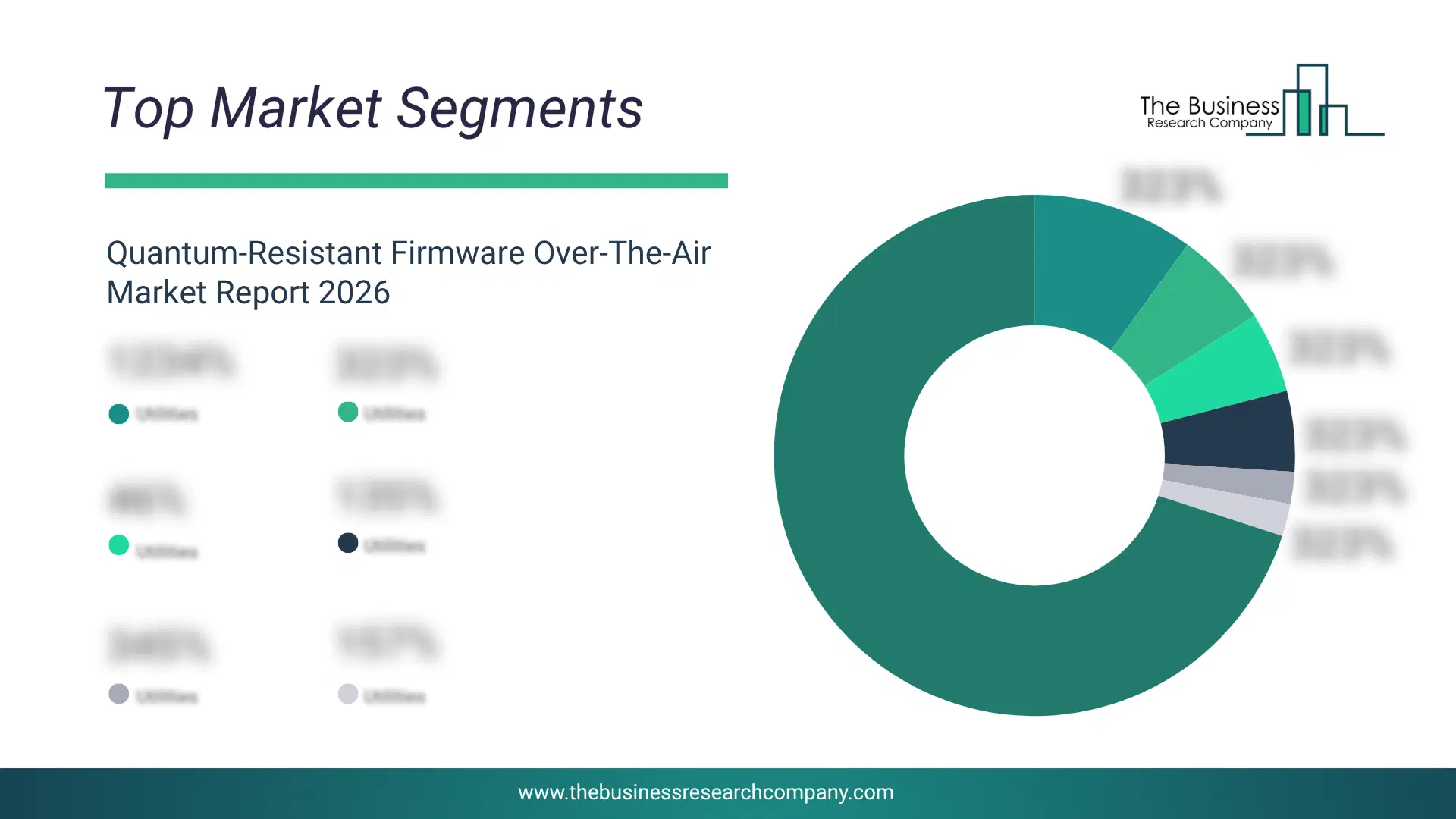
1) By Security Algorithm: Lattice-Based Cryptography, Multivariate Cryptography, Hash-Based Cryptography, Code-Based Cryptography, Other Security Algorithms 2) By Device Type: Smartphones, Connected Vehicles, Industrial Equipment, Wearables, Other Device Types 3) By Deployment Mode: On-Premises, Cloud-Based 4) By Application: Automotive, Consumer Electronics, Industrial Internet Of Things (IoT), Healthcare, Aerospace And Defense, Other Applications 5) By End-User: Original Equipment Manufacturer (OEMs), Service Providers, Enterprises, Other End-Users Subsegments: 1) By Lattice-Based Cryptography: Learning With Errors (LWE), Ring Learning With Errors (RLWE), Module Learning With Errors (MLWE), Nth-degree Truncated Polynomial Ring Units (NTRU), Short Integer Solution (SIS) 2) By Multivariate Cryptography: Unbalanced Oil and Vinegar (UOV), Rainbow Signature Scheme, Hidden Field Equations (HFE), Matsumoto-ImAI (MI) Cryptosystem 3) By Hash-Based Cryptography: Merkle Signature Scheme (MSS), Extended Merkle Signature Scheme (XMSS), Leighton-Micali Signature (LMS), SPHINCS Or SPHINCS+ 4) By Code-Based Cryptography: McEliece Cryptosystem, Niederreiter Cryptosystem, Bit Flipping Key Encapsulation (BIKE), Hamming Quasi-Cyclic (HQC) 5) By Others Security Algorithm: Isogeny-Based Cryptography, Symmetric Key Quantum-Resistant Schemes, Hybrid Post-Quantum CryptographyWhat Is The Driver Of The Quantum-Resistant Firmware Over-The-Air Market?
The increasing cybersecurity risks are expected to propel the growth of the quantum-resistant firmware over-the-air market going forward. Cybersecurity risks are the chances of someone breaking into computer systems or stealing information, which can cause harm to people or organizations. The rise in cybersecurity risks is driven by increased reliance on digital technology, as it creates more opportunities for attackers to access sensitive information. The quantum-resistant firmware over-the-air helps reduce cybersecurity risks by ensuring that device updates remain secure even against future threats from quantum computers, protecting sensitive data from being exposed or tampered with. For instance, in October 2025, according to the National Cyber Security Centre, a UK-based government agency, cyber threats in the UK are escalating, with the NCSC handling 204 nationally significant attacks in the 12 months to August 2025, up sharply from 89 in the previous year. Therefore, the increasing cybersecurity risks are driving the growth of the quantum-resistant firmware over-the-air industry.Key Players In The Global Quantum-Resistant Firmware Over-The-Air Market
Major companies operating in the quantum-resistant firmware over-the-air market are Microsoft Corporation, Samsung Electronics Co. Ltd., Huawei Technologies Co. Ltd., International Business Machines Corporation, Cisco Systems Inc., Honeywell International Inc., Qualcomm Technologies Inc., Thales Group, STMicroelectronics N.V., Infineon Technologies AG, Enova Technology Ltd, Post‑Quantum Ltd., DigiCert Inc., QNu Labs Private Limited, Kudelski IoT SA, Crypto Quantique Ltd., zeroRISC Ltd., Arqit Quantum Inc., QuantiCor Security GmbH, ResQuant GmbH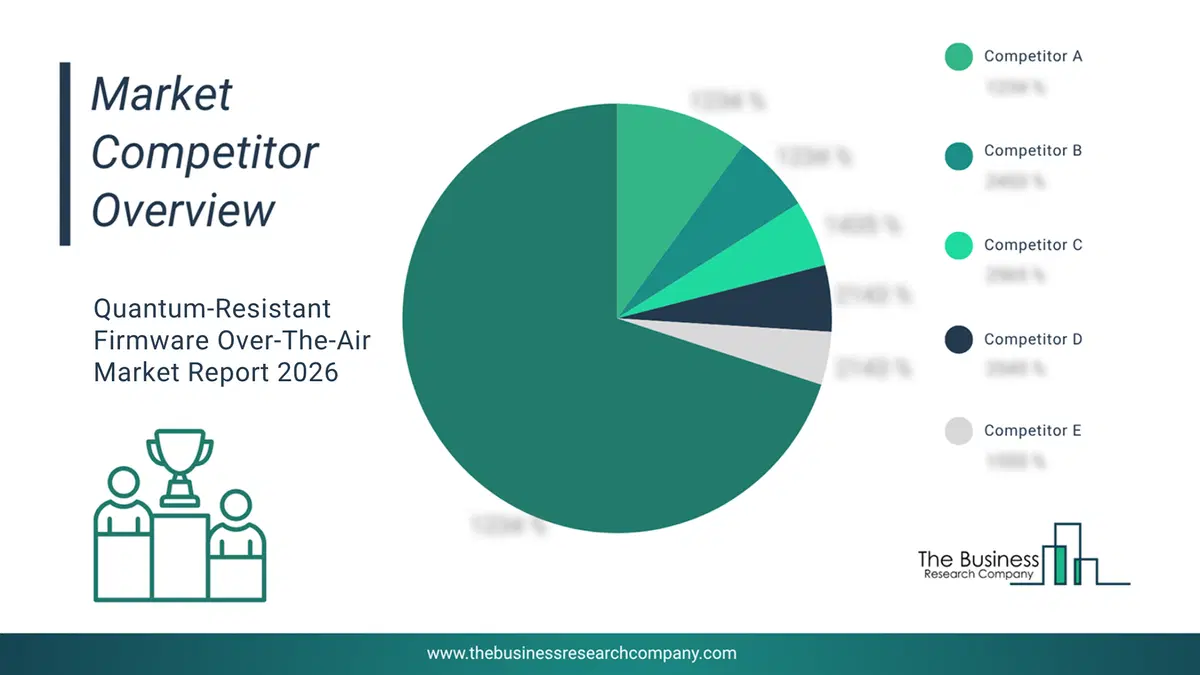
This chart is for illustrative purposes; the full report includes a detailed competitor analysis and comprehensive overview of the top 10 companies in the market.
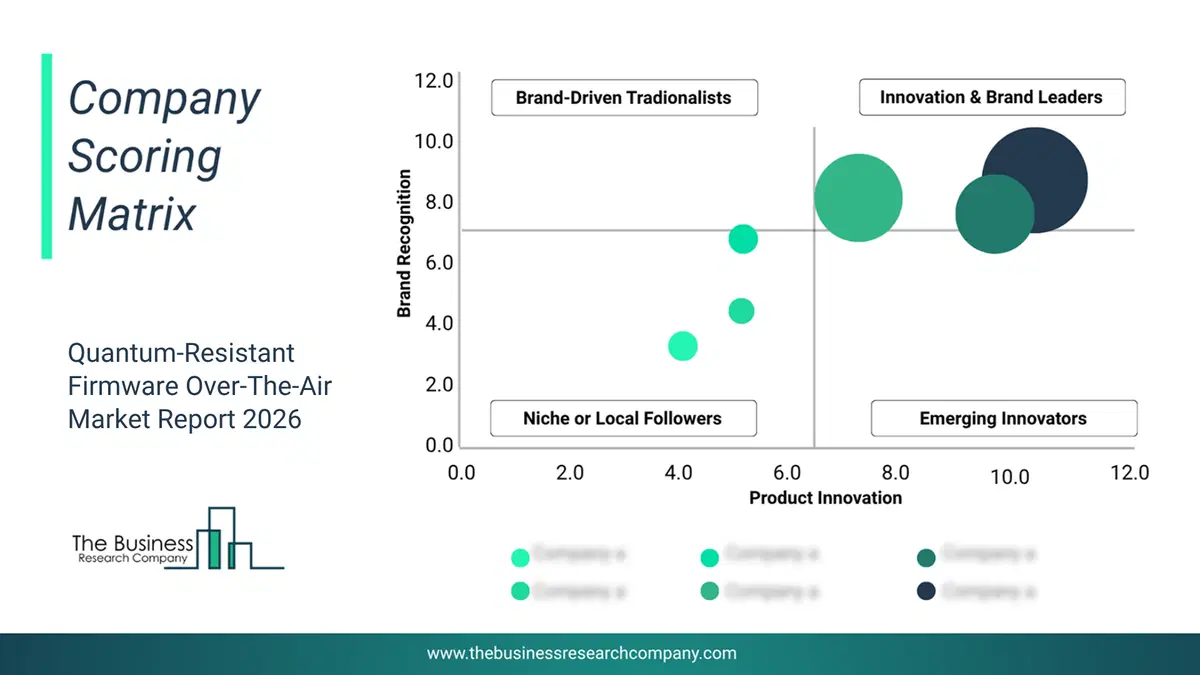
This chart maps companies by product innovation and brand strength, with bubble size indicating relative revenue, helping identify market leaders, challengers, and niche players. This is an illustrative chart; the full report provides a complete and accurate competitive analysis.
Global Quantum-Resistant Firmware Over-The-Air Market Trends and Insights
Major companies in the quantum-resistant firmware over-the-air market are focusing on developing technological advancements such as quantum-resistant single-chip solutions to enhance device security, ensure future-proof data protection, and support seamless secure updates against evolving cyber threats. A quantum-resistant single-chip solution refers to an integrated hardware platform designed with post-quantum cryptographic algorithms to safeguard data and communications against potential threats posed by quantum computing. For instance, in December 2023, Enova Technology Ltd., a Taiwan-based provider of hardware-based encryption and security solutions, launched its Quantum Resistant (QR) Digital Signature Algorithm (DSA) solution, powered by the FIPS 140-2 Level 3 certified single-chip crypto module X-Wall MX+ xF/QR. The solution utilizes stateful hash-based eXtended Merkle Signature Scheme (XMSS) and multi-tree XMSS (XMSSMT) DSA to enhance secure user and device authentication, while the built-in AES 256-bit hardware accelerator provides advanced protection of controlled unclassified information (CUI), ensuring confidentiality and privacy.What Are Latest Mergers And Acquisitions In The Quantum-Resistant Firmware Over-The-Air Market?
In November 2023, Crypto Quantique, a UK-based cybersecurity and quantum-driven technology company, partnered with Blaitek Limited to integrate quantum-driven security into IoT device firmware. With this partnership Crypto Quantique aims to enable secure, quantum-resistant chip-to-cloud connectivity by integrating post-quantum cryptographic protocols into over-the-air firmware updates for IoT devices, thereby safeguarding smart-home ecosystems against future quantum computing threats. Blaitek Limited is a Taiwan-based IoT smart home technology company that specializes in developing quantum-resistant firmware over the air.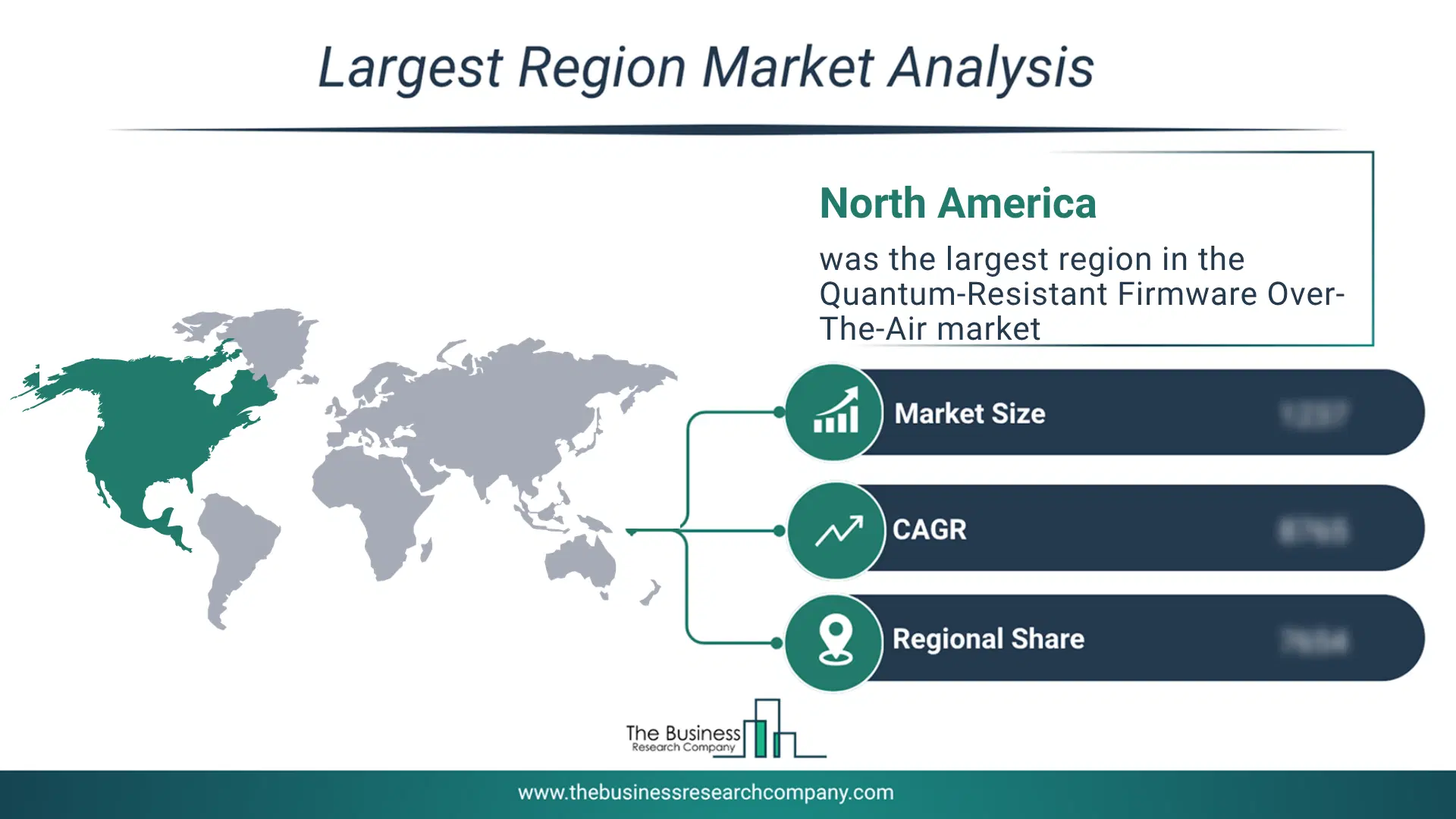
Regional Insights
North America was the largest region in the quantum-resistant firmware over-the-air market in 2025. Asia-Pacific is expected to be the fastest-growing region in the forecast period. The regions covered in this market report are Asia-Pacific, South East Asia, Western Europe, Eastern Europe, North America, South America, Middle East, Africa. The countries covered in this market report are Australia, Brazil, China, France, Germany, India, Indonesia, Japan, Taiwan, Russia, South Korea, UK, USA, Canada, Italy, Spain.What Defines the Quantum-Resistant Firmware Over-The-Air Market?
The quantum-resistant firmware over-the-air (FOTA) market consists of revenues earned by entities by providing services such as secure wireless software updates, cybersecurity protection, system monitoring, firmware management, and consulting to help devices stay safe from advanced hacking threats. The market value includes the value of related goods sold by the service provider or included within the service offering. The quantum-resistant firmware over-the-air (FOTA) market also includes sales of secure firmware update software, encryption tools, management platforms, security modules, and related hardware used to deliver and protect wireless software updates against advanced cyber threats. Values in this market are ‘factory gate’ values, that is, the value of goods sold by the manufacturers or creators of the goods, whether to other entities (including downstream manufacturers, wholesalers, distributors, and retailers) or directly to end customers. The value of goods in this market includes related services sold by the creators of the goods.How is Market Value Defined and Measured?
The market value is defined as the revenues that enterprises gain from the sale of goods and/or services within the specified market and geography through sales, grants, or donations in terms of the currency (in USD unless otherwise specified). The revenues for a specified geography are consumption values that are revenues generated by organizations in the specified geography within the market, irrespective of where they are produced. It does not include revenues from resales along the supply chain, either further along the supply chain or as part of other products.
This chart presents market attractiveness based on a quantitative evaluation of growth, competition, strategic alignment, and risk, offering a clear view of opportunity areas for decision-making. This chart is for illustrative purposes; the full report contains the complete analysis.

This chart highlights the Total Addressable Market (TAM) by estimating the maximum revenue opportunity using an assumption-driven approach, supporting strategic planning and opportunity sizing across markets. The chart is illustrative; the full report provides a more comprehensive analysis.
What Key Data and Analysis Are Included in the Quantum-Resistant Firmware Over-The-Air Market Report 2026?
The quantum-resistant firmware over-the-air market research report is one of a series of new reports from The Business Research Company that provides market statistics, including industry global market size, regional shares, competitors with the market share, detailed market segments, market trends and opportunities, and any further data you may need to thrive in the quantum-resistant firmware over-the-air industry. The market research report delivers a complete perspective of everything you need, with an in-depth analysis of the current and future state of the industry.Quantum-Resistant Firmware Over-The-Air Market Report Forecast Analysis
| Report Attribute | Details |
|---|---|
| Market Size Value In 2026 | $2.36 billion |
| Revenue Forecast In 2030 | $7.58 billion |
| Growth Rate | CAGR of 33.9% from 2026 to 2030 |
| Base Year For Estimation | 2025 |
| Actual Estimates/Historical Data | 2020-2025 |
| Forecast Period | 2026 - 2030 |
| Market Representation | Revenue in USD Billion and CAGR from 2026 to 2030 |
| Segments Covered | Security Algorithm, Device Type, Deployment Mode, Application, End-User |
| Regional Scope | Asia-Pacific, Western Europe, Eastern Europe, North America, South America, Middle East, Africa |
| Country Scope | The Countries Covered In This Market Report Are Australia, Brazil, China, France, Germany, India, Indonesia, Japan, Taiwan, Russia, South Korea, Uk, Usa, Canada, Italy, Spain. |
| Key Companies Profiled | Microsoft Corporation, Samsung Electronics Co. Ltd., Huawei Technologies Co. Ltd., International Business Machines Corporation, Cisco Systems Inc., Honeywell International Inc., Qualcomm Technologies Inc., Thales Group, STMicroelectronics N.V., Infineon Technologies AG, Enova Technology Ltd, Post‑Quantum Ltd., DigiCert Inc., QNu Labs Private Limited, Kudelski IoT SA, Crypto Quantique Ltd., zeroRISC Ltd., Arqit Quantum Inc., QuantiCor Security GmbH, ResQuant GmbH |
| Customization Scope | Request for Customization |
| Pricing And Purchase Options | Explore Purchase Options |