
Quantum-Safe Multi-Factor Authentication Market Report 2026
Global Outlook – By Component (Hardware, Software, Services), By Deployment Mode (On-Premises, Cloud), By Authentication Method (Biometric, Password-Based, Token-Based, Smart Card, Other Authentication Methods), By Organization Size (Small And Medium Enterprises, Large Enterprises), By End-User (Banking, Financial Services, And Insurance (BFSI), Healthcare, Government, Information Technology (IT) And Telecommunications, Retail, Other End-Users) – Market Size, Trends, Strategies, and Forecast to 2030
Quantum-Safe Multi-Factor Authentication Market Overview
• Quantum-Safe Multi-Factor Authentication market size has reached to $1.77 billion in 2025 • Expected to grow to $4.55 billion in 2030 at a compound annual growth rate (CAGR) of 20.7% • Growth Driver: Increasing Cyber Threats Are Driving The Growth Of The Market Due To Rising Risks To Networks And Sensitive Data • Market Trend: Advancing Enterprise Security With Quantum-Safe Professional-Grade Authentication • North America was the largest region in 2025 and Asia-Pacific is the fastest growing region.What Is Covered Under Quantum-Safe Multi-Factor Authentication Market?
Quantum-safe multi-factor authentication (MFA) is a robust security solution that secures access using multiple authentication factors alongside quantum-resistant cryptography. It protects sensitive digital assets and networks from traditional cyberattacks as well as emerging quantum-based threats. Quantum-safe multi-factor authentication integrates quantum-safe encryption and ensures that authentication remains secure even against future quantum-enabled attacks. The main types of quantum-safe multi-factor authentication components are hardware, software, and services. Hardware refers to physical devices used to enable secure authentication, such as tokens, smart cards, and biometric devices. The deployment modes are on-premises and cloud, with various authentication methods, including biometric, password-based, token-based, smart card, and others. It is used by multiple organizations of different sizes, such as small and medium enterprises (SMEs) and large enterprises, to adopt these solutions to safeguard sensitive data and key end-users such as banking, financial services, and insurance (BFSI), healthcare, government, information technology (IT) and telecommunications, retail, and others.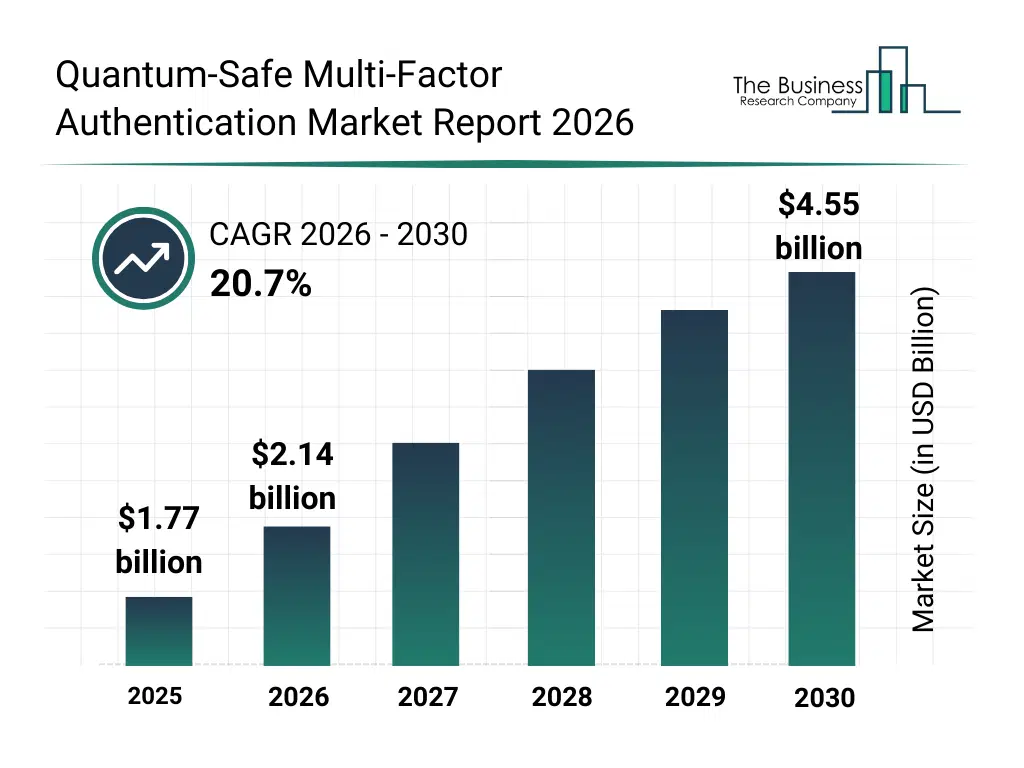
What Is The Quantum-Safe Multi-Factor Authentication Market Size and Share 2026?
The quantum-safe multi-factor authentication market size has grown exponentially in recent years. It will grow from $1.77 billion in 2025 to $2.14 billion in 2026 at a compound annual growth rate (CAGR) of 21.0%. The growth in the historic period can be attributed to increasing cyber threats targeting sensitive data, adoption of multi-factor authentication in enterprises, growth of digital banking and financial services, demand for secure identity and access management, regulatory compliance requirements for authentication.What Is The Quantum-Safe Multi-Factor Authentication Market Growth Forecast?
The quantum-safe multi-factor authentication market size is expected to see exponential growth in the next few years. It will grow to $4.55 billion in 2030 at a compound annual growth rate (CAGR) of 20.7%. The growth in the forecast period can be attributed to emergence of quantum computing threats, rising adoption of post-quantum cryptography, expansion of cloud-based authentication solutions, increasing need for secure remote access, integration of AI-driven identity verification and monitoring. Major trends in the forecast period include quantum-safe multi-factor authentication deployment, post-quantum cryptography integration, risk-based authentication enhancements, biometric security solutions adoption, secure token and smart card management.
Global Quantum-Safe Multi-Factor Authentication Market Segmentation
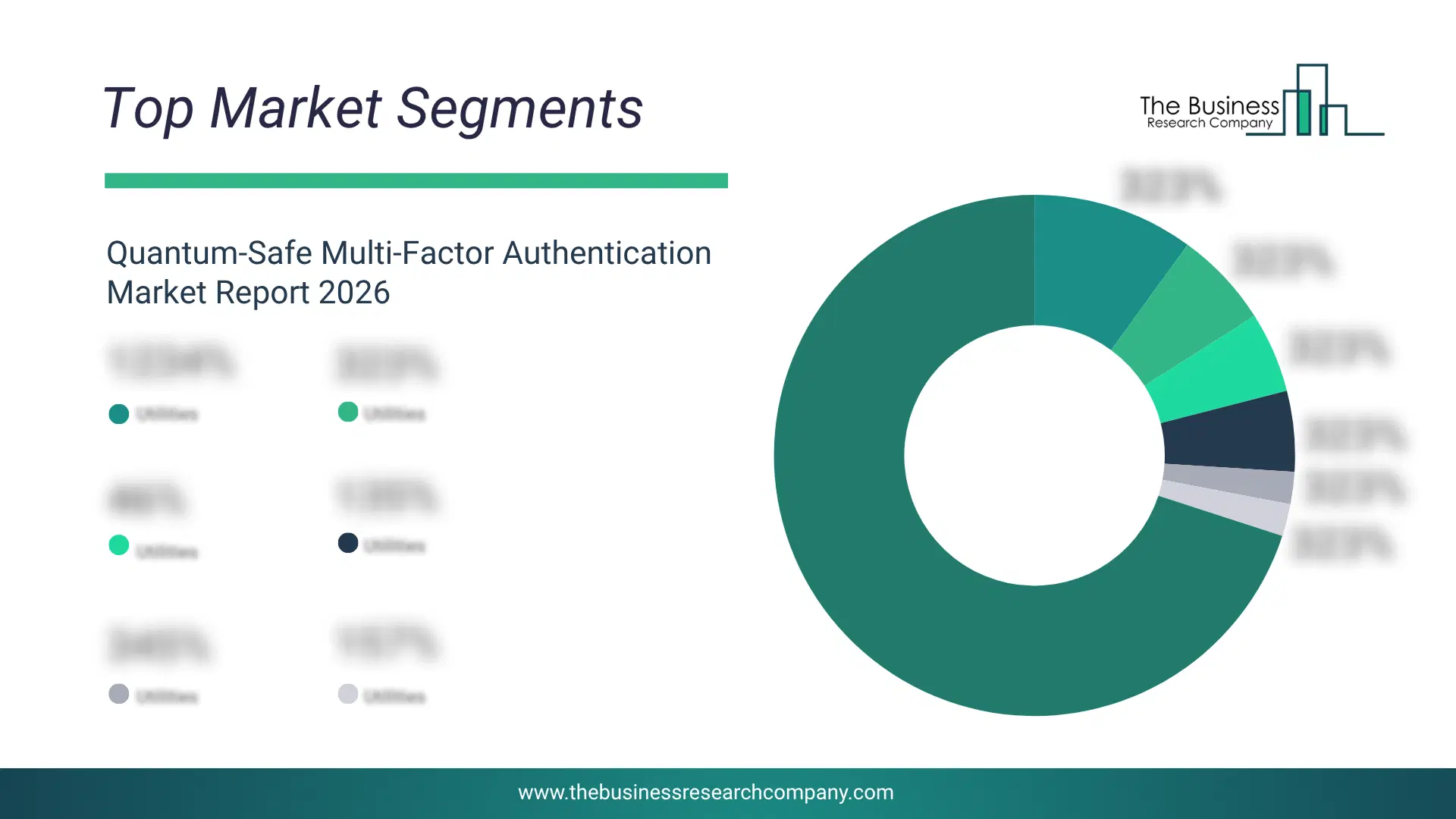
1) By Component: Hardware, Software, Services 2) By Deployment Mode: On-Premises, Cloud 3) By Authentication Method: Biometric, Password-Based, Token-Based, Smart Card, Other Authentication Methods 4) By Organization Size: Small And Medium Enterprises, Large Enterprises 5) By End-User: Banking, Financial Services, And Insurance (BFSI), Healthcare, Government, Information Technology (IT) And Telecommunications, Retail, Other End-Users Subsegments: 1) By Hardware: Security Tokens, Smart Cards, Biometric Devices, Universal Serial Bus (USB) Authentication Keys 2) By Software: Authentication Management Software, Identity And Access Management (IAM) Solutions, Mobile Authentication Applications, Risk-Based Authentication Software 3) By Services: Consulting Services, Integration Services, Managed Security Services, Training And Support ServicesWhat Is The Driver Of The Quantum-Safe Multi-Factor Authentication Market?
The increasing cyber threats are expected to propel the growth of quantum-safe multi-factor authentication market going forward. Cyber threats are malicious actions or tools that aim to steal, damage, or disrupt computer systems, networks, or data. Cyber threats are rising due to the rapid increase in internet-connected devices, which expands the attack surface and provides more opportunities for malicious actors to exploit vulnerabilities, making networks and systems more susceptible to breaches and attacks. Quantum-safe multi-factor authentication reduces cyber threats by employing quantum-resistant cryptography to safeguard sensitive data from future attacks while integrating multiple verification factors to block unauthorized access and provide strong protection for digital identities and critical systems across networks. For instance, in October 2025, according to the National Cyber Security Centre, a UK-based government agency, cyber threats in the UK are escalating, with the NCSC handling 204 nationally significant attacks in the 12 months to August 2025, up sharply from 89 in the previous year. Therefore, the increasing cyber threats are driving the growth of the quantum-safe multi-factor authentication industry.Key Players In The Global Quantum-Safe Multi-Factor Authentication Market
Major companies operating in the quantum-safe multi-factor authentication market are Microsoft Corporation, International Business Machines Corporation (IBM), Thales S.A., Infineon Technologies AG, Kudelski SA, Entrust Corporation, OneSpan Inc., MagTek Inc., Futurex Inc., SEALSQ Corporation, QuintessenceLabs Pty Ltd, SSH Communications Security Oyj, Wultra s.r.o., evolutionQ Inc., Qusecure Ltd, PQShield Ltd, Cryptonext Security SAS, Post-Quantum Ltd, Crypto Quantique Ltd, Quantum Xchange LLC.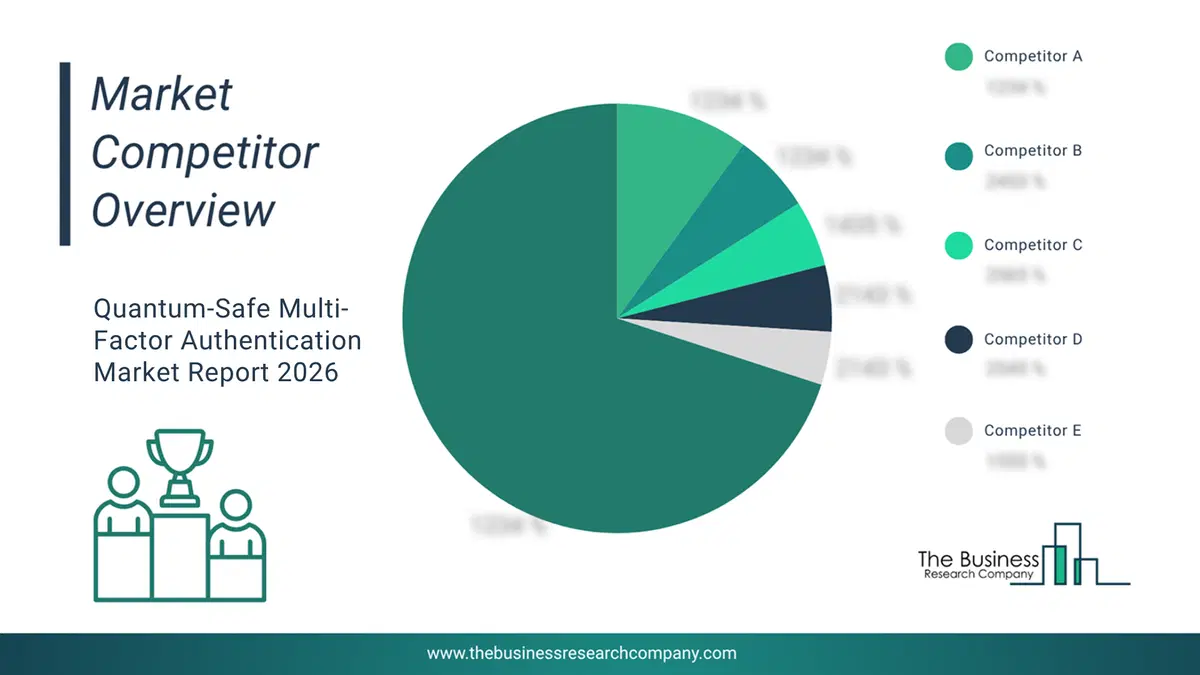
This chart is for illustrative purposes; the full report includes a detailed competitor analysis and comprehensive overview of the top 10 companies in the market.
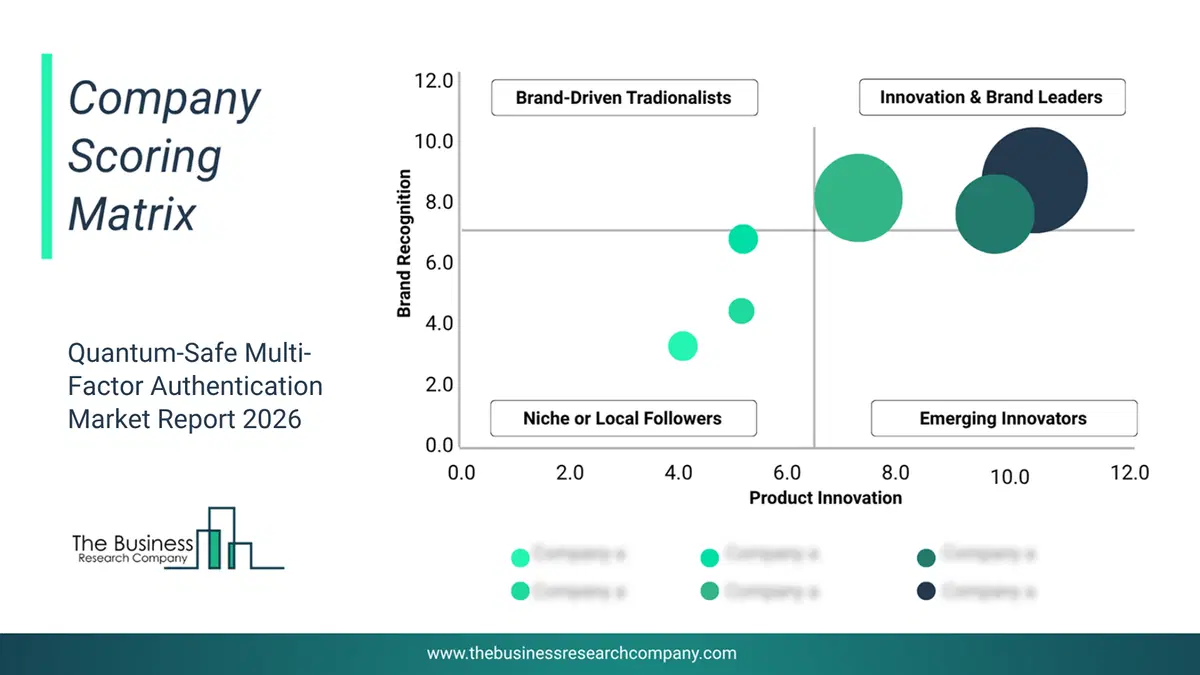
This chart maps companies by product innovation and brand strength, with bubble size indicating relative revenue, helping identify market leaders, challengers, and niche players. This is an illustrative chart; the full report provides a complete and accurate competitive analysis.
Global Quantum-Safe Multi-Factor Authentication Market Trends and Insights
Major companies operating in the quantum-safe multi-factor authentication market are focusing on developing advanced solutions, such as professional-grade authentication methods, to ensure robust security against emerging cyber threats. A professional-grade authentication method is a high-security system for enterprise or critical applications that integrates multiple factors to block unauthorized access while utilizing advanced technologies such as quantum-resistant cryptography, AI analytics, and hardware-based security to provide robust and scalable protection for sensitive digital assets. For instance, in September 2023, Google LLC, a US-based technology company, developed quantum-safe security keys as part of its cloud key management service (Cloud KMS). It is a professional-grade authentication method introducing quantum-safe digital signatures compliant with the National Institute of Standards and Technology (NIST) post-quantum cryptography standards (FIPS 204 and FIPS 205). This innovation aims to protect data against future quantum computing threats that could break current encryption methods, enabling enterprises to test and integrate quantum-resistant cryptographic signatures today. Google’s approach includes software and hardware support, migration paths for existing keys, and open-source implementations to ensure transparency and a secure transition to quantum-safe encryption.What Are Latest Mergers And Acquisitions In The Quantum-Safe Multi-Factor Authentication Market?
In November 2024, SEALSQ Corp., a Switzerland-based provider of post-quantum cryptography (PQC) hardware and software products, collaborated with WISeKey International Holding Ltd. to empower a secure, human-centric digital world through AI-driven cybersecurity. The partnership aims to integrate AI into post-quantum semiconductors and predictive IoT solutions, enhancing cybersecurity, protecting digital identities, and ensuring secure operations across global networks. WISeKey International Holding Ltd. is a Switzerland-based provider of cybersecurity, digital identity, and IoT solutions platforms.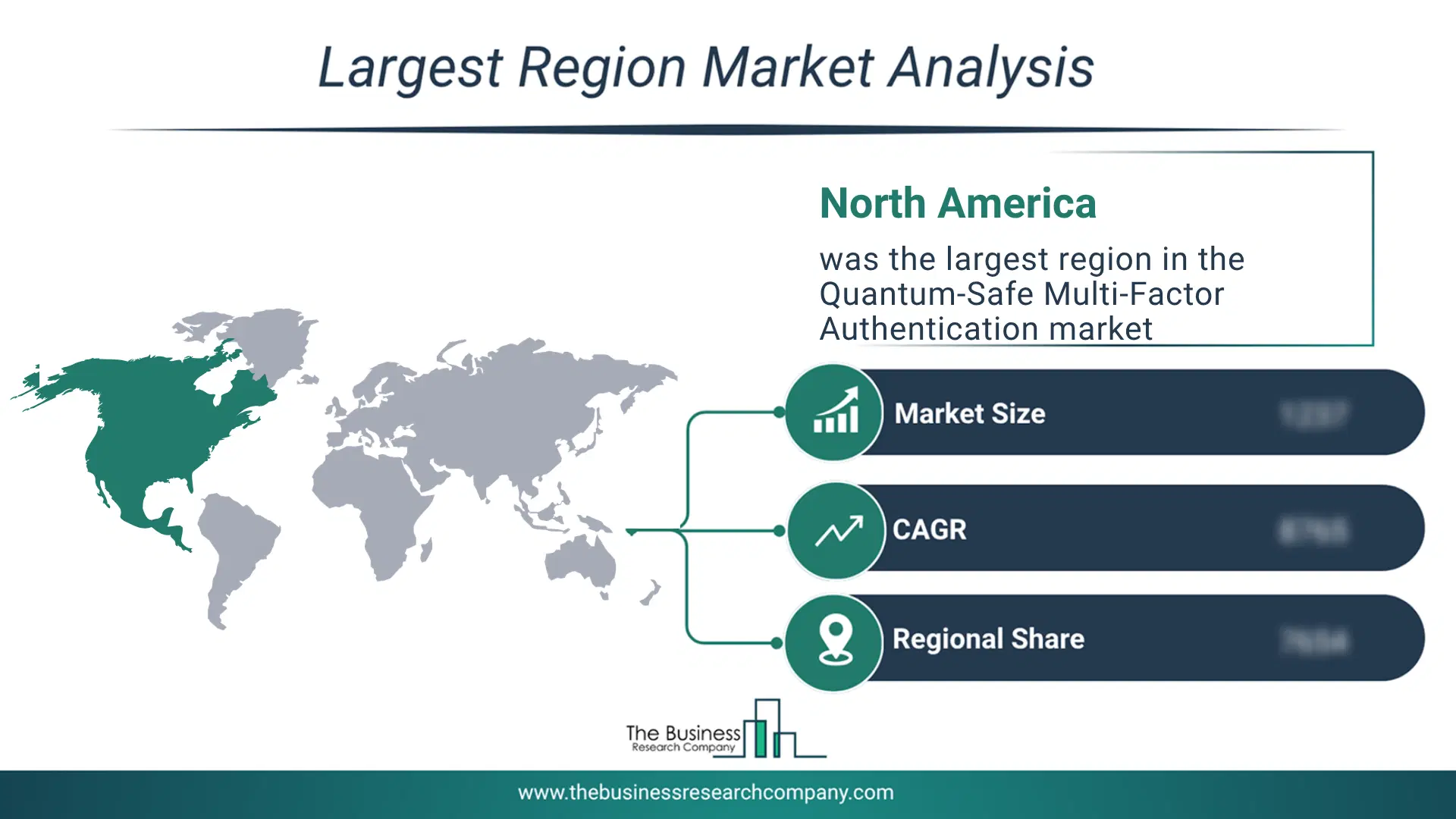
Regional Insights
North America was the largest region in the quantum-safe multi-factor authentication market in 2025. Asia-Pacific is expected to be the fastest-growing region in the forecast period. The regions covered in this market report are Asia-Pacific, South East Asia, Western Europe, Eastern Europe, North America, South America, Middle East, Africa. The countries covered in this market report are Australia, Brazil, China, France, Germany, India, Indonesia, Japan, Taiwan, Russia, South Korea, UK, USA, Canada, Italy, Spain.What Defines the Quantum-Safe Multi-Factor Authentication Market?
The quantum-safe multi-factor authentication market consists of revenues earned by entities by providing services such as biometric authentication, push notification authentication, managed security services, and identity and access management. The market value includes the value of related goods sold by the service provider or included within the service offering. The quantum-safe multi-factor authentication market also includes sales of hardware security modules, trusted platform modules, one-time password (OTP) generators, and mobile hardware tokens. Values in this market are ‘factory gate’ values, that is, the value of goods sold by the manufacturers or creators of the goods, whether to other entities (including downstream manufacturers, wholesalers, distributors, and retailers) or directly to end customers. The value of goods in this market includes related services sold by the creators of the goods.How is Market Value Defined and Measured?
The market value is defined as the revenues that enterprises gain from the sale of goods and/or services within the specified market and geography through sales, grants, or donations in terms of the currency (in USD unless otherwise specified). The revenues for a specified geography are consumption values that are revenues generated by organizations in the specified geography within the market, irrespective of where they are produced. It does not include revenues from resales along the supply chain, either further along the supply chain or as part of other products.
This chart presents market attractiveness based on a quantitative evaluation of growth, competition, strategic alignment, and risk, offering a clear view of opportunity areas for decision-making. This chart is for illustrative purposes; the full report contains the complete analysis.

This chart highlights the Total Addressable Market (TAM) by estimating the maximum revenue opportunity using an assumption-driven approach, supporting strategic planning and opportunity sizing across markets. The chart is illustrative; the full report provides a more comprehensive analysis.
What Key Data and Analysis Are Included in the Quantum-Safe Multi-Factor Authentication Market Report 2026?
The quantum-safe multi-factor authentication market research report is one of a series of new reports from The Business Research Company that provides market statistics, including industry global market size, regional shares, competitors with the market share, detailed market segments, market trends and opportunities, and any further data you may need to thrive in the quantum-safe multi-factor authentication industry. The market research report delivers a complete perspective of everything you need, with an in-depth analysis of the current and future state of the industry.Quantum-Safe Multi-Factor Authentication Market Report Forecast Analysis
| Report Attribute | Details |
|---|---|
| Market Size Value In 2026 | $2.14 billion |
| Revenue Forecast In 2030 | $4.55 billion |
| Growth Rate | CAGR of 20.7% from 2026 to 2030 |
| Base Year For Estimation | 2025 |
| Actual Estimates/Historical Data | 2020-2025 |
| Forecast Period | 2026 - 2030 |
| Market Representation | Revenue in USD Billion and CAGR from 2026 to 2030 |
| Segments Covered | Component, Deployment Mode, Authentication Method, Organization Size, End-User |
| Regional Scope | Asia-Pacific, Western Europe, Eastern Europe, North America, South America, Middle East, Africa |
| Country Scope | The Countries Covered In This Market Report Are Australia, Brazil, China, France, Germany, India, Indonesia, Japan, Taiwan, Russia, South Korea, Uk, Usa, Canada, Italy, Spain. |
| Key Companies Profiled | Microsoft Corporation, International Business Machines Corporation (IBM), Thales S.A., Infineon Technologies AG, Kudelski SA, Entrust Corporation, OneSpan Inc., MagTek Inc., Futurex Inc., SEALSQ Corporation, QuintessenceLabs Pty Ltd, SSH Communications Security Oyj, Wultra s.r.o., evolutionQ Inc., Qusecure Ltd, PQShield Ltd, Cryptonext Security SAS, Post-Quantum Ltd, Crypto Quantique Ltd, Quantum Xchange LLC. |
| Customization Scope | Request for Customization |
| Pricing And Purchase Options | Explore Purchase Options |