
Quantum-Safe Remote Credentialing Market Report 2026
Global Outlook – By Solution Type (Software, Hardware, Services), By Deployment Mode (On-Premises, Cloud), By Organization Size (Large Enterprises, Small And Medium Enterprises), By Application (Banking And Financial Services, Government And Defense, Healthcare, Information Technology (IT) And Telecommunications, Education, Other Applications), By End-User (Public Sector, Private Sector) – Market Size, Trends, Strategies, and Forecast to 2030
Quantum-Safe Remote Credentialing Market Overview
• Quantum-Safe Remote Credentialing market size has reached to $1.96 billion in 2025 • Expected to grow to $7.22 billion in 2030 at a compound annual growth rate (CAGR) of 29.7% • Growth Driver: Rising Cyber Threats Fueling The Growth Of The Market Due To Increasing Sophistication Of Attacks And Data Breaches • Market Trend: Advancements In Quantum-Resistant Security Technologies And Solutions • North America was the largest region in 2025 and Asia-Pacific is the fastest growing region.What Is Covered Under Quantum-Safe Remote Credentialing Market?
Quantum-safe remote credentialing refers to the verification and management of digital identities, such as user logins, access credentials, and authentication tokens, using cryptographic methods designed to withstand both current cyber threats and future quantum computing attacks. This ensures long-term security, trust, and resilience in digital identity systems. The main solutions of quantum-safe remote credentialing include software, hardware, and services. Software refers to the set of quantum-resistant cryptographic libraries, identity management platforms, and authentication modules that enable secure remote credentialing by integrating advanced post-quantum algorithms within information technology systems. It offers various deployment modes, including on-premises and cloud, and is used by large enterprises and small and medium enterprises. It is applied for banking and financial services, government and defense, healthcare, information technology (IT) and telecommunications, education, and others by several end users, including public and private sectors.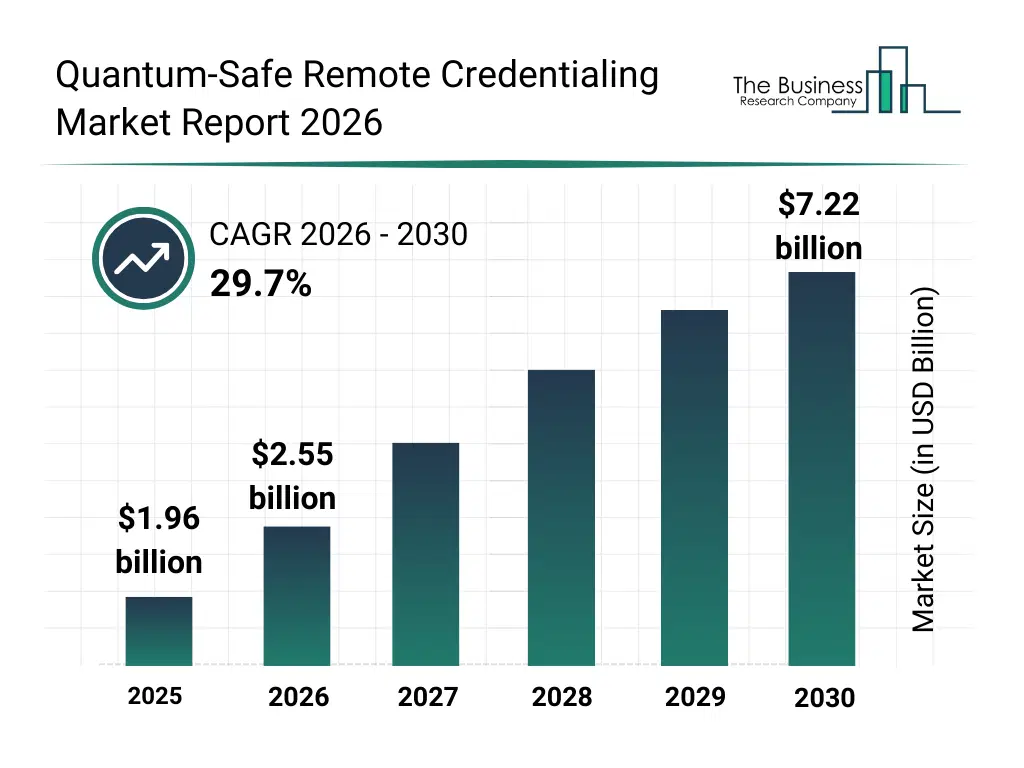
What Is The Quantum-Safe Remote Credentialing Market Size and Share 2026?
The quantum-safe remote credentialing market size has grown exponentially in recent years. It will grow from $1.96 billion in 2025 to $2.55 billion in 2026 at a compound annual growth rate (CAGR) of 29.9%. The growth in the historic period can be attributed to increasing cyber threats targeting digital identities, adoption of multi-factor authentication in enterprises, demand for secure remote access, regulatory compliance for identity management, growth of digital banking and financial services.What Is The Quantum-Safe Remote Credentialing Market Growth Forecast?
The quantum-safe remote credentialing market size is expected to see exponential growth in the next few years. It will grow to $7.22 billion in 2030 at a compound annual growth rate (CAGR) of 29.7%. The growth in the forecast period can be attributed to emergence of quantum computing threats, rising adoption of post-quantum cryptography, expansion of cloud-based credentialing solutions, increasing need for secure digital identity verification, integration of AI-driven identity monitoring and management. Major trends in the forecast period include quantum-safe remote identity verification, post-quantum cryptography integration for credentialing, secure token and smart card deployment, managed security services for remote credentialing, key management and lifecycle security.
Global Quantum-Safe Remote Credentialing Market Segmentation
1) By Solution Type: Software, Hardware, Services 2) By Deployment Mode: On-Premises, Cloud 3) By Organization Size: Large Enterprises, Small And Medium Enterprises 4) By Application: Banking And Financial Services, Government And Defense, Healthcare, Information Technology (IT) And Telecommunications, Education, Other Applications 5) By End-User: Public Sector, Private Sector Subsegments: 1) By Software: Quantum-Safe Authentication Software, Post-Quantum Cryptographic Libraries, Identity And Access Management (IAM) Platforms, Key Management And Lifecycle Software, Encryption And Tokenization Solutions 2) By Hardware: Quantum-Safe Hardware Security Modules (HSMS), Secure Authentication Tokens And Smart Cards, Quantum-Resistant Network Appliances, Trusted Platform Modules (TPMS), Cryptographic Accelerators 3) By Services: Managed Security Services (MSS), Cryptographic Assessment And Consulting, Post-Quantum Migration Services, Integration And Deployment Services, Training And Support ServicesWhat Is The Driver Of The Quantum-Safe Remote Credentialing Market?
The increasing cyber threat is expected to propel the growth of the quantum-safe remote credentialing market going forward. A cyber threat is a malicious act or circumstance that seeks to damage, steal, or disrupt data, systems, networks, or digital life. Increasing cyber threats are due to the growing sophistication of attack techniques, rising incidences of data breaches, and the expanding digital ecosystem, which together drive organizations to adopt stronger security frameworks to safeguard sensitive information and ensure business continuity. Quantum-safe remote credentialing helps address increasing cyber threats by securing digital identities and authentication processes with encryption methods resistant to both current and future quantum attacks, ensuring long-term data protection, system integrity, and resilience against evolving cyber risks. For instance, in October 2024, according to Check Point Software Technologies, an Israel-based cybersecurity company, the average number of weekly cyberattacks targeting each organization reached 1,876 during the third quarter of 2024, reflecting a 75% growth from the third quarter of 2023 and a 15% rise compared to the previous quarter. Therefore, the increasing cyber threat is driving the growth of the quantum-safe remote credentialing industry.Key Players In The Global Quantum-Safe Remote Credentialing Market
Major companies operating in the quantum-safe remote credentialing market are Infineon Technologies AG, DigiCert Inc., OneSpan Inc., QNu Labs Pvt. Ltd., QuintessenceLabs Pty Ltd., ISARA Corporation, MagiQ Technologies Inc., SandboxAQ, Qrypt Inc., Securosys SA, QuantumXchange Inc., CryptoNext Security, PQSHIELD LTD., evolutionQ Inc., KETS Quantum Security Ltd., VeriQloud SAS, Quantum Bridge Technologies Inc., Pantherun Technologies Private Limited, Nomidio, Arqit Quantum Inc.
This chart is for illustrative purposes; the full report includes a detailed competitor analysis and comprehensive overview of the top 10 companies in the market.
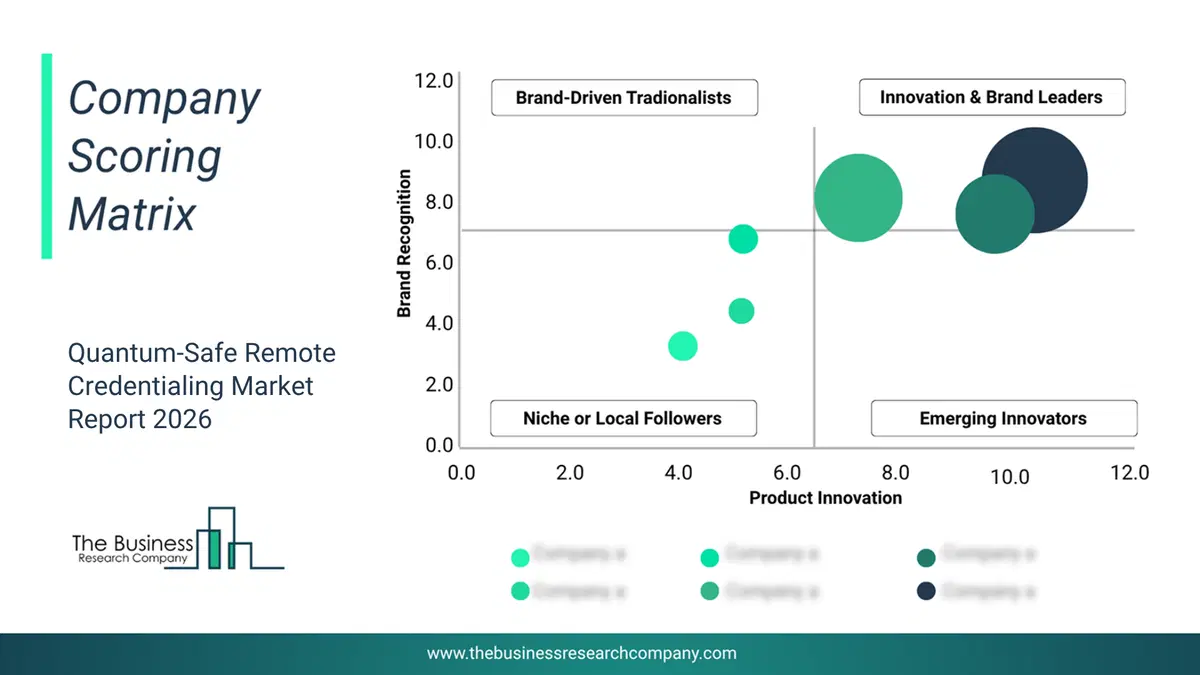
This chart maps companies by product innovation and brand strength, with bubble size indicating relative revenue, helping identify market leaders, challengers, and niche players. This is an illustrative chart; the full report provides a complete and accurate competitive analysis.
Global Quantum-Safe Remote Credentialing Market Trends and Insights
Major companies operating in the quantum-safe remote credentialing market are focusing on developing advanced solutions, such as post-quantum cryptography (PQC), to enhance cryptographic security, enable smooth migration to quantum-resistant algorithms, and provide strong protection against future quantum-driven threats. PQC involves the creation of cryptographic algorithms designed to withstand attacks from quantum computers. For instance, in April 2025, Utimaco, a Germany-based provider of trusted cybersecurity and compliance solutions, introduced Quantum Protect, a solution package for the u.trust General Purpose HSM Se-Series that can be activated in the field without hardware replacement. The package integrates advanced quantum-resistant algorithms with existing authentication systems to protect identities, secure remote access, and strengthen cybersecurity infrastructures against both current and future quantum threats. Its flexibility allows organizations to deploy quantum-safe security efficiently through in-field activation and comprehensive cryptographic support.What Are Latest Mergers And Acquisitions In The Quantum-Safe Remote Credentialing Market?
In May 2025, IonQ, a US-based quantum computing hardware and software company, acquired ID Quantique for an undisclosed amount. IonQ’s acquisition of IDQ broadens its offerings with QKD systems, QRNGs, and single-photon detectors, while boosting its patent portfolio to more than 900 with the addition of around 300 IDQ patents. The move reinforces IonQ’s position in quantum technology leadership and ensures uninterrupted delivery of IDQ’s reliable products, services, and customer support. ID Quantique is a Switzerland-based company specializing in quantum-safe remote credentialing.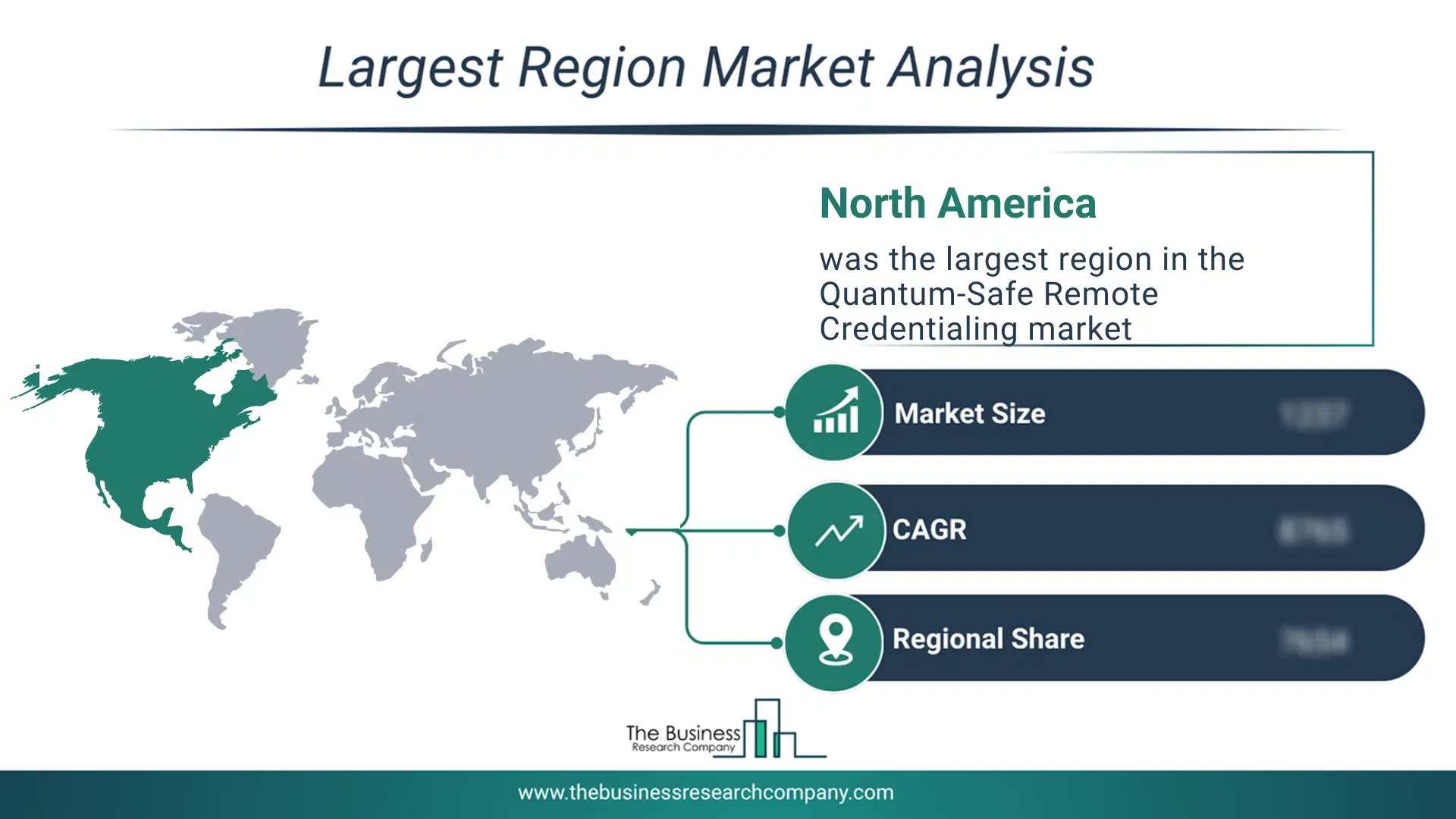
Regional Insights
North America was the largest region in the quantum-safe remote credentialing market in 2025. Asia-Pacific is expected to be the fastest-growing region in the forecast period. The regions covered in this market report are Asia-Pacific, South East Asia, Western Europe, Eastern Europe, North America, South America, Middle East, Africa. The countries covered in this market report are Australia, Brazil, China, France, Germany, India, Indonesia, Japan, Taiwan, Russia, South Korea, UK, USA, Canada, Italy, Spain.What Defines the Quantum-Safe Remote Credentialing Market?
The quantum-safe remote credentialing market consists of revenues earned by entities by providing services such as quantum-safe authentication, cryptographic asset discovery, secure remote access management, post-quantum key distribution, and quantum-resistant identity verification. The market value includes the value of related goods sold by the service provider or included within the service offering. The quantum-safe remote credentialing market also includes sales of biometric authentication devices, quantum-safe multi-factor authentication devices, smart card readers, and wearable authentication devices. Values in this market are ‘factory gate’ values, that is the value of goods sold by the manufacturers or creators of the goods, whether to other entities (including downstream manufacturers, wholesalers, distributors and retailers) or directly to end customers. The value of goods in this market includes related services sold by the creators of the goods.How is Market Value Defined and Measured?
The market value is defined as the revenues that enterprises gain from the sale of goods and/or services within the specified market and geography through sales, grants, or donations in terms of the currency (in USD unless otherwise specified). The revenues for a specified geography are consumption values that are revenues generated by organizations in the specified geography within the market, irrespective of where they are produced. It does not include revenues from resales along the supply chain, either further along the supply chain or as part of other products.
This chart presents market attractiveness based on a quantitative evaluation of growth, competition, strategic alignment, and risk, offering a clear view of opportunity areas for decision-making. This chart is for illustrative purposes; the full report contains the complete analysis.

This chart highlights the Total Addressable Market (TAM) by estimating the maximum revenue opportunity using an assumption-driven approach, supporting strategic planning and opportunity sizing across markets. The chart is illustrative; the full report provides a more comprehensive analysis.
What Key Data and Analysis Are Included in the Quantum-Safe Remote Credentialing Market Report 2026?
The quantum-safe remote credentialing market research report is one of a series of new reports from The Business Research Company that provides market statistics, including industry global market size, regional shares, competitors with the market share, detailed market segments, market trends and opportunities, and any further data you may need to thrive in the quantum-safe remote credentialing industry. The market research report delivers a complete perspective of everything you need, with an in-depth analysis of the current and future state of the industry.Quantum-Safe Remote Credentialing Market Report Forecast Analysis
| Report Attribute | Details |
|---|---|
| Market Size Value In 2026 | $2.55 billion |
| Revenue Forecast In 2030 | $7.22 billion |
| Growth Rate | CAGR of 29.7% from 2026 to 2030 |
| Base Year For Estimation | 2025 |
| Actual Estimates/Historical Data | 2020-2025 |
| Forecast Period | 2026 - 2030 |
| Market Representation | Revenue in USD Billion and CAGR from 2026 to 2030 |
| Segments Covered | Solution Type, Deployment Mode, Organization Size, Application, End-User |
| Regional Scope | Asia-Pacific, Western Europe, Eastern Europe, North America, South America, Middle East, Africa |
| Country Scope | The Countries Covered In This Market Report Are Australia, Brazil, China, France, Germany, India, Indonesia, Japan, Taiwan, Russia, South Korea, Uk, Usa, Canada, Italy, Spain. |
| Key Companies Profiled | Infineon Technologies AG, DigiCert Inc., OneSpan Inc., QNu Labs Pvt. Ltd., QuintessenceLabs Pty Ltd., ISARA Corporation, MagiQ Technologies Inc., SandboxAQ, Qrypt Inc., Securosys SA, QuantumXchange Inc., CryptoNext Security, PQSHIELD LTD., evolutionQ Inc., KETS Quantum Security Ltd., VeriQloud SAS, Quantum Bridge Technologies Inc., Pantherun Technologies Private Limited, Nomidio, Arqit Quantum Inc. |
| Customization Scope | Request for Customization |
| Pricing And Purchase Options | Explore Purchase Options |