

Quick Commerce Market Report 2026
Global Outlook – By Product (Food And Groceries, Stationery, Personal Care Items, Medicines, Household Products, Others Products), By Technology (Application Based Operation, Website Based Operation, Hybrid Operation), By Payment Mode (Cash On Delivery, Online) – Market Size, Trends, Strategies, and Forecast to 2030
Quick Commerce Market Overview
• Quick Commerce market size has reached to $129.73 billion in 2025 • Expected to grow to $358.16 billion in 2030 at a compound annual growth rate (CAGR) of 22% • Growth Driver: Expansion Of The E-Commerce Industry And Online Shopping Fuels Growth In The Quick Commerce Market • Market Trend: Accelerated Same Day Prescription Delivery Networks • North America was the largest region in 2025 and Asia-Pacific is the fastest growing region.Market Gains By 2030 – Top Opportunities By Segment
Market Gain identifies the most promising market opportunities by highlighting the segments or products expected to generate the highest incremental revenue growth over the next five years.
What Is Covered Under Quick Commerce Market?
Quick commerce refers to a segment of the e-commerce industry that focuses on the rapid delivery of goods and services to customers, typically within an hour or even minutes of placing an order. It often involves the use of localized warehouses, advanced logistics, and delivery technologies to ensure speed and efficiency. The main products of quick commerce are food and groceries, stationery, personal care items, medicines, small electronics and accessories, clothing, household products, and others. Food and groceries refer to edible items and household essentials typically purchased for consumption and daily living needs. The technology involved is application-based operation, website-based operation, and hybrid operation. Its payment modes include cash on delivery, and online.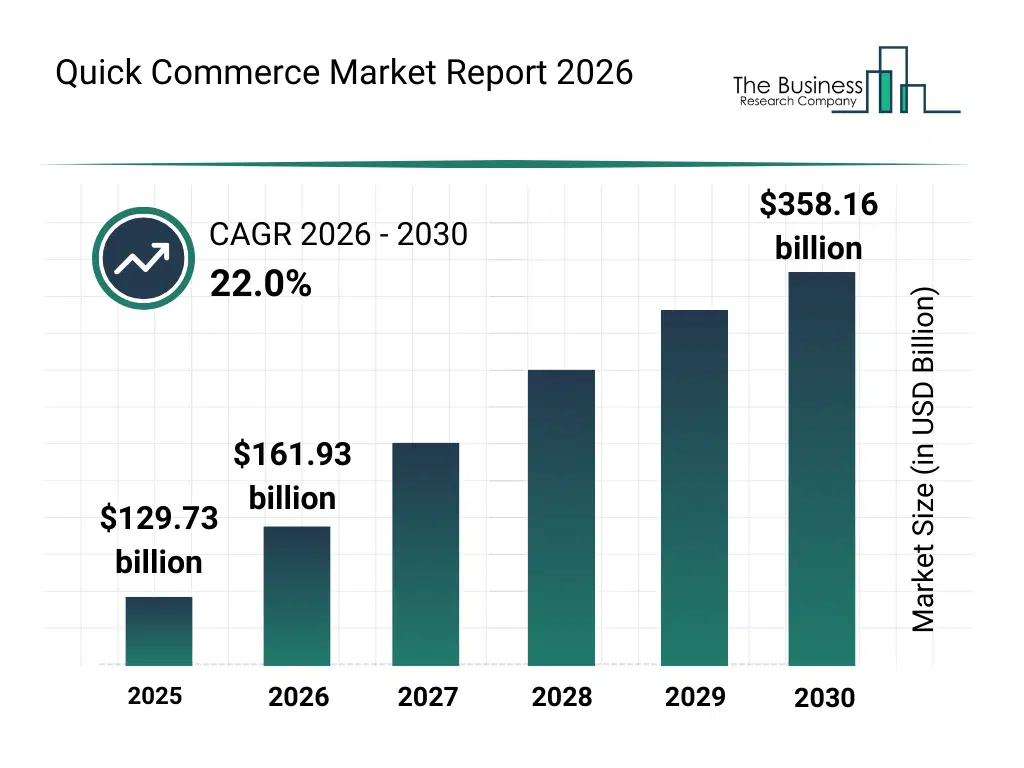
What Is The Quick Commerce Market Size and Share 2026?
The quick commerce market size has grown exponentially in recent years. It will grow from $129.73 billion in 2025 to $161.93 billion in 2026 at a compound annual growth rate (CAGR) of 24.8%. The growth in the historic period can be attributed to increasing growth in online shopping, rising demand for convenience purchases, early expansion of urban delivery platforms, growth in smartphone penetration, increasing consumer preference for fast logistics.What Is The Quick Commerce Market Growth Forecast?
The quick commerce market size is expected to see exponential growth in the next few years. It will grow to $358.16 billion in 2030 at a compound annual growth rate (CAGR) of 22.0%. The growth in the forecast period can be attributed to rising demand for instant delivery ecosystems, increasing investment in delivery automation, growing urban lifestyle convenience needs, expansion of quick fulfillment infrastructure, rising focus on enhanced customer experience. Major trends in the forecast period include increasing shift toward ultra fast delivery services, growing expansion of dark stores and micro warehousing models, rising adoption of app based instant order fulfillment, expansion of on demand product accessibility platforms, increasing customer expectation for real time convenience delivery.
Global Quick Commerce Market Segmentation
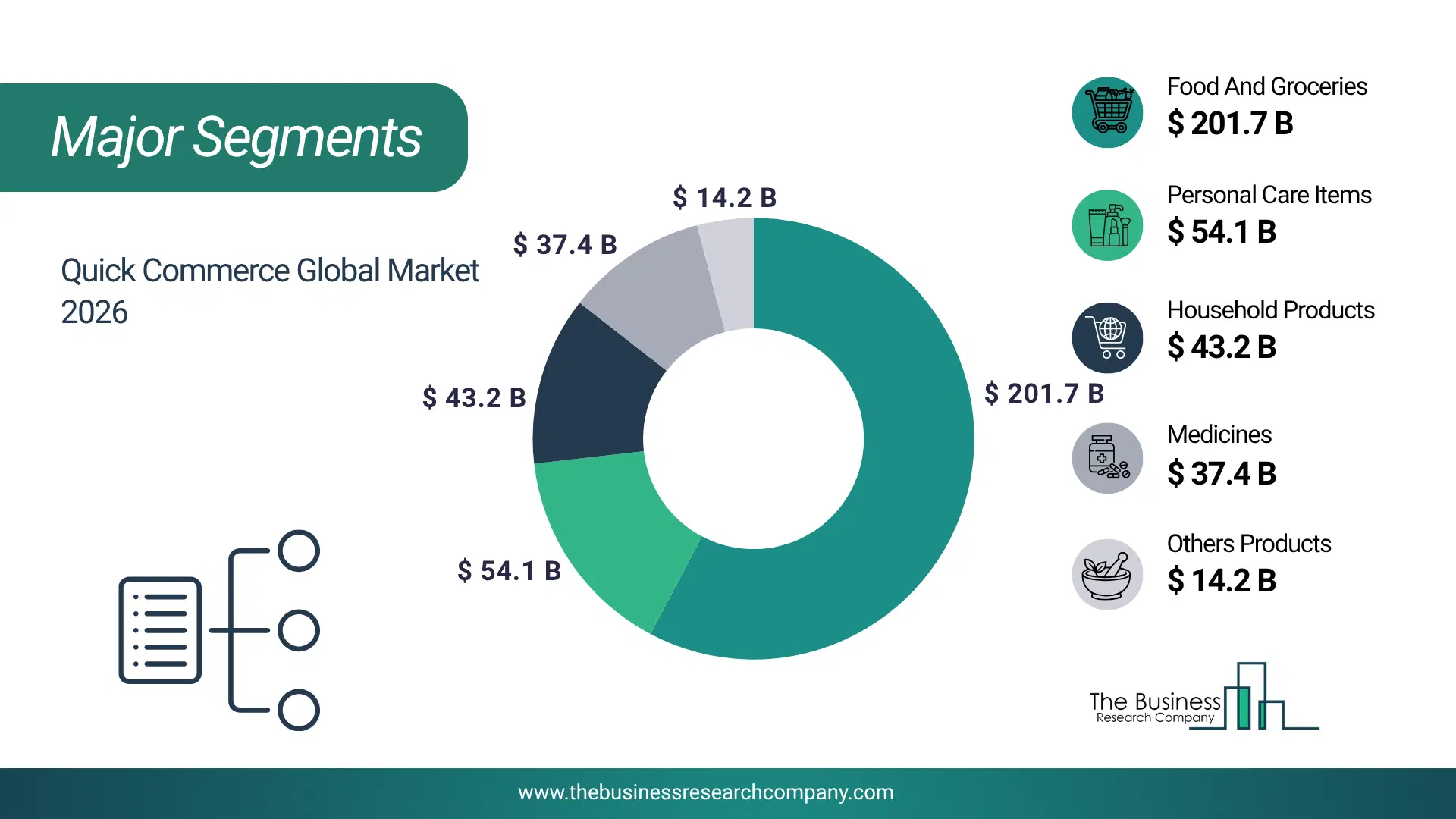
1) By Product: Food And Groceries, Stationery, Personal Care Items, Medicines, Household Products, Others Products 2) By Technology: Application Based Operation, Website Based Operation, Hybrid Operation 3) By Payment Mode: Cash On Delivery, Online Subsegments: 1) By Food And Groceries: Fresh Produce, Dairy Products, Packaged Foods, Frozen Foods, Meat, Poultry And Seafood, Bakery And Confectionery, Organic And Health Foods 2) By Stationery: Office Supplies, School Supplies, Printing And Copying Materials, Art Supplies, Technology Accessories 3) By Personal Care Items: Skincare Products, Hair Care Products, Oral Care, Cosmetics, Bath And Shower 4) By Medicines: Over-The-Counter Medications, Prescription Drugs, Health Supplements, First Aid Supplies, Wellness And Herbal Products 5) By Household Products: Cleaning Supplies, Kitchenware, Home Décor, Paper Products, Small Furniture 6) By Other Products: Pet Supplies, Baby Products, Books And Magazines, Party Supplies, Gardening Supplies The top segments in the quick commerce market will be: • Food And Groceries will reach $201.66 billion by 2030. • Personal Care Items will reach $54.08 billion by 2030. • Household Products will reach $43.16 billion by 2030. • Medicines will reach $37.42 billion by 2030. • Others Products will reach $14.21 billion by 2030.What Is The Driver Of The Quick Commerce Market?
The expansion of the e-commerce industry and online shopping is expected to propel the growth of the quick commerce market going forward. The e-commerce industry includes the buying and selling of goods and services over the Internet, while online shopping refers to the act of purchasing products or services through websites or mobile applications. The e-commerce industry and online shopping are expanding because of increased internet and mobile device penetration, advancements in technology, improved logistics and delivery services, and the convenience of shopping from home. Quick Commerce offers rapid on-demand delivery of online goods and services to consumers, enhancing convenience and meeting immediate needs. For instance, in August 2024, according to the United States Census Bureau, a US-based government department, the U.S. retail e-commerce sales for the second quarter of 2024 were estimated at $282.3 billion, reflecting a 5.3 percent (±0.7) increase compared to the first quarter of 2023. Therefore, the expansion of the e-commerce industry and online shopping is driving the growth of the quick commerce industry.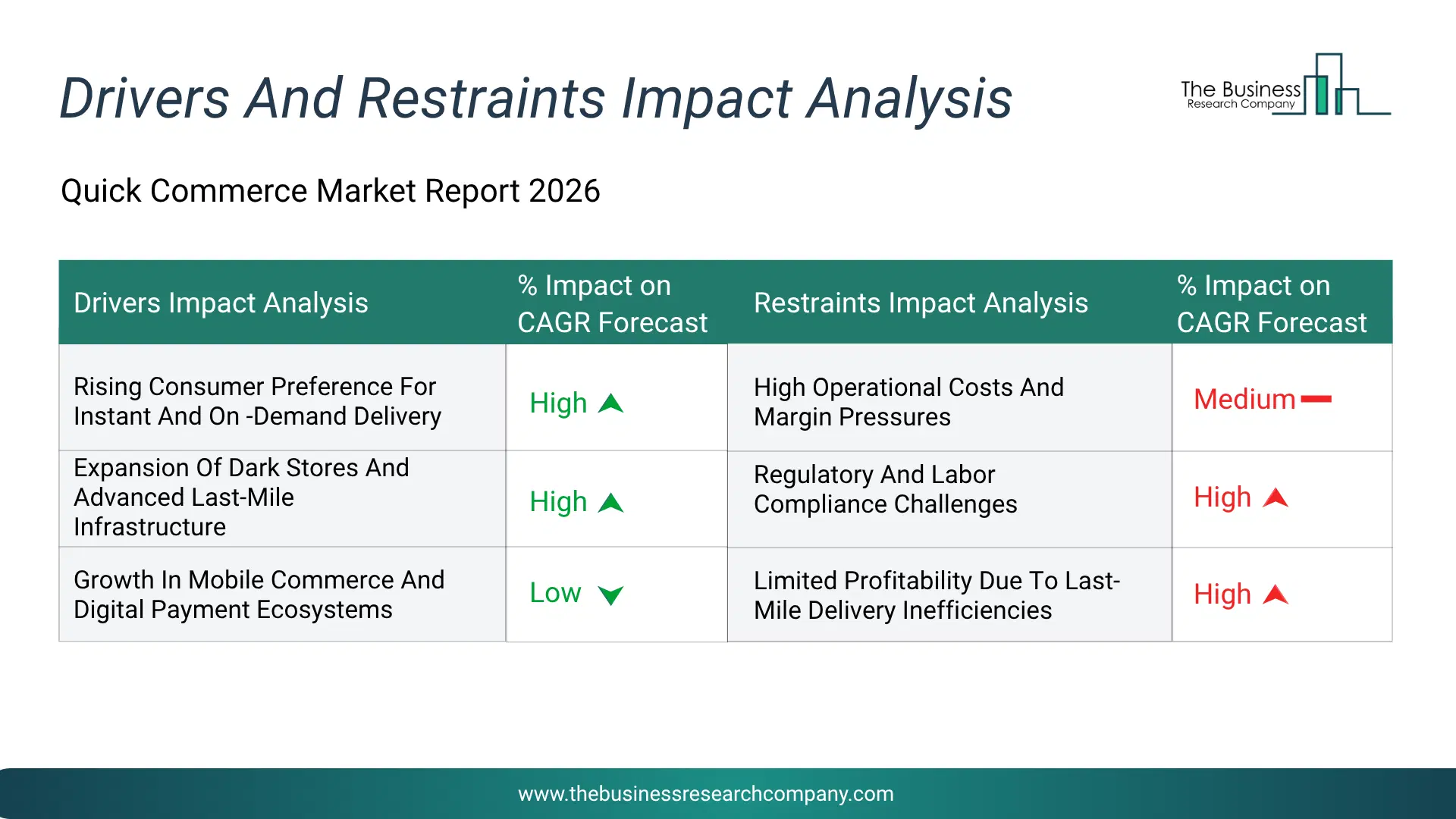
Infographic Chart Showing Key Market Drivers Analysis And Restraints For Quick Commerce Market
The chart presents an impact analysis of key drivers and restraints, quantifying their relative influence on the market's growth rate and helping assess the balance between growth enablers and limiting factors. This chart offers a high-level perspective; the full report contains more detailed insights.
How Will The Drivers Impact Growth In The Global Quick Commerce Market?
• Rising Consumer Preference For Instant And On -Demand Delivery (High) – During the forecast period, the rising consumer preference for instant and on -demand delivery is expected to become a key growth driver for the quick commerce market by 2030. The increasing consumer demand for ultra -fast delivery and convenience is the primary driver of the quick commerce market. Urban consumers increasingly expect groceries, essentials, and daily -use products to be delivered within minutes rather than days. Changing lifestyles, dual -income households, and time -constrained professionals are accelerating reliance on instant delivery platforms. As convenience becomes a key differentiator in retail, quick commerce platforms continue to expand aggressively in metropolitan areas. • Expansion Of Dark Stores And Advanced Last-Mile Infrastructure (High) – During the forecast period, the expansion of dark stores and advanced last-mile infrastructure is expected to emerge as a major factor driving the expansion of the quick commerce market by 2030. Expansion of dark store networks and last-mile logistics optimization significantly fuels market growth. Companies are investing in micro-fulfillment centers located near high-demand urban clusters to reduce delivery times. Ai-driven inventory management, route optimization, and real-time tracking technologies improve operational efficiency and order accuracy. As logistics infrastructure strengthens and operational models mature, scalability and service reliability improve. • Growth In Mobile Commerce And Digital Payment Ecosystems (Low) – During the forecast period, the growth in mobile commerce and digital payment ecosystems is expected to act as a key growth catalyst for the quick commerce market by 2030. Rapid digital adoption and mobile commerce penetration further accelerate market expansion. High smartphone usage, digital payment integration, and app-based retail ecosystems enable seamless ordering experiences. Personalized promotions, subscription models, and data-driven consumer targeting enhance customer retention. As internet penetration increases across emerging markets, quick commerce platforms are gaining broader consumer reach.How Will The Restraints Impact Growth In The Global Quick Commerce Market?
• High Operational Costs And Margin Pressures (Medium) – During the forecast period, the high operational costs and profitability challenges act as major restraints in the quick commerce market. Maintaining dark stores, delivery fleets, rider incentives, and promotional discounts significantly increases cost structures. Thin margins on grocery and daily essentials further pressure profitability. Many players rely on external funding to sustain expansion, which may limit long-term sustainability if unit economics are not optimized. • Regulatory And Labor Compliance Challenges (High) – During the forecast period, the regulatory scrutiny and labor-related challenges also restrain market growth. Governments are increasingly focusing on gig worker rights, minimum wages, and urban traffic regulations. Compliance with local labor laws and safety standards may increase operational complexity and costs. Additionally, intense competition among platforms can lead to consolidation and market exits, impacting overall growth dynamics. • Limited Profitability Due To Last-Mile Delivery Inefficiencies (High) – During the forecast period, the limited profitability due to last-mile delivery inefficiencies acts as a restraint for the quick commerce market by increasing delivery costs and reducing overall operational efficiency. The requirement for ultra-fast delivery within short time windows often leads to inefficient route planning and underutilization of delivery capacity. Frequent small order deliveries further increase fuel consumption and labor costs. In densely populated urban areas, traffic congestion and delivery delays add additional operational strain. As a result, maintaining fast delivery standards while achieving profitability becomes challenging for market players.Key Players In The Global Quick Commerce Market
Major companies operating in the quick commerce market report are Delivery Hero SE, DoorDash Inc., Gopuff, Maplebear Inc., Swiggy, Grab Holdings Inc., Getir, Shipt Inc., Postmates Inc., Missfresh Inc., Flink SE, ZeptoExpress Sdn Bhd, FreshDirect LLC, Jokr Inc., Dunzo Digital Private Limited, Zapp Ltd., Blink Commerce Private Limited, Gorillas Technologies GmbH, GoJek, Rappi S.A.S, Weezy Technologies Limited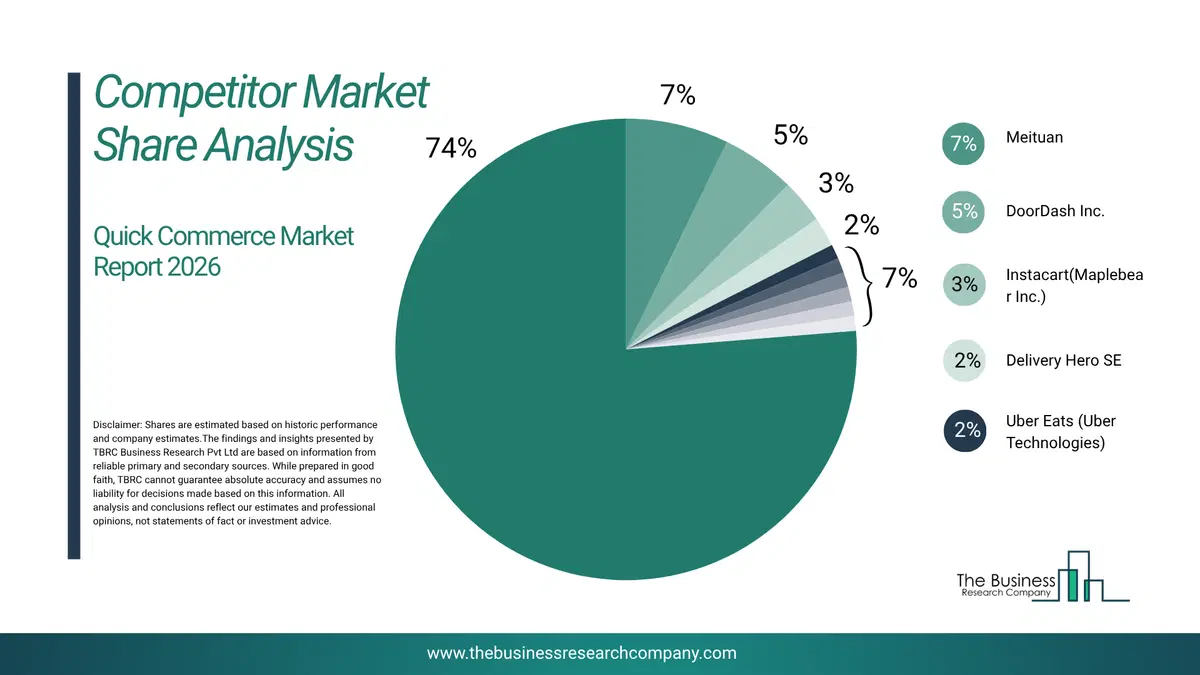
This chart is for illustrative purposes; the full report includes a detailed competitor analysis and comprehensive overview of the top 10 companies in the market.
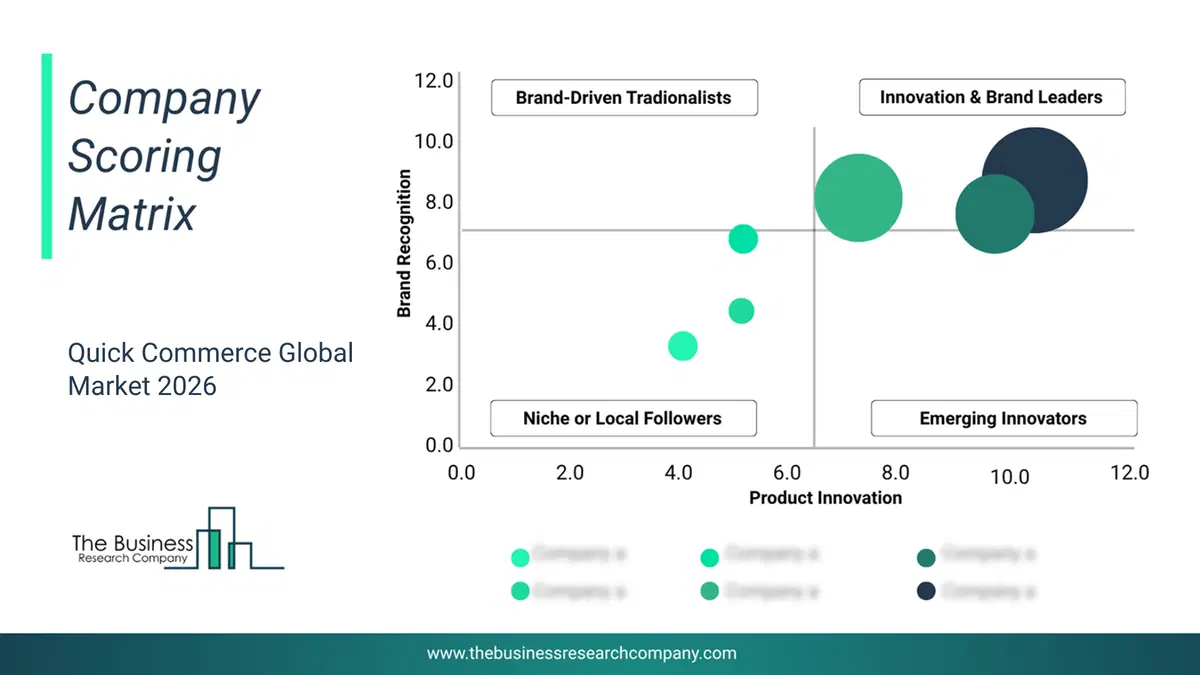
This chart maps companies by product innovation and brand strength, with bubble size indicating relative revenue, helping identify market leaders, challengers, and niche players. This is an illustrative chart; the full report provides a complete and accurate competitive analysis.
Global Quick Commerce Market Trends and Insights
Major companies operating in the quick commerce market are focusing on developing innovative platforms, such as same day prescription delivery networks, to gain a competitive advantage. A same day prescription delivery network coordinates licensed pharmacies, automated fulfillment hubs, and fast logistics to bring prescribed medication to patients’ doors within hours of ordering. For instance, in March 2024, Amazon.com Inc., a U.S.-based retail pharmacy service, launched same-day prescription delivery in New York City and the Los Angeles area, featuring small-format fulfillment centers, 24/7 pharmacist access, and delivery by e-bike or electric van within hours. This model improves patient access and adherence while leveraging existing logistics infrastructure. However, scaling such systems faces regulatory hurdles and high operational costs in many countries.What Are Latest Mergers And Acquisitions In The Quick Commerce Market?
In January 2023, Getir Retail Logistics Joint Stock Company, a Turkey-based ultrafast grocery delivery company, acquired Gorillas Technologies Ltd., for an undisclosed amount. With this acquisition, Getir aims to strengthen its presence in the European quick-commerce market, optimize operational efficiencies, and expand its customer base by integrating Gorillas’ delivery network, dark stores, and local market expertise. Gorillas Technologies Ltd. is a Germany-based rapid delivery company known for providing grocery deliveries within minutes through its network of micro-fulfillment centers.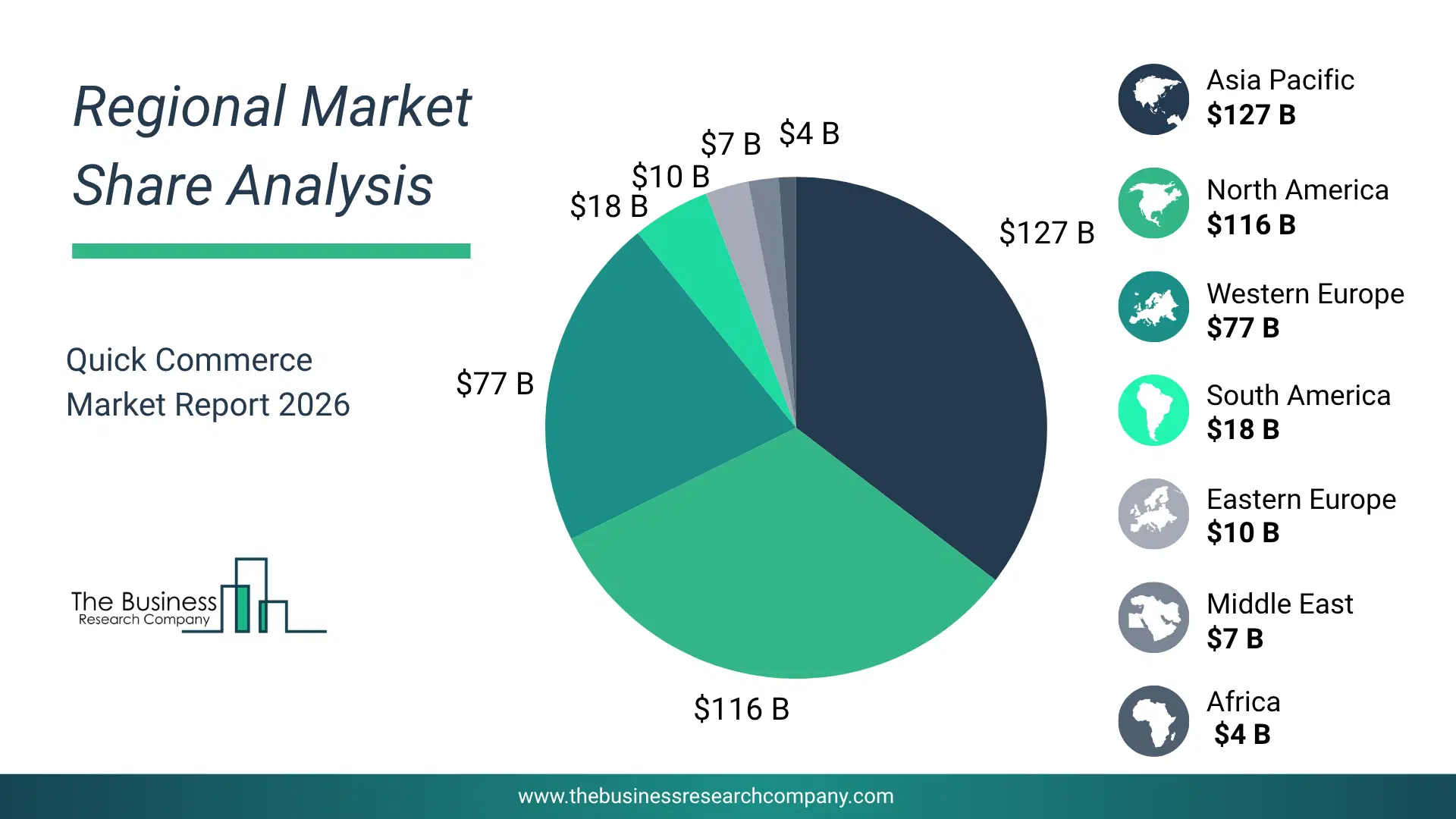
Regional Outlook
North America was the largest region in the quick commerce market in 2025. Asia-Pacific is expected to be the fastest-growing region in the forecast period. The regions covered in this market report are Asia-Pacific, South East Asia, Western Europe, Eastern Europe, North America, South America, Middle East, Africa. The countries covered in this market report are Australia, Brazil, China, France, Germany, India, Indonesia, Japan, Taiwan, Russia, South Korea, UK, USA, Canada, Italy, SpainWhat Defines the Quick Commerce Market?
The quick commerce market includes revenues earned by entities by providing services such as grocery delivery, medicines delivery, office supplies, and food delivery. The market value includes the value of related goods sold by the service provider or included within the service offering. Only goods and services traded between entities or sold to end consumers are included.How is Market Value Defined and Measured?
The market value is defined as the revenues that enterprises gain from the sale of goods and/or services within the specified market and geography through sales, grants, or donations in terms of the currency (in USD unless otherwise specified). The revenues for a specified geography are consumption values that are revenues generated by organizations in the specified geography within the market, irrespective of where they are produced. It does not include revenues from resales along the supply chain, either further along the supply chain or as part of other products.
This chart presents market attractiveness based on a quantitative evaluation of growth, competition, strategic alignment, and risk, offering a clear view of opportunity areas for decision-making. This chart is for illustrative purposes; the full report contains the complete analysis.

This chart highlights the Total Addressable Market (TAM) by estimating the maximum revenue opportunity using an assumption-driven approach, supporting strategic planning and opportunity sizing across markets. The chart is illustrative; the full report provides a more comprehensive analysis.
What Key Data and Analysis Are Included in the Quick Commerce Market Report 2026?
The quick commerce market research report is one of a series of new reports from The Business Research Company that provides market statistics, including industry global market size, regional shares, competitors with the market share, detailed market segments, market trends and opportunities, and any further data you may need to thrive in the quick commerce industry. The market research report delivers a complete perspective of everything you need, with an in-depth analysis of the current and future state of the industry.Quick Commerce Market Report Forecast Analysis
| Report Attribute | Details |
|---|---|
| Market Size Value In 2026 | $161.93 billion |
| Revenue Forecast In 2030 | $358.16 billion |
| Growth Rate | CAGR of 24.8% from 2026 to 2030 |
| Base Year For Estimation | 2025 |
| Actual Estimates/Historical Data | 2020-2025 |
| Forecast Period | 2026 - 2030 |
| Market Representation | Revenue in USD Billion and CAGR from 2026 to 2030 |
| Segments Covered | Product, Technology, Payment Mode |
| Regional Scope | Asia-Pacific, Western Europe, Eastern Europe, North America, South America, Middle East, Africa |
| Country Scope | The countries covered in the report are Australia, Brazil, China, France, Germany, India, Indonesia, Japan, Taiwan, Russia, South Korea, UK, USA, Canada, Italy, Spain. |
| Key Companies Profiled | Delivery Hero SE, DoorDash Inc., Gopuff, Maplebear Inc., Swiggy, Grab Holdings Inc., Getir, Shipt Inc., Postmates Inc., Missfresh Inc., Flink SE, ZeptoExpress Sdn Bhd, FreshDirect LLC, Jokr Inc., Dunzo Digital Private Limited, Zapp Ltd., Blink Commerce Private Limited, Gorillas Technologies GmbH, GoJek, Rappi S.A.S, Weezy Technologies Limited |
| Customization Scope | Request for Customization |
| Pricing And Purchase Options | Explore Purchase Options |