
Contact Us
  Search
The Business Research Company Logo
Quinine Global Market Opportunities And Strategies To 2035
Published :July 2026
Pages :289
Format :PDF
Delivery Time :2-3 Business Days
Why 2-3 days? We update the report with the latest data and news before delivery. Let us know if you need us to expedite.
Report Price :$4,490.00

Quinine Global Market Opportunities And Strategies To 2035

By Product (Quinine Sulphate, Quinine Hydrochloride, Quinine Gluconate, Quinine Bisulphate), By Administration (Oral Administration, Intramuscular Administration, Intravenous Administration, Other Administrations), By Application (Malaria Treatment, Nocturnal Leg Cramps, Other Applications), By Enduser (Hospitals, Clinics, Other Endusers), And By Region, Opportunities And Strategies – Global Forecast To 2035

Quinine Market Definition

Quinine is a natural compound extracted from the bark of the cinchona tree, traditionally used to treat malaria. It works by interfering with the growth and reproduction of the malaria parasite in red blood cells. The quinine market consists of sales by entities (organizations, sole traders and partnerships) of quinine that is used by healthcare providers, hospitals, clinics, and patients, particularly in regions where malaria is prevalent or where quinine-based therapies are prescribed for muscle cramps. It is typically used when patients require treatment for malaria infections caused by Plasmodium parasites, especially in cases where resistance to other antimalarial drugs is observed, and also for managing nocturnal leg cramps under controlled medical supervision.
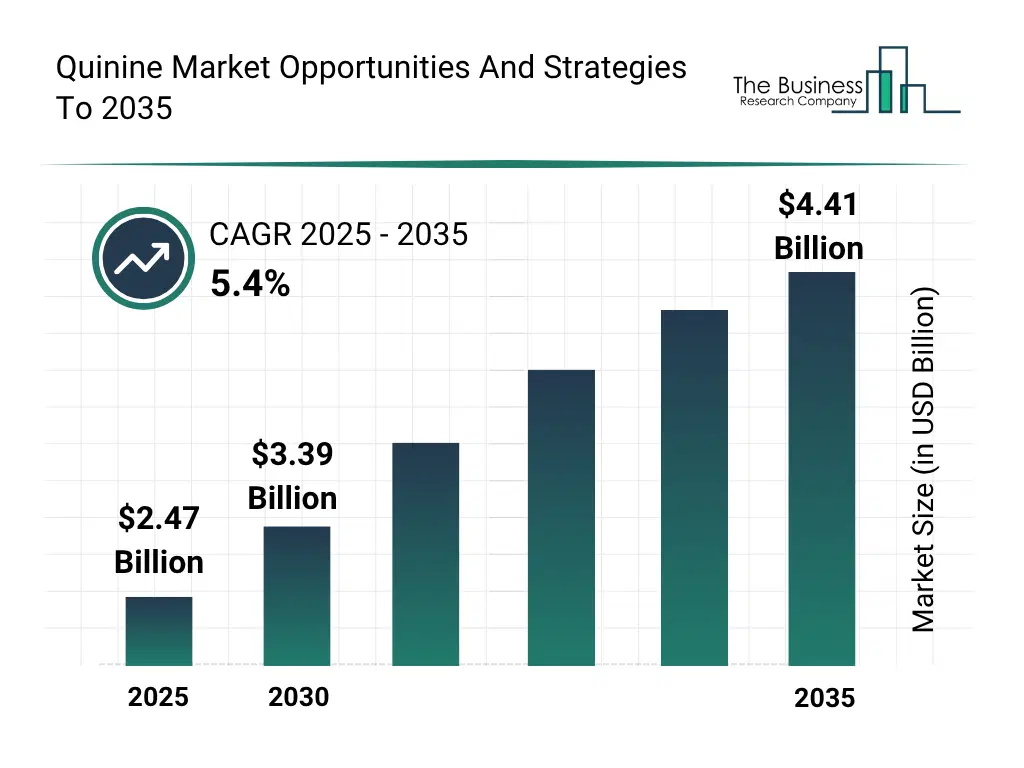
Quinine Global Market Opportunities And Strategies To 2035 Market Size and growth rate 2026 to 2030: Graph

Quinine Market Size

The global quinine market reached a value of nearly $2,466.7 million in 2025, having grown at a compound annual growth rate (CAGR) of 7.1% since 2020. The market is expected to grow from $2,466.7 million in 2025 to $3,389.1 million in 2030 at a rate of 6.6%. The market is then expected to grow at a CAGR of 5.4% from 2030 and reach $4,410.8 million in 2035. Growth in the historic period resulted from high global prevalence of malaria, public-private partnerships in malaria eradication programs, rising public health programs and government procurement of antimalarial drugs and rising demand for tonic water and bitter beverages. Factors that negatively affected growth in the historic period were shift toward artemisinin-based combination therapies (acts) reducing reliance and side effects and toxicity concerns. Going forward, increasing off-label use for nocturnal leg cramps treatment, efforts towards the support for cinchona cultivation and processing, increasing rural healthcare penetration in malaria-endemic regions and support from global health organizations (WHO malaria programs) will drive the growth. Factors that could hinder the growth of the quinine market in the future include stringent regulatory restrictions, reduced physician preference due to side-effect profile and availability of synthetic bittering alternatives in beverages.
Research Expert

Book your 30 minutes free consultation with our research experts

Quinine Market Segmentation

The quinine market is segmented by product, by administration, by application and by end-user.

By Product –
The quinine market is segmented by product into:
    • a) Quinine Sulphate
    • b) Quinine Hydrochloride
    • c) Quinine Gluconate
    • D) Quinine Bisulphate
The quinine sulphate was the largest segment of the quinine market segmented by product, accounting for 54.4% or $1,342.7 million of the total in 2025. Going forward, the quinine hydrochloride segment is expected to be the fastest-growing segment in the quinine market segmented by product, at a CAGR of 9.2% during 2025-2030.

By Administration –
The quinine market is segmented by administration into:
    • a) Oral Administration
    • b) Intramuscular Administration
    • c) Intravenous Administration
    • d) Other Administration
The oral administration market was the largest segment of the quinine market segmented by administration, accounting for 69.0% or $1,701.2 million of the total in 2025. Going forward, the oral administration segment is expected to be the fastest-growing segment in the quinine market segmented by administration, at a CAGR of 7.0% during 2025-2030.

By Application–
The quinine market is segmented by application into:
    • a) Malaria Treatment
    • b) Nocturnal Leg Cramps
    • c) Other Applications
The malaria treatment market was the largest segment of the quinine market segmented by application, accounting for 62.7% or $1,547.2 million of the total in 2025. Going forward, the other applications segment is expected to be the fastest-growing segment in the quinine market segmented by application, at a CAGR of 10.0% during 2025-2030.

By End-User–
The quinine market is segmented by end-user into:
    • a) Hospitals
    • b) Clinics
    • c) Other End Users
The hospitals market was the largest segment of the quinine market segmented by end user, accounting for 49.5% or $1,222.0 million of the total in 2025. Going forward, the other end users segment is expected to be the fastest-growing segment in the quinine market segmented by end user, at a CAGR of 8.5% during 2025-2030.

By Geography - The quinine market is segmented by geography into:
      o Asia Pacific
      • China
      • India
      • Japan
      • Australia
      • Indonesia
      • South Korea
      o North America
      • USA
      • Canada
      o South America
      • Brazil
      o Western Europe
      • France
      • Germany
      • UK
      • Italy
      • Spain
      o Eastern Europe
      • Russia
      o Middle East
      o Africa
Africa was the largest region in the quinine market, accounting for 47.96% or $1,183.0 million of the total in 2025. It was followed by Asia Pacific, South America and then the other regions. Going forward, the fastest-growing regions in the quinine market will be Asia Pacific and Western Europe where growth will be at CAGRs of 8.18% and 6.54% respectively. These will be followed by Eastern Europe and North America where the markets are expected to grow at CAGRs of 6.46% and 6.36% respectively.

Quinine Market Drivers

The key drivers of the quinine market include: Increasing Rural Healthcare Penetration In Malaria-Endemic Regions During the forecast period, the increasing rural healthcare penetration in malaria-endemic regions is expected to propel the growth of the quinine market. Governments and global health organizations are expanding primary healthcare infrastructure, improving access to diagnosis and treatment in remote areas. Enhanced distribution networks and the availability of essential medicines at rural health centers are supporting timely malaria management. In areas where advanced therapies are limited or cost-prohibitive, quinine remains a viable treatment option. Additionally, awareness campaigns and community health programs are encouraging early treatment-seeking behavior. Therefore, the increasing rural healthcare penetration in malaria-endemic regions will drive the growth of the quinine market. The increasing rural healthcare penetration in malaria-endemic regions growth contribution during the forecast period in 2026 is 1.5%.

Quinine Market Restraints

The key restraints on the quinine market include: Stringent Regulatory Restrictions Stringent regulatory restrictions is expected to hinder the growth of the quinine market in forecast period. Governments and health authorities impose strict guidelines on the use, dosage, and sale of quinine due to potential side effects and safety concerns. Additionally, regulatory approvals for pharmaceutical applications are time-consuming and costly, discouraging new market entrants. Restrictions on sourcing natural raw materials, such as cinchona bark, further constrain supply. Moreover, the growing preference for alternative antimalarial drugs that face fewer regulatory barriers reduces demand, collectively impacting market expansion and profitability for quinine manufacturers. Therefore, stringent regulatory restrictions may hinder the growth of the quinine market. Growth affected by stringent regulatory restrictions during the forecast period in 2026 is -2.0%.

Quinine Market Competitive Landscape

Major Competitors are:

  • Alchem International Private Ltd
  • PT Sinkona Indonesia Lestari
  • SimSon Pharma Limited
  • Sun Pharmaceutical Industries Ltd.
  • Lupin Limited
  • Other Competitors Include:

  • Dayang chem (Hangzhou) Co., Ltd.
  • Cipla Limited
  • Vital Laboratories Private Limited
  • Pharmakina SA
  • Merck KGaA
  • AdvaCare Pharma
  • Alps Pharmaceutical Ind. Co., Ltd
  • American Elements
  • Chempro Pharma Private Limited
  • Hoshi Pharmaceutical Co
  • Merck & Co., Inc.
  • Phebra Pty Ltd
  • Prism Industries Pvt. Ltd.
  • PT Kimia Farma Tbk
  • Siam Pharmaceutical Co., LTD.
  • Spectrum Chemical Mfg. Corp
  • Swiss Parenterals Private Limited
  • Swiss Pharma Nigeria Limited
  • Taj Pharmaceuticals Ltd
  • Teva Czech Industries
  • Teva Pharmaceutical Industries Ltd.
  • Thermo Fisher Scientific Inc.
  • Tokyo Chemical Industry UK Ltd.
  • Zeon Pharma Industries India Pvt. Ltd
  • Need data on a specific region in this market?

    Opportunities And Recommendations In The Quinine Market

    Opportunities – The top opportunities in the quinine market segmented by product will arise in the quinine sulphate segment, which will gain $466.5 million of global annual sales by 2030. The top opportunities in the quinine market segmented by administration will arise in the oral administration segment, which will gain $688.6 million of global annual sales by 2030. The top opportunities in the quinine market segmented by application will arise in the malaria treatment segment, which will gain $429.2 million of global annual sales by 2030. The top opportunities in the quinine market segmented by end user will arise in the hospitals segment, which will gain $485.9 million of global annual sales by 2030. The quinine market size will gain the most in the India at $138.2 million. Recommendations- To take advantage of the opportunities, The Business Research Company recommends the focus on premium beverage expansion and lifestyle positioning, focus on premium mixer innovation and multi-channel distribution, focus on quinine hydrochloride for hospital and injectable applications, focus on oral administration for mass treatment and outpatient demand, expand in emerging markets, continue to focus on developed markets, focus on tiered pricing and value-based product positioning, focus on healthcare awareness and clinical education campaigns, focus on premium beverage branding and consumer engagement, focus on premium beverage and niche non-malarial applications, focus on government, research and humanitarian end-user expansion.
    Chat with us