

Racing Cars Market Report 2026
Global Outlook – By Vehicle Type (Formula Cars, Touring Cars, Sports Cars, Stock Cars, Rally Cars, Drag Racing Cars, Off-Road Racing Cars, Prototype Racing Cars, Other Racing Cars), By Engine Type (Petrol Engines, Diesel Engines, Electric Engines, Hybrid Engines, Hydrogen Fuel Cell Engines), By Sales Channel (Original Equipment Manufacturers, Aftermarket), By Application (Professional Racing, Amateur Racing, Track Testing, Promotional Events, Simulation And Training), By End User (Motorsport Teams, Automotive Manufacturers, Private Racing Teams, Racing Academies, Research Organizations) – Market Size, Trends, Strategies, and Forecast to 2030
Racing Cars Market Overview
• Racing Cars market size has reached to $5.12 billion in 2025 • Expected to grow to $7.08 billion in 2030 at a compound annual growth rate (CAGR) of 6.6% • Growth Driver: Growing Popularity Of Motorsport Events And Racing Championships Fueling The Growth Of The Market Due To Rising Investments In Racing Vehicle Development • Market Trend: Development Of High-Performance Electric Racing Cars With Advanced Powertrains And Sustainable Technologies • North America was the largest region in 2025 and Asia-Pacific is the fastest growing region.What Is Covered Under Racing Cars Market?
The racing cars are specially engineered high-performance vehicles designed exclusively for competitive motorsport events. They are built to maximize speed, handling, acceleration, stability, and safety under demanding racing conditions. These vehicles incorporate advanced engineering, lightweight construction, precision-tuned powertrains, optimized aerodynamics, and specialized control systems to deliver superior performance on racing circuits or designated competition environments while complying with the technical and safety regulations established by governing motorsport authorities. The main vehicle types in the racing cars market include formula cars, touring cars, sports cars, stock cars, rally cars, drag racing cars, off-road racing cars, prototype racing cars, and other racing cars. Formula cars refer to purpose-built single-seat racing vehicles designed for competitive motorsport events with specialized aerodynamic, chassis, and performance characteristics. These vehicles use petrol engines, diesel engines, electric engines, hybrid engines, and hydrogen fuel cell engines and sold through original equipment manufacturers and aftermarket channels. The various applications involved are professional racing, amateur racing, track testing, promotional events, and simulation and training, and utilized by end users including motorsport teams, automotive manufacturers, private racing teams, racing academies, and research organizations.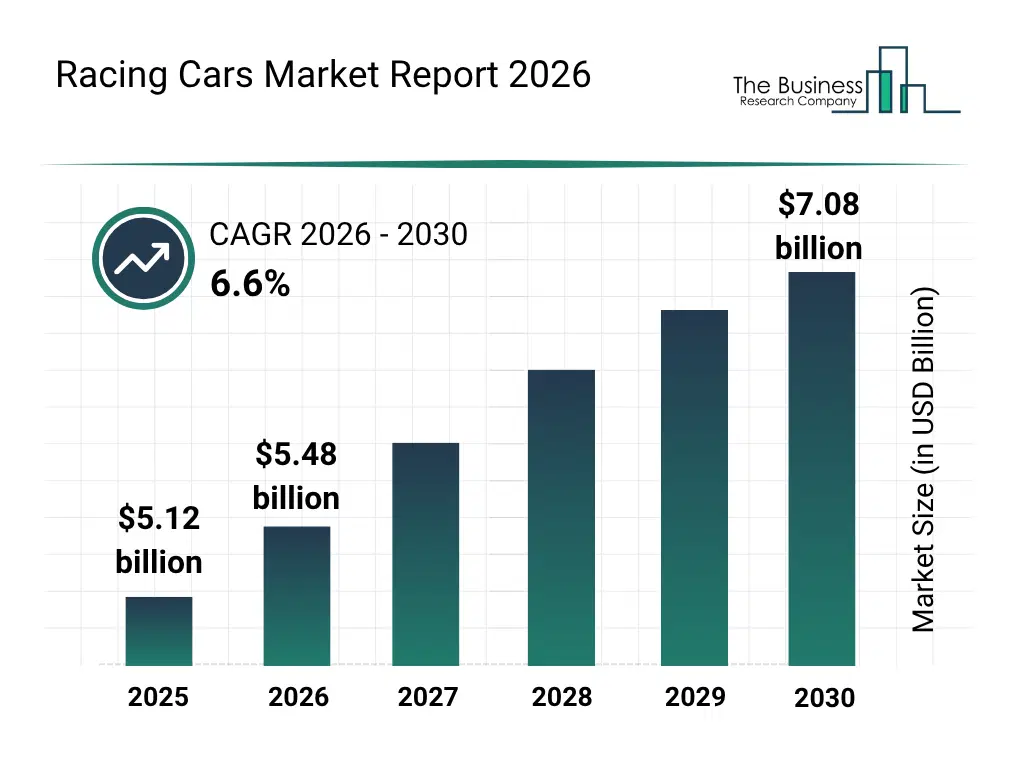
What Is The Racing Cars Market Size and Share 2026?
The racing cars market size has grown strongly in recent years. It will grow from $5.12 billion in 2025 to $5.48 billion in 2026 at a compound annual growth rate (CAGR) of 7.0%. The growth in the historic period can be attributed to increasing motorsport participation, rising professional racing events, growing demand for high-performance vehicles, expansion of racing academies, increasing track testing activities.What Is The Racing Cars Market Growth Forecast?
The racing cars market size is expected to see strong growth in the next few years. It will grow to $7.08 billion in 2030 at a compound annual growth rate (CAGR) of 6.6%. The growth in the forecast period can be attributed to growing adoption of electric racing cars, rising demand for lightweight racing vehicles, increasing development of hybrid racing powertrains, expanding motorsport championships, growing demand for advanced racing safety systems. Major trends in the forecast period include increasing adoption of hybrid and hydrogen-powered racing cars, growing use of lightweight materials in racing car construction, rising demand for advanced aerodynamic designs, increasing participation in motorsport events, growing demand for high-performance racing powertrains.Tariff Impact On Racing Cars Market
Tariffs are impacting the racing cars market by increasing the cost of imported racing components, lightweight materials, specialized powertrain systems, and high-performance electronic equipment required for competitive motorsport vehicles. This is affecting Formula Cars, Sports Cars, Prototype Racing Cars, and other specialized racing vehicles, particularly in regions dependent on imported automotive components such as Europe, North America, and Asia-Pacific. Component-intensive segments and professional racing applications are most affected due to their reliance on specialized global supply chains. However, tariffs are also encouraging local sourcing, regional supplier diversification, domestic component production, and greater resilience across racing vehicle manufacturing ecosystems.
Global Racing Cars Market Segmentation
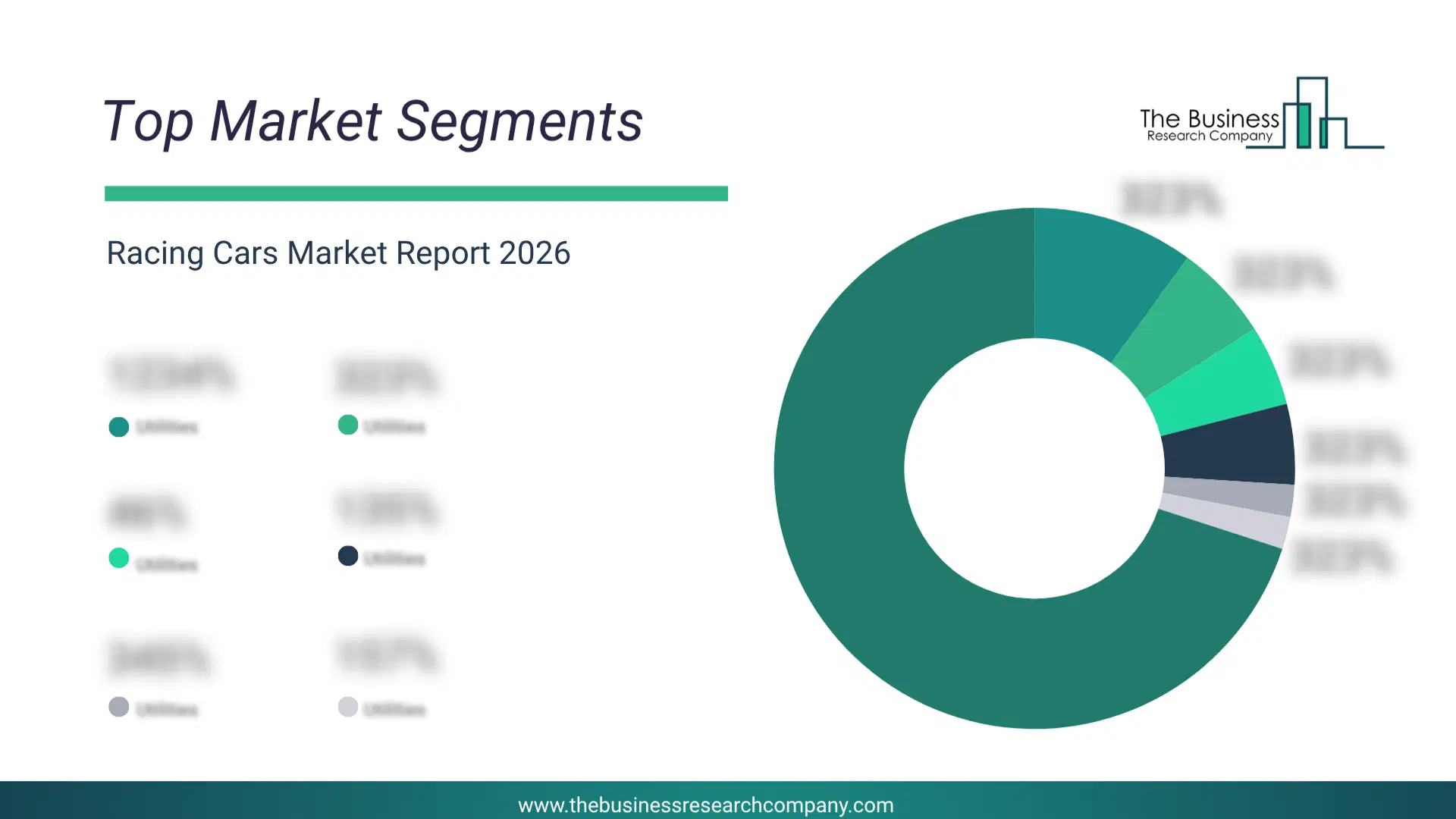
1) By Vehicle Type: Formula Cars, Touring Cars, Sports Cars, Stock Cars, Rally Cars, Drag Racing Cars, Off-Road Racing Cars, Prototype Racing Cars, Other Racing Cars 2) By Engine Type: Petrol Engines, Diesel Engines, Electric Engines, Hybrid Engines, Hydrogen Fuel Cell Engines 3) By Sales Channel: Original Equipment Manufacturers, Aftermarket 4) By Application: Professional Racing, Amateur Racing, Track Testing, Promotional Events, Simulation And Training 5) By End User: Motorsport Teams, Automotive Manufacturers, Private Racing Teams, Racing Academies, Research Organizations Subsegments: 1) By Formula Cars: Formula One Cars, Formula Two Cars, Formula Three Cars, Formula Four Cars 2) By Touring Cars: Super Touring Cars, Supercars, Production Touring Cars, TCR Touring Cars 3) By Sports Cars: Grand Touring Cars, Le Mans Sports Cars, Club Racing Sports Cars, One Make Sports Cars 4) By Stock Cars: Cup Series Cars, Xfinity Series Cars, Truck Series Racing Cars, Regional Stock Cars 5) By Rally Cars: Rally One Cars, Rally Two Cars, Rally Three Cars, Rally Four Cars 6) By Drag Racing Cars: Top Fuel Dragsters, Funny Cars, Pro Stock Cars, Pro Modified Cars 7) By Off-Road Racing Cars: Baja Racing Cars, Rally Raid Cars, Short Course Racing Cars, Desert Racing Cars 8) By Prototype Racing Cars: Le Mans Hypercars, Le Mans Daytona Hybrid Cars, Le Mans Prototype Two Cars, Daytona Prototype Cars 9) By Other Racing Cars: Hill Climb Cars, Time Attack Cars, Autocross Cars, Drift Competition CarsWhat Is The Driver Of The Racing Cars Market?
The growing popularity of motorsport events and racing championships is expected to propel the growth of the racing cars market going forward. Motorsport events and racing championships are organized competitive automobile racing series that attract professional teams, manufacturers, sponsors, broadcasters, and millions of spectators worldwide. The growing popularity of motorsport events and racing championships is due to increasing media coverage and digital streaming platforms, that expanded global audience reach and enhanced fan engagement. The growing popularity of motorsport events and racing championships supports the racing cars by encouraging racing teams and manufacturers to invest in the development of advanced racing cars, accelerate technological innovation, and increase demand for high-performance racing vehicles across multiple racing categories. For instance, in August 2025, according to Formula One World Championship Limited, a UK-based sports management and entertainment company, Formula 1's global fanbase reached 827 million, representing a 12% year-on-year increase, while the first 14 races of the 2025 season attracted a record 3.9 million spectators. Therefore, the growing popularity of motorsport events and racing championships is driving the growth of the racing cars industry.Key Players In The Global Racing Cars Market
Major companies operating in the racing cars market are Ford Motor Company, General Motors Company, Mercedes-Benz Group AG, BMW AG, Toyota Motor Corporation, Honda Motor Co. Ltd., Dr. Ing. h.c. F. Porsche AG, Ferrari N.V., Hyundai Motor Company, AUDI AG, Škoda Auto a.s., Subaru Corporation, McLaren Group Limited, Automobili Lamborghini S.p.A., Alpine Racing SAS, Ligier Automotive, Oreca Groupe, Dallara Automobili S.p.A., Tatuus Racing S.p.A., Multimatic Inc., Aston Martin Lagonda Global Holdings plc, Riley Technologies LLC, Ginetta Cars Limited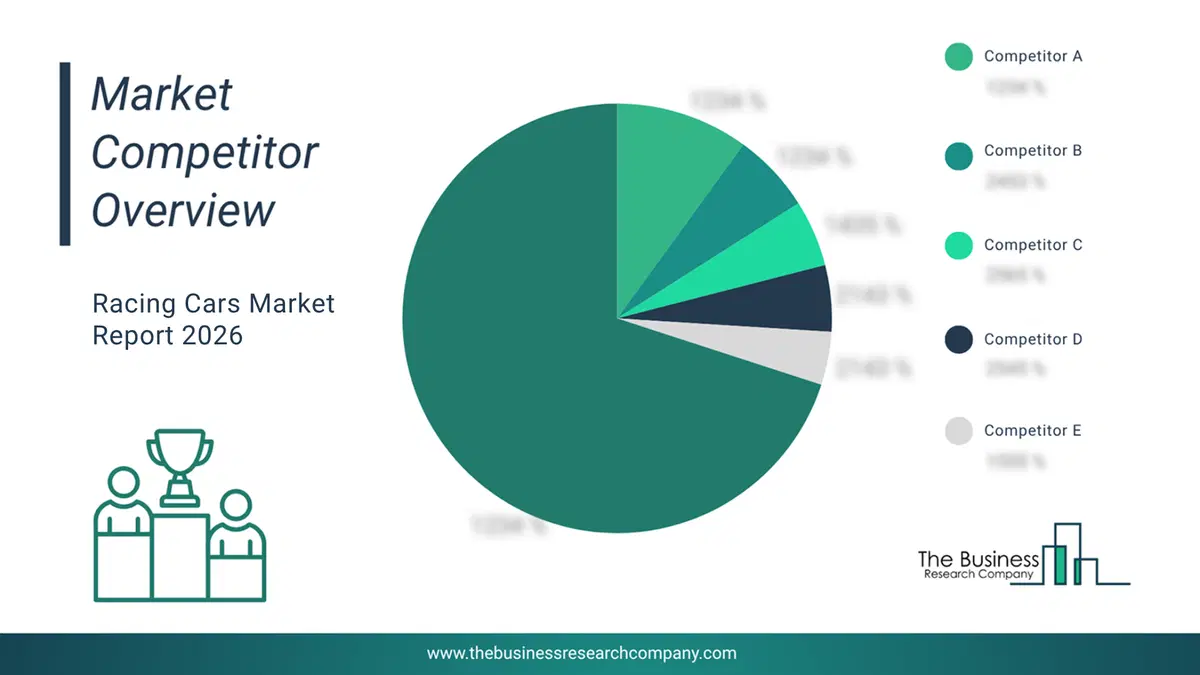
This chart is for illustrative purposes; the full report includes a detailed competitor analysis and comprehensive overview of the top 10 companies in the market.
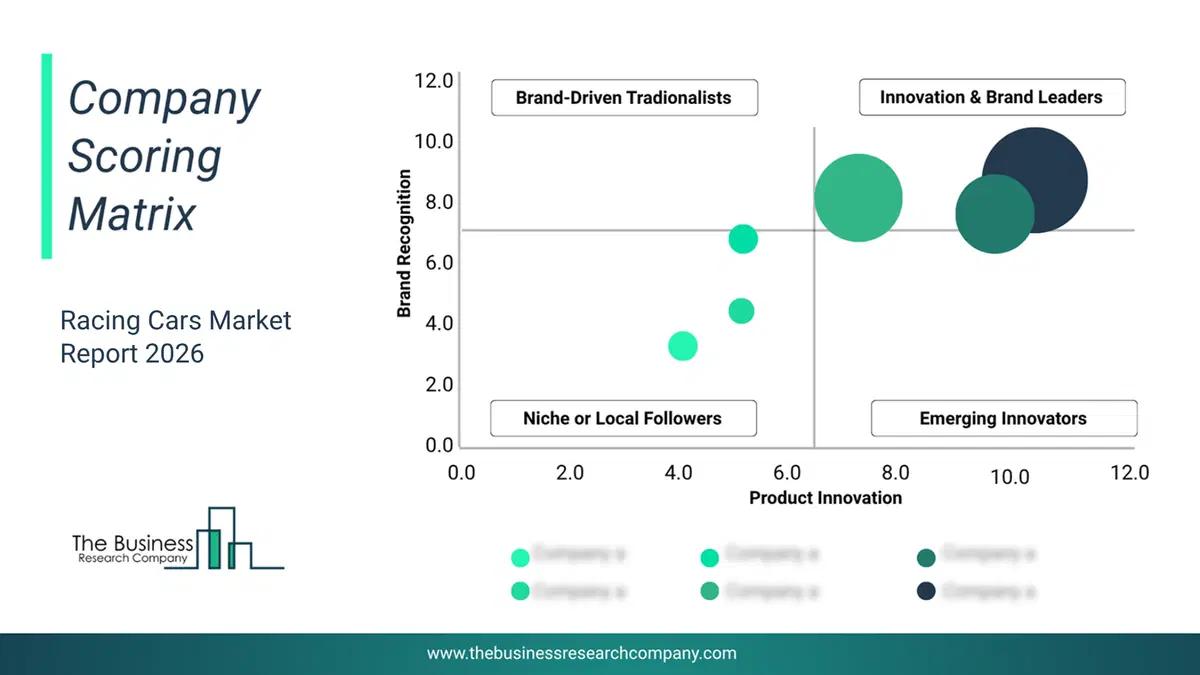
This chart maps companies by product innovation and brand strength, with bubble size indicating relative revenue, helping identify market leaders, challengers, and niche players. This is an illustrative chart; the full report provides a complete and accurate competitive analysis.
Global Racing Cars Market Trends and Insights
Major companies operating in the racing cars market are focusing on developing high-performance electric racing cars that combine greater power, higher speeds, improved acceleration, and advanced sustainable technologies. Electric racing cars are increasingly incorporating enhanced powertrains, regenerative braking systems, lightweight materials, and recycled components to improve racing performance while supporting the transition toward more sustainable motorsport. For instance, in April 2026, Formula E, a UK-based all-electric motorsport championship, and the Fédération Internationale de l'Automobile (FIA), a France-based governing body for global motorsport and mobility organizations, unveiled the GEN4 electric race car, a new generation of high-performance electric racing technology designed to deliver speeds exceeding 335 km/h, approximately 1.8-second acceleration from 0–100 km/h, and up to 600 kW of power in Attack Mode. The GEN4 also incorporates sustainability-focused technologies, including recycled materials and tires containing renewable and recycled materials.What Are Latest Mergers And Acquisitions In The Racing Cars Market?
In January 2025, Audi AG, a Germany-based manufacturer of premium automobiles, electric vehicles, high-performance vehicles, and automotive technologies, acquired Sauber Group for $702 million (€600 million). With this acquisition, Audi aims to establish a fully integrated Formula One factory team, strengthen its racing car engineering capabilities, accelerate the development of next-generation Formula One race cars, and support its entry into the FIA Formula One World Championship from 2026. Sauber Motorsport AG is a Switzerland-based motorsport engineering company that designs, develops, manufactures, and operates Formula One racing cars while also providing advanced motorsport engineering and technology services.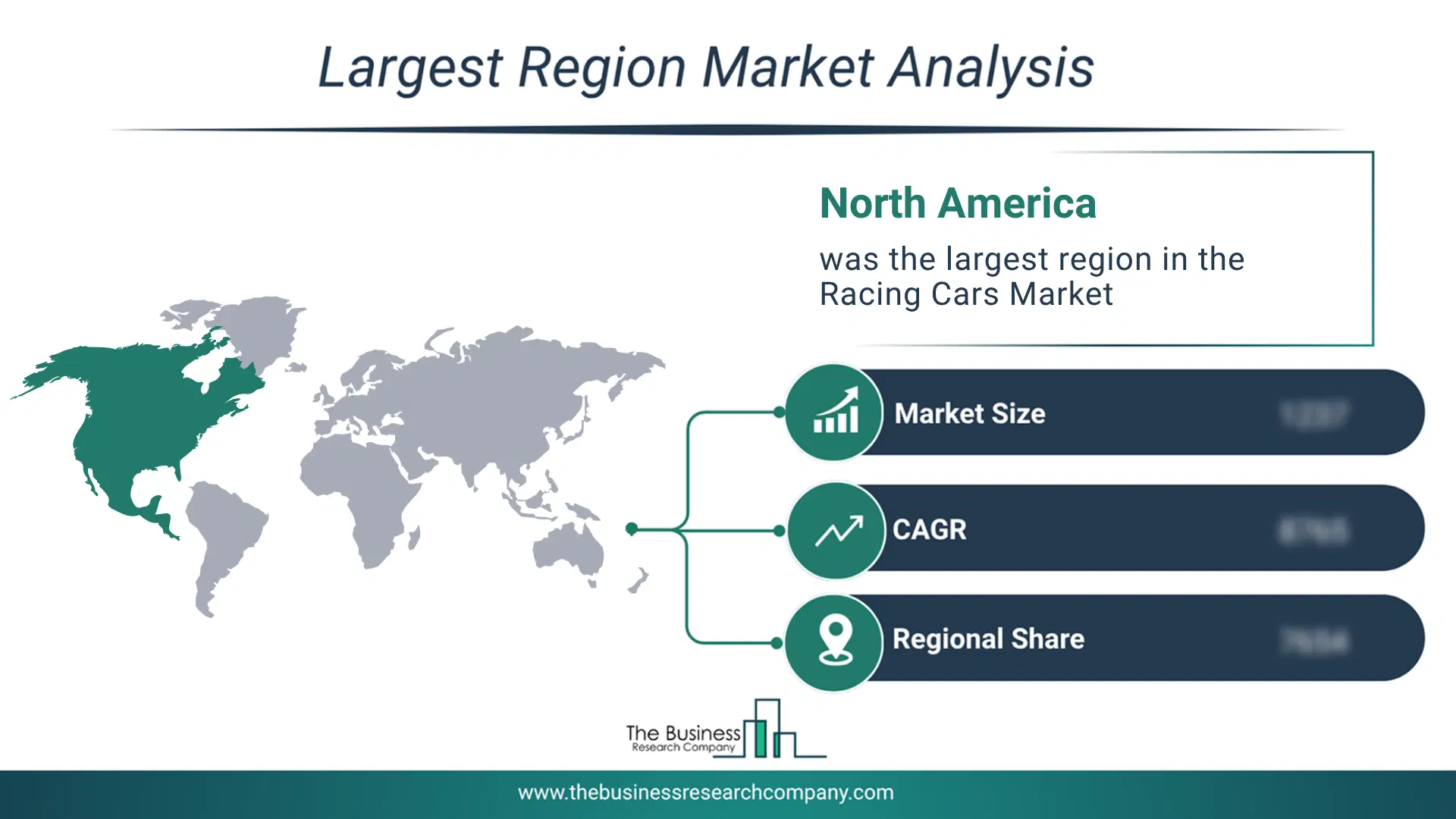
Regional Outlook
North America was the largest region in the racing cars market in 2025. Asia-Pacific is expected to be the fastest-growing region in the forecast period. The regions covered in this market report are Asia-Pacific, South East Asia, Western Europe, Eastern Europe, North America, South America, Middle East, Africa. The countries covered in this market report are Australia, Brazil, China, France, Germany, India, Indonesia, Japan, Taiwan, Russia, South Korea, UK, USA, Canada, Italy, Spain.What Defines the Racing Cars Market?
The racing cars market consists of sales of carbon fiber body panels, aerodynamic wings, front splitters, rear diffusers, racing tires, alloy wheels, racing seats, roll cages, racing harnesses, and steering wheels. Values in this market are ‘factory gate’ values, that is, the value of goods sold by the manufacturers or creators of the goods, whether to other entities (including downstream manufacturers, wholesalers, distributors, and retailers) or directly to end customers. The value of goods in this market includes related services sold by the creators of the goods.How is Market Value Defined and Measured?
The market value is defined as the revenues that enterprises gain from the sale of goods and/or services within the specified market and geography through sales, grants, or donations in terms of the currency (in USD unless otherwise specified). The revenues for a specified geography are consumption values that are revenues generated by organizations in the specified geography within the market, irrespective of where they are produced. It does not include revenues from resales along the supply chain, either further along the supply chain or as part of other products.
This chart presents market attractiveness based on a quantitative evaluation of growth, competition, strategic alignment, and risk, offering a clear view of opportunity areas for decision-making. This chart is for illustrative purposes; the full report contains the complete analysis.

This chart highlights the Total Addressable Market (TAM) by estimating the maximum revenue opportunity using an assumption-driven approach, supporting strategic planning and opportunity sizing across markets. The chart is illustrative; the full report provides a more comprehensive analysis.
What Key Data and Analysis Are Included in the Racing Cars Market Report 2026?
The racing cars market research report is one of a series of new reports from The Business Research Company that provides market statistics, including industry global market size, regional shares, competitors with the market share, detailed market segments, market trends and opportunities, and any further data you may need to thrive in the racing cars industry. The market research report delivers a complete perspective of everything you need, with an in-depth analysis of the current and future state of the industry.Racing Cars Market Report Forecast Analysis
| Report Attribute | Details |
|---|---|
| Market Size Value In 2026 | $5.48 billion |
| Revenue Forecast In 2030 | $7.08 billion |
| Growth Rate | CAGR of 6.6% from 2026 to 2030 |
| Base Year For Estimation | 2025 |
| Actual Estimates/Historical Data | 2020-2025 |
| Forecast Period | 2026 - 2030 |
| Market Representation | Revenue in USD Billion and CAGR from 2026 to 2030 |
| Segments Covered | Vehicle Type, Engine Type, Sales Channel, Application, End User |
| Regional Scope | Asia-Pacific, Western Europe, Eastern Europe, North America, South America, Middle East, Africa |
| Country Scope | The countries covered in the report are Australia, Brazil, China, France, Germany, India, Indonesia, Japan, Taiwan, Russia, South Korea, UK, USA, Canada, Italy, Spain. |
| Key Companies Profiled | Ford Motor Company, General Motors Company, Mercedes-Benz Group AG, BMW AG, Toyota Motor Corporation, Honda Motor Co. Ltd., Dr. Ing. h.c. F. Porsche AG, Ferrari N.V., Hyundai Motor Company, AUDI AG, Škoda Auto a.s., Subaru Corporation, McLaren Group Limited, Automobili Lamborghini S.p.A., Alpine Racing SAS, Ligier Automotive, Oreca Groupe, Dallara Automobili S.p.A., Tatuus Racing S.p.A., Multimatic Inc., Aston Martin Lagonda Global Holdings plc, Riley Technologies LLC, Ginetta Cars Limited |
| Customization Scope | Request for Customization |
| Pricing And Purchase Options | Explore Purchase Options |