
Radiation-Hardened Field-Programmable Gate Array (FPGA) Market Report 2026
Global Outlook – By Type (Static Random-Access Memory-Based, Flash-Based, Antifuse-Based), By Node Size (Less Than Or Equal To 28 Nanometers, 28 To 90 Nanometers, Greater Than 90 Nanometers), By Material (Silicon Carbide, Gallium Nitride), By Operating Frequency (Up To 50 Megahertz, 51 To 100 Megahertz, Above 100 Megahertz), By Application (Aerospace And Defense, Space, Nuclear Power, Industrial, Other Applications) – Market Size, Trends, Strategies, and Forecast to 2030
Radiation-Hardened Field-Programmable Gate Array (FPGA) Market Overview
• Radiation-Hardened Field-Programmable Gate Array (FPGA) market size has reached to $1.15 billion in 2025 • Expected to grow to $1.7 billion in 2030 at a compound annual growth rate (CAGR) of 8% • Growth Driver: Increasing Military Modernization Programs Driving The Market Growth Due To Escalating Geopolitical Tensions And Security Threats • Market Trend: Innovations In Space Qualified Radiation Hardened FPGA Technology Strengthen Reliability For Next Generation Space Applications • North America was the largest region in 2025 and Asia-Pacific is the fastest growing region.What Is Covered Under Radiation-Hardened Field-Programmable Gate Array (FPGA) Market?
A radiation-hardened field-programmable gate array (FPGA) is a programmable semiconductor device specifically designed to operate reliably in high-radiation environments such as space, satellites, and defense systems. It is engineered to withstand radiation-induced faults, including single-event upsets (SEUs) and total ionizing dose (TID) effects. Its primary purpose is to provide flexible, reconfigurable computing and signal processing while ensuring high reliability and long-term operation in mission-critical applications. The main types of radiation-hardened field-programmable gate arrays (FPGA) include static random-access memory-based, flash-based, and antifuse-based. Static random-access memory-based refer to programmable semiconductor devices that use static random-access memory cells to configure logic functions while providing resistance to radiation effects in harsh operating environments. These devices are available across node sizes of less than or equal to 28 nanometers, 28 to 90 nanometers, and greater than 90 nanometers and use materials such as silicon carbide and gallium nitride. They operate at frequencies of up to 50 megahertz, 51 to 100 megahertz, and above 100 megahertz and find application in aerospace and defense, space, nuclear power, industrial, and others.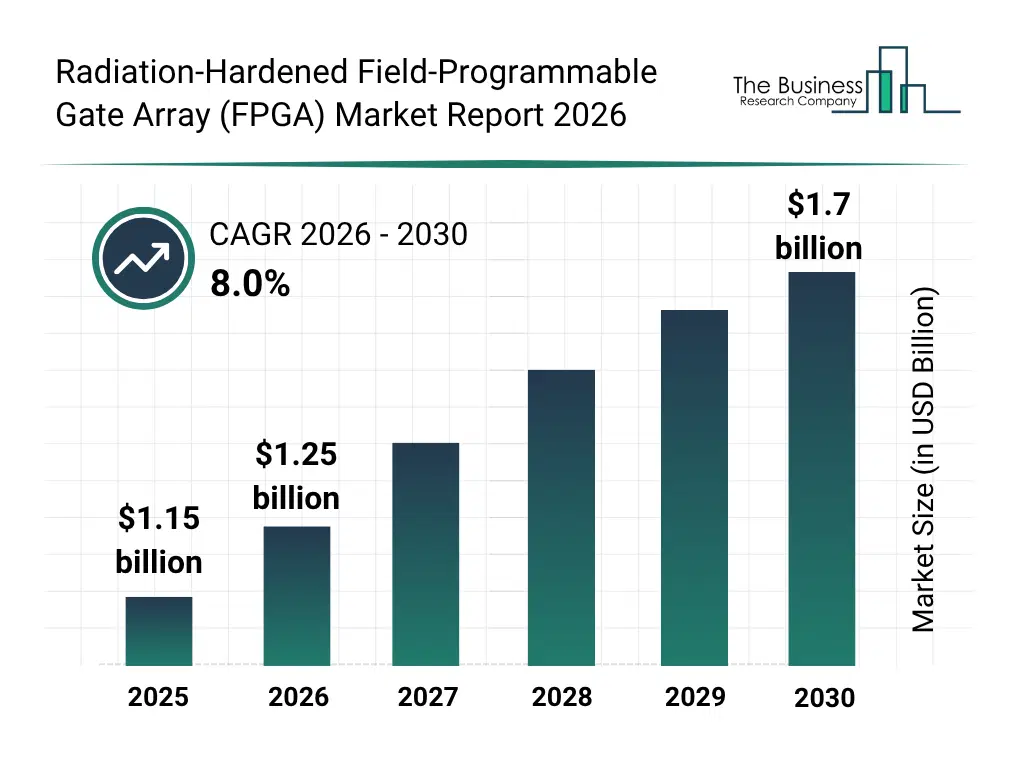
What Is The Radiation-Hardened Field-Programmable Gate Array (FPGA) Market Size and Share 2026?
The radiation-hardened field-programmable gate array (fpga) market size has grown strongly in recent years. It will grow from $1.15 billion in 2025 to $1.25 billion in 2026 at a compound annual growth rate (CAGR) of 8.4%. The growth in the historic period can be attributed to increasing deployment of satellites and spacecraft, rising demand for radiation-resistant electronics, growing defense modernization programs, expanding space exploration activities, increasing need for reliable mission-critical computing.What Is The Radiation-Hardened Field-Programmable Gate Array (FPGA) Market Growth Forecast?
The radiation-hardened field-programmable gate array (fpga) market size is expected to see strong growth in the next few years. It will grow to $1.7 billion in 2030 at a compound annual growth rate (CAGR) of 8.0%. The growth in the forecast period can be attributed to rising deployment of advanced satellite constellations, increasing demand for high-performance space computing, growing adoption of autonomous aerospace systems, expanding defense electronics modernization, increasing need for long-duration radiation-tolerant electronics. Major trends in the forecast period include increasing development of higher radiation-tolerance fpga architectures, advancements in single-event upset mitigation and fault-tolerant designs, rising integration of radiation-hardened fpgas into mission-critical systems, development of higher-performance reconfigurable space-grade processors, increasing use of radiation-hardened fpgas for long-duration missions.
Global Radiation-Hardened Field-Programmable Gate Array (FPGA) Market Segmentation
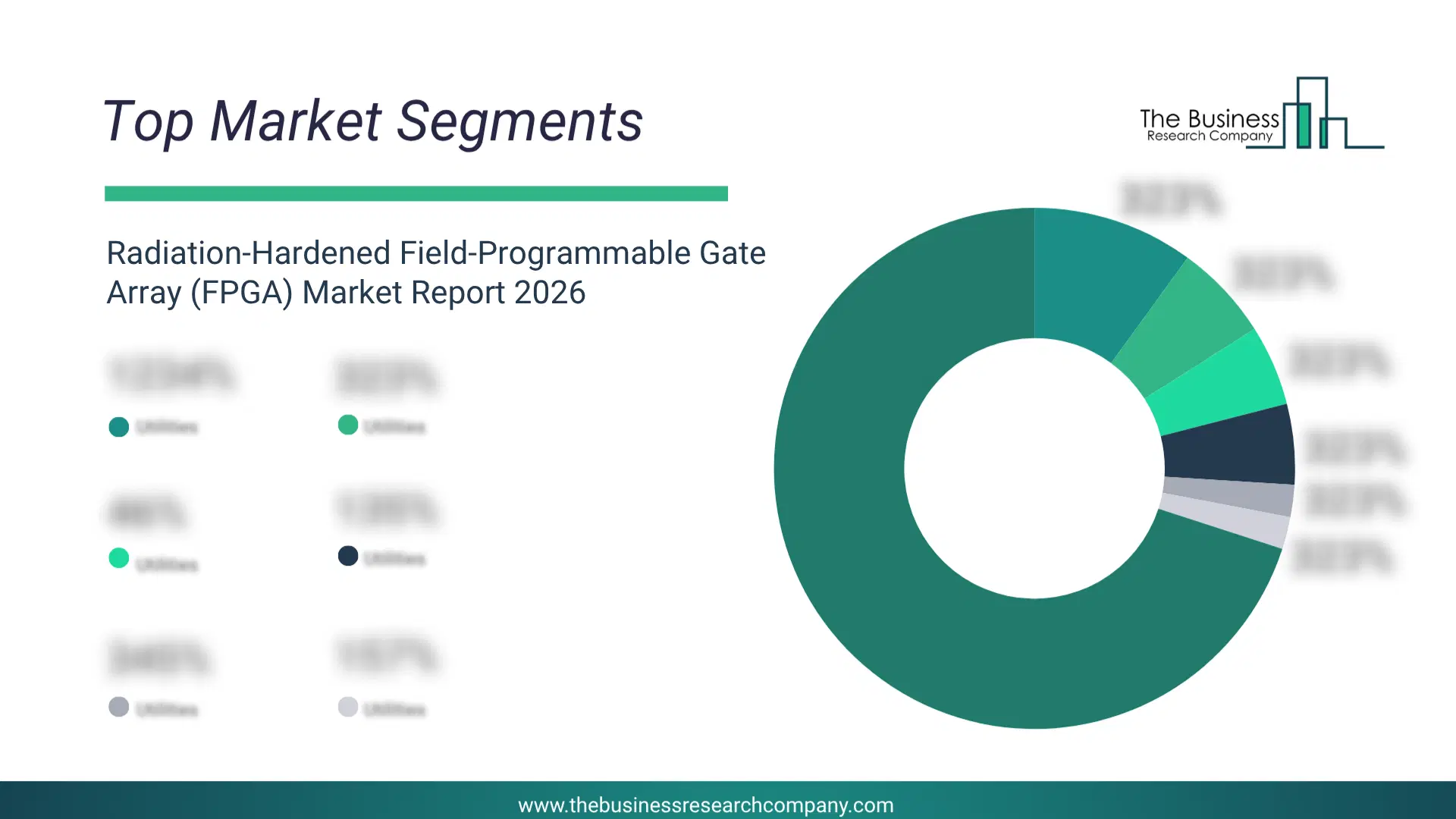
1) By Type: Static Random-Access Memory-Based, Flash-Based, Antifuse-Based 2) By Node Size: Less Than Or Equal To 28 Nanometers, 28 To 90 Nanometers, Greater Than 90 Nanometers 3) By Material: Silicon Carbide, Gallium Nitride 4) By Operating Frequency: Up To 50 Megahertz, 51 To 100 Megahertz, Above 100 Megahertz 5) By Application: Aerospace And Defense, Space, Nuclear Power, Industrial, Other Applications Subsegments: 1) By Static Random-Access Memory-Based: Spaceborne Computing Systems, Satellite Communication Systems, Software-Defined Radio Systems, Artificial Intelligence Processing, Image Processing Systems, High-Performance Computing, Reconfigurable Signal Processing, Secure Data Processing 2) By Flash-Based: Low-Power Space Electronics, Satellite Control Systems, Industrial Control Systems, Mission-Critical Embedded Systems, Radiation-Tolerant Data Acquisition, Sensor Interface Systems, Edge Computing Platforms, Avionics Control Systems 3) By Antifuse-Based: One-Time Programmable Logic Devices, Flight Control Systems, Missile Guidance Systems, Launch Vehicle Electronics, Spacecraft Command And Control, Secure Cryptographic Hardware, Safety-Critical Aerospace Systems, Defense Communication SystemsWhat Is The Driver Of The Radiation-Hardened Field-Programmable Gate Array (FPGA) Market?
The increasing military modernization programs are expected to propel the growth of the radiation-hardened field-programmable gate array (FPGA) market going forward. Military modernization programs are comprehensive initiatives by armed forces to upgrade and enhance their defense capabilities through advanced weapons systems and technologies. The rising military modernization programs are due to escalating geopolitical tensions and security threats to national sovereignty and regional stability, as nations seek to enhance their defense capabilities, deter potential adversaries, and safeguard their strategic interests. Increasing military modernization programs are driving the adoption of radiation-hardened field-programmable gate arrays (FPGAs) by increasing demand for reliable, reconfigurable, and radiation-tolerant electronics in advanced defense, space, missile, and secure communication systems. For instance, in March 2023, according to the European Security and Defense College, a Belgium-based autonomous institution, in 2030, the ongoing US Army modernization program is set to field 35 new future force systems, forming the core of more than 500 development, acquisition, or upgrade initiatives underway. Therefore, the increasing military modernization programs are driving the growth of the radiation-hardened field-programmable gate array market.Key Players In The Global Radiation-Hardened Field-Programmable Gate Array (FPGA) Market
Major companies operating in the radiation-hardened field-programmable gate array (fpga) market are BAE Systems plc, Honeywell International Inc., Advanced Micro Devices Inc., Thales S.A., QuickLogic Corporation, STMicroelectronics N.V., United Microelectronics Corporation, GlobalFoundries Inc., Microchip Technology Incorporated, Mercury Systems Inc., Frontgrade Technologies Inc., NanoXplore SAS, Rochester Electronics LLC, Achronix Semiconductor Corporation, Menta SAS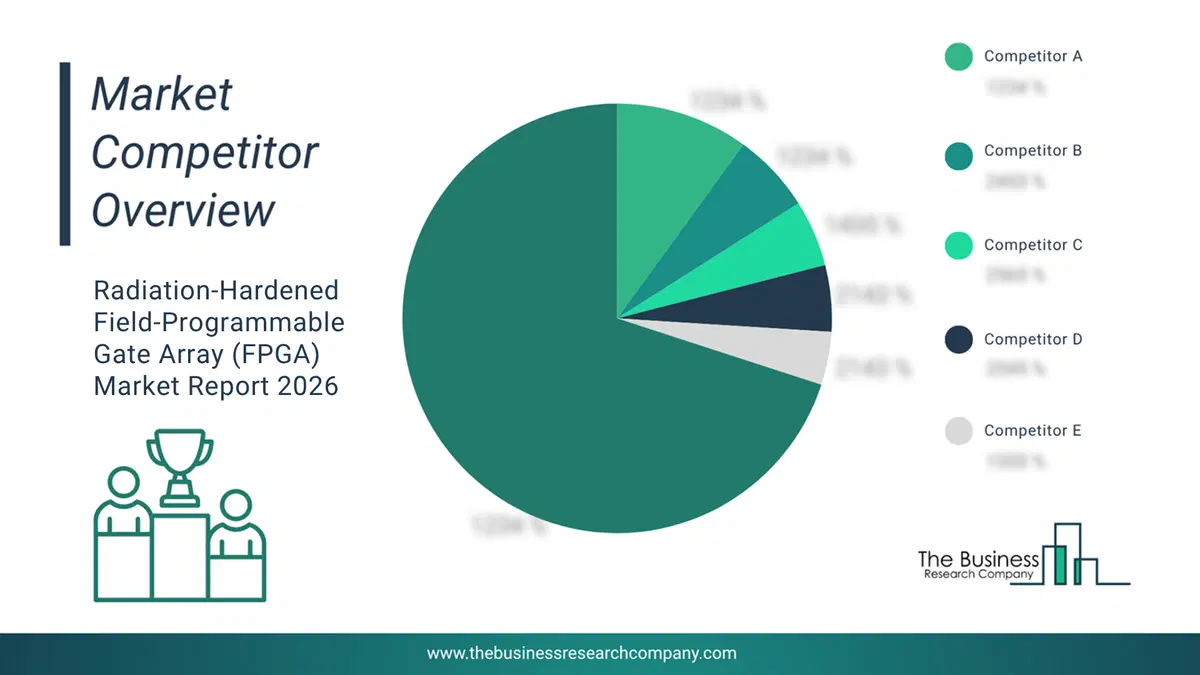
This chart is for illustrative purposes; the full report includes a detailed competitor analysis and comprehensive overview of the top 10 companies in the market.
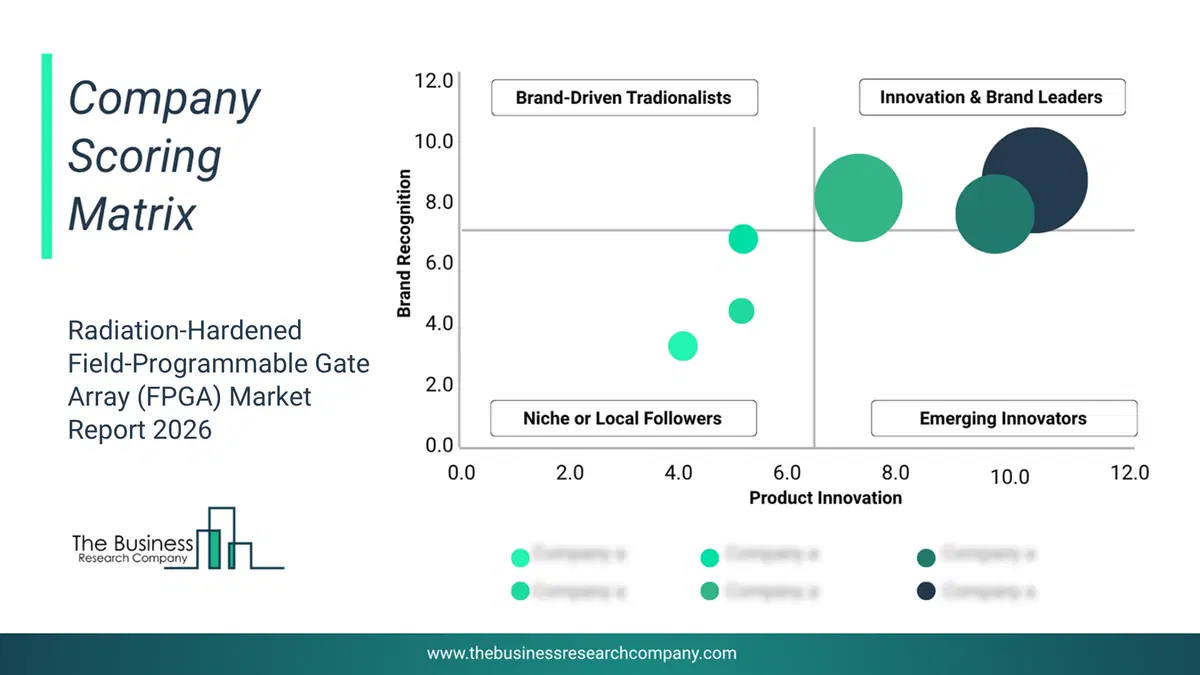
This chart maps companies by product innovation and brand strength, with bubble size indicating relative revenue, helping identify market leaders, challengers, and niche players. This is an illustrative chart; the full report provides a complete and accurate competitive analysis.
Global Radiation-Hardened Field-Programmable Gate Array (FPGA) Market Trends and Insights
Major companies operating in the radiation-hardened field-programmable gate array (FPGA) market are focusing on expanding advanced space-qualified FPGA portfolios to improve reliability, radiation tolerance, and power efficiency for satellite, avionics, and deep space missions. Space-qualified radiation-hardened FPGAs are programmable semiconductor devices designed to operate reliably in high-radiation environments while maintaining performance under extreme space conditions. For instance, in July 2025, Microchip Technology Inc., a US-based semiconductor company, expanded its space-qualified FPGA portfolio by announcing MIL-STD-883 Class B and QML Class Q qualification for its RT PolarFire RTPF500ZT FPGA and introducing engineering samples of the RT PolarFire System-on-Chip (SoC) FPGA. The new devices offer enhanced radiation resilience, lower power consumption, and integrated RISC-V processing capabilities, enabling reliable and efficient performance for next-generation satellite, avionics, and other mission-critical space applications.What Are Latest Mergers And Acquisitions In The Radiation-Hardened Field-Programmable Gate Array (FPGA) Market?
In August 2025, NanoXplore, a France-based developer of radiation-hardened Field-Programmable Gate Arrays (FPGAs), partnered with Thales Alenia Space to accelerate the adoption of its NG-ULTRA radiation-hardened System-on-Chip (SoC) FPGA for next-generation satellite platforms. Through this partnership, the companies aim to strengthen Europe's sovereign space electronics capabilities by integrating advanced radiation-hardened FPGA technology into flexible and reconfigurable space systems for commercial and institutional missions. Thales Alenia Space is a France-based aerospace manufacturer.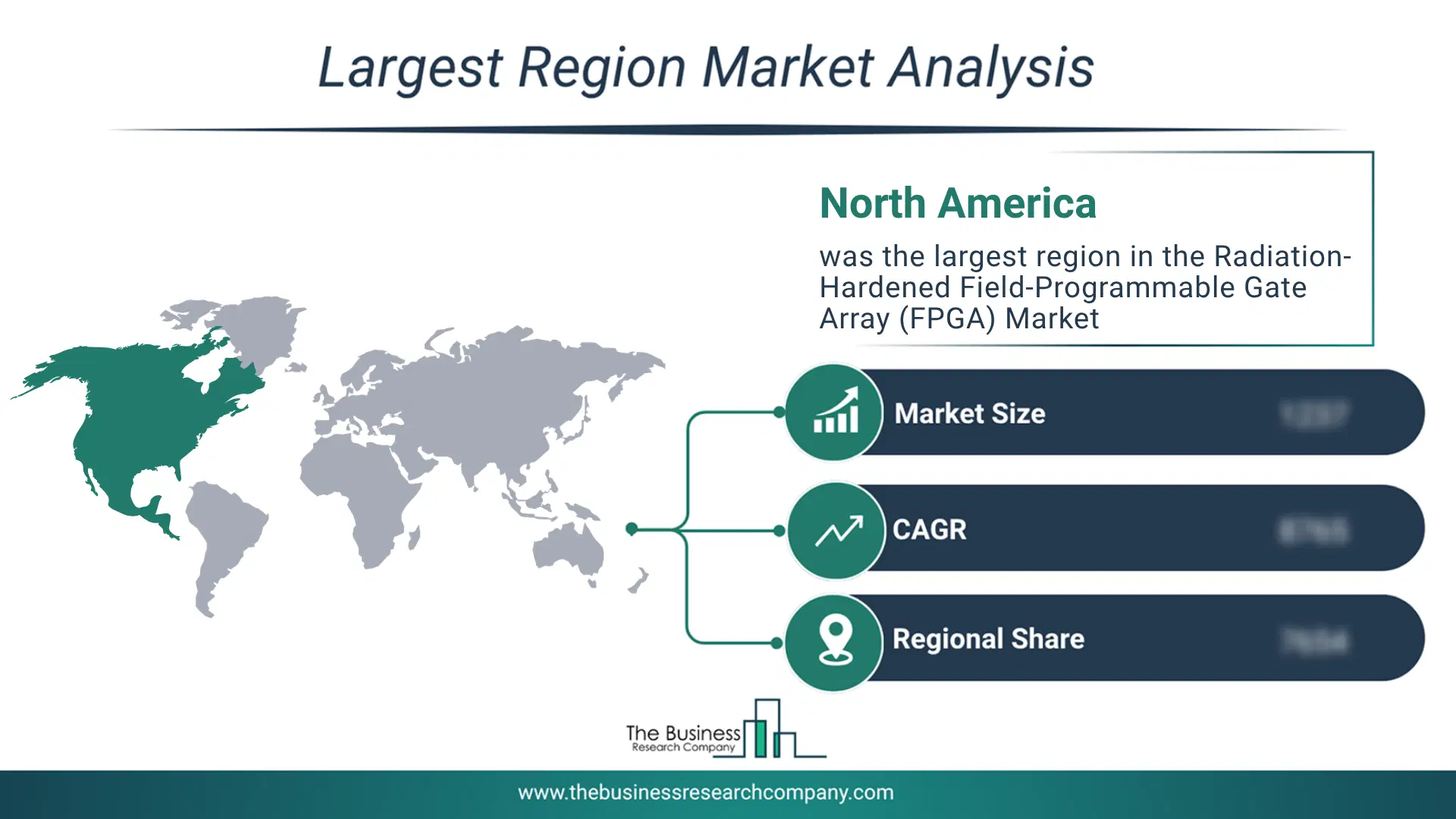
Regional Outlook
North America was the largest region in the radiation-hardened field-programmable gate array (FPGA) market in 2025. Asia-Pacific is expected to be the fastest-growing region in the forecast period. The regions covered in this market report are Asia-Pacific, South East Asia, Western Europe, Eastern Europe, North America, South America, Middle East, Africa. The countries covered in this market report are Australia, Brazil, China, France, Germany, India, Indonesia, Japan, Taiwan, Russia, South Korea, UK, USA, Canada, Italy, Spain.What Defines the Radiation-Hardened Field-Programmable Gate Array (FPGA) Market?
The radiation-hardened field-programmable gate array (FPGA) market consists of sales of radiation-hardened field-programmable gate array chips, radiation-tolerant field-programmable gate array modules, system-on-chip (SoC) radiation-hardened field-programmable gate array, and space-grade field-programmable gate array processor modules. Values in this market are ‘factory gate’ values, that is, the value of goods sold by the manufacturers or creators of the goods, whether to other entities (including downstream manufacturers, wholesalers, distributors, and retailers) or directly to end customers. The value of goods in this market includes related services sold by the creators of the goods.How is Market Value Defined and Measured?
The market value is defined as the revenues that enterprises gain from the sale of goods and/or services within the specified market and geography through sales, grants, or donations in terms of the currency (in USD unless otherwise specified). The revenues for a specified geography are consumption values that are revenues generated by organizations in the specified geography within the market, irrespective of where they are produced. It does not include revenues from resales along the supply chain, either further along the supply chain or as part of other products.
This chart presents market attractiveness based on a quantitative evaluation of growth, competition, strategic alignment, and risk, offering a clear view of opportunity areas for decision-making. This chart is for illustrative purposes; the full report contains the complete analysis.

This chart highlights the Total Addressable Market (TAM) by estimating the maximum revenue opportunity using an assumption-driven approach, supporting strategic planning and opportunity sizing across markets. The chart is illustrative; the full report provides a more comprehensive analysis.
What Key Data and Analysis Are Included in the Radiation-Hardened Field-Programmable Gate Array (FPGA) Market Report 2026?
The radiation-hardened field-programmable gate array (fpga) market research report is one of a series of new reports from The Business Research Company that provides market statistics, including industry global market size, regional shares, competitors with the market share, detailed market segments, market trends and opportunities, and any further data you may need to thrive in the radiation-hardened field-programmable gate array (fpga) industry. The market research report delivers a complete perspective of everything you need, with an in-depth analysis of the current and future state of the industry.Radiation-Hardened Field-Programmable Gate Array (FPGA) Market Report Forecast Analysis
| Report Attribute | Details |
|---|---|
| Market Size Value In 2026 | $1.25 billion |
| Revenue Forecast In 2030 | $1.7 billion |
| Growth Rate | CAGR of 8.0% from 2026 to 2030 |
| Base Year For Estimation | 2025 |
| Actual Estimates/Historical Data | 2020-2025 |
| Forecast Period | 2026 - 2030 |
| Market Representation | Revenue in USD Billion and CAGR from 2026 to 2030 |
| Segments Covered | Type, Node Size, Material, Operating Frequency, Application |
| Regional Scope | Asia-Pacific, Western Europe, Eastern Europe, North America, South America, Middle East, Africa |
| Country Scope | The countries covered in the report are Australia, Brazil, China, France, Germany, India, Indonesia, Japan, Taiwan, Russia, South Korea, UK, USA, Canada, Italy, Spain. |
| Key Companies Profiled | BAE Systems plc, Honeywell International Inc., Advanced Micro Devices Inc., Thales S.A., QuickLogic Corporation, STMicroelectronics N.V., United Microelectronics Corporation, GlobalFoundries Inc., Microchip Technology Incorporated, Mercury Systems Inc., Frontgrade Technologies Inc., NanoXplore SAS, Rochester Electronics LLC, Achronix Semiconductor Corporation, Menta SAS |
| Customization Scope | Request for Customization |
| Pricing And Purchase Options | Explore Purchase Options |