
Radio Frequency Front End Market Report 2026
Global Outlook – By Type (Radio Frequency Filters, Radio Frequency Power Amplifiers, Radio Frequency Switches, Other Types), By Application (Smartphones, PC (Personal Computer), Tablets, Wearables, Industrial Internet Of Things (IoT), Mobile Broadband, Other Applications), By End-User (Consumer Electronics, Automotive Systems, Wireless Networks, Military, Other End Users) – Market Size, Trends, Strategies, and Forecast to 2030
Radio Frequency Front End Market Overview
• Radio Frequency Front End market size has reached to $24.69 billion in 2025 • Expected to grow to $50.14 billion in 2030 at a compound annual growth rate (CAGR) of 15.2% • Growth Driver: Growing 5G Network Penetration Drives Growth In The Radio Frequency Front-End Market • Market Trend: Advanced Connectivity Solutions Transforming Radio Frequency Front-End Market • Asia-Pacific was the largest region and fastest growing region.What Is Covered Under Radio Frequency Front End Market?
The radio frequency (RF) front end refers to the section of a communication system or electronic device that handles signals in the radio frequency range. It is an essential component in radio receivers and other radio frequency systems, responsible for initial signal processing and preparing the signal for further stages of processing and demodulation. The main types of radio frequency front end are RF filters, RF power amplifiers, RF switches, and others. RF Filters are electronic components designed to allow or reject specific frequency bands in a communication system. These are used in various applications such as smartphones, PCs (personal computers), tablets, wearables, industrial lot (internet of things), mobile broadband, and others, and used by various end-users such as consumer electronics, automotive systems, wireless networks, military, and others.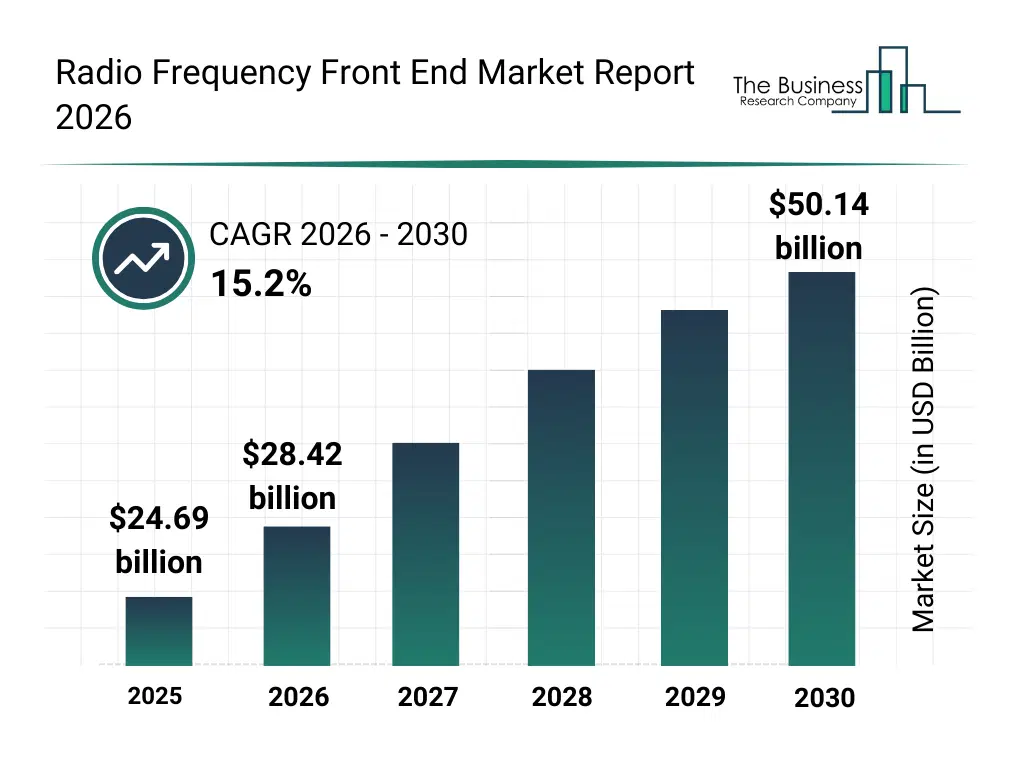
What Is The Radio Frequency Front End Market Size and Share 2026?
The radio frequency front end market size has grown rapidly in recent years. It will grow from $24.69 billion in 2025 to $28.42 billion in 2026 at a compound annual growth rate (CAGR) of 15.1%. The growth in the historic period can be attributed to growth in mobile communication devices, expansion of wireless network infrastructure, increasing smartphone penetration, demand for efficient signal processing components, development of semiconductor rf technologies.What Is The Radio Frequency Front End Market Growth Forecast?
The radio frequency front end market size is expected to see rapid growth in the next few years. It will grow to $50.14 billion in 2030 at a compound annual growth rate (CAGR) of 15.2%. The growth in the forecast period can be attributed to rollout of 5g and next generation wireless networks, rising adoption of connected and wearable devices, growth in automotive connectivity systems, expansion of industrial iot deployments, increasing demand for high speed data transmission. Major trends in the forecast period include rising integration of rf front end modules in smartphones, growing demand for high frequency and multi band rf components, increasing miniaturization of rf front end architectures, expansion of rf front end usage in iot and wearable devices, rising adoption of advanced rf filters and power amplifiers.Tariff Impact On Radio Frequency Front End Market
Tariffs have impacted the radio frequency front end market by increasing costs of imported semiconductors, rf filters, power amplifiers, and advanced packaging materials. These impacts are most pronounced in smartphone and wireless infrastructure segments, particularly in regions dependent on cross border semiconductor manufacturing such as Asia Pacific and Europe. Higher tariffs have raised component pricing and affected device manufacturing margins. At the same time, tariffs have encouraged regional semiconductor fabrication, localization of rf component supply chains, and investment in cost optimized rf front end solutions, supporting long term market resilience.
Global Radio Frequency Front End Market Segmentation
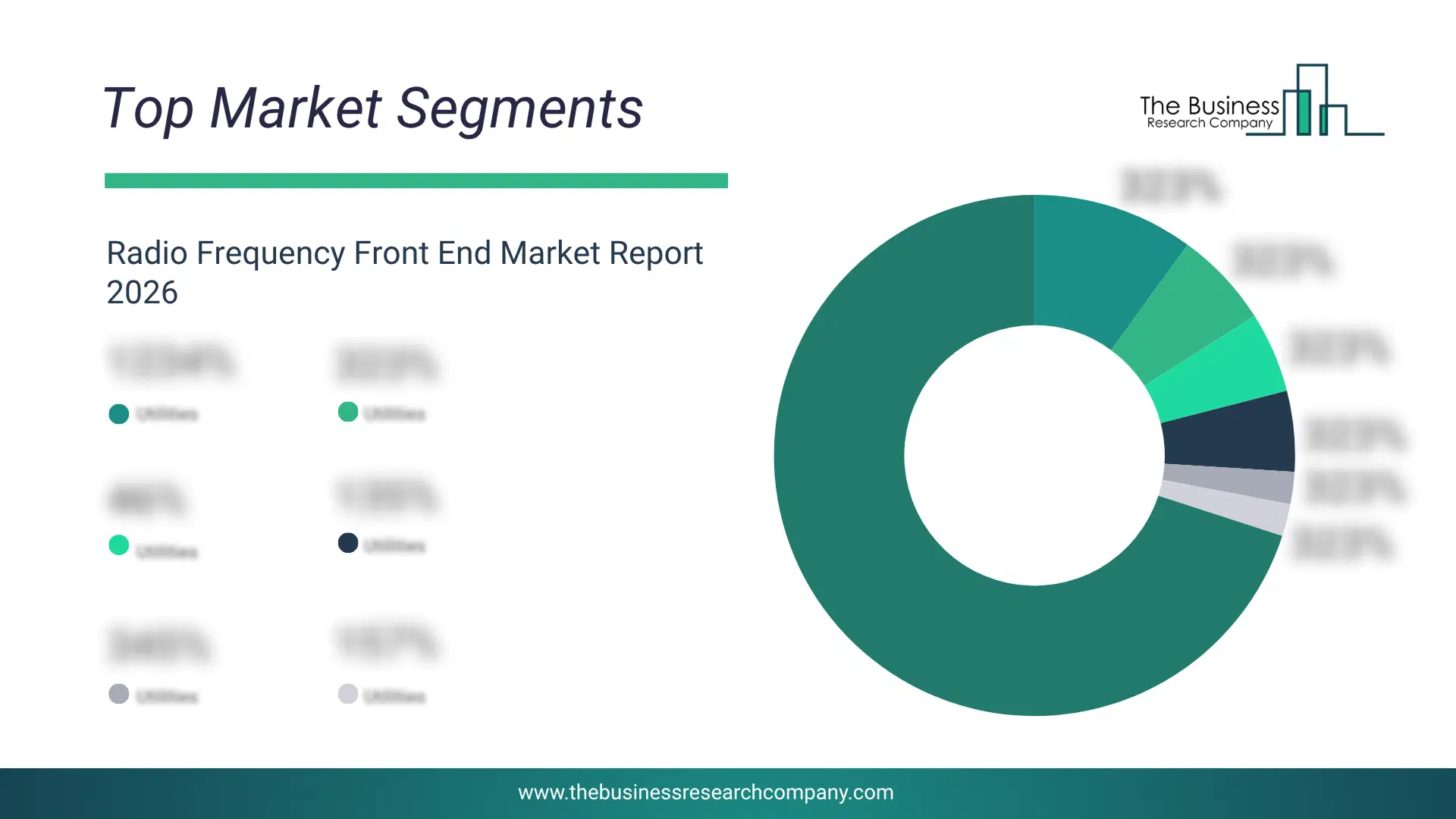
1) By Type: Radio Frequency Filters, Radio Frequency Power Amplifiers, Radio Frequency Switches, Other Types 2) By Application: Smartphones, PC (Personal Computer), Tablets, Wearables, Industrial Internet Of Things (IoT), Mobile Broadband, Other Applications 3) By End-User: Consumer Electronics, Automotive Systems, Wireless Networks, Military, Other End Users Subsegments: 1) By Radio Frequency Filters: Bandpass Filters, Low-pass Filters, High-pass Filters, Notch Filters 2) By Radio Frequency Power Amplifiers: Class A Amplifiers, Class B Amplifiers, Class AB Amplifiers, Class C Amplifiers 3) By Radio Frequency Switches: Single-Pole Single-Throw (SPST) Switches, Single-Pole Double-throw (SPDT) Switches, Multi-pole Switches 4) By Other Types: Radio Frequency Attenuators, Radio Frequency Mixers, Radio Frequency DetectorsWhat Is The Driver Of The Radio Frequency Front End Market?
The increasing 5G network penetration is expected to propel the growth of the radio frequency front-end market going forward. 5G refers to a mobile network that is fifth-generation. Radiofrequency front-end components play a crucial role in 5G networks by enabling the transmission and reception of high-frequency signals, supporting the increased data rates, low latency, and enhanced connectivity essential for the advanced capabilities of 5G technology. For instance, in May 2023, according to Telefonaktiebolaget LM Ericsson, a Sweden-based information and communication technology company, in 2028, it is expected that 4.624 billion 5G mobile subscriptions will be in place, up from 1.481 billion in 2023. Therefore, the increasing 5G network penetration is driving the radio frequency front-end market.Key Players In The Global Radio Frequency Front End Market
Major companies operating in the radio frequency front end market are Qualcomm Incorporated, Broadcom Incorporated, Texas Instruments Incorporated, Infineon Technologies Aktiengesellschaft, TDK Corporation, STMicroelectronics N.V., NXP Semiconductors N.V., Murata Manufacturing Co., Ltd., Analog Devices, Inc., Renesas Electronics Corporation, Microchip Technology Incorporated, onsemi, Inc., Skyworks Solutions, Inc., Qorvo, Inc., Taiyo Yuden Co., Ltd., Diodes Incorporated, Silicon Laboratories Inc., Würth Elektronik eiSos GmbH & Co. KG, MACOM Technology Solutions Holdings, Inc., WIN Semiconductors Corp., Vanchip (Tianjin) Technology Co., Ltd.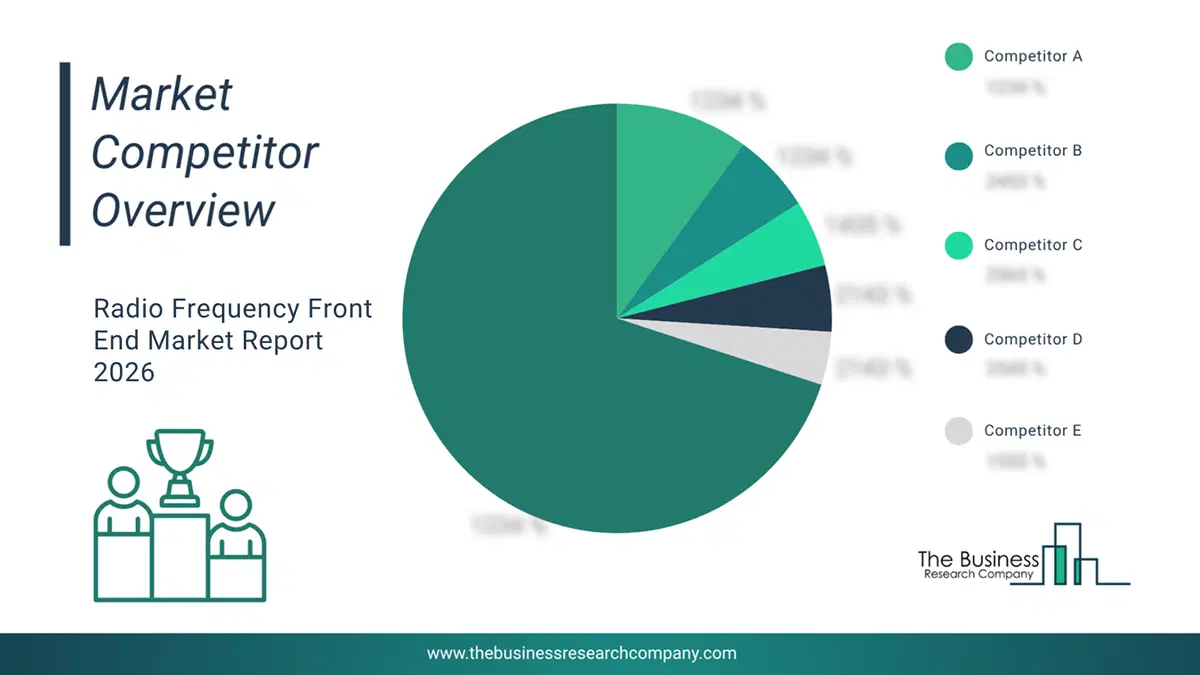
This chart is for illustrative purposes; the full report includes a detailed competitor analysis and comprehensive overview of the top 10 companies in the market.
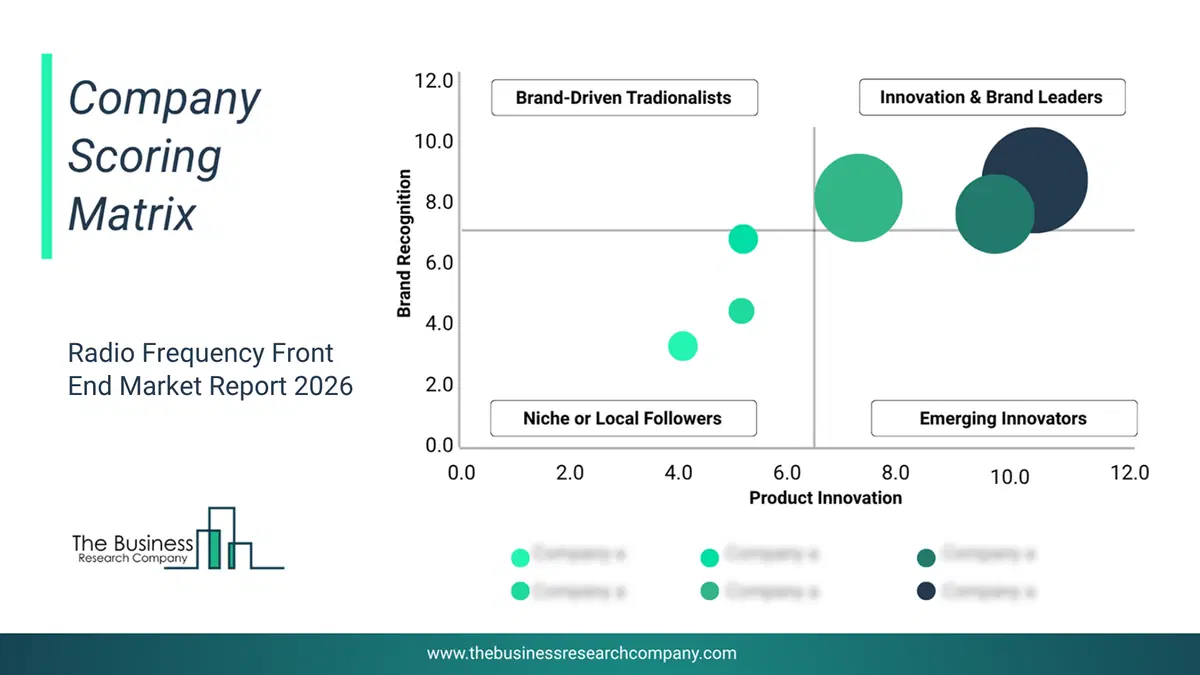
This chart maps companies by product innovation and brand strength, with bubble size indicating relative revenue, helping identify market leaders, challengers, and niche players. This is an illustrative chart; the full report provides a complete and accurate competitive analysis.
Global Radio Frequency Front End Market Trends and Insights
Major companies operating in the radio frequency front-end market are increasing their focus on introducing innovative solutions, such as software-defined radio development kits, to maximize their revenues in the market. A software-defined radio development kit is a set of tools, hardware, and software components provided to engineers and developers to design, prototype, and implement wireless communication systems using software-configurable radio frequency (RF) hardware. For instance, in May 2023, Richardson RFPD, a US-based company, launched the RadioCarbon RF Front End, which is a development kit designed to reduce radio system development time. The kit operates at 4.4–5.0 GHz and can serve as a software-defined radio (SDR) development kit. This kit is part of a collection of RF development tools that enable system architects to explore the entire signal chain, from antenna to digital, using highly optimized APIs and abstracted commands to control radio frequency components.What Are Latest Mergers And Acquisitions In The Radio Frequency Front End Market?
In December 2023, MACOM Technology Solutions Holdings, Inc., a U.S.-based provider of high‑performance semiconductor products, acquired the RF business of Wolfspeed, Inc. for US$125 million. The purpose of this acquisition was to bolster MACOM’s RF and microwave capabilities and broaden its technology/product portfolio by integrating Wolfspeed’s GaN-on‑SiC RF assets into its offerings. Wolfspeed, Inc. is a U.S.-based provider of semiconductor technologies, including RF and power devices.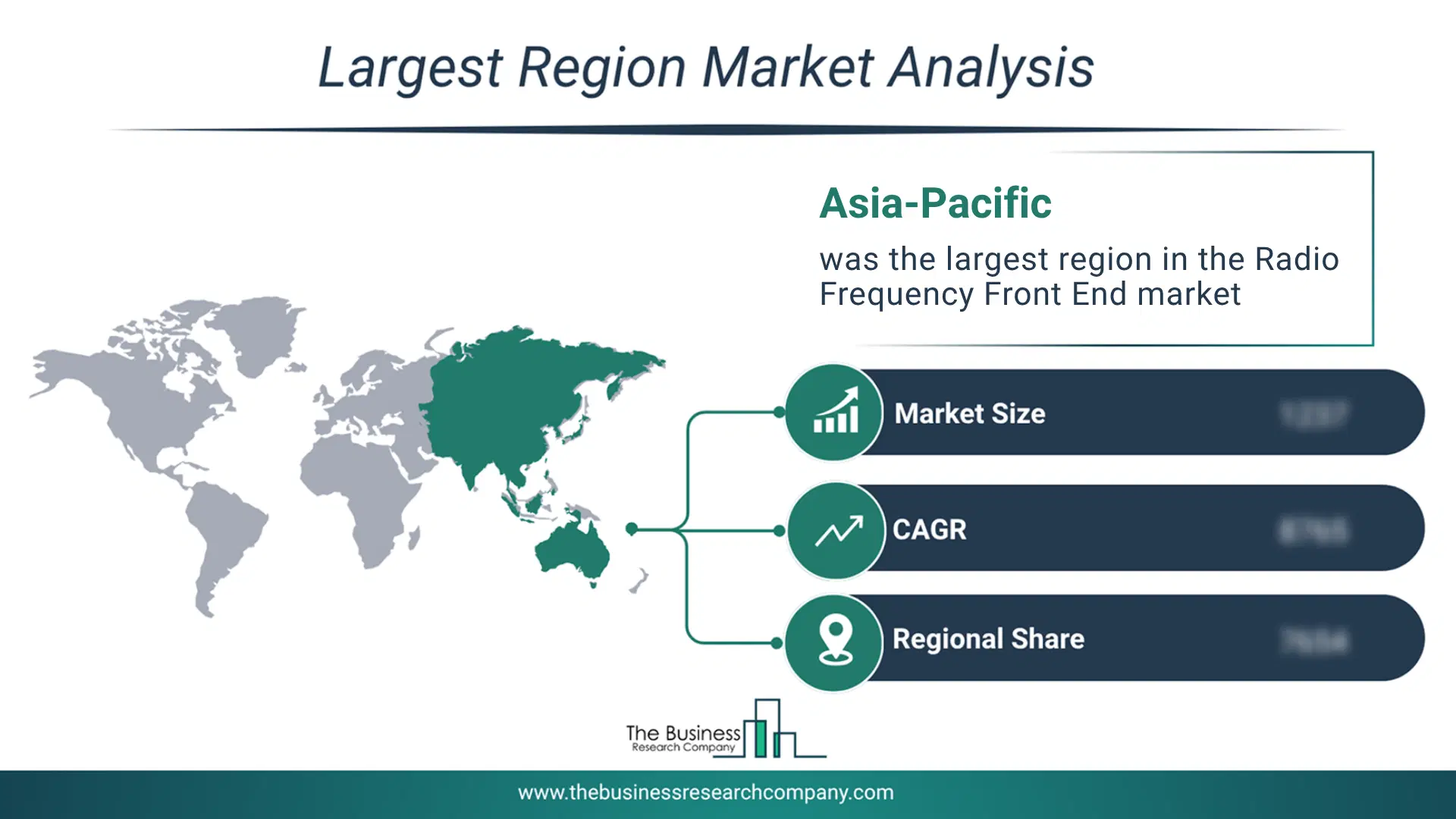
Regional Outlook
Asia-Pacific was the largest region in the radio frequency front end market in 2025. Asia-Pacific is expected to be the fastest-growing region in the forecast period. The regions covered in this market report are Asia-Pacific, South East Asia, Western Europe, Eastern Europe, North America, South America, Middle East, Africa The countries covered in this market report are Australia, Brazil, China, France, Germany, India, Indonesia, Japan, Taiwan, Russia, South Korea, UK, USA, Canada, Italy, Spain.What Defines the Radio Frequency Front End Market?
The radio frequency front-end market consists of sales of antennas, low-noise amplifiers, filters, mixers, phase shifters, and oscillators. Values in this market are ‘factory gate’ values, that is the value of goods sold by the manufacturers or creators of the goods, whether to other entities (including downstream manufacturers, wholesalers, distributors, and retailers) or directly to end customers. The value of goods in this market includes related services sold by the creators of the goods.How is Market Value Defined and Measured?
The market value is defined as the revenues that enterprises gain from the sale of goods and/or services within the specified market and geography through sales, grants, or donations in terms of the currency (in USD unless otherwise specified). The revenues for a specified geography are consumption values that are revenues generated by organizations in the specified geography within the market, irrespective of where they are produced. It does not include revenues from resales along the supply chain, either further along the supply chain or as part of other products.
This chart presents market attractiveness based on a quantitative evaluation of growth, competition, strategic alignment, and risk, offering a clear view of opportunity areas for decision-making. This chart is for illustrative purposes; the full report contains the complete analysis.

This chart highlights the Total Addressable Market (TAM) by estimating the maximum revenue opportunity using an assumption-driven approach, supporting strategic planning and opportunity sizing across markets. The chart is illustrative; the full report provides a more comprehensive analysis.
What Key Data and Analysis Are Included in the Radio Frequency Front End Market Report 2026?
The radio frequency front end market research report is one of a series of new reports from The Business Research Company that provides market statistics, including industry global market size, regional shares, competitors with the market share, detailed market segments, market trends and opportunities, and any further data you may need to thrive in the radio frequency front end industry. The market research report delivers a complete perspective of everything you need, with an in-depth analysis of the current and future state of the industry.Radio Frequency Front End Market Report Forecast Analysis
| Report Attribute | Details |
|---|---|
| Market Size Value In 2026 | $28.42 billion |
| Revenue Forecast In 2030 | $50.14 billion |
| Base Year For Estimation | 2025 |
| Actual Estimates/Historical Data | 2020-2025 |
| Forecast Period | 2026 - 2030 |
| Market Representation | Revenue in USD Billion and CAGR from 2026 to 2030 |
| Segments Covered | Type, Application, End-User |
| Regional Scope | Asia-Pacific, Western Europe, Eastern Europe, North America, South America, Middle East, Africa |
| Key Companies Profiled | Qualcomm Incorporated, Broadcom Incorporated, Texas Instruments Incorporated, Infineon Technologies Aktiengesellschaft, TDK Corporation, STMicroelectronics N.V., NXP Semiconductors N.V., Murata Manufacturing Co., Ltd., Analog Devices, Inc., Renesas Electronics Corporation, Microchip Technology Incorporated, onsemi, Inc., Skyworks Solutions, Inc., Qorvo, Inc., Taiyo Yuden Co., Ltd., Diodes Incorporated, Silicon Laboratories Inc., Würth Elektronik eiSos GmbH & Co. KG, MACOM Technology Solutions Holdings, Inc., WIN Semiconductors Corp., Vanchip (Tianjin) Technology Co., Ltd. |
| Customization Scope | Request for Customization |
| Pricing And Purchase Options | Explore Purchase Options |