
Radio Frequency Identification (RFID) And Barcode Printer Market Report 2026
Global Outlook – By Type (Barcode, Radio Frequency Identification (RFID) Printers), By Printing Technology (Thermal Transfer, Direct Thermal, Inkjet), By Printing Resolution (Below 300 Dots Per Inch (Dpi), Between 301 And 600 Dots Per Inch (Dpi), Above 601 Dots Per Inch (Dpi)), By Connectivity Type (Ethernet, Bluetooth, Serial And Parallel, Universal Serial Bus), By Application (Manufacturing, Retail, Transportation And Logistics, Healthcare, Government, Entertainment, Other Applications) – Market Size, Trends, Strategies, and Forecast to 2035
Radio Frequency Identification (RFID) And Barcode Printer Market Overview
• Radio Frequency Identification (RFID) And Barcode Printer market size has reached to $4.39 billion in 2025 • Expected to grow to $7.49 billion in 2030 at a compound annual growth rate (CAGR) of 11.3% • Growth Driver: The Expansion of Electronic Commerce and Retail Automation Is Fueling the Growth of the Market due to Increasing Online Shopping Adoption and Automated Supply Chain Needs • Market Trend: Advancements In RFID And Barcode Printing Technology Enhance Operational Efficiency And Data Accuracy • North America was the largest region in 2025 and Asia-Pacific is the fastest growing region.What Is Covered Under Radio Frequency Identification (RFID) And Barcode Printer Market?
Radio frequency identification (RFID) and barcode printers are devices designed to produce labels or tags containing barcode images or RFID chips for automatic identification and data collection. Its purpose is to support effective tracking, inventory control, and asset management by printing encoded and easily readable information on labels. These printers enhance accuracy, minimize manual errors, and enable real-time data monitoring across various industries. The main types of radio frequency identification (RFID) and barcode printers include barcode printers and radio frequency identification printers. Barcode printers refer to devices used to generate machine-readable barcode labels for identification and tracking purposes across operations. They are different printing technologies such as thermal transfer, direct thermal, and inkjet, while printing resolution such as below 300 dots per inch, between 301 and 600 dots per inch, and above 601 dots per inch. The connectivity types include ethernet, bluetooth, serial and parallel, and universal serial bus and the various applications involved are manufacturing, retail, transportation and logistics, healthcare, government, entertainment, and other applications.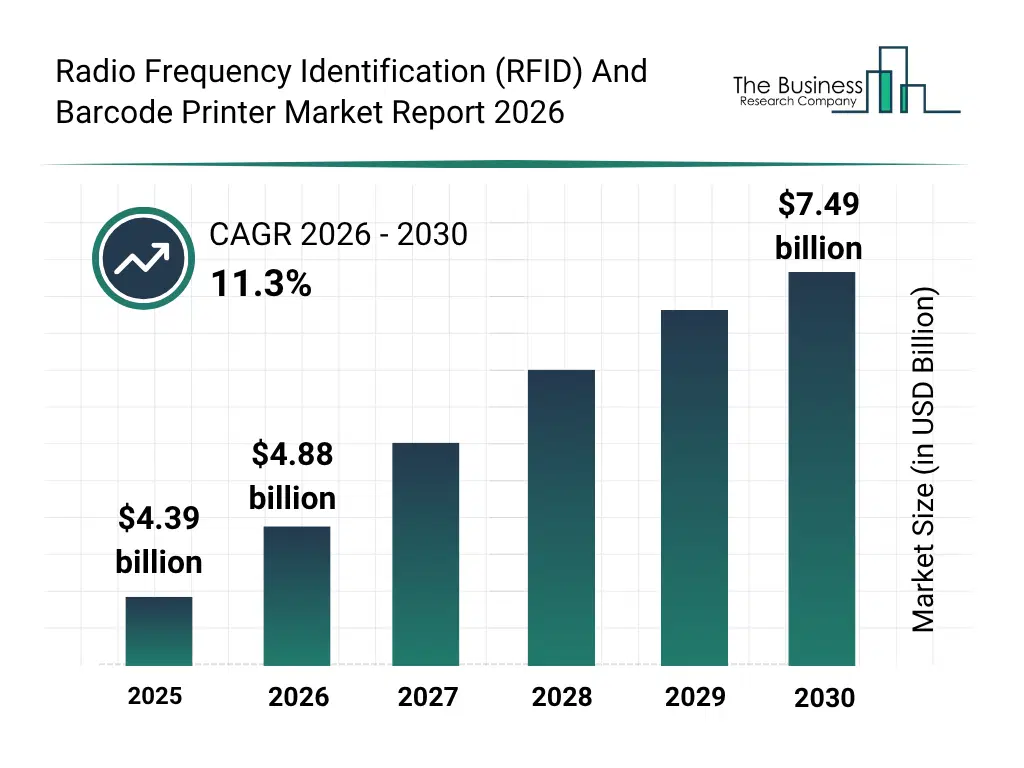
What Is The Radio Frequency Identification (RFID) And Barcode Printer Market Size and Share 2026?
The radio frequency identification (RFID) and barcode printer market size has grown rapidly in recent years.It will grow from $4.39 billion in 2025 to $4.88 billion in 2026 at a compound annual growth rate (CAGR) of 11.1%. The growth in the historic period can be attributed to growing adoption of automated inventory management systems, rising demand for accurate product identification and tracking, increasing use of barcode technology in retail and logistics, expansion of e-commerce and warehouse operations, growing implementation of RFID technology in supply chain management.What Is The Radio Frequency Identification (RFID) And Barcode Printer Market Growth Forecast?
The radio frequency identification (RFID) and barcode printer market size is expected to see rapid growth in the next few years.It will grow to $7.49 billion by 2030 at a compound annual growth rate (CAGR) of 11.3%. The growth in the forecast period can be attributed to increasing deployment of smart manufacturing and connected factories, rising demand for high-speed and high-resolution label printing, growing adoption of mobile and wireless printing devices, expansion of healthcare asset tracking and patient identification solutions, increasing investment in sustainable and recyclable labeling technologies.Major trends in the forecast period include increasing adoption of cloud-connected RFID and barcode printing systems, growing integration of RFID printers with industrial automation and smart factories, rising deployment of wireless and mobile barcode printing solutions, expansion of eco-friendly and linerless label printing technologies, increasing use of real-time inventory visibility and asset tracking solutions.
Global Radio Frequency Identification (RFID) And Barcode Printer Market Segmentation
1) By Type: Barcode, Radio Frequency Identification (RFID) Printers 2) By Printing Technology: Thermal Transfer, Direct Thermal, Inkjet 3) By Printing Resolution: Below 300 Dots Per Inch (Dpi), Between 301 And 600 Dots Per Inch (Dpi), Above 601 Dots Per Inch (Dpi) 4) By Connectivity Type: Ethernet, Bluetooth, Serial And Parallel, Universal Serial Bus 5) By Application: Manufacturing, Retail, Transportation And Logistics, Healthcare, Government, Entertainment, Other Applications Subsegments: 1) By Barcode: Desktop Barcode Printers, Industrial Barcode Printers, Mobile Barcode Printers, Card Barcode Printers, Label Barcode Printers 2) By Radio Frequency Identification Printers: Desktop Radio Frequency Identification Printers, Industrial Radio Frequency Identification Printers, Mobile Radio Frequency Identification Printers, Card Radio Frequency Identification Printers, On-Demand Radio Frequency Identification PrintersWhat Is The Driver Of The Radio Frequency Identification (RFID) And Barcode Printer Market?
The expansion of electronic commerce and retail automation is expected to propel the growth of the radio frequency identification (RFID) and barcode printer industry going forward.Electronic commerce and retail automation refer to the use of digital platforms, technologies, and automated systems to facilitate online buying and selling, streamline store and warehouse operations, and enhance efficiency across the retail value chain.The rising expansion of electronic commerce and retail automation is driven by increasing consumer adoption of online shopping, as more customers prefer the convenience, speed, and accessibility of digital retail channels.The growing demand for electronic commerce and retail automation drives the need for RFID and barcode printers to enable efficient inventory management, accurate product tracking, and seamless order fulfillment across increasingly digital and automated supply chains.For instance, in February 2024, according to the U.S.Census Bureau, a U.S.-based government agency, in 2023, total e-commerce sales were estimated at $1,118.7 billion, representing a 7.6% increase compared to 2022.Therefore, expansion of electronic commerce and retail automation is driving the growth of the radio frequency identification (RFID) and barcode printer industry.Key Players In The Global Radio Frequency Identification (RFID) And Barcode Printer Market
Major companies operating in the radio frequency identification (rfid) and barcode printer market are TE Connectivity Ltd., Avery Dennison Corporation, Omron Corporation, Brother International Corporation, Zebra Technologies Corporation, Toshiba Tec Corporation, Brady Corporation, SATO Holdings Corporation, Balluff Inc., Impinj Inc., TSC Auto ID Technology Co. Ltd., General Data Company Inc., Primera Technology Inc., Citizen Systems Japan Co. Ltd., CAB Produkttechnik GmbH & Co. KG, GoDEX International Co. Ltd., FEIG ELECTRONIC GmbH, Postek Electronics Co. Ltd., Dascom Holdings Ltd., Xiamen Hanin Electronic Technology Co. Ltd., CYBRA Corporation, Chainway India Pvt. Ltd.Global Radio Frequency Identification (RFID) And Barcode Printer Market Trends and Insights
Major companies operating in the radio frequency identification (RFID) and barcode printer market are focusing on developing advanced printing solutions with enhanced speed, precision, and connectivity to improve tracking efficiency and streamline supply chain operations. Printing solutions with enhanced speed, precision, and connectivity innovations aim to support high-performance labeling, real-time data capture, and seamless integration across industrial applications. For instance, in November 2023, Chainway, a China-based manufacturer and provider of Internet of Things (IoT) products and solutions, launched the CP30 RFID Printer, a high-speed and high-precision device designed for printing and encoding RFID tags and barcodes. The printer supports ultra-small 10 mm wide tags, offers multiple connectivity options including USB, Ethernet, Bluetooth, and wireless, and features offline operation with a touchscreen interface, making it suitable for logistics, warehousing, and inventory management applications.What Are Latest Mergers And Acquisitions In The Radio Frequency Identification (RFID) And Barcode Printer Market?
In September 2024, Atlas RFID Solutions Store, LLC, a US-based RFID and barcode solutions provider, partnered with TSC Printronix Auto ID to expand the availability of high-performance RFID and barcode printing solutions. With this partnership, Atlas RFIDstore aims to enhance its product portfolio by integrating TSC Printronix Auto ID’s comprehensive range of industrial, desktop, and mobile RFID and barcode printers, along with media and accessories, providing end-to-end labeling and RFID printing solutions to enterprise customers across logistics, warehousing, retail, and manufacturing sectors. TSC Printronix Auto ID is a Taiwan-based manufacturer of barcode and RFID printers.Regional Insights
North America was the largest region in the radio frequency identification (RFID) and barcode printer market in 2025. Asia-Pacific is expected to be the fastest-growing region in the forecast period. The regions covered in this market report are Asia-Pacific, South East Asia, Western Europe, Eastern Europe, North America, South America, Middle East and Africa. The countries covered in this market report are Australia, Brazil, China, France, Germany, India, Indonesia, Japan, Taiwan, Russia, South Korea, UK, USA, Canada, Italy, Spain.What Defines the Radio Frequency Identification (RFID) And Barcode Printer Market?
The radio frequency identification (RFID) and barcode printer market consists of sales of fixed RFID readers, handheld RFID readers, passive RFID tags, active RFID tags, barcode label printers, industrial barcode printers, desktop barcode printers, mobile barcode printers, thermal transfer printers, and direct thermal printers. Values in this market are ‘factory gate’ values, that is, the value of goods sold by the manufacturers or creators of the goods, whether to other entities (including downstream manufacturers, wholesalers, distributors, and retailers) or directly to end customers. The value of goods in this market includes related services sold by the creators of the goods.What is the Market Assessment and Strategic Outlook for the Radio Frequency Identification (RFID) And Barcode Printer Industry?
The radio frequency identification (rfid) and barcode printer market research report is one of a series of new reports from The Business Research Company that provides market statistics, including industry global market size, regional shares, competitors with the market share, detailed market segments, market trends and opportunities, and any further data you may need to thrive in the radio frequency identification (rfid) and barcode printer industry. The market research report delivers a complete perspective of everything you need, with an in-depth analysis of the current and future state of the industry.What is the Market Assessment and Strategic Outlook for the Radio Frequency Identification (RFID) And Barcode Printer Market Report 2026?
The radio frequency identification (RFID) and barcode printer market research report is one of a series of new reports from The Business Research Company that provides radio frequency identification (RFID) and barcode printer market statistics, including radio frequency identification (RFID) and barcode printer industry global market size, regional shares, competitors with a radio frequency identification (RFID) and barcode printer market share, detailed radio frequency identification (RFID) and barcode printer market segments, market trends and opportunities, and any further data you may need to thrive in the radio frequency identification (RFID) and barcode printer industry. This radio frequency identification (RFID) and barcode printer market research report delivers a complete perspective of everything you need, with an in-depth analysis of the current and future scenario of the industry.Radio Frequency Identification (RFID) And Barcode Printer Market Report Forecast Analysis
| Report Attribute | Details |
|---|---|
| Market Size Value In 2026 | $4.88 billion |
| Revenue Forecast In 2035 | $7.49 billion |
| Growth Rate | CAGR of 11.3% from 2026 to 2035 |
| Base Year For Estimation | 2025 |
| Actual Estimates/Historical Data | 2020-2025 |
| Forecast Period | 2026 - 2030 - 2035 |
| Market Representation | Revenue in USD Billion and CAGR from 2026 to 2035 |
| Segments Covered | Type, Printing Technology, Printing Resolution, Connectivity Type, Application |
| Regional Scope | Asia-Pacific, Western Europe, Eastern Europe, North America, South America, Middle East, Africa |
| Country Scope | The countries covered in the report are Australia, Brazil, China, France, Germany, India, Indonesia, Japan, Taiwan, Russia, South Korea, UK, USA, Canada, Italy, Spain. |
| Key Companies Profiled | TE Connectivity Ltd., Avery Dennison Corporation, Omron Corporation, Brother International Corporation, Zebra Technologies Corporation, Toshiba Tec Corporation, Brady Corporation, SATO Holdings Corporation, Balluff Inc., Impinj Inc., TSC Auto ID Technology Co. Ltd., General Data Company Inc., Primera Technology Inc., Citizen Systems Japan Co. Ltd., CAB Produkttechnik GmbH & Co. KG, GoDEX International Co. Ltd., FEIG ELECTRONIC GmbH, Postek Electronics Co. Ltd., Dascom Holdings Ltd., Xiamen Hanin Electronic Technology Co. Ltd., CYBRA Corporation, Chainway India Pvt. Ltd. |
| Customization Scope | Request for Customization |
| Pricing And Purchase Options | Explore Purchase Options |