
Radio Frequency Identification (RFID) Anti-Counterfeiting Tag Market Report 2026
Global Outlook – By Type (Active Radio Frequency Identification Tags, Passive Radio Frequency Identification Tags, Semi Passive Radio Frequency Identification Tags), By Frequency (Low Frequency Radio Frequency Identification Tags, High Frequency Radio Frequency Identification Tags, Ultra High Frequency Radio Frequency Identification Tags), By Form Factor (Label Tags, Card Tags, In Mold Tags, Embed Tags), By Application (Pharmaceuticals, Luxury Goods, Electronics, Apparel And Footwear, Tangible Assets), By End User (Consumer Goods, Healthcare, Manufacturing, Retail, Logistics) – Market Size, Trends, Strategies, and Forecast to 2030
Radio Frequency Identification (RFID) Anti-Counterfeiting Tag Market Overview
• Radio Frequency Identification (RFID) Anti-Counterfeiting Tag market size has reached to $5.37 billion in 2025 • Expected to grow to $10.65 billion in 2030 at a compound annual growth rate (CAGR) of 14.6% • Growth Driver: Rising Incidences Of Counterfeiting Fueling The Growth Of The Market Due To Increasing Need For Product Authentication And Supply Chain Tracking Solutions • Market Trend: Shift Toward Tamper-Proof Sewn-In RFID Anti-Counterfeiting Tags In Apparel • North America was the largest region in 2025 and Asia-Pacific is the fastest growing region.What Is Covered Under Radio Frequency Identification (RFID) Anti-Counterfeiting Tag Market?
A radio frequency identification (RFID) anti-counterfeiting tags are smart identification tags that use radio frequency identification technology to verify the authenticity of products and prevent counterfeit activities. These tags store unique product information that can be scanned and tracked throughout the supply chain. They are widely used in industries to improve product security and traceability. RFID anti-counterfeiting tags also help manufacturers enhance inventory management and brand protection. The main types of radio frequency identification (RFID) anti-counterfeiting tag include active radio frequency identification tags, passive radio frequency identification tags, and semi passive radio frequency identification tags. Active radio frequency identification tags refer to battery-powered tracking tags designed to provide long-range identification and real-time authentication of products to prevent counterfeiting. These tags operate across frequencies including low frequency radio frequency identification tags, high frequency radio frequency identification tags, and ultra high frequency radio frequency identification tags, and are available in form factors such as label tags, card tags, in mold tags, and embed tags. The various applications involved are pharmaceuticals, luxury goods, electronics, apparel and footwear, and tangible assets, and they are used by several end users such as consumer goods, healthcare, manufacturing, retail, and logistics.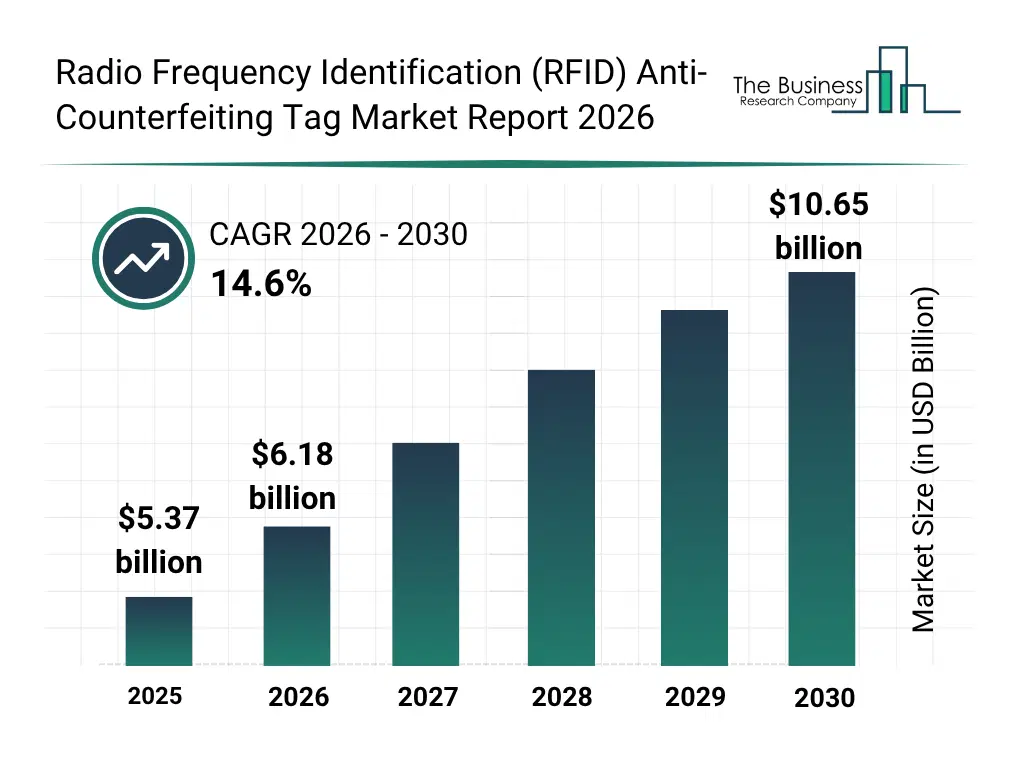
What Is The Radio Frequency Identification (RFID) Anti-Counterfeiting Tag Market Size and Share 2026?
The radio frequency identification (RFID) anti-counterfeiting tag market size has grown rapidly in recent years. It will grow from $5.37 billion in 2025 to $6.18 billion in 2026 at a compound annual growth rate (CAGR) of 15.0%. The growth in the historic period can be attributed to rising prevalence of counterfeit products in global trade, increasing adoption of barcode and early rfid based tracking systems, growth of global supply chain complexity requiring traceability, expansion of retail and e commerce distribution networks, increasing regulatory focus on product authentication and safety compliance.What Is The Radio Frequency Identification (RFID) Anti-Counterfeiting Tag Market Growth Forecast?
The radio frequency identification (RFID) anti-counterfeiting tag market size is expected to see rapid growth in the next few years. It will grow to $10.65 billion in 2030 at a compound annual growth rate (CAGR) of 14.6%. The growth in the forecast period can be attributed to integration of AI and predictive analytics in rfid tracking systems, rising demand for end to end supply chain transparency, expansion of smart packaging and intelligent labeling solutions, increasing adoption of blockchain based authentication ecosystems, growth in automated logistics and warehouse management systems. Major trends in the forecast period include iot enabled rfid tracking for real time supply chain visibility, blockchain integrated product authentication for anti counterfeit verification, AI powered inventory and traceability optimization using rfid data, expansion of smart label and embedded rfid tag adoption in retail and logistics, increasing use of tamper evident and secure rfid tagging in luxury goods and pharmaceuticals.
Global Radio Frequency Identification (RFID) Anti-Counterfeiting Tag Market Segmentation
1) By Type: Active Radio Frequency Identification Tags; Passive Radio Frequency Identification Tags; Semi Passive Radio Frequency Identification Tags 2) By Frequency: Low Frequency Radio Frequency Identification Tags; High Frequency Radio Frequency Identification Tags; Ultra High Frequency Radio Frequency Identification Tags 3) By Form Factor: Label Tags; Card Tags; In Mold Tags; Embed Tags 4) By Application: Pharmaceuticals; Luxury Goods; Electronics; Apparel And Footwear; Tangible Assets 5) By End User: Consumer Goods; Healthcare; Manufacturing; Retail; Logistics Subsegments: 1) By Active Radio Frequency Identification Tags: Battery Assisted Active Radio Frequency Identification Tags; Real Time Location System Tags; Long Range Active Radio Frequency Identification Tags; Sensor Enabled Active Radio Frequency Identification Tags; Global Positioning System Integrated Radio Frequency Identification Tags 2) By Passive Radio Frequency Identification Tags: Ultra High Frequency Passive Radio Frequency Identification Tags; High Frequency Passive Radio Frequency Identification Tags; Near Field Communication Based Radio Frequency Identification Tags; Radio Frequency Identification Label or Smart Label Tags; Radio Frequency Identification Inlay Tags; Tamper Evident Radio Frequency Identification Security Tags; Printable Radio Frequency Identification Tags 3) By Semi Passive Radio Frequency Identification Tags: Battery Assisted Passive Tags; Sensor Integrated Semi Passive Tags; Temperature Monitoring Semi Passive Tags; Asset Tracking Semi Passive Tags; High Sensitivity Semi Passive TagsWhat Is The Driver Of The Radio Frequency Identification (RFID) Anti-Counterfeiting Tag Market?
The rising incidences of counterfeiting are expected to propel the growth of the radio frequency identification (RFID) anti-counterfeiting tag market going forward. Counterfeiting refers to the illegal production and distribution of imitation goods that replicate authentic products without authorization, often violating intellectual property rights and compromising product integrity. The rising incidences of counterfeiting are increasing due to the expansion of global e-commerce platforms, which enable anonymous cross-border trade and make it easier for counterfeit goods to enter legitimate supply chains. Radio frequency identification (RFID) anti-counterfeiting tags are used to authenticate products, track supply chain movement, and prevent the sale of counterfeit goods during incidences of counterfeiting. For instance, in February 2025, according to the Deutsche Bundesbank, a Germany-based central bank, in 2024, approximately 141,300 counterfeit coins were detected in German payments, compared with around 115,900 counterfeit coins in the previous year. Therefore, the rising incidences of counterfeiting is driving the growth of the radio frequency identification (RFID) anti-counterfeiting tag industry.Key Players In The Global Radio Frequency Identification (RFID) Anti-Counterfeiting Tag Market
Major companies operating in the radio frequency identification (rfid) anti-counterfeiting tag market are Shanghai Fudan Microelectronics Group Co. Ltd.; Avery Dennison Corporation; Zebra Technologies Corporation; SATO Holdings Corporation; HID Global Corporation; Mühlbauer Holding AG & Co. KGaA; Beontag Ltd.; Impinj Inc.; Tagify RFID Co. Ltd.; Omnia Technologies Pvt. Ltd.; Tadbik Advanced Technologies Ltd.; Shang Yang RFID Technology Co. Ltd.; GAO RFID Inc.; Brady Corporation; Xerafy Singapore Pte Ltd.; Invengo Information Technology Co. Ltd.; SIVA IoT India Private Limited; Identis Tech Solutions Pvt. Ltd.; XH Smart Tech (China) Co. Ltd.; Hana Technologies Inc.; NXP Semiconductors N.V.; Alien Technology LLC; Checkpoint Systems Inc.; SML Group; TageosGlobal Radio Frequency Identification (RFID) Anti-Counterfeiting Tag Market Trends and Insights
Major companies operating in the radio frequency identification (RFID) anti-counterfeiting tag market are focusing on developing advanced solutions, such as sewn-in or iron-on RFID labels, to enhance product authentication, prevent counterfeit goods, and improve end-to-end supply chain traceability. Sewn-in or iron-on RFID labels are durable RFID-enabled textile tags that are permanently embedded or heat-bonded into garments during manufacturing to enable secure product identification, authentication, and lifecycle tracking without easy removal or tampering. For instance, in January 2023, Prosegur Security, a US-based security solutions provider, launched eRibbon, the first sewn-in or iron-on RFID label designed specifically for apparel authentication and tracking. The solution is developed for high-risk and heavily processed textile products such as denim and is engineered to withstand harsh manufacturing processes, including stone washing and chemical treatments. Designed to strengthen product security and authenticity verification, eRibbon enables permanent item-level identification by embedding RFID data directly into garments, thereby eliminating the possibility of tag tampering or replacement. The solution enhances anti-counterfeiting protection, improves inventory accuracy, and supports greater transparency across the apparel supply chain.What Are Latest Mergers And Acquisitions In The Radio Frequency Identification (RFID) Anti-Counterfeiting Tag Market?
In July 2024, Fedrigoni Group, an Italy-based specialty papers and RFID solutions provider, acquired a majority stake in Boing Tech for an undisclosed amount. This strategic acquisition is aimed at enhancing Fedrigoni’s RFID and anti-counterfeiting technology capabilities. Through this deal, the company seeks to expand its portfolio in RFID inlays, smart labels, and track-and-trace solutions used for brand protection and product authentication. Boing Tech is a China-based manufacturer that specializes in RFID inlays and tags.Regional Outlook
North America was the largest region in the radio frequency identification (RFID) anti-counterfeiting tag market in 2025. Asia-Pacific is expected to be the fastest-growing region in the forecast period. The regions covered in this market report are Asia-Pacific, South East Asia, Western Europe, Eastern Europe, North America, South America, Middle East, Africa. The countries covered in this market report are Australia, Brazil, China, France, Germany, India, Indonesia, Japan, Taiwan, Russia, South Korea, UK, USA, Canada, Italy, Spain.What Defines the Radio Frequency Identification (RFID) Anti-Counterfeiting Tag Market?
The radio frequency identification (RFID) anti-counterfeiting tags market consists of sales of RFID labels, RFID inlays, smart tags, RFID readers, and authentication systems. Values in this market are ‘factory gate’ values, that is the value of goods sold by the manufacturers or creators of the goods, whether to other entities (including downstream manufacturers, wholesalers, distributors and retailers) or directly to end customers. The value of goods in this market includes related services sold by the creators of the goods.How is Market Value Defined and Measured?
The market value is defined as the revenues that enterprises gain from the sale of goods and/or services within the specified market and geography through sales, grants, or donations in terms of the currency (in USD unless otherwise specified). The revenues for a specified geography are consumption values that are revenues generated by organizations in the specified geography within the market, irrespective of where they are produced. It does not include revenues from resales along the supply chain, either further along the supply chain or as part of other products.What Key Data and Analysis Are Included in the Radio Frequency Identification (RFID) Anti-Counterfeiting Tag Market Report 2026?
The radio frequency identification (rfid) anti-counterfeiting tag market research report is one of a series of new reports from The Business Research Company that provides market statistics, including industry global market size, regional shares, competitors with the market share, detailed market segments, market trends and opportunities, and any further data you may need to thrive in the radio frequency identification (rfid) anti-counterfeiting tag industry. The market research report delivers a complete perspective of everything you need, with an in-depth analysis of the current and future state of the industry.Radio Frequency Identification (RFID) Anti-Counterfeiting Tag Market Report Forecast Analysis
| Report Attribute | Details |
|---|---|
| Market Size Value In 2026 | $6.18 billion |
| Revenue Forecast In 2030 | $10.65 billion |
| Growth Rate | CAGR of 14.6% from 2026 to 2030 |
| Base Year For Estimation | 2025 |
| Actual Estimates/Historical Data | 2020-2025 |
| Forecast Period | 2026 - 2030 |
| Market Representation | Revenue in USD Billion and CAGR from 2026 to 2030 |
| Segments Covered | Type, Frequency, Form Factor, Application, End User |
| Regional Scope | Asia-Pacific, Western Europe, Eastern Europe, North America, South America, Middle East, Africa |
| Country Scope | The countries covered in the report are Australia, Brazil, China, France, Germany, India, ... |
| Key Companies Profiled | Shanghai Fudan Microelectronics Group Co. Ltd.; Avery Dennison Corporation; Zebra Technologies Corporation; SATO Holdings Corporation; HID Global Corporation; Mühlbauer Holding AG & Co. KGaA; Beontag Ltd.; Impinj Inc.; Tagify RFID Co. Ltd.; Omnia Technologies Pvt. Ltd.; Tadbik Advanced Technologies Ltd.; Shang Yang RFID Technology Co. Ltd.; GAO RFID Inc.; Brady Corporation; Xerafy Singapore Pte Ltd.; Invengo Information Technology Co. Ltd.; SIVA IoT India Private Limited; Identis Tech Solutions Pvt. Ltd.; XH Smart Tech (China) Co. Ltd.; Hana Technologies Inc.; NXP Semiconductors N.V.; Alien Technology LLC; Checkpoint Systems Inc.; SML Group; Tageos |
| Customization Scope | Request for Customization |
| Pricing And Purchase Options | Explore Purchase Options |