
Radio Frequency Identification (RFID) Market Report 2026
Global Outlook – By Component (Hardware, Software, Services), By Frequency (Low Frequency (30kHz - 300kHz), High Frequency (3MHz - 30MHz), Ultra-High Frequency (300MHz - 3GHz)), By Material And Form Factor (Labels And Inlays, Cards And Key Fobs, Tags And Hard Tags), By Application (Asset Tracking, Inventory Management, Access Control And Authentication, Supply Chain And Logistics Tracking, Animal Tracking, Retail Item Level Tracking, Healthcare Asset Management), By Industry (Agriculture And Forestry, Healthcare, Manufacturing, Retail, Transportation And Logistics, Other Industries) – Market Size, Trends, Strategies, and Forecast to 2030
Radio Frequency Identification (RFID) Market Overview
• Radio Frequency Identification (RFID) market size has reached to $15.41 billion in 2025 • Expected to grow to $26.77 billion in 2030 at a compound annual growth rate (CAGR) of 11.7% • Growth Driver: Growing E-Commerce Driving The Market Growth Due To Increasing Demand For Real-Time Inventory Tracking And Order Fulfillment • Market Trend: Innovations In Radio Frequency Identification (RFID) Technology Enhance Real-Time Asset Visibility And Supply Chain Efficiency • North America was the largest region in 2025 and Asia-Pacific is the fastest growing region.What Is Covered Under Radio Frequency Identification (RFID) Market?
Radio frequency identification (RFID) is a wireless communication technology that uses electromagnetic fields to automatically identify, track, and exchange data with tagged objects without direct line-of-sight scanning. The system allows multiple items to be scanned simultaneously and remotely, which reduces manual errors, speeds up operational workflows, and provides accurate tracking across complex environments. The main components of radio frequency identification include hardware, software, and services. Hardware refers to physical devices such as tags, readers, antennas, and related equipment that enable data capture and communication within identification systems. These solutions operate across low frequency (30 kilohertz to 300 kilohertz), high frequency (3 megahertz to 30 megahertz), and ultra-high frequency (300 megahertz to 3 gigahertz) and are available in labels and inlays, cards and key fobs, and tags and hard tags. They find application in asset tracking, inventory management, access control and authentication, supply chain and logistics tracking, animal tracking, retail item level tracking, and healthcare asset management, serving end users including agriculture and forestry, healthcare, manufacturing, retail, transportation and logistics, and other industries.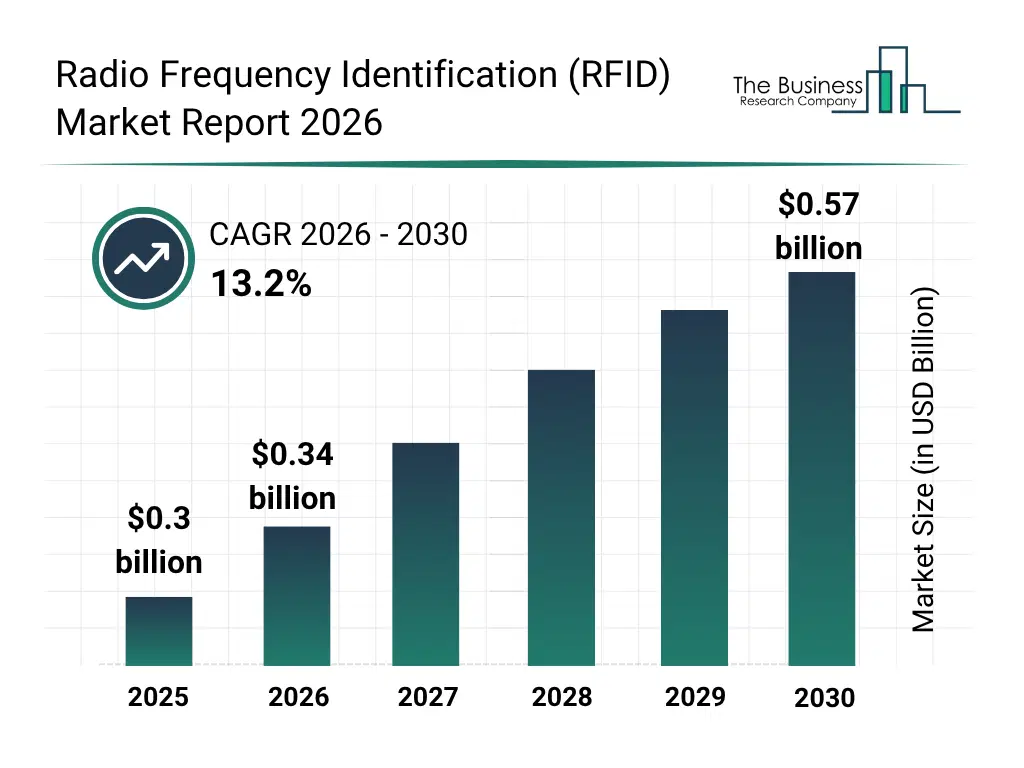
What Is The Radio Frequency Identification (RFID) Market Size and Share 2026?
The radio frequency identification (RFID) market size has grown rapidly in recent years. It will grow from $15.41 billion in 2025 to $17.18 billion in 2026 at a compound annual growth rate (CAGR) of 11.5%. The growth in the historic period can be attributed to rising demand for supply chain automation, increasing adoption of barcode and rfid systems, growth of retail and logistics sectors, need for operational efficiency, technological advancements in rfid hardware.What Is The Radio Frequency Identification (RFID) Market Growth Forecast?
The radio frequency identification (RFID) market size is expected to see rapid growth in the next few years. It will grow to $26.77 billion in 2030 at a compound annual growth rate (CAGR) of 11.7%. The growth in the forecast period can be attributed to adoption of ai and ml integrated rfid systems, expansion of iot-enabled tracking devices, increasing demand for real-time asset monitoring, growth of smart warehouses and manufacturing, investment in rfid middleware and analytics software. Major trends in the forecast period include real-time inventory tracking, enhanced asset visibility, rfid-enabled workflow automation, integration with enterprise resource planning (erp) systems, rfid-based access control solutions.
Global Radio Frequency Identification (RFID) Market Segmentation
1) By Component: Hardware, Software, Services 2) By Frequency: Low Frequency (30kHz - 300kHz), High Frequency (3MHz - 30MHz), Ultra-High Frequency (300MHz - 3GHz) 3) By Material And Form Factor: Labels And Inlays, Cards And Key Fobs, Tags And Hard Tags 4) By Application: Asset Tracking, Inventory Management, Access Control And Authentication, Supply Chain And Logistics Tracking, Animal Tracking, Retail Item Level Tracking, Healthcare Asset Management 5) By Industry: Agriculture And Forestry, Healthcare, Manufacturing, Retail, Transportation And Logistics, Other Industries Subsegments: 1) By Hardware: Tags, Readers, Antennas, Printers And Encoders, Label Applicators, Handheld Readers, Fixed Readers, Integrated Readers, Cables And Connectors 2) By Software: Middleware Platforms, Location Analytics Software, Device Management Software, Inventory Management Software, Data Visualization Software 3) By Services: Consulting Services, System Integration Services, Deployment And Installation Services, Maintenance And Support Services, Training And Technical Assistance ServicesWhat Is The Driver Of The Radio Frequency Identification (RFID) Market?
The growing e-commerce is expected to propel the growth of the radio frequency identification (RFID) market going forward. E-commerce refers to the buying and selling of goods and services over the internet through online platforms and digital transactions. The rise of e-commerce is driven by growth in internet penetration and smartphone adoption, which enable convenient online shopping access for consumers worldwide. Growing e-commerce drives demand for RFID technology as it enables real-time inventory tracking, accurate order fulfillment, and efficient warehouse management, which are essential for meeting customer expectations in online retail operations. For instance, in February 2024, according to the U.S. Census Bureau, a U.S.-based government agency, in 2023, total e-commerce sales were estimated at $1,118.7 billion, representing a 7.6% increase compared to 2022. Therefore, growing e-commerce is driving the growth of the radio frequency identification (RFID) industry.Key Players In The Global Radio Frequency Identification (RFID) Market
Major companies operating in the radio frequency identification (RFID) market are Siemens AG, Honeywell International Inc., NXP Semiconductors N.V., Murata Manufacturing Co. Ltd., Avery Dennison Corporation, Zebra Technologies Corporation, HID Global Corporation, Checkpoint Systems Inc., Pepperl+Fuchs SE, Datalogic S.p.A., Beontag S.A., Impinj Inc., Nedap N.V., Identiv Inc., Mojix Inc., Invengo Information Technology Co. Ltd., Alien Technology LLC, CipherLab Co. Ltd., GAO RFID Inc., Unitech Electronics Co. Ltd., Tageos SAS, FEIG ELECTRONIC GmbH, SATO Holdings Corporation, RF Code Inc., CAEN RFID S.r.l., and .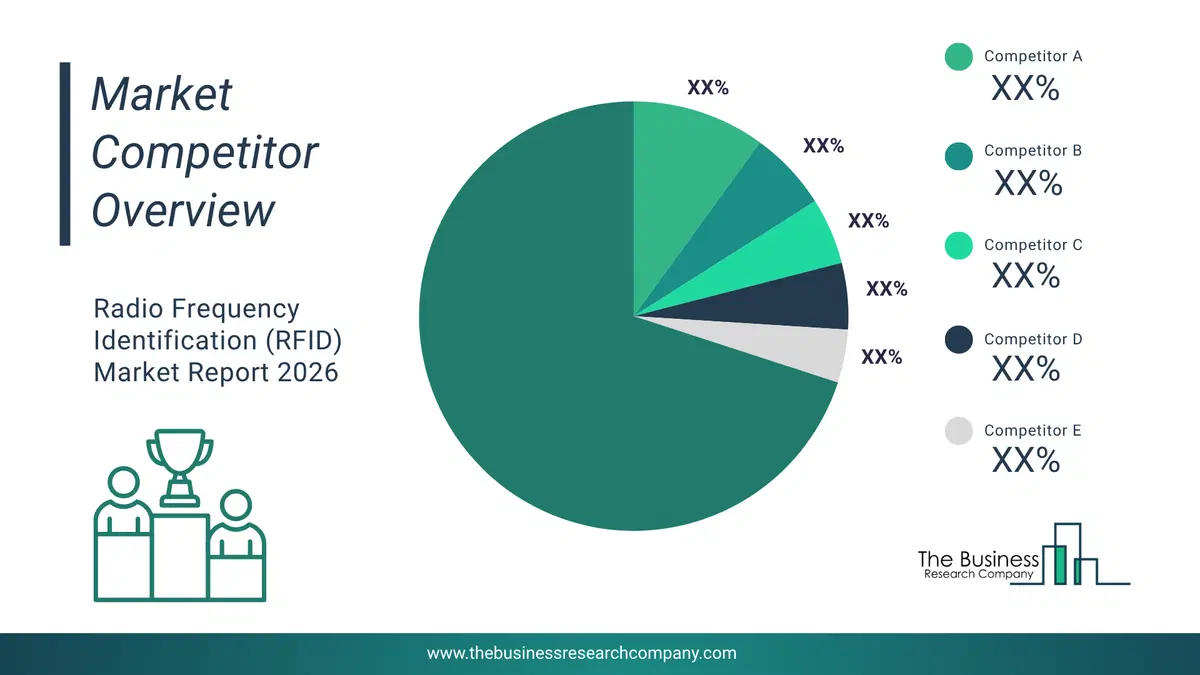
This chart is for illustrative purposes; the full report includes a detailed competitor analysis and comprehensive overview of the top 10 companies in the market.
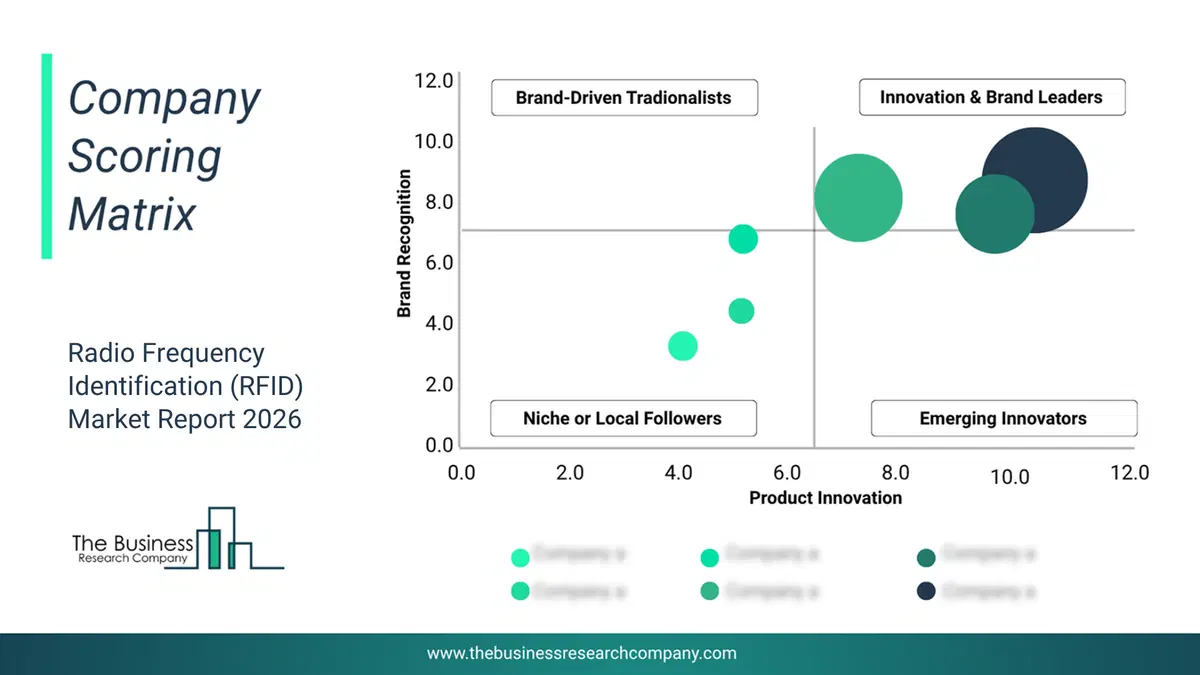
This chart maps companies by product innovation and brand strength, with bubble size indicating relative revenue, helping identify market leaders, challengers, and niche players. This is an illustrative chart; the full report provides a complete and accurate competitive analysis.
Global Radio Frequency Identification (RFID) Market Trends and Insights
Major companies operating in the radio frequency identification (RFID) market are focusing on developing advanced solutions, such as ultra-rugged fixed RAIN RFID readers, to improve inventory accuracy, enable real-time asset tracking, and enhance operational efficiency across industrial environments. Ultra-rugged fixed RAIN RFID readers are designed to withstand harsh conditions while delivering high-performance, long-range RFID data capture for warehouses, manufacturing plants, and outdoor logistics operations. For instance, in January 2024, Zebra Technologies, a US-based enterprise asset intelligence company, introduced the FXR90, an ultra-rugged fixed RAIN RFID reader. The solution is engineered for extreme environments and supports extended read ranges, edge computing capabilities, and flexible connectivity options, enabling seamless integration into industrial workflows. The reader enhances visibility across supply chains by delivering accurate, real-time tracking of inventory, pallets, and critical assets, helping enterprises reduce shrinkage, improve throughput, and optimize operational performance.What Are Latest Mergers And Acquisitions In The Radio Frequency Identification (RFID) Market?
In February 2023, HID Global Corporation, a US-based provider of secure identity solutions, RFID credentials, readers, and location services technologies, acquired GuardRFID for an undisclosed amount. With this acquisition, HID aimed to expand its active RFID and real-time location services portfolio while strengthening its presence in healthcare safety, asset tracking, and patient monitoring solutions. GuardRFID is a Canada-based provider of real-time location services hardware and software that offers active RFID tags, readers, and monitoring platforms designed for healthcare applications.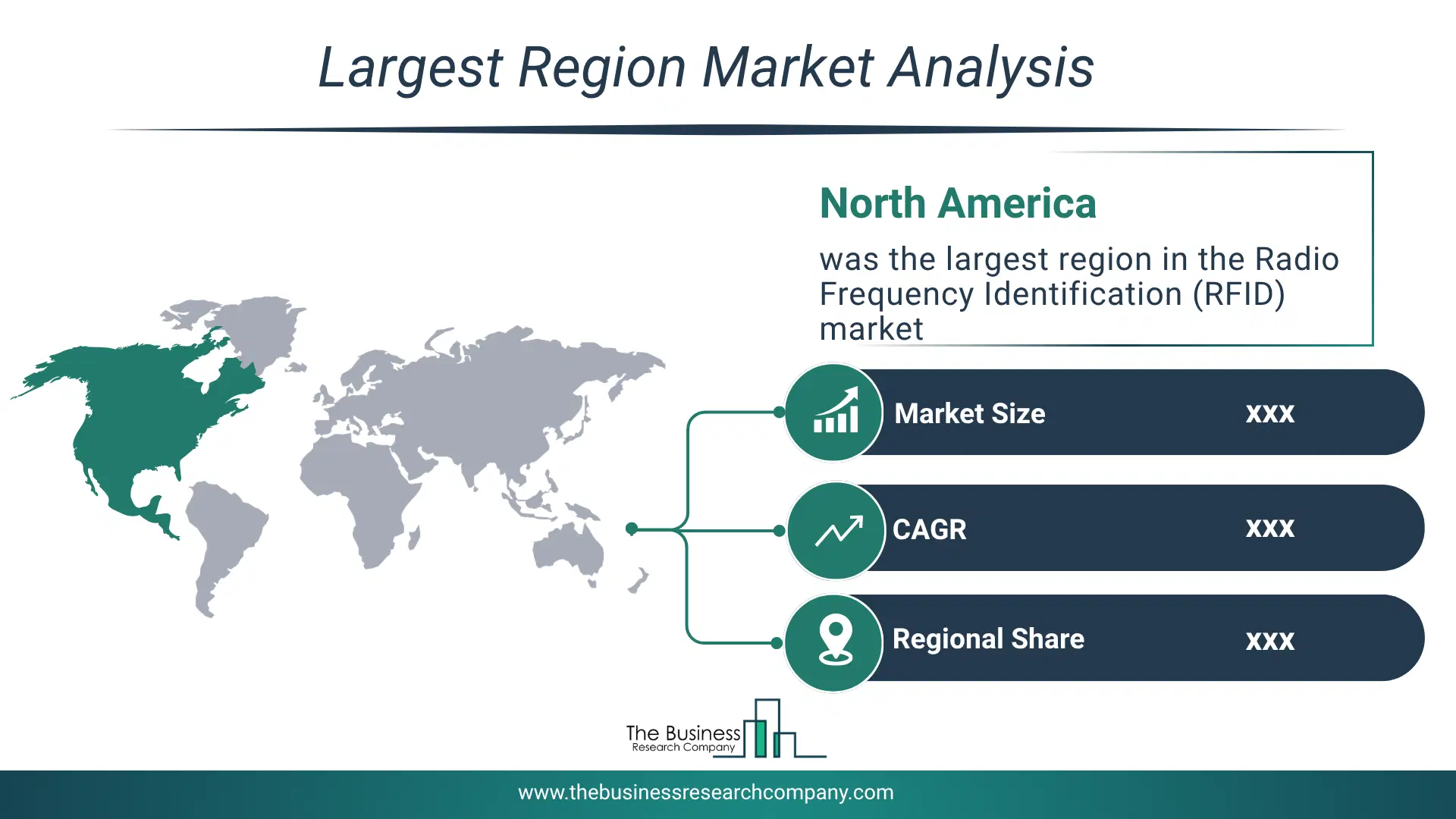
Regional Insights
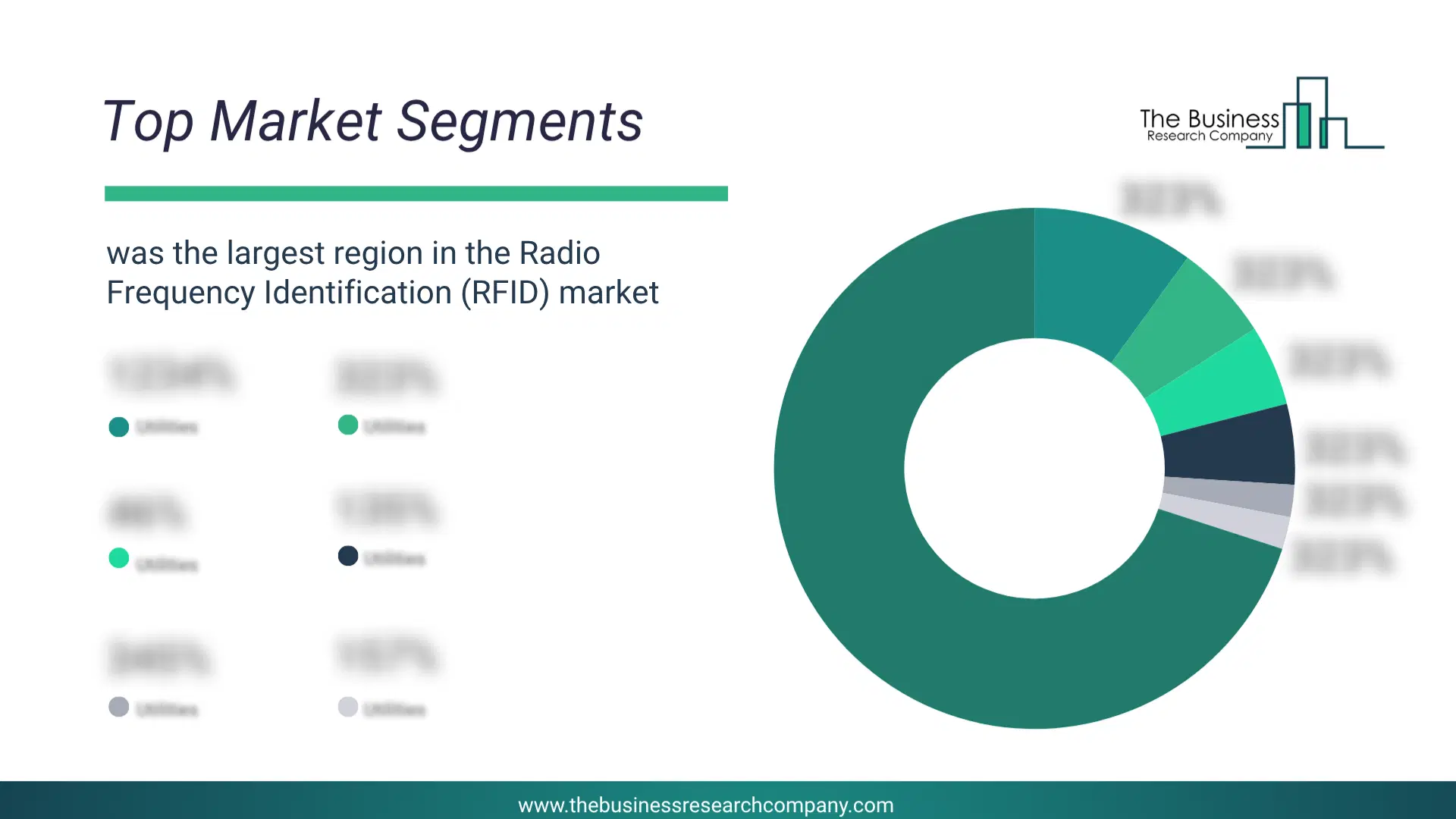
North America was the largest region in the radio frequency identification (RFID) market in 2025. Asia-Pacific is expected to be the fastest-growing region in the forecast period. The regions covered in this market report are Asia-Pacific, South East Asia, Western Europe, Eastern Europe, North America, South America, Middle East, Africa. The countries covered in this market report are Australia, Brazil, China, France, Germany, India, Indonesia, Japan, Taiwan, Russia, South Korea, UK, USA, Canada, Italy, Spain.What Defines the Radio Frequency Identification (RFID) Market?
The radio frequency identification (RFID) market consists of revenues earned by entities by providing services such as cold chain temperature monitoring, document and file tracking, waste management tracking, and smart manufacturing process monitoring. The market value includes the value of related goods sold by the service provider or included within the service offering. The radio frequency identification (RFID) market also includes sales of RFID readers, RFID antennas, RFID handheld scanners, and RFID printer-encoders. Values in this market are ‘factory gate’ values, that is, the value of goods sold by the manufacturers or creators of the goods, whether to other entities (including downstream manufacturers, wholesalers, distributors, and retailers) or directly to end customers. The value of goods in this market includes related services sold by the creators of the goods.How is Market Value Defined and Measured?
The market value is defined as the revenues that enterprises gain from the sale of goods and/or services within the specified market and geography through sales, grants, or donations in terms of the currency (in USD unless otherwise specified). The revenues for a specified geography are consumption values that are revenues generated by organizations in the specified geography within the market, irrespective of where they are produced. It does not include revenues from resales along the supply chain, either further along the supply chain or as part of other products.
This chart presents market attractiveness based on a quantitative evaluation of growth, competition, strategic alignment, and risk, offering a clear view of opportunity areas for decision-making. This chart is for illustrative purposes; the full report contains the complete analysis.

This chart highlights the Total Addressable Market (TAM) by estimating the maximum revenue opportunity using an assumption-driven approach, supporting strategic planning and opportunity sizing across markets. The chart is illustrative; the full report provides a more comprehensive analysis.
What Key Data And Analysis Are Included In The Radio Frequency Identification (RFID) Market Report 2026?
The radio frequency identification (rfid) market research report is one of a series of new reports from The Business Research Company that provides market statistics, including industry global market size, regional shares, competitors with the market share, detailed market segments, market trends and opportunities, and any further data you may need to thrive in the radio frequency identification (rfid) industry. The market research report delivers a complete perspective of everything you need, with an in-depth analysis of the current and future state of the industry.Radio Frequency Identification (RFID) Market Report Forecast Analysis
| Report Attribute | Details |
|---|---|
| Market Size Value In 2026 | $17.18 billion |
| Revenue Forecast In 2030 | $26.77 billion |
| Growth Rate | CAGR of 11.7% from 2026 to 2030 |
| Base Year For Estimation | 2025 |
| Actual Estimates/Historical Data | 2020-2025 |
| Forecast Period | 2026 - 2030 |
| Market Representation | Revenue in USD Billion and CAGR from 2026 to 2030 |
| Segments Covered | Component, Frequency, Material And Form Factor, Application, Industry |
| Regional Scope | Asia-Pacific, Western Europe, Eastern Europe, North America, South America, Middle East, Africa |
| Country Scope | The Countries Covered In This Market Report Are Australia, Brazil, China, France, Germany, India, Indonesia, Japan, Taiwan, Russia, South Korea, Uk, Usa, Canada, Italy, Spain. |
| Key Companies Profiled | Siemens AG, Honeywell International Inc., NXP Semiconductors N.V., Murata Manufacturing Co. Ltd., Avery Dennison Corporation, Zebra Technologies Corporation, HID Global Corporation, Checkpoint Systems Inc., Pepperl+Fuchs SE, Datalogic S.p.A., Beontag S.A., Impinj Inc., Nedap N.V., Identiv Inc., Mojix Inc., Invengo Information Technology Co. Ltd., Alien Technology LLC, CipherLab Co. Ltd., GAO RFID Inc., Unitech Electronics Co. Ltd., Tageos SAS, FEIG ELECTRONIC GmbH, SATO Holdings Corporation, RF Code Inc., CAEN RFID S.r.l., and . |
| Customization Scope | Request for Customization |
| Pricing And Purchase Options | Explore Purchase Options |