
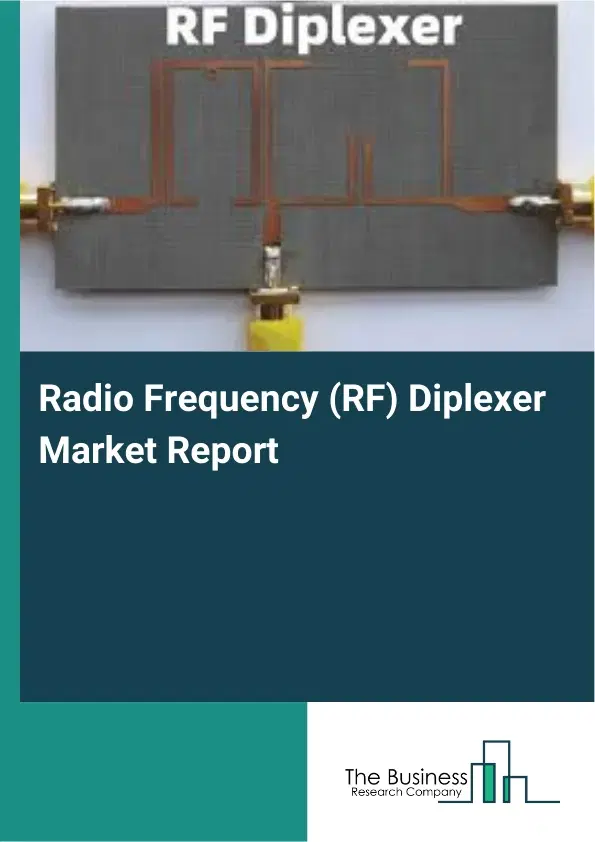
Radio Frequency (RF) Diplexer Market Report 2026
Global Outlook – By Type (Crystal Type, Ceramics Type, Other Types), By Material (Silicon Gallium Arsenide, Silicon-Germanium), By Application (Cellular, Wireless Communication, Military, Fiber-Optic (FO) Communication, Consumer, Automatic And Miscellaneous), By End-User (Petrochemicals, Residential, Commercial, Power Generation, Other End Users) – Market Size, Trends, Strategies, and Forecast to 2030
Radio Frequency (RF) Diplexer Market Overview
• Radio Frequency (RF) Diplexer market size has reached to $6.51 billion in 2025 • Expected to grow to $10.76 billion in 2030 at a compound annual growth rate (CAGR) of 10.3% • Growth Driver: Rise Of Internet Of Things (IoT) Devices Fueling RF Diplexer Market Growth • Market Trend: Technological Advancements In RF Diplexer Market • North America was the largest region in 2025 and Asia-Pacific is the fastest growing region.What Is Covered Under Radio Frequency (RF) Diplexer Market?
A radio frequency (RF) diplexer is a passive device used in telecommunications and signal processing to combine or separate signals based on their frequency. It allows multiple RF signals to share a common transmission medium while minimizing interference between them. The primary function of an RF diplexer is to separate signals into different frequency bands. The main types of radio frequency (RF) diplexers are crystal type, ceramic type, and others. Crystal-type RF diplexers use crystalline materials to split and mix radio waves. It is made using both silicon gallium arsenide and silicon-germanium, and it is applied for cellular, wireless, military, fiber-optic (FO) communication, consumer, automatic, and miscellaneous. It is used by several end-users, such as petrochemicals, residential, commercial, power generation, and others.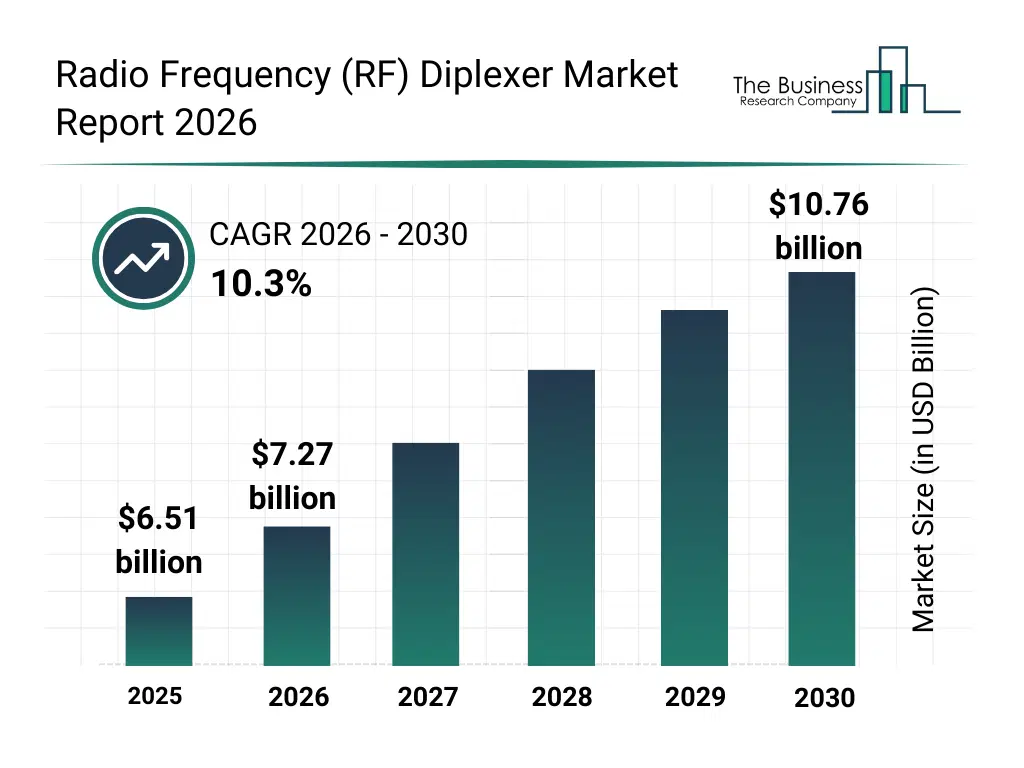
What Is The Radio Frequency (RF) Diplexer Market Size and Share 2026?
The radio frequency (rf) diplexer market size has grown rapidly in recent years. It will grow from $6.51 billion in 2025 to $7.27 billion in 2026 at a compound annual growth rate (CAGR) of 11.7%. The growth in the historic period can be attributed to expansion of cellular network infrastructure, growth in wireless communication devices, adoption of rf components in military systems, increasing use of diplexers in consumer electronics, advancements in rf material science.What Is The Radio Frequency (RF) Diplexer Market Growth Forecast?
The radio frequency (rf) diplexer market size is expected to see rapid growth in the next few years. It will grow to $10.76 billion in 2030 at a compound annual growth rate (CAGR) of 10.3%. The growth in the forecast period can be attributed to increasing deployment of 5G and advanced wireless networks, rising demand for miniaturized rf components, expansion of fiber-optic communication systems, growing use of rf diplexers in automotive electronics, increasing focus on high-performance communication hardware. Major trends in the forecast period include increasing demand for high-frequency signal separation, rising adoption of compact rf components, growing use of ceramic and ltcc diplexers, expansion of multi-band communication systems, enhanced focus on signal integrity and interference reduction.
Global Radio Frequency (RF) Diplexer Market Segmentation
1) By Type: Crystal Type, Ceramics Type, Other Types 2) By Material: Silicon Gallium Arsenide, Silicon-Germanium 3) By Application: Cellular, Wireless Communication, Military, Fiber-Optic (FO) Communication, Consumer, Automatic And Miscellaneous 4) By End-User: Petrochemicals, Residential, Commercial, Power Generation, Other End Users Subsegments: 1) By Crystal Type: Quartz Crystal Diplexers, Monolithic Crystal Filters, Surface Acoustic Wave (SAW) Crystal Diplexers 2) By Ceramics Type: Dielectric Ceramics Diplexers, Multilayer Ceramic Diplexers, Low-Temperature Co-Fired Ceramics (LTCC) Diplexers 3) By Other Types: Cavity Diplexers, Microstrip Diplexers, Hybrid Diplexers, Waveguide DiplexersWhat Is The Driver Of The Radio Frequency (RF) Diplexer Market?
The rise in Internet of Things (IoT) devices is expected to propel the growth of the radio frequency (RF) diplexer market going forward. The Internet of Things (IoT) refers to a network of physical devices that are embedded with sensors, software, and other technologies to connect and exchange data with other devices and systems over the internet. IoT devices are rising due to their ability to enhance efficiency, automation, and real-time data insights across various industries and applications. RF diplexers are required for IoT devices to efficiently separate and manage different frequency bands, enabling simultaneous transmission and reception of multiple signals without interference. For instance, in September 2023, according to a report published by Ericsson, a Sweden-based telecommunications company, global IoT connections reached 15.7 billion in 2023 and are forecast to grow to 38.9 billion by 2029. Therefore, the rise in Internet of Things (IoT) devices is driving the growth of the radio frequency (RF) diplexer industry going forward.Key Players In The Global Radio Frequency (RF) Diplexer Market
Major companies operating in the radio frequency (rf) diplexer market are Broadcom Inc., STMicroelectronics, TDK Corporation, Murata Manufacturing Co. Ltd., Skyworks Solutions Inc., Qorvo Inc., Yageo Corporation, Taiyo Yuden Co. Ltd., Pulse Electronics GmbH, Walsin Technology Corporation, Comba Telecom Systems Holdings Ltd., M/A-COM Technology Solutions, CTS Corporation, Anaren Inc., Integrated Device Technology Inc., Johanson Technology Inc., Planar Monolithics Industries Inc., Westell Technologies Inc., Vectron International Inc., Kyocera Corporation, Reactel Inc., Microwave Filter Company Inc., Anatech Electronics Inc.
This chart is for illustrative purposes; the full report includes a detailed competitor analysis and comprehensive overview of the top 10 companies in the market.
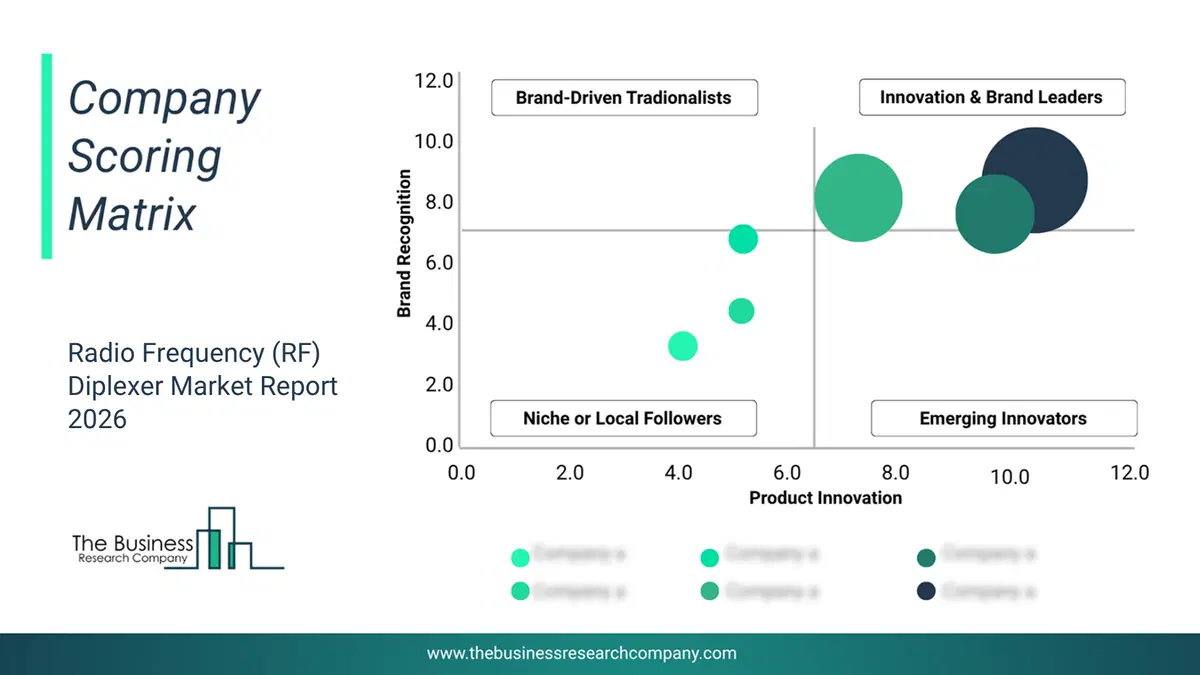
This chart maps companies by product innovation and brand strength, with bubble size indicating relative revenue, helping identify market leaders, challengers, and niche players. This is an illustrative chart; the full report provides a complete and accurate competitive analysis.
Global Radio Frequency (RF) Diplexer Market Trends and Insights
Major companies operating in the radio frequency (RF) diplexer market are developing technologically advanced solutions, such as E-Band radio solutions, to better serve customers with advanced features. E-band radio solutions refer to wireless communication systems that operate in the millimeter-wave spectrum, specifically in the frequency range of 60 to 90 GHz. For instance, in August 2023, Filtronic, a UK-based manufacturer of RF, microwave, and millimeter-wave (mmWave) components, launched the HADES X2 active diplexer. This diplexer stands out with its ability to deliver high performance while remaining cost-effective. With a typical PSAT of 30 dBm, the HADES X2 features dual high-power amplifiers, enabling exceptional linear transmission powers for long-range E-Band communications. This is achieved by integrating two gallium arsenide (GaAs) monolithic microwave integrated circuits (MMICs) that are precisely matched and power-combined in the waveguide. As a result, the HADES X2 achieves maximum power efficiency and signal quality, ensuring superior performance in demanding communication environments.What Are Latest Mergers And Acquisitions In The Radio Frequency (RF) Diplexer Market?
In November 2024, MACOM Technology Solutions Holdings Inc., a US-based developer and manufacturer of high-performance semiconductor products, acquired ENGIN-IC Inc. for $14.2 million. Through this acquisition, MACOM aims to enhance its GaN-based monolithic microwave integrated circuit (MMIC) and integrated microwave module design capabilities, particularly for high-frequency and defense-focused applications. ENGIN-IC Inc. is a US-based fabless semiconductor company that designs advanced GaAs and GaN monolithic microwave integrated circuits (MMICs) and integrated RF modules, particularly for defense and high-frequency applications.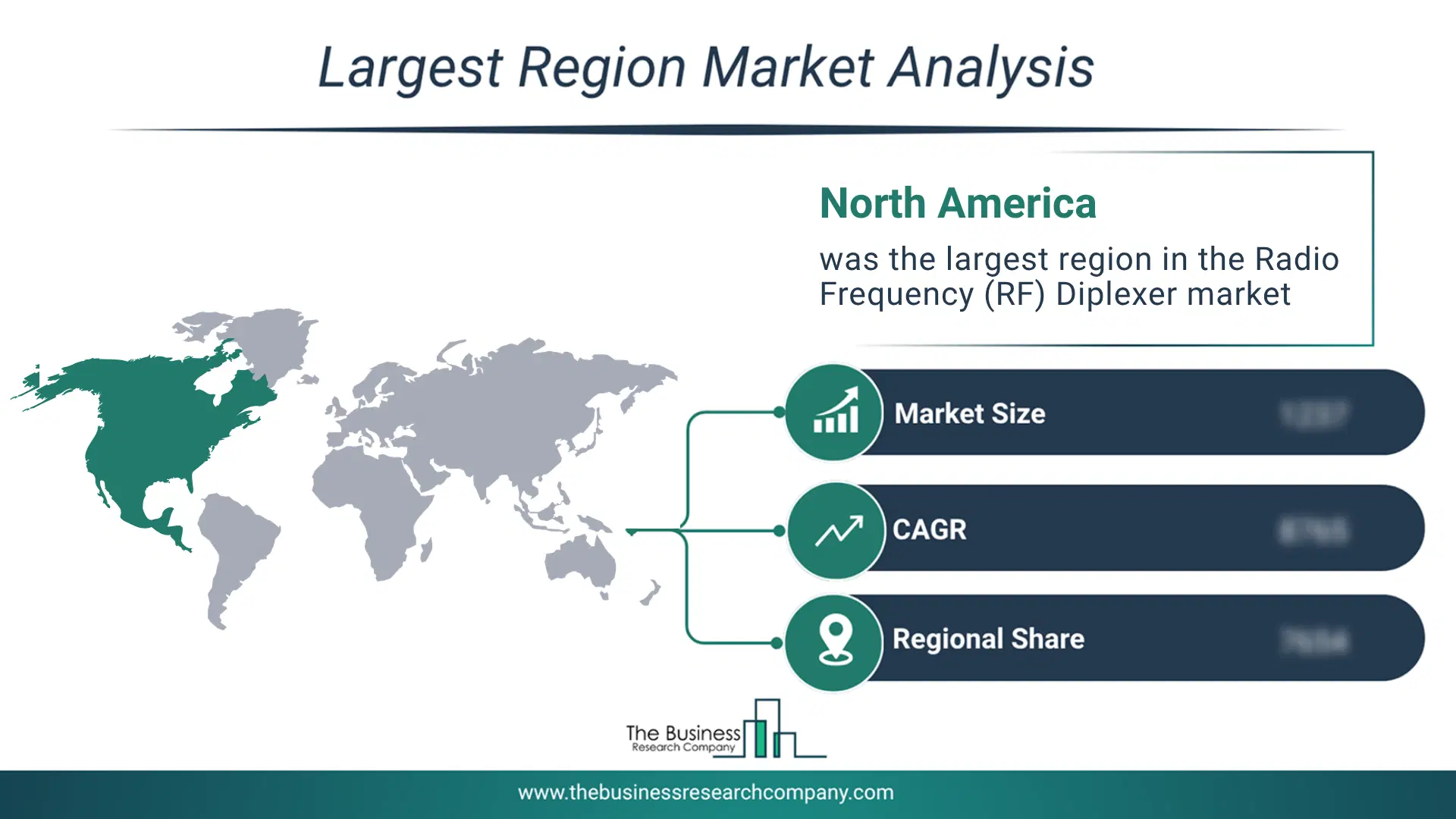
Regional Insights
North America was the largest region in the radio frequency (RF) diplexer market in 2025. Asia-Pacific is expected to be the fastest-growing region in the forecast period. The regions covered in this market report are Asia-Pacific, South East Asia, Western Europe, Eastern Europe, North America, South America, Middle East, Africa. The countries covered in this market report are Australia, Brazil, China, France, Germany, India, Indonesia, Japan, Taiwan, Russia, South Korea, UK, USA, Canada, Italy, Spain.What Defines the Radio Frequency (RF) Diplexer Market?
The radio frequency (RF) diplexer market consists of sales of miniature RF diplexers, broadband RF diplexers, surface mount technology (SMT) diplexers, and microstrip RF diplexers. Values in this market are ‘factory gate’ values, that is the value of goods sold by the manufacturers or creators of the goods, whether to other entities (including downstream manufacturers, wholesalers, distributors and retailers) or directly to end customers. The value of goods in this market includes related services sold by the creators of the goods.How is Market Value Defined and Measured?
The market value is defined as the revenues that enterprises gain from the sale of goods and/or services within the specified market and geography through sales, grants, or donations in terms of the currency (in USD unless otherwise specified). The revenues for a specified geography are consumption values that are revenues generated by organizations in the specified geography within the market, irrespective of where they are produced. It does not include revenues from resales along the supply chain, either further along the supply chain or as part of other products.
This chart presents market attractiveness based on a quantitative evaluation of growth, competition, strategic alignment, and risk, offering a clear view of opportunity areas for decision-making. This chart is for illustrative purposes; the full report contains the complete analysis.

This chart highlights the Total Addressable Market (TAM) by estimating the maximum revenue opportunity using an assumption-driven approach, supporting strategic planning and opportunity sizing across markets. The chart is illustrative; the full report provides a more comprehensive analysis.
What Key Data and Analysis Are Included in the Radio Frequency (RF) Diplexer Market Report 2026?
The radio frequency (rf) diplexer market research report is one of a series of new reports from The Business Research Company that provides market statistics, including industry global market size, regional shares, competitors with the market share, detailed market segments, market trends and opportunities, and any further data you may need to thrive in the radio frequency (rf) diplexer industry. The market research report delivers a complete perspective of everything you need, with an in-depth analysis of the current and future state of the industry.Radio Frequency (RF) Diplexer Market Report Forecast Analysis
| Report Attribute | Details |
|---|---|
| Market Size Value In 2026 | $7.27 billion |
| Revenue Forecast In 2030 | $10.76 billion |
| Growth Rate | CAGR of 10.3% from 2026 to 2030 |
| Base Year For Estimation | 2025 |
| Actual Estimates/Historical Data | 2020-2025 |
| Forecast Period | 2026 - 2030 |
| Market Representation | Revenue in USD Billion and CAGR from 2026 to 2030 |
| Segments Covered | Type, Material, Application, End-User |
| Regional Scope | Asia-Pacific, Western Europe, Eastern Europe, North America, South America, Middle East, Africa |
| Country Scope | The Countries Covered In This Market Report Are Australia, Brazil, China, France, Germany, India, Indonesia, Japan, Taiwan, Russia, South Korea, Uk, Usa, Canada, Italy, Spain. |
| Key Companies Profiled | Broadcom Inc., STMicroelectronics, TDK Corporation, Murata Manufacturing Co. Ltd., Skyworks Solutions Inc., Qorvo Inc., Yageo Corporation, Taiyo Yuden Co. Ltd., Pulse Electronics GmbH, Walsin Technology Corporation, Comba Telecom Systems Holdings Ltd., M/A-COM Technology Solutions, CTS Corporation, Anaren Inc., Integrated Device Technology Inc., Johanson Technology Inc., Planar Monolithics Industries Inc., Westell Technologies Inc., Vectron International Inc., Kyocera Corporation, Reactel Inc., Microwave Filter Company Inc., Anatech Electronics Inc. |
| Customization Scope | Request for Customization |
| Pricing And Purchase Options | Explore Purchase Options |