
Radio Frequency (RF) Fingerprinting Security Market Report 2026
Global Outlook – By Component (Hardware, Software, Services), By Deployment Mode (On-Premises, Cloud), By Application (Authentication, Intrusion Detection, Device Identification, Access Control, Other Application), By End-User (Banking, Financial Services, And Insurance (BFSI), Healthcare, Government And Defense, Automotive, Consumer Electronics, Industrial, Other End-Users) – Market Size, Trends, Strategies, and Forecast to 2030
Radio Frequency (RF) Fingerprinting Security Market Overview
• Radio Frequency (RF) Fingerprinting Security market size has reached to $1.19 billion in 2025 • Expected to grow to $2.94 billion in 2030 at a compound annual growth rate (CAGR) of 19.8% • Growth Driver: Surge In Advanced Non-Invasive Identification And Authentication Solutions Fueling The Growth Of The Market Due To Rising Need For Secure And Touchless Identity Verification • North America was the largest region in 2025 and Asia-Pacific is the fastest growing region.What Is Covered Under Radio Frequency (RF) Fingerprinting Security Market?
Radio frequency (RF) fingerprinting security is a technique that identifies and authenticates wireless devices based on their unique signal characteristics caused by hardware imperfections. It helps detect unauthorized devices and prevent spoofing or cloning in wireless networks. The main types of radio frequency (RF) fingerprinting security are hardware, software, and services. Hardware includes physical devices and equipment such as sensors, transceivers, and monitoring systems used to implement RF fingerprinting security. These are deployed through on-premises and cloud. It supports applications such as authentication, intrusion detection, device identification, access control, and others, serving end-users including banking, financial services, and insurance (BFSI), healthcare, government and defense, automotive, consumer electronics, industrial, and others.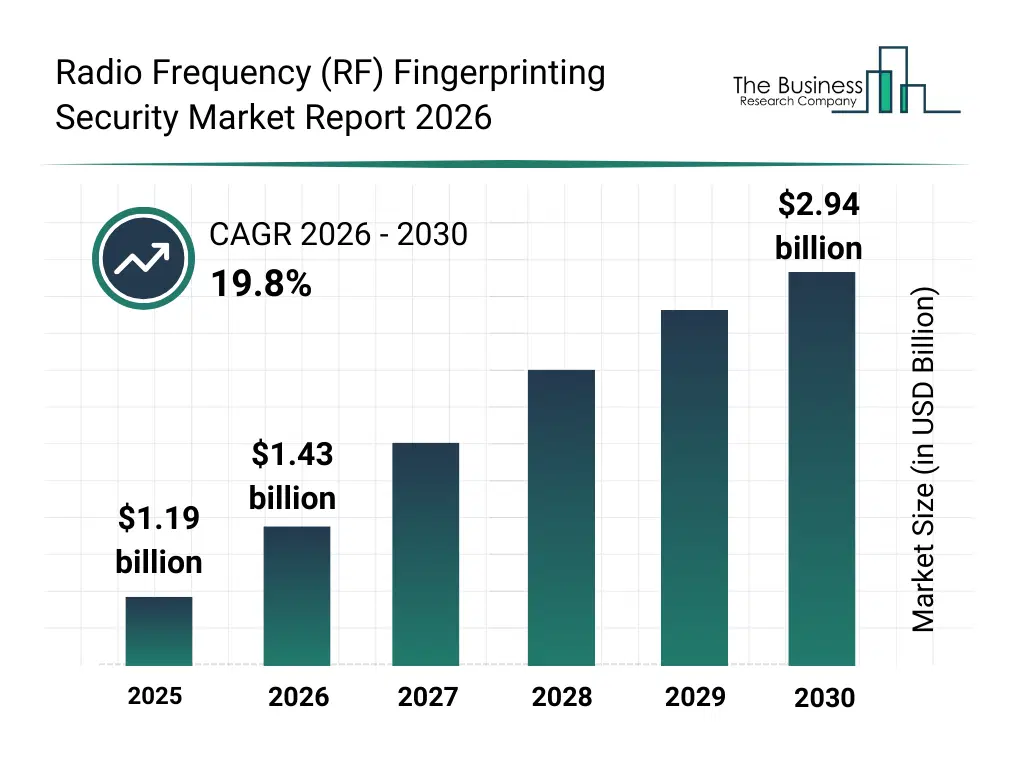
What Is The Radio Frequency (RF) Fingerprinting Security Market Size and Share 2026?
The radio frequency (rf) fingerprinting security market size has grown exponentially in recent years. It will grow from $1.19 billion in 2025 to $1.43 billion in 2026 at a compound annual growth rate (CAGR) of 20.0%. The growth in the historic period can be attributed to increasing cyber threats targeting wireless networks, adoption of wireless devices in enterprise and defense sectors, rising cases of device spoofing and cloning, regulatory mandates for device authentication, growth in rf hardware manufacturing and deployment.What Is The Radio Frequency (RF) Fingerprinting Security Market Growth Forecast?
The radio frequency (rf) fingerprinting security market size is expected to see rapid growth in the next few years. It will grow to $2.94 billion in 2030 at a compound annual growth rate (CAGR) of 19.8%. The growth in the forecast period can be attributed to advancement in AI-driven rf fingerprinting algorithms, expansion of iot and 5g networks, increasing demand for secure wireless communication in critical infrastructure, integration with next-generation intrusion detection systems, adoption of rf fingerprinting in smart city deployments. Major trends in the forecast period include standardization of rf fingerprinting methods and interoperability frameworks, expansion from defense-led pilots to large-scale commercial deployments, bundling of rf fingerprinting within broader wireless security and monitoring suites, increased focus on robustness of rf fingerprints under varying channel and environmental conditions, growing demand for embedded rf fingerprinting capabilities in constrained hardware devices.
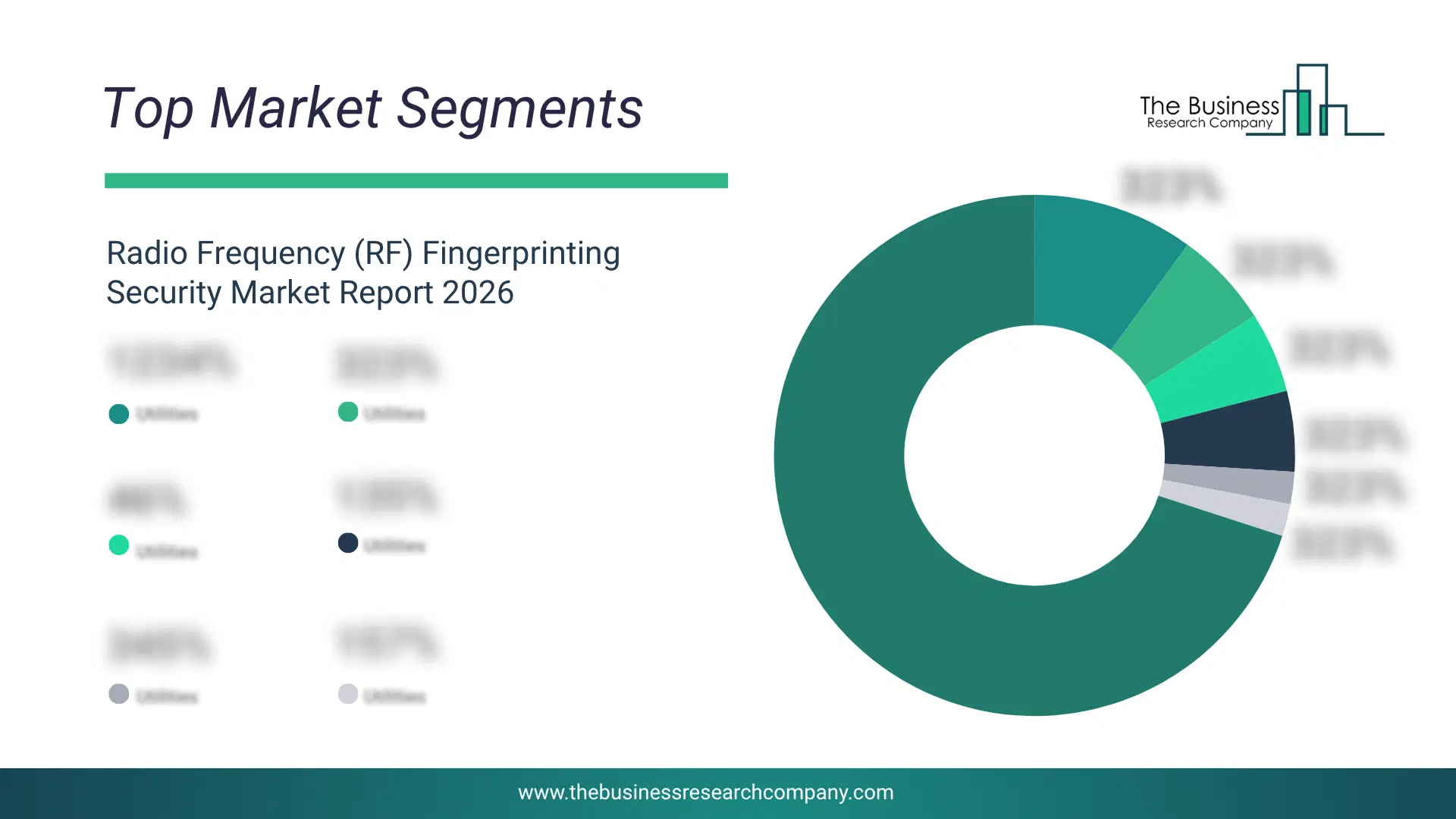
Global Radio Frequency (RF) Fingerprinting Security Market Segmentation
1) By Component: Hardware, Software, Services 2) By Deployment Mode: On-Premises, Cloud 3) By Application: Authentication, Intrusion Detection, Device Identification, Access Control, Other Application 4) By End-User: Banking, Financial Services, And Insurance (BFSI), Healthcare, Government And Defense, Automotive, Consumer Electronics, Industrial, Other End-Users Subsegments: 1) By Hardware: Antennas, Signal Processors, Transceivers 2) By Software: Device Identification Software, Authentication And Access Control Software, Intrusion Detection Software 3) By Services: Consulting And Implementation Services, Training And Education Services, Maintenance And Support ServicesWhat Is Driver Of The Radio Frequency (RF) Fingerprinting Security Market?
The rise in adoption of the internet of things (IoT) is expected to propel the growth of the radio frequency (RF) fingerprinting security market going forward. The internet of things (IoT) refers to the system of interconnected devices that communicate and share data with each other through the internet, enabling automation, monitoring, and smart decision-making. The internet of things (IoT) is increasing due to the rise of data-driven decision-making because organizations are leveraging IoT devices to collect real-time data, enabling better operational efficiency, predictive maintenance, and informed business strategies. Radio Frequency (RF) fingerprinting security helps the internet of things (IoT) by uniquely identifying and authenticating each connected device based on its RF signal characteristics, preventing unauthorized access, detecting spoofed devices, and enhancing overall network security. For instance, in September 2024, according to the IoT Analytics GmbH, a Germany-based non-governmental organization, by the end of 2023 there were 16.6 billion connected IoT devices, reflecting a 15% increase from 2022, with IoT Analytics projecting a further 13% growth to 18.8 billion by the end of 2024. Additionally, the number of connected IoT devices is projected to reach 40 billion by 2030, a significant increase from the last market update in 2023. Therefore, the rise in adoption of the Internet of Things (IoT) is driving the growth of the radio frequency (RF) fingerprinting security industry.Key Players In The Global Radio Frequency (RF) Fingerprinting Security Market
Major companies operating in the radio frequency (rf) fingerprinting security market are Huawei Technologies Co Ltd., Airbus Defence and Space, Raytheon Technologies Corporation, Intel Corporation, Northrop Grumman Corporation, NEC Corporation, Nokia Bell Labs, Thales Group, L3Harris Technologies Inc, NXP Semiconductors N.V., Elbit Systems Ltd., Keysight Technologies Inc, IDEMIA Group, Rohde & Schwarz GmbH & Co KG, MITRE Corporation, HID Global Corporation, Kratos Defense & Security Solutions Inc., Sierra Nevada Corporation, Mercury Systems Inc., Suprema Inc., Precise Biometrics AB, BIO-key International Inc., GA Intelligence Ltd.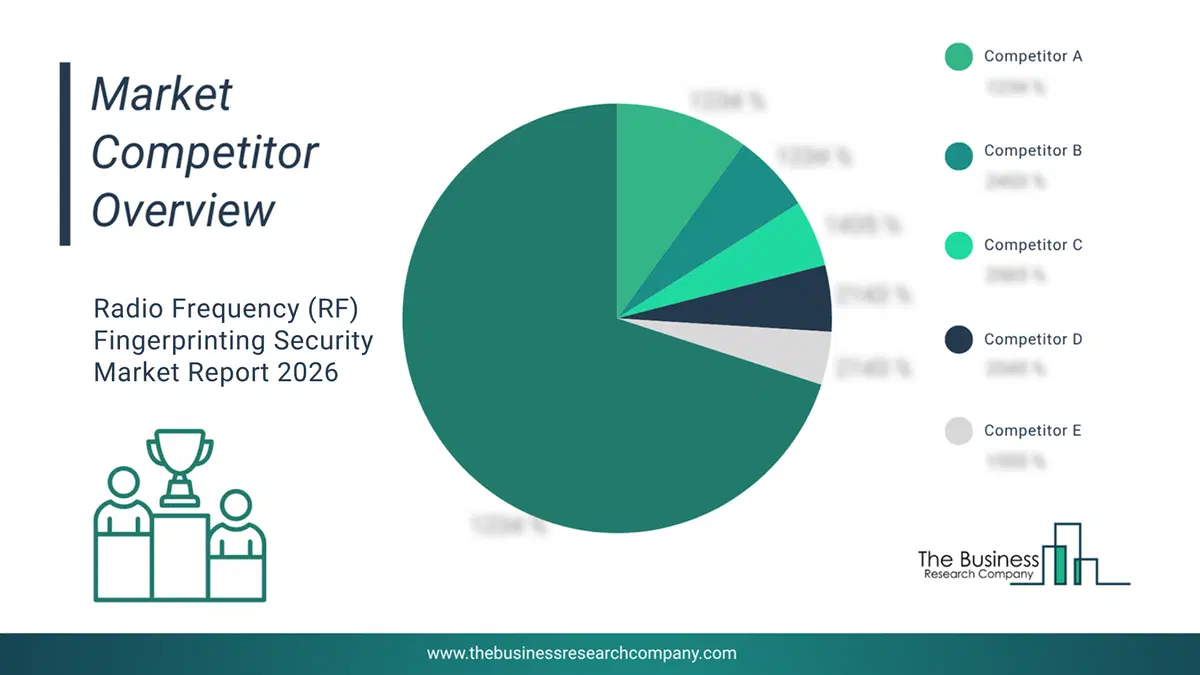
This chart is for illustrative purposes; the full report includes a detailed competitor analysis and comprehensive overview of the top 10 companies in the market.
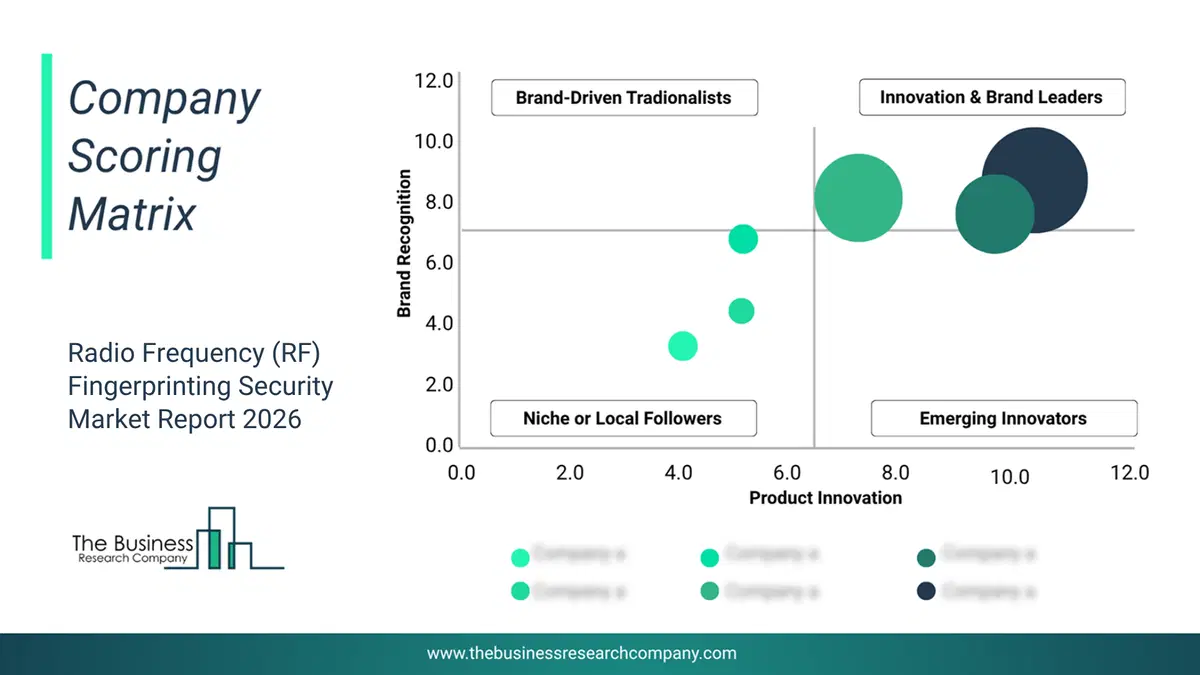
This chart maps companies by product innovation and brand strength, with bubble size indicating relative revenue, helping identify market leaders, challengers, and niche players. This is an illustrative chart; the full report provides a complete and accurate competitive analysis.
Regional Insights
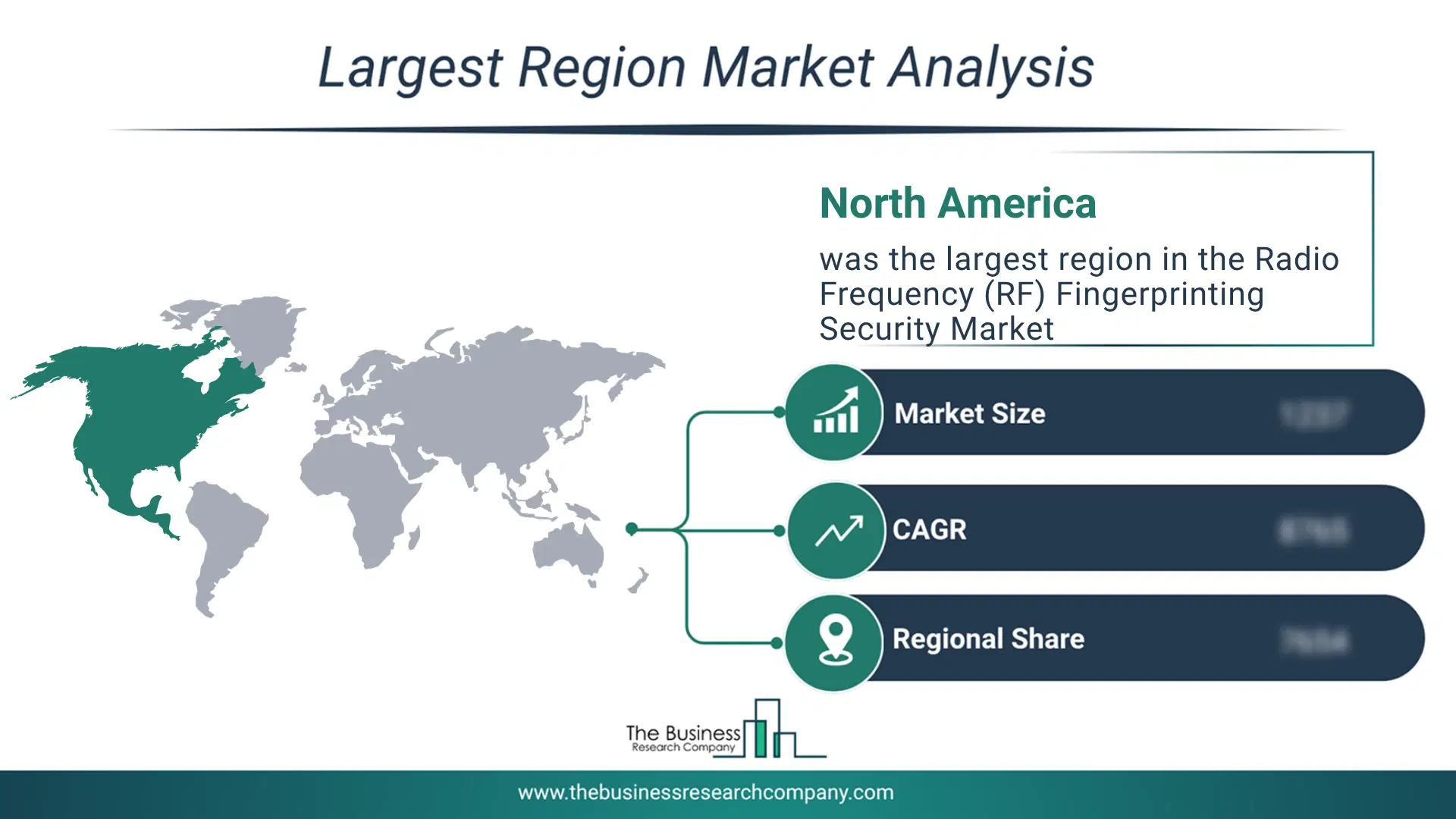
North America was the largest region in the radio frequency (RF) fingerprinting security market in 2025. Asia-Pacific is expected to be the fastest-growing region in the forecast period. The regions covered in this market report are Asia-Pacific, South East Asia, Western Europe, Eastern Europe, North America, South America, Middle East, Africa. The countries covered in this market report are Australia, Brazil, China, France, Germany, India, Indonesia, Japan, Taiwan, Russia, South Korea, UK, USA, Canada, Italy, SpainWhat Defines the Radio Frequency (RF) Fingerprinting Security Market?
The radio frequency (RF) fingerprinting security market consists of revenues earned by entities by providing services such as device authentication, intrusion detection, and spoofing and cloning prevention. The market value includes the value of related goods sold by the service provider or included within the service offering. The radio frequency (RF) fingerprinting security market includes sales of SignCRF, envelope power spectrum, and RF IDEAS WAVE ID bio reader. Values in this market are 'factory gate' values, that is, the value of goods sold by the manufacturers or creators of the goods, whether to other entities (including downstream manufacturers, wholesalers, distributors, and retailers) or directly to end customers. The value of goods in this market includes related services sold by the creators of the goods.How is Market Value Defined and Measured?
The market value is defined as the revenues that enterprises gain from the sale of goods and/or services within the specified market and geography through sales, grants, or donations in terms of the currency (in USD unless otherwise specified). The revenues for a specified geography are consumption values that are revenues generated by organizations in the specified geography within the market, irrespective of where they are produced. It does not include revenues from resales along the supply chain, either further along the supply chain or as part of other products.
This chart presents market attractiveness based on a quantitative evaluation of growth, competition, strategic alignment, and risk, offering a clear view of opportunity areas for decision-making. This chart is for illustrative purposes; the full report contains the complete analysis.

This chart highlights the Total Addressable Market (TAM) by estimating the maximum revenue opportunity using an assumption-driven approach, supporting strategic planning and opportunity sizing across markets. The chart is illustrative; the full report provides a more comprehensive analysis.
What Key Data and Analysis Are Included in the Radio Frequency (RF) Fingerprinting Security Market Report 2026?
The radio frequency (rf) fingerprinting security market research report is one of a series of new reports from The Business Research Company that provides market statistics, including industry global market size, regional shares, competitors with the market share, detailed market segments, market trends and opportunities, and any further data you may need to thrive in the radio frequency (rf) fingerprinting security industry. The market research report delivers a complete perspective of everything you need, with an in-depth analysis of the current and future state of the industry.Radio Frequency (RF) Fingerprinting Security Market Report Forecast Analysis
| Report Attribute | Details |
|---|---|
| Market Size Value In 2026 | $1.43 billion |
| Revenue Forecast In 2030 | $2.94 billion |
| Growth Rate | CAGR of 19.8% from 2026 to 2030 |
| Base Year For Estimation | 2025 |
| Actual Estimates/Historical Data | 2020-2025 |
| Forecast Period | 2026 - 2030 |
| Market Representation | Revenue in USD Billion and CAGR from 2026 to 2030 |
| Segments Covered | Component, Deployment Mode, Application, End-User |
| Regional Scope | Asia-Pacific, Western Europe, Eastern Europe, North America, South America, Middle East, Africa |
| Country Scope | The countries covered in the radio frequency (rf) fingerprinting security market report are Australia, Brazil, China, France, Germany, India, Indonesia, Japan, Taiwan, Russia, South Korea, UK, USA, Canada, Italy, Spain |
| Key Companies Profiled | Huawei Technologies Co Ltd., Airbus Defence and Space, Raytheon Technologies Corporation, Intel Corporation, Northrop Grumman Corporation, NEC Corporation, Nokia Bell Labs, Thales Group, L3Harris Technologies Inc, NXP Semiconductors N.V., Elbit Systems Ltd., Keysight Technologies Inc, IDEMIA Group, Rohde & Schwarz GmbH & Co KG, MITRE Corporation, HID Global Corporation, Kratos Defense & Security Solutions Inc., Sierra Nevada Corporation, Mercury Systems Inc., Suprema Inc., Precise Biometrics AB, BIO-key International Inc., GA Intelligence Ltd. |
| Customization Scope | Request for Customization |
| Pricing And Purchase Options | Explore Purchase Options |