
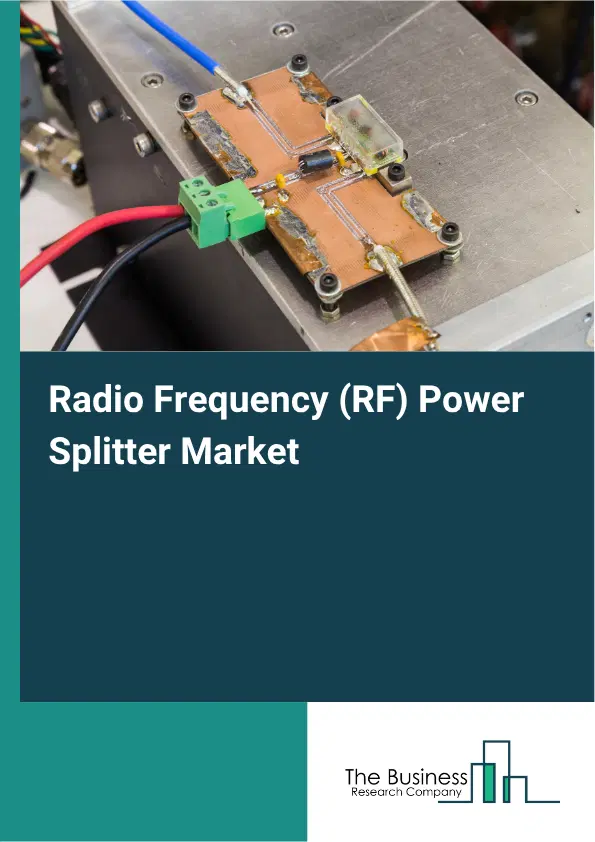
Radio Frequency (RF) Power Splitter Market Report 2026
Global Outlook – By Type (Active Radio Frequency Power Splitters, Passive Radio Frequency Power Splitters), By Frequency Range (Low Frequency (Below 1 Gigahertz), Medium Frequency (1 Gigahertz To 6 Gigahertz), High Frequency (Above 6 Gigahertz)), By Configuration (Two Way Splitters, Four Way Splitters, Eight Way Splitters, Sixteen Way Splitters), By Application (Telecommunications, Aerospace And Defense, Medical Equipment, Consumer Electronics, Industrial Applications), By End User Industries (Information Technology And Telecommunications, Healthcare, Automotive, Retail, Energy And Utilities) – Market Size, Trends, Strategies, and Forecast to 2030
Radio Frequency (RF) Power Splitter Market Overview
• Radio Frequency (RF) Power Splitter market size has reached to $1.29 billion in 2025 • Expected to grow to $1.92 billion in 2030 at a compound annual growth rate (CAGR) of 8.4% • Growth Driver: Surge In 5G Communication Network Expansion Fueling The Growth Of The Market Due To Rising Demand For Efficient Signal Distribution And Enhanced Network Performance • Market Trend: Advancing High-Isolation And Low-Loss RF Signal Distribution Capabilities • North America was the largest region in 2025 and Asia-Pacific is the fastest growing region.What Is Covered Under Radio Frequency (RF) Power Splitter Market?
Radio frequency (RF) power splitters are electronic components designed to divide a radio frequency (RF) signal into multiple output signals while maintaining signal integrity and minimizing loss. These devices are widely used in wireless communication systems, radar systems, satellite communications, broadcasting, and testing applications for efficient signal distribution and network performance optimization. The main types of radio frequency (RF) power splitter include active radio frequency power splitters and passive radio frequency power splitters. Active radio frequency power splitters refer to signal distribution devices that use active electronic components to amplify and divide radio frequency signals while maintaining signal strength. These splitters are available in frequency ranges including low frequency (below 1 gigahertz), medium frequency (1 gigahertz to 6 gigahertz), and high frequency (above 6 gigahertz) and are offered in configurations such as two way splitters, four way splitters, eight way splitters, and sixteen way splitters. The various applications involved are telecommunications, aerospace and defense, medical equipment, consumer electronics, and industrial applications, and they are used by several end user industries such as information technology and telecommunications, healthcare, automotive, retail, and energy and utilities.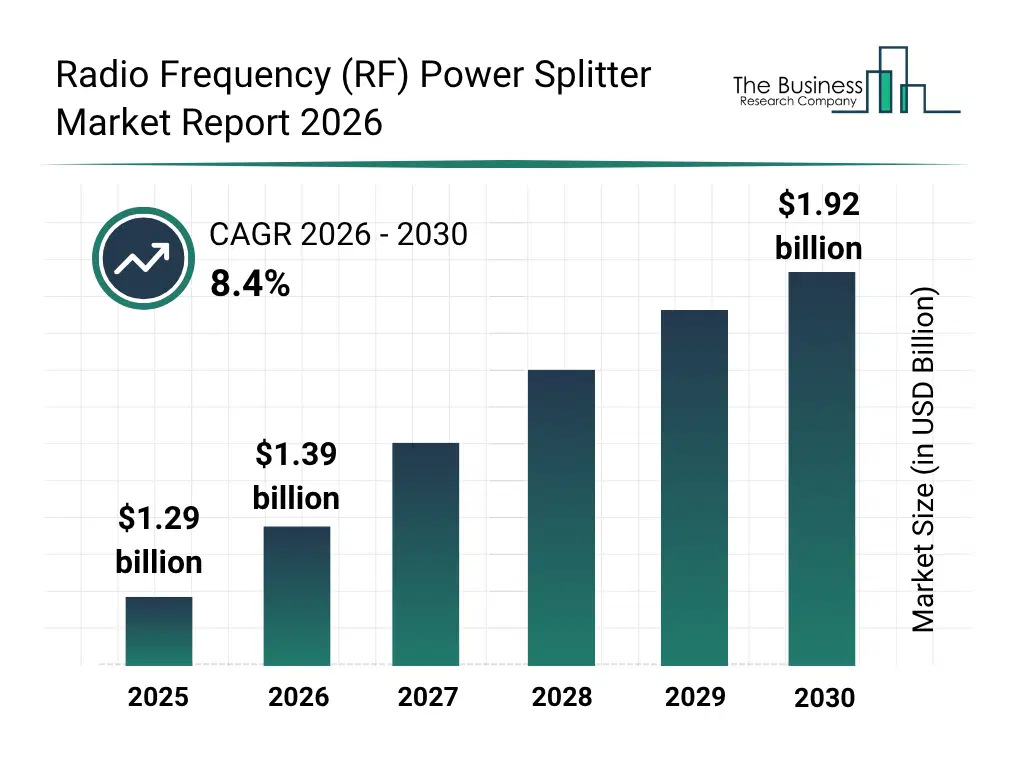
What Is The Radio Frequency (RF) Power Splitter Market Size and Share 2026?
The radio frequency (RF) power splitter market size has grown strongly in recent years. It will grow from $1.29 billion in 2025 to $1.39 billion in 2026 at a compound annual growth rate (CAGR) of 8.1%. The growth in the historic period can be attributed to growing deployment of wireless communication networks, increasing adoption of satellite communication systems, rising demand for RF testing equipment, expanding use of radar systems, increasing investment in broadcasting infrastructure.What Is The Radio Frequency (RF) Power Splitter Market Growth Forecast?
The radio frequency (RF) power splitter market size is expected to see strong growth in the next few years. It will grow to $1.92 billion in 2030 at a compound annual growth rate (CAGR) of 8.4%. The growth in the forecast period can be attributed to growing expansion of 5G and future wireless networks, increasing demand for advanced aerospace communication systems, rising adoption of high frequency communication devices, expanding deployment of next generation telecom infrastructure, increasing need for reliable signal distribution across industrial networks. Major trends in the forecast period include increasing development of wideband RF power splitters, growing adoption of low loss signal distribution solutions, rising demand for high frequency RF components, expanding use of compact RF power splitter designs, increasing integration of high power handling RF splitters.
Global Radio Frequency (RF) Power Splitter Market Segmentation
2) By Frequency Range: Low Frequency (Below 1 Gigahertz), Medium Frequency (1 Gigahertz To 6 Gigahertz), High Frequency (Above 6 Gigahertz) 3) By Configuration: Two Way Splitters, Four Way Splitters, Eight Way Splitters, Sixteen Way Splitters 4) By Application: Telecommunications, Aerospace And Defense, Medical Equipment, Consumer Electronics, Industrial Applications 5) By End User Industries: Information Technology And Telecommunications, Healthcare, Automotive, Retail, Energy And Utilities Subsegments: 1) By Active Radio Frequency Power Splitters: Wilkinson Power Splitters, Resistive Power Splitters, Hybrid Power Splitters, Broadband Power Splitters 2) By Passive Radio Frequency Power Splitters: Two Way Power Splitters, Four Way Power Splitters, Eight Way Power Splitters, Sixteen Way Power SplittersWhat Are The Drivers Of The Radio Frequency (RF) Power Splitter Market?
The rising expansion of 5G communication networks is expected to propel the growth of the radio frequency (RF) power splitter market going forward. 5G communication networks refer to next-generation wireless infrastructure designed to provide ultra-fast data speeds, low latency, and enhanced connectivity for mobile and industrial applications. The demand for 5G communication networks is increasing due to the high-bandwidth applications, which require faster, more reliable, and low-latency connectivity to support modern digital services and real-time data exchange. RF power splitters support 5G communication networks by enabling efficient signal distribution, improved network performance, and reliable transmission across wireless communication systems. For instance, in January 2026, according to Telefonaktiebolaget LM Ericsson , a Sweden-based company that provides telecommunications equipment, software, and services, global 5G subscriptions are expected to grow to nearly 6.4 billion by 2031, making 5G the fastest-adopted mobile generation in history. Therefore, the rising expansion of 5G communication networks is driving the growth of the radio frequency (RF) power splitter industry. The rising adoption of IoT devices is expected to propel the growth of the radio frequency (RF) power splitter market going forward. IoT devices are physical objects embedded with sensors, software, and connectivity that allow them to collect and exchange data over the internet. The rising adoption of IoT devices is due to the increasing need for automation as people and industries want systems that can perform tasks automatically with minimal human intervention, improving speed, accuracy, and efficiency while reducing manual effort and errors. RF power splitters support IoT devices by enabling simultaneous and balanced distribution of RF signals across multiple connected nodes, which is essential in IoT networks where a single gateway, base station, or transmitter must communicate with several sensors and devices at once. For instance, in January 2026, according to Telefonaktiebolaget LM Ericsson , a Sweden-based company that provides telecommunications equipment, software, and services, global cellular IoT connections reached approximately 4.5 billion in 2025 and are expected to grow to nearly 8 billion by 2031, showing strong expansion of wireless IoT networks. Therefore, the rising adoption of IoT devices is driving the radio frequency (RF) power splitter industry.Key Players In The Global Radio Frequency (RF) Power Splitter Market
Major companies operating in the radio frequency (rf) power splitter market are Analog Devices Inc., HUBER+SUHNER AG, MACOM Technology Solutions Holdings Inc., Mini-Circuits, JFW Industries Inc., Telewave Inc., JQL Electronics Inc., RLC Electronics Inc., Raditek Inc., Synergy Microwave Corporation, RF-Lambda USA LLC, Werlatone Inc., MECA Electronics Inc., DETI Microwave Inc., Anatech Electronics Inc., KRYTAR Inc., Pulsar Microwave Corporation, Microwave Communications Laboratories Inc., VidaRF Technologies Co. Ltd., Kete Microwave Electronics Co. Ltd., Qorvo Inc., Skyworks Solutions Inc., Knowles Corporation, Smiths Interconnect
This chart is for illustrative purposes; the full report includes a detailed competitor analysis and comprehensive overview of the top 10 companies in the market.
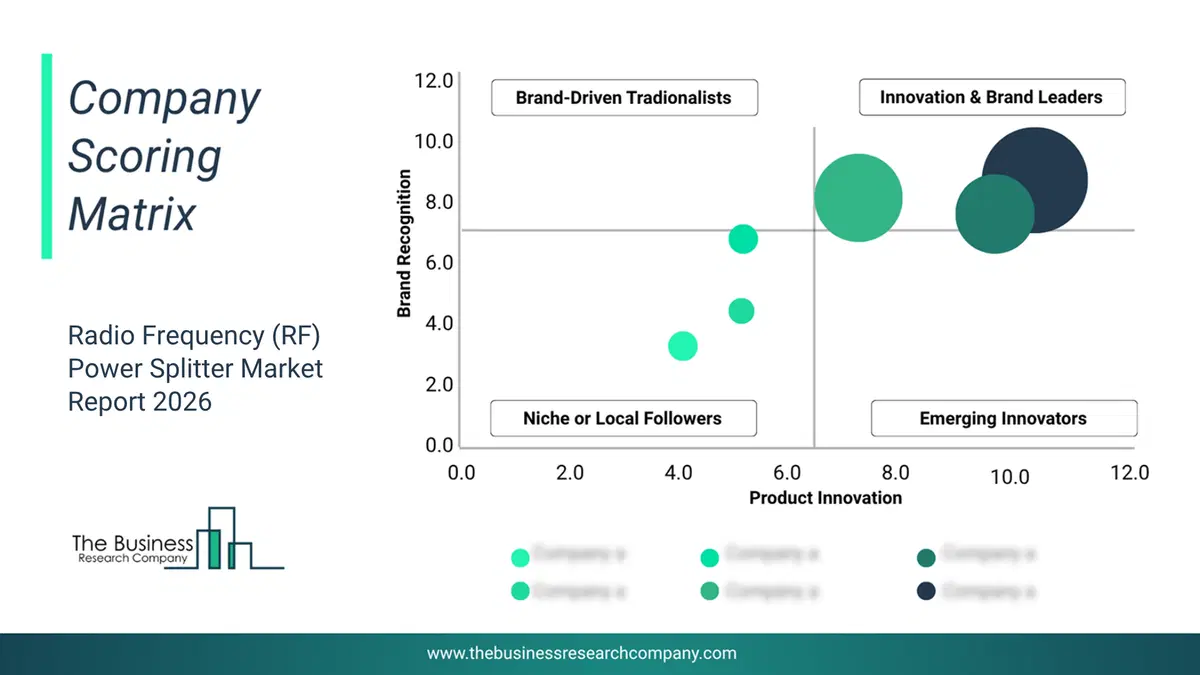
This chart maps companies by product innovation and brand strength, with bubble size indicating relative revenue, helping identify market leaders, challengers, and niche players. This is an illustrative chart; the full report provides a complete and accurate competitive analysis.
Global Radio Frequency (RF) Power Splitter Market Trends and Insights
Major companies operating in the radio frequency (RF) power splitter market are focusing on developing innovative solutions, such as matched-line directional divider (MLDD) power dividers, to enhance signal distribution efficiency, improve power-handling capabilities, and support high-frequency communication and radar applications. Matched-line directional divider (MLDD) power dividers are advanced RF components that split an input signal into multiple output paths while maintaining precise impedance matching, high isolation, and low signal loss across a wide frequency range. For instance, in October 2024, KRYTAR, Inc., a US-based manufacturer of ultra-broadband microwave components and test equipment, launched the Model 6005100 MLDD 2-Way Power Divider. The compact device operates across a broadband frequency range of 0.5 GHz to 10 GHz and delivers greater than 19 dB isolation, less than 1.0 dB insertion loss, ±0.2 dB amplitude tracking, and ±4° phase tracking. It is designed for wireless communications, radar, satellite communications, and complex switch-matrix systems. The power divider provides reliable signal distribution in a compact package while supporting demanding broadband and multi-frequency applications.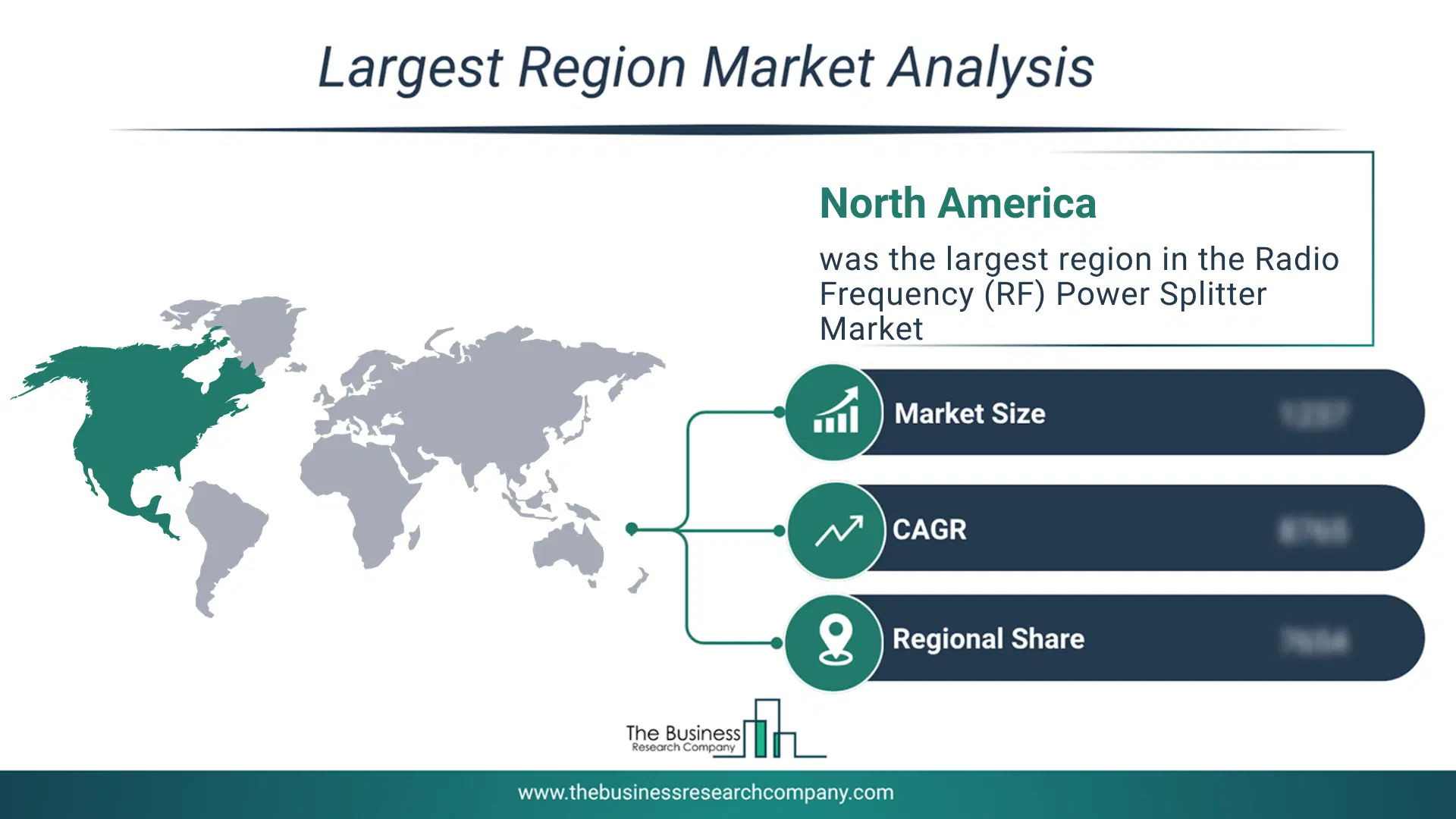
Regional Outlook/Insights
North America was the largest region in the radio frequency (RF) power splitter market in 2025. Asia-Pacific is expected to be the fastest-growing region in the forecast period. The regions covered in this market report are Asia-Pacific, South East Asia, Western Europe, Eastern Europe, North America, South America, Middle East, Africa. The countries covered in this market report are Australia, Brazil, China, France, Germany, India, Indonesia, Japan, Taiwan, Russia, South Korea, UK, USA, Canada, Italy, Spain.What Defines the Radio Frequency (RF) Power Splitter Market?
The radio frequency (RF) power splitter market consists of sales of active microwave splitters, coaxial splitters, wilkinson power splitters, and resistive splitters. Values in this market are ‘factory gate’ values, that is the value of goods sold by the manufacturers or creators of the goods, whether to other entities (including downstream manufacturers, wholesalers, distributors and retailers) or directly to end customers. The value of goods in this market includes related services sold by the creators of the goods.How is Market Value Defined and Measured?
The market value is defined as the revenues that enterprises gain from the sale of goods and/or services within the specified market and geography through sales, grants, or donations in terms of the currency (in USD unless otherwise specified). The revenues for a specified geography are consumption values that are revenues generated by organizations in the specified geography within the market, irrespective of where they are produced. It does not include revenues from resales along the supply chain, either further along the supply chain or as part of other products.
This chart presents market attractiveness based on a quantitative evaluation of growth, competition, strategic alignment, and risk, offering a clear view of opportunity areas for decision-making. This chart is for illustrative purposes; the full report contains the complete analysis.

This chart highlights the Total Addressable Market (TAM) by estimating the maximum revenue opportunity using an assumption-driven approach, supporting strategic planning and opportunity sizing across markets. The chart is illustrative; the full report provides a more comprehensive analysis.
What Key Data and Analysis Are Included in the Radio Frequency (RF) Power Splitter Market Report 2026?
The radio frequency (rf) power splitter market research report is one of a series of new reports from The Business Research Company that provides radio frequency (rf) power splitter market statistics, including radio frequency (rf) power splitter industry global market size, regional shares, competitors with a radio frequency (rf) power splitter market share, detailed radio frequency (rf) power splitter market segments, market trends and opportunities, and any further data you may need to thrive in the radio frequency (rf) power splitter industry. This radio frequency (rf) power splitter market research report delivers a complete perspective of everything you need, with an in-depth analysis of the current and future scenario of the industry.Radio Frequency (RF) Power Splitter Market Report Forecast Analysis
| Report Attribute | Details |
|---|---|
| Market Size Value In 2026 | $1.39 billion |
| Revenue Forecast In 2030 | $1.92 billion |
| Growth Rate | CAGR of 8.4% from 2026 to 2030 |
| Base Year For Estimation | 2025 |
| Actual Estimates/Historical Data | 2020-2025 |
| Forecast Period | 2026 - 2030 |
| Market Representation | Revenue in USD Billion and CAGR from 2026 to 2030 |
| Segments Covered | Type, Frequency Range, Configuration, Application, End User Industries |
| Regional Scope | Asia-Pacific, Western Europe, Eastern Europe, North America, South America, Middle East, Africa |
| Country Scope | The countries covered in the report are Australia, Brazil, China, France, Germany, India, Indonesia, Japan, Taiwan, Russia, South Korea, UK, USA, Canada, Italy, Spain. |
| Key Companies Profiled | Analog Devices Inc., HUBER+SUHNER AG, MACOM Technology Solutions Holdings Inc., Mini-Circuits, JFW Industries Inc., Telewave Inc., JQL Electronics Inc., RLC Electronics Inc., Raditek Inc., Synergy Microwave Corporation, RF-Lambda USA LLC, Werlatone Inc., MECA Electronics Inc., DETI Microwave Inc., Anatech Electronics Inc., KRYTAR Inc., Pulsar Microwave Corporation, Microwave Communications Laboratories Inc., VidaRF Technologies Co. Ltd., Kete Microwave Electronics Co. Ltd., Qorvo Inc., Skyworks Solutions Inc., Knowles Corporation, Smiths Interconnect |
| Customization Scope | Request for Customization |
| Pricing And Purchase Options | Explore Purchase Options |