
Radio Frequency (RF) Radio Transmitter Market Report 2026
Global Outlook – By Type (Analog Radio Transmitter, Digital Radio Transmitter), By Frequency Range (Low Frequency, Medium Frequency, High Frequency, Very High Frequency, Ultra High Frequency), By Technology (Frequency Modulation Radio Transmitters, Amplitude Modulation Radio Transmitters, Digital Radio Transmitters), By Application (Broadcasting, Telecommunications, Military, Research And Development) – Market Size, Trends, Strategies, and Forecast to 2030
Radio Frequency (RF) Radio Transmitter Market Overview
• Radio Frequency (RF) Radio Transmitter market size has reached to $3.46 billion in 2025 • Expected to grow to $4.99 billion in 2030 at a compound annual growth rate (CAGR) of 7.5% • Growth Driver: Expansion Of 5G Communication Infrastructure Fueling The Growth Of The Market Due To Rising Demand For High-Speed, Low-Latency Connectivity And Data-Intensive Applications • Market Trend: Silicon Carbide–Based RF Amplification Advancing High-Efficiency Modular Broadcast Transmitter Platforms • North America was the largest region in 2025 and Asia-Pacific is the fastest growing region.What Is Covered Under Radio Frequency (RF) Radio Transmitter Market?
A radio frequency (RF) radio transmitter is an electronic device that generates and emits electromagnetic signals in the radio frequency portion of the electromagnetic spectrum by converting electrical energy into radio waves. It functions by producing a controlled high-frequency signal with defined frequency and power characteristics, enabling the transmission of information through wireless electromagnetic propagation. The main types of radio frequency (RF) radio transmitter include analog radio transmitters and digital radio transmitters. Analog radio transmitters refer to devices that generate and transmit radio frequency signals using continuous analog modulation techniques for voice, audio, and data communication. These transmitters operate across frequency ranges including low frequency, medium frequency, high frequency, very high frequency, and ultra high frequency. They utilize technologies such as frequency modulation radio transmitters, amplitude modulation radio transmitters, and digital radio transmitters and are used in applications including broadcasting, telecommunications, military, and research and development.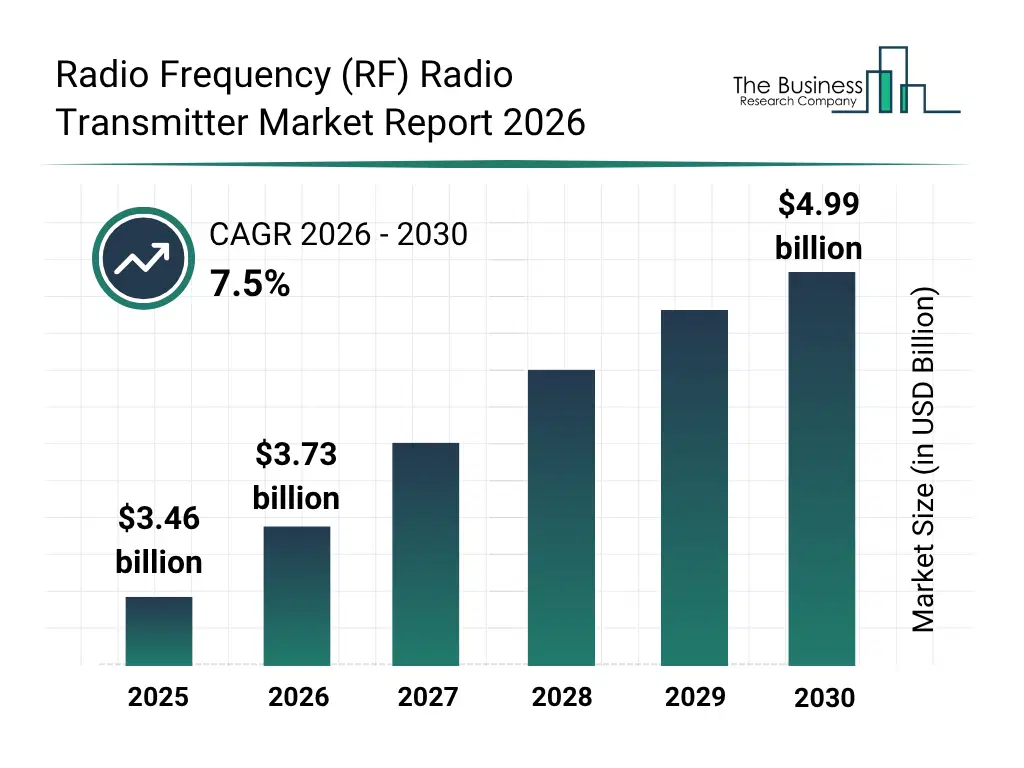
What Is The Radio Frequency (RF) Radio Transmitter Market Size and Share 2026?
The radio frequency (RF) radio transmitter market size has grown strongly in recent years. It will grow from $3.46 billion in 2025 to $3.73 billion in 2026 at a compound annual growth rate (CAGR) of 8.0%. The growth in the historic period can be attributed to growing expansion of broadcasting infrastructure, increasing deployment of wireless communication networks, rising investments in military communication systems, expanding adoption of radio communication equipment, increasing demand for reliable long distance communication.What Is The Radio Frequency (RF) Radio Transmitter Market Growth Forecast?
The radio frequency (RF) radio transmitter market size is expected to see strong growth in the next few years. It will grow to $4.99 billion in 2030 at a compound annual growth rate (CAGR) of 7.5%. The growth in the forecast period can be attributed to growing deployment of next generation wireless communication infrastructure, increasing demand for advanced digital broadcasting systems, rising adoption of secure defense communication networks, expanding investments in satellite communication infrastructure, increasing need for high performance RF transmission technologies. Major trends in the forecast period include increasing adoption of software defined radio transmitters, growing development of high power RF transmission systems, rising demand for multi band radio transmitters, expanding integration of compact RF transmitter designs, increasing focus on high signal stability and transmission efficiency.
Global Radio Frequency (RF) Radio Transmitter Market Segmentation
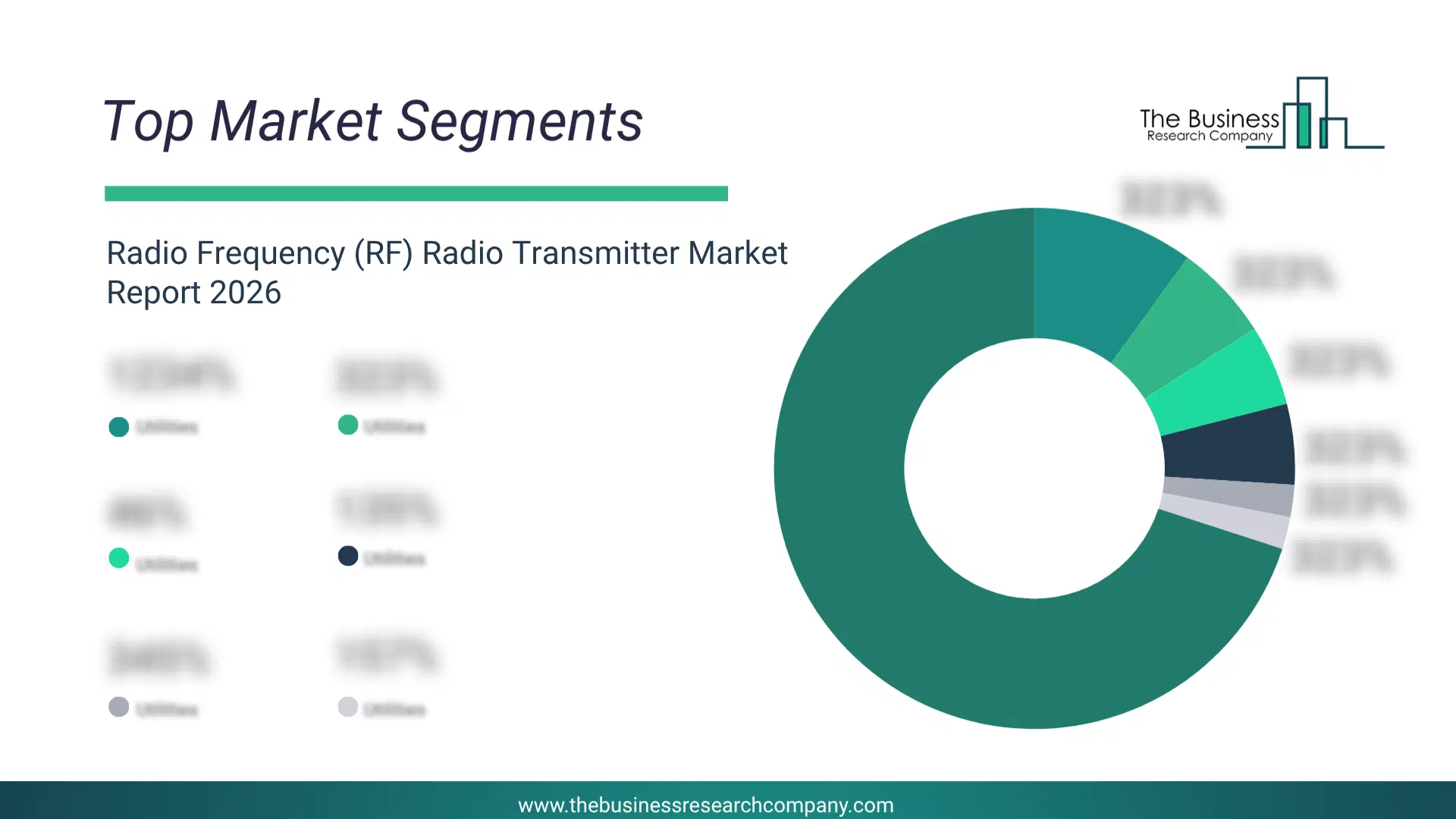
2) By Frequency Range: Low Frequency, Medium Frequency, High Frequency, Very High Frequency, Ultra High Frequency 3) By Technology: Frequency Modulation Radio Transmitters, Amplitude Modulation Radio Transmitters, Digital Radio Transmitters 4) By Application: Broadcasting, Telecommunications, Military, Research And Development Subsegments: 1) By Analog Radio Transmitter: Amplitude Modulation Transmitters, Shortwave Radio Transmitters, Longwave Radio Transmitters, Medium Wave Radio Transmitters 2) By Digital Radio Transmitter: Digital Audio Broadcasting Transmitters, High Definition Radio Transmitters, Software Defined Radio Transmitters, Digital Two Way Radio TransmittersWhat Is The Driver Of The Radio Frequency (RF) Radio Transmitter Market?
The expansion of 5G communication infrastructure is expected to propel the growth of radio frequency (RF) radio transmitter market going forward. 5G communication infrastructure refers to the network of advanced base stations, antennas, fiber-optic links, small cells, and core network systems that enable ultra-fast, low-latency, and high-capacity wireless connectivity. 5G communication infrastructure is rising due to the increasing demand for high-speed, low-latency connectivity to support data-intensive applications such as AI, IoT, and cloud computing. RF radio transmitters in 5G infrastructure are used in base stations to convert digital baseband signals into high-frequency RF signals and transmit them wirelessly to user devices for communication. For instance, in March 2024, according to the 5G Americas, a US-based trade organization for telecommunication, global 5G connections reached 1.76 billion by the end of 2023, with 700 million new connections added during the year, marking a 66% annual increase. In North America, 5G accounted for 29% of all wireless connections, growing 64% year-on-year to reach 197 million connections after adding 77 million new users in 2023. Therefore, the expansion of 5G communication infrastructure is driving the growth of the radio frequency (RF) radio transmitter industry.Key Players In The Global Radio Frequency (RF) Radio Transmitter Market
Major companies operating in the radio frequency (rf) radio transmitter market are Aareff Systems Limited, Ampegon AG, Aviat Networks Inc., Bext Corporation, Broadcast Electronics LLC, Cisco Systems Inc., Comark Communications LLC, Continental Electronics Corporation, DB Elettronica Telecomunicazioni S.p.A., Elenos S.r.l., Electronics Research Inc., Filtronic plc, GatesAir Inc., Hitachi Kokusai Electric Inc., Huawei Technologies Co. Ltd., L3Harris Technologies Inc., Motorola Solutions Inc., Nautel Limited, NEC Corporation, Rohde & Schwarz GmbH & Co. KG, SYES S.r.l., Telefonaktiebolaget LM Ericsson, Thales Group, WorldCast Systems SAS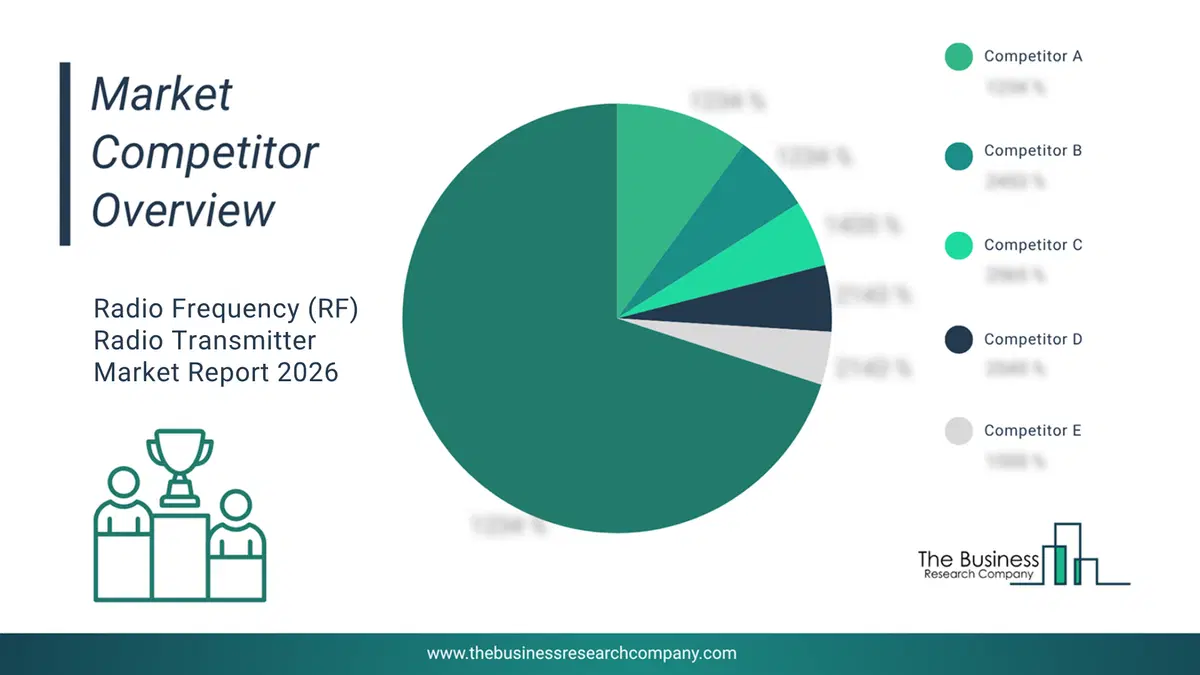
This chart is for illustrative purposes; the full report includes a detailed competitor analysis and comprehensive overview of the top 10 companies in the market.
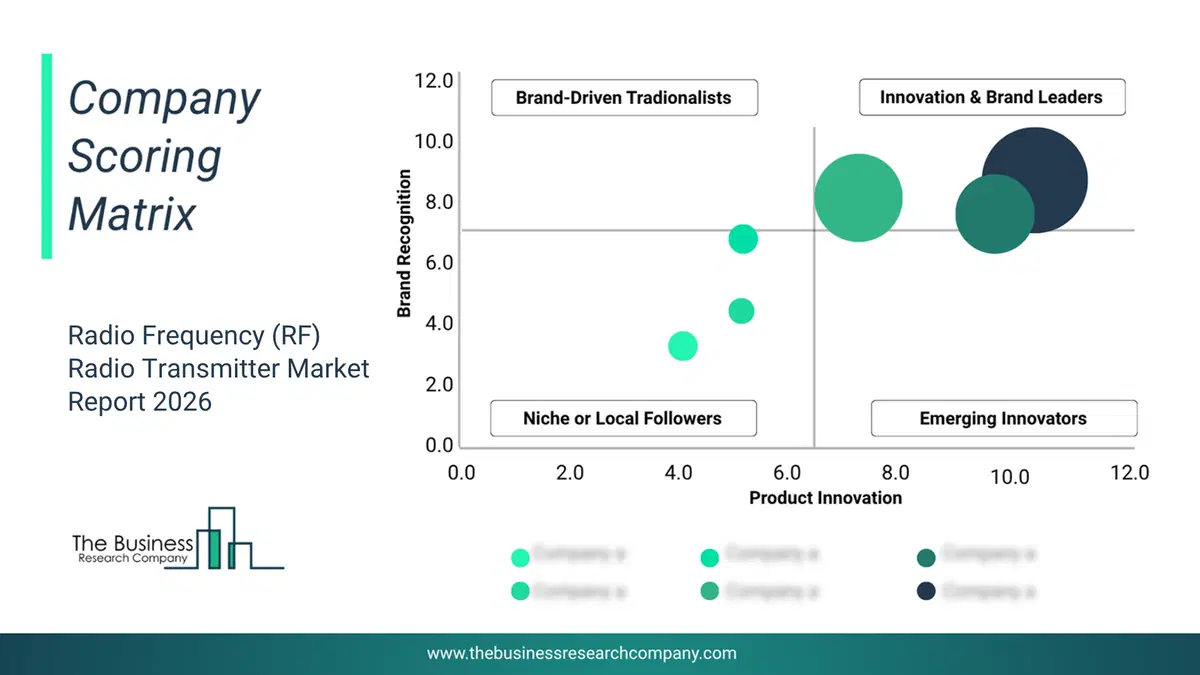
This chart maps companies by product innovation and brand strength, with bubble size indicating relative revenue, helping identify market leaders, challengers, and niche players. This is an illustrative chart; the full report provides a complete and accurate competitive analysis.
Global Radio Frequency (RF) Radio Transmitter Market Trends and Insights
Major companies operating in the radio frequency (RF) radio transmitter market are focusing on developing advanced transmitter platforms with silicon carbide (SiC)-based RF amplification technology to improve energy efficiency, reduce system size, enhance reliability, and support multi-standard digital broadcasting capabilities. Silicon carbide (SiC)-based RF amplification technology uses wide-bandgap SiC semiconductor devices (like MOSFETs) to amplify radio frequency signals with higher efficiency, greater power density, and improved thermal and voltage handling compared to traditional silicon-based amplifiers. For instance, in April 2026, BE, a US-based manufacturer of radio broadcast equipment, has introduced the AMX AM transmitter platform, a next-generation broadcast solution designed to deliver higher efficiency, compact design, and simplified maintenance for AM radio transmission. Built as a modular system, it provides 5 kW output in a highly compact five-rack-unit chassis, making it easy to ship and deploy. The transmitter uses silicon carbide (SiC) MOSFET-based RF amplifier and modulator modules, improving voltage handling, efficiency, and system robustness compared to conventional designs. It supports analog, HD Radio, and Digital Radio Mondiale (DRM) broadcasting, along with features like redundant power supplies and modular harmonic filtering. Overall, the AMX platform enhances performance while reducing size, power consumption, and operational complexity in broadcast infrastructure.What Are Latest Mergers And Acquisitions In The Radio Frequency (RF) Radio Transmitter Market?
In October 2025, Saothair Capital Partners, a US-based private equity company, acquired GatesAir for an undisclosed amount. With this acquisition, Saothair Capital Partners aims to accelerate GatesAir’s technological innovation, expand its global footprint, and scale its broadcast and public safety communications solutions portfolio. GatesAir is a US-based manufacturer of over-the-air RF broadcast transmitters.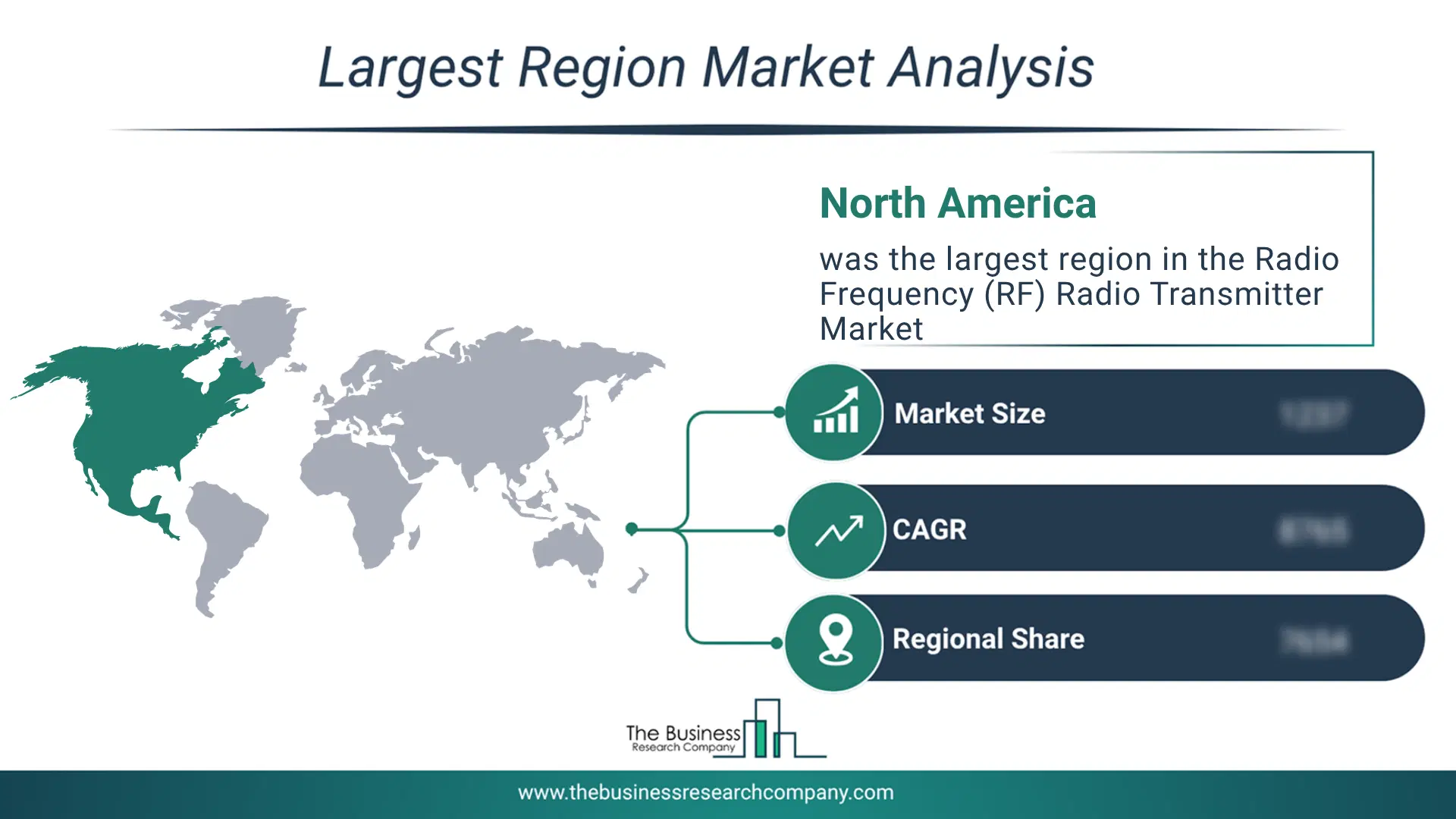
Regional Outlook/Insights
North America was the largest region in the radio frequency (RF) radio transmitter market in 2025. Asia-Pacific is expected to be the fastest-growing region in the forecast period. The regions covered in this market report are Asia-Pacific, South East Asia, Western Europe, Eastern Europe, North America, South America, Middle East, Africa. The countries covered in this market report are Australia, Brazil, China, France, Germany, India, Indonesia, Japan, Taiwan, Russia, South Korea, UK, USA, Canada, Italy, Spain.What Defines the Radio Frequency (RF) Radio Transmitter Market?
The radio frequency (RF) radio transmitter market consists of sales of low-power RF transmitters, narrowband RF transmitters, broadband RF transmitters, multi-channel RF transmitters, and rack-mounted RF transmitters. Values in this market are ‘factory gate’ values, that is the value of goods sold by the manufacturers or creators of the goods, whether to other entities (including downstream manufacturers, wholesalers, distributors and retailers) or directly to end customers. The value of goods in this market includes related services sold by the creators of the goods.How is Market Value Defined and Measured?
The market value is defined as the revenues that enterprises gain from the sale of goods and/or services within the specified market and geography through sales, grants, or donations in terms of the currency (in USD unless otherwise specified). The revenues for a specified geography are consumption values that are revenues generated by organizations in the specified geography within the market, irrespective of where they are produced. It does not include revenues from resales along the supply chain, either further along the supply chain or as part of other products.
This chart presents market attractiveness based on a quantitative evaluation of growth, competition, strategic alignment, and risk, offering a clear view of opportunity areas for decision-making. This chart is for illustrative purposes; the full report contains the complete analysis.

This chart highlights the Total Addressable Market (TAM) by estimating the maximum revenue opportunity using an assumption-driven approach, supporting strategic planning and opportunity sizing across markets. The chart is illustrative; the full report provides a more comprehensive analysis.
What Key Data and Analysis Are Included in the Radio Frequency (RF) Radio Transmitter Market Report 2026?
The radio frequency (rf) radio transmitter market research report is one of a series of new reports from The Business Research Company that provides radio frequency (rf) radio transmitter market statistics, including radio frequency (rf) radio transmitter industry global market size, regional shares, competitors with a radio frequency (rf) radio transmitter market share, detailed radio frequency (rf) radio transmitter market segments, market trends and opportunities, and any further data you may need to thrive in the radio frequency (rf) radio transmitter industry. This radio frequency (rf) radio transmitter market research report delivers a complete perspective of everything you need, with an in-depth analysis of the current and future scenario of the industry.Radio Frequency (RF) Radio Transmitter Market Report Forecast Analysis
| Report Attribute | Details |
|---|---|
| Market Size Value In 2026 | $3.73 billion |
| Revenue Forecast In 2030 | $4.99 billion |
| Growth Rate | CAGR of 7.5% from 2026 to 2030 |
| Base Year For Estimation | 2025 |
| Actual Estimates/Historical Data | 2020-2025 |
| Forecast Period | 2026 - 2030 |
| Market Representation | Revenue in USD Billion and CAGR from 2026 to 2030 |
| Segments Covered | Type, Frequency Range, Technology, Application |
| Regional Scope | Asia-Pacific, Western Europe, Eastern Europe, North America, South America, Middle East, Africa |
| Country Scope | The countries covered in the report are Australia, Brazil, China, France, Germany, India, Indonesia, Japan, Taiwan, Russia, South Korea, UK, USA, Canada, Italy, Spain. |
| Key Companies Profiled | Aareff Systems Limited, Ampegon AG, Aviat Networks Inc., Bext Corporation, Broadcast Electronics LLC, Cisco Systems Inc., Comark Communications LLC, Continental Electronics Corporation, DB Elettronica Telecomunicazioni S.p.A., Elenos S.r.l., Electronics Research Inc., Filtronic plc, GatesAir Inc., Hitachi Kokusai Electric Inc., Huawei Technologies Co. Ltd., L3Harris Technologies Inc., Motorola Solutions Inc., Nautel Limited, NEC Corporation, Rohde & Schwarz GmbH & Co. KG, SYES S.r.l., Telefonaktiebolaget LM Ericsson, Thales Group, WorldCast Systems SAS |
| Customization Scope | Request for Customization |
| Pricing And Purchase Options | Explore Purchase Options |