
Radio Frequency (RF) Signal Amplifier Market Report 2026
Global Outlook – By Product Type (Low Noise Amplifiers, Power Amplifiers, Wideband Amplifiers, Operational Amplifiers, Radio Frequency Integrated Circuits), By Frequency Range (Below 1 Gigahertz, 1 Gigahertz To 2 Gigahertz, 2 Gigahertz To 6 Gigahertz, 6 Gigahertz To 10 Gigahertz, Above 10 Gigahertz), By Technology (Solid State Amplifiers, Thermionic Emission Amplifiers, Other Technologies), By End Use Industry (Military And Defense, Commercial, Industrial, Healthcare, Agriculture) – Market Size, Trends, Strategies, and Forecast to 2030
Radio Frequency (RF) Signal Amplifier Market Overview
• Radio Frequency (RF) Signal Amplifier market size has reached to $27.96 billion in 2025 • Expected to grow to $51.48 billion in 2030 at a compound annual growth rate (CAGR) of 12.9% • Growth Driver: Expansion Of 5G Communication Infrastructure Fueling The Growth Of The Market Due To Rising Demand For High-Speed, Low-Latency Connectivity And Enhanced Signal Coverage • Market Trend: Advancements In Thermal Management Driving Compact And Efficient 5G RF Amplifier Designs • North America was the largest region in 2025 and Asia-Pacific is the fastest growing region.What Is Covered Under Radio Frequency (RF) Signal Amplifier Market?
Radio frequency (RF) signal amplifier refers to an electronic device designed to increase the strength and quality of radio frequency signals while minimizing distortion and noise. It uses amplification technologies to improve signal transmission, reception, and overall communication performance across various frequency ranges. These amplifiers support stable connectivity, enhanced signal coverage, and efficient wireless communication operations. The main product types of radio frequency (RF) signal amplifier include low noise amplifiers, power amplifiers, wideband amplifiers, operational amplifiers, and radio frequency integrated circuits. Low noise amplifiers refer to electronic devices designed to amplify weak radio frequency signals while adding minimal noise, thereby improving signal quality and receiver sensitivity. These amplifiers operate across frequency ranges including below 1 gigahertz, 1 gigahertz to 2 gigahertz, 2 gigahertz to 6 gigahertz, 6 gigahertz to 10 gigahertz, and above 10 gigahertz. They utilize technologies such as solid state amplifiers, thermionic emission amplifiers, and others and are utilized by end-use industries including military and defense, commercial, industrial, healthcare, and agriculture.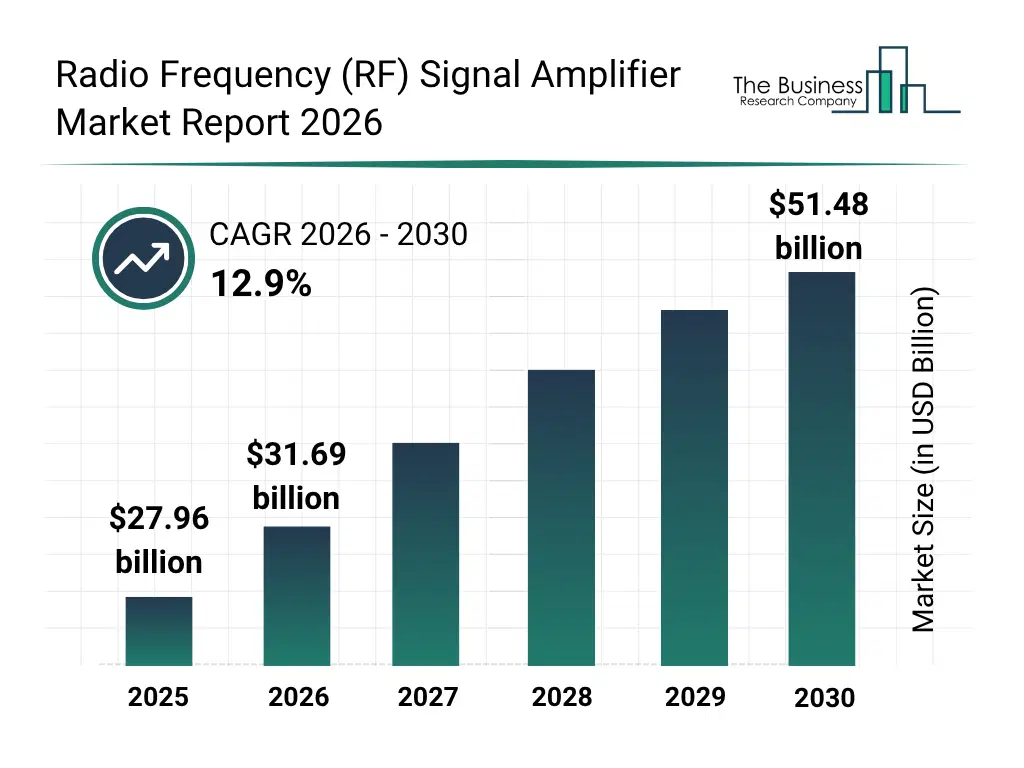
What Is The Radio Frequency (RF) Signal Amplifier Market Size and Share 2026?
The radio frequency (RF) signal amplifier market size has grown rapidly in recent years. It will grow from $27.96 billion in 2025 to $31.69 billion in 2026 at a compound annual growth rate (CAGR) of 13.3%. The growth in the historic period can be attributed to increasing demand for wireless communication systems, rising expansion of cellular network infrastructure, growing need for improved signal transmission quality, increasing adoption of radio communication technologies, expansion of defense and aerospace communication applications.What Is The Radio Frequency (RF) Signal Amplifier Market Growth Forecast?
The radio frequency (RF) signal amplifier market size is expected to see rapid growth in the next few years. It will grow to $51.48 billion in 2030 at a compound annual growth rate (CAGR) of 12.9%. The growth in the forecast period can be attributed to growing demand for 5g and advanced wireless networks, increasing requirement for high performance signal amplification, rising adoption of satellite communication systems, growing deployment of connected industrial communication networks, increasing demand for next generation RF communication equipment. Major trends in the forecast period include increasing adoption of high efficiency rf signal amplification solutions, growing demand for low noise and high gain rf amplifiers, rising development of compact and energy efficient rf amplifier designs, increasing integration of multi frequency rf amplification capabilities, growing focus on improved signal quality and reduced communication interference.
Global Radio Frequency (RF) Signal Amplifier Market Segmentation
2) By Frequency Range: Below 1 Gigahertz, 1 Gigahertz To 2 Gigahertz, 2 Gigahertz To 6 Gigahertz, 6 Gigahertz To 10 Gigahertz, Above 10 Gigahertz 3) By Technology: Solid State Amplifiers, Thermionic Emission Amplifiers, Other Technologies 4) By End Use Industry: Military And Defense, Commercial, Industrial, Healthcare, Agriculture Subsegments: 1) By Low Noise Amplifiers: Broadband Low Noise Amplifiers, Narrowband Low Noise Amplifiers, Cryogenic Low Noise Amplifiers, Gallium Arsenide Low Noise Amplifiers 2) By Power Amplifiers: Linear Power Amplifiers, High Power Radio Frequency Amplifiers, Solid State Power Amplifiers, Gallium Nitride Power Amplifiers 3) By Wideband Amplifiers: Multi Band Wideband Amplifiers, Ultra Wideband Amplifiers, Broadband Driver Amplifiers, Distributed Wideband Amplifiers 4) By Operational Amplifiers: High Speed Operational Amplifiers, Precision Operational Amplifiers, Low Power Operational Amplifiers, Voltage Feedback Operational Amplifiers 5) By Radio Frequency Integrated Circuits: Radio Frequency Front End Integrated Circuits, Radio Frequency Transceiver Integrated Circuits, Radio Frequency Gain Block Integrated Circuits, Radio Frequency System On Chip Integrated CircuitsWhat Is The Driver Of The Radio Frequency (RF) Signal Amplifier Market?
The expansion of 5G communication infrastructure is expected to propel the growth of radio frequency (RF) signal amplifier market going forward. 5G communication infrastructure refers to the network of advanced base stations, antennas, fiber-optic links, small cells, and core network systems that enable ultra-fast, low-latency, and high-capacity wireless connectivity. 5G communication infrastructure is rising due to the increasing demand for high-speed, low-latency connectivity to support data-intensive applications such as AI, IoT, and cloud computing. RF signal amplifiers in 5G communication infrastructure are used to boost weak radio signals to higher power levels, ensuring strong, efficient, and long-range transmission between base stations and user devices. For instance, in March 2024, according to the 5G Americas, a US-based trade organization for telecommunication, global 5G connections reached 1.76 billion by the end of 2023, with 700 million new connections added during the year, marking a 66% annual increase. In North America, 5G accounted for 29% of all wireless connections, growing 64% year-on-year to reach 197 million connections after adding 77 million new users in 2023. Therefore, the expansion of 5G communication infrastructure is driving the growth of the radio frequency (RF) signal amplifier industry.Key Players In The Global Radio Frequency (RF) Signal Amplifier Market
Major companies operating in the radio frequency (rf) signal amplifier market are Broadcom Inc., Qualcomm Incorporated, Mitsubishi Electric Corporation, Sumitomo Electric Industries Ltd., Toshiba Electronic Devices & Storage Corporation, Texas Instruments Incorporated, STMicroelectronics N.V., Infineon Technologies AG, NXP Semiconductors N.V., Analog Devices Inc., Murata Manufacturing Co. Ltd., Renesas Electronics Corporation, Microchip Technology Incorporated, Skyworks Solutions Inc., Qorvo Inc., Wolfspeed Inc., Ampleon Coöperatief U.A., MACOM Technology Solutions Holdings Inc., Rohm Co. Ltd., Teledyne Defense Electronics LLC, Mini-Circuits Inc., Richardson RFPD Inc., RFHIC Corporation, United Monolithic Semiconductors SAS, Empower RF Systems Inc.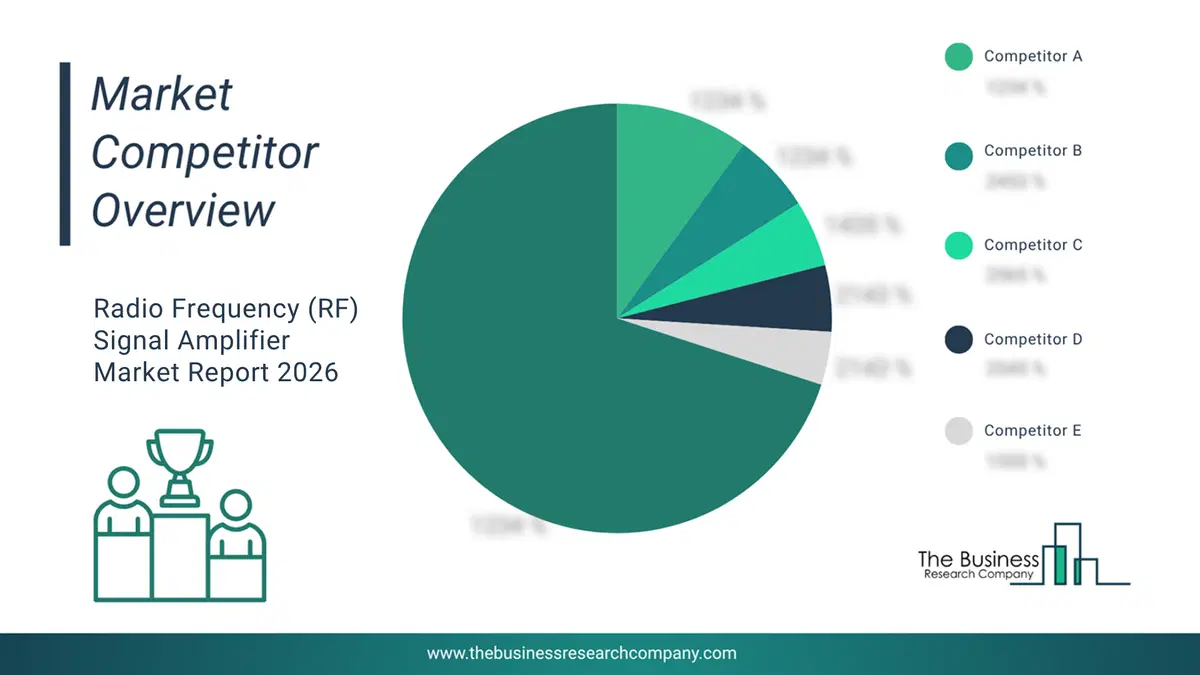
This chart is for illustrative purposes; the full report includes a detailed competitor analysis and comprehensive overview of the top 10 companies in the market.
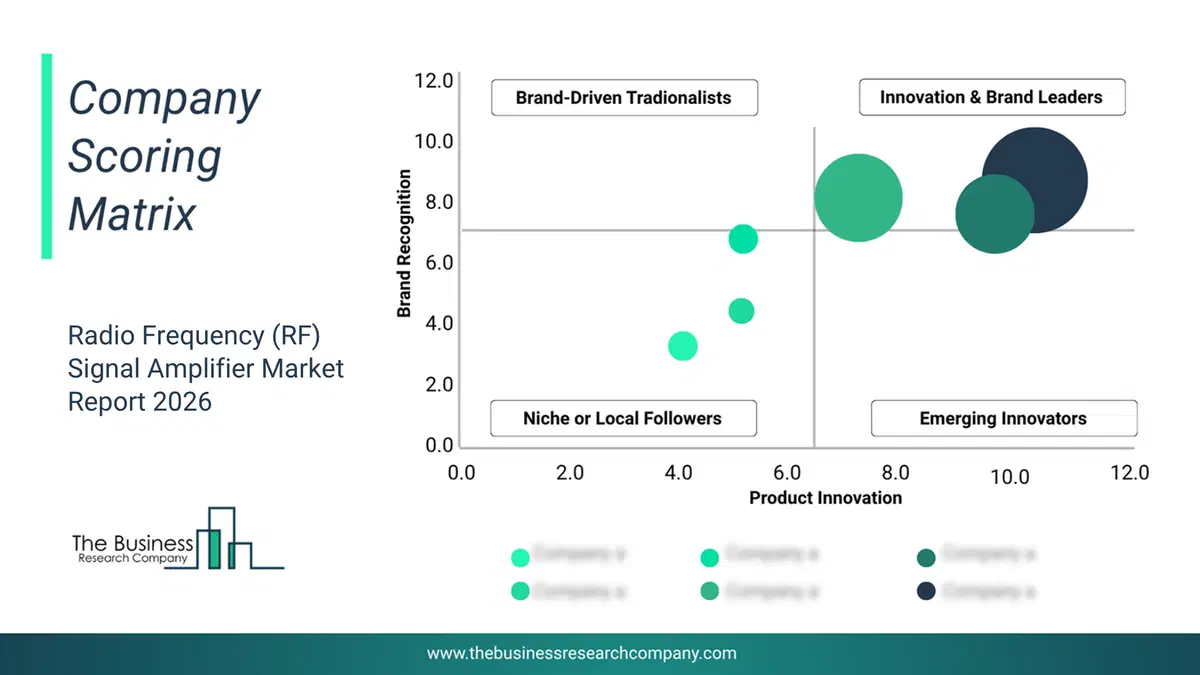
This chart maps companies by product innovation and brand strength, with bubble size indicating relative revenue, helping identify market leaders, challengers, and niche players. This is an illustrative chart; the full report provides a complete and accurate competitive analysis.
Global Radio Frequency (RF) Signal Amplifier Market Trends and Insights
Major companies operating in the radio frequency (RF) signal amplifier market are focusing on developing advanced solutions, such as top-side cooling technologies to improve heat dissipation, enhance amplifier efficiency, reduce system size, and support high-performance 5G network infrastructure deployments. Top-side cooling technology refers to a thermal design approach where heat is released through the top of an RF amplifier device rather than the bottom. For instance, in June 2023, NXP Semiconductors N.V., a Netherlands-based semiconductor manufacturing company, launched its top-side-cooled RF amplifier module family, targeting next-generation 5G infrastructure with a focus on smaller, lighter, and more energy-efficient base station designs. The new GaN-based multi-chip modules introduce an industry-first top-side cooling approach that improves thermal management while reducing radio size and weight by over 20%. By separating thermal and RF design functions and eliminating the need for dedicated RF shielding, the solution simplifies manufacturing, lowers costs, and shortens design cycles. Designed for 32T32R, 200W radios operating in the 3.3–3.8 GHz range, the modules deliver high gain and efficiency, supporting denser and more sustainable 5G network deployments.What Are Latest Mergers And Acquisitions In The Radio Frequency (RF) Signal Amplifier Market?
In October 2023, AMETEK Inc., a UK-based industrial technology solutions company, acquired Amplifier Research Corp. for an undisclosed amount. With this acquisition, AMETEK aims to strengthen its electromagnetic compatibility testing portfolio by expanding capabilities in RF and microwave amplifier design. The acquisition also helps AMETEK provide a broader range of solutions for defense communications, electric vehicle testing, and medical, automotive, and communications markets. Amplifier Research Corp. is a US-based company specializing in RF signal amplifiers, microwave amplifiers, and hybrid power amplifier modules.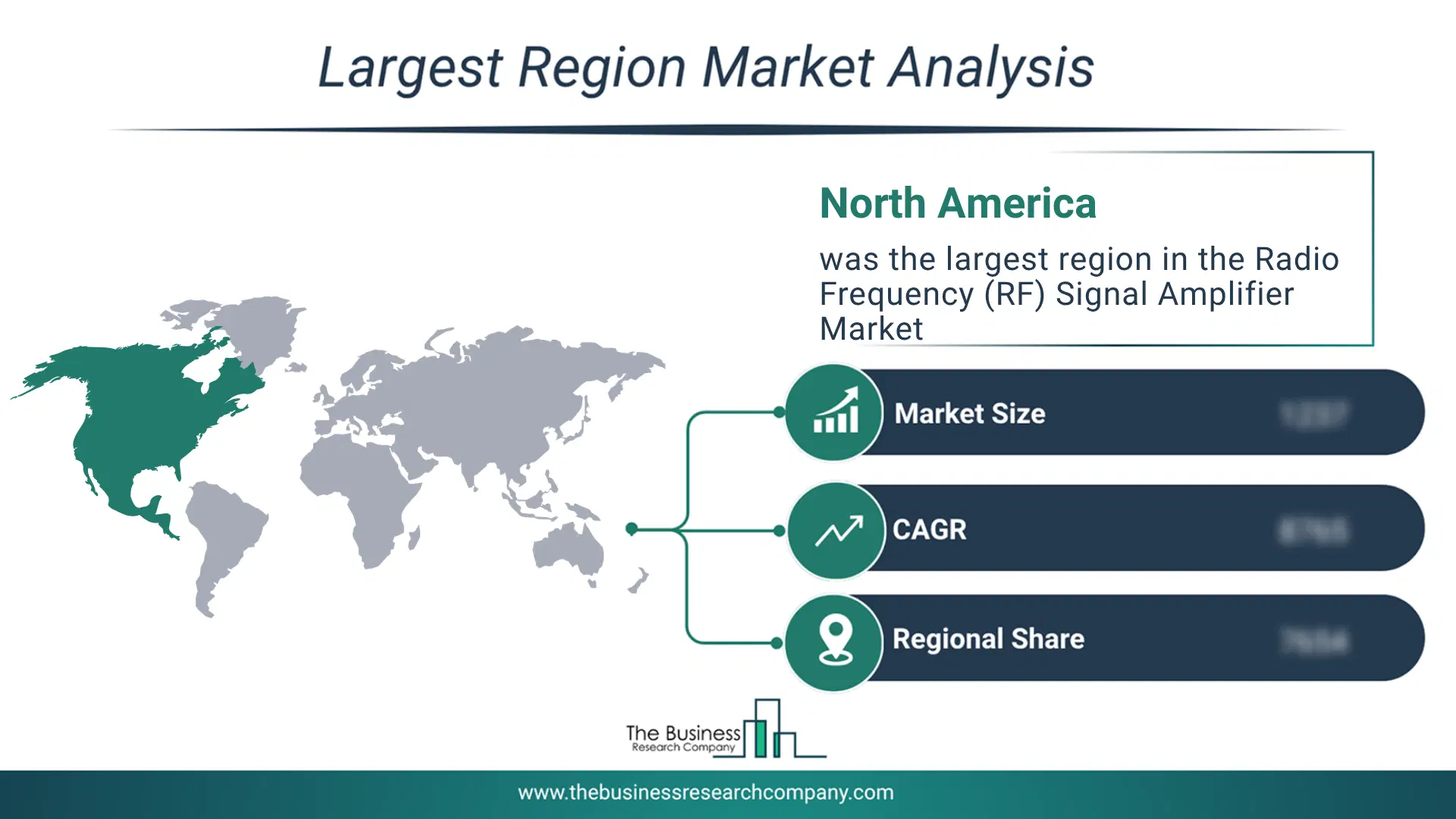
Regional Outlook/Insights
North America was the largest region in the radio frequency (RF) signal amplifier market in 2025. Asia-Pacific is expected to be the fastest-growing region in the forecast period. The regions covered in this market report are Asia-Pacific, South East Asia, Western Europe, Eastern Europe, North America, South America, Middle East, Africa. The countries covered in this market report are Australia, Brazil, China, France, Germany, India, Indonesia, Japan, Taiwan, Russia, South Korea, UK, USA, Canada, Italy, Spain.What Defines the Radio Frequency (RF) Signal Amplifier Market?
The radio frequency (RF) signal amplifier market consists of sales of broadband amplifiers, signal booster modules, and amplification systems. Values in this market are ‘factory gate’ values, that is the value of goods sold by the manufacturers or creators of the goods, whether to other entities (including downstream manufacturers, wholesalers, distributors and retailers) or directly to end customers. The value of goods in this market includes related services sold by the creators of the goods.How is Market Value Defined and Measured?
The market value is defined as the revenues that enterprises gain from the sale of goods and/or services within the specified market and geography through sales, grants, or donations in terms of the currency (in USD unless otherwise specified). The revenues for a specified geography are consumption values that are revenues generated by organizations in the specified geography within the market, irrespective of where they are produced. It does not include revenues from resales along the supply chain, either further along the supply chain or as part of other products.
This chart presents market attractiveness based on a quantitative evaluation of growth, competition, strategic alignment, and risk, offering a clear view of opportunity areas for decision-making. This chart is for illustrative purposes; the full report contains the complete analysis.

This chart highlights the Total Addressable Market (TAM) by estimating the maximum revenue opportunity using an assumption-driven approach, supporting strategic planning and opportunity sizing across markets. The chart is illustrative; the full report provides a more comprehensive analysis.
What Key Data and Analysis Are Included in the Radio Frequency (RF) Signal Amplifier Market Report 2026?
The radio frequency (rf) signal amplifier market research report is one of a series of new reports from The Business Research Company that provides radio frequency (rf) signal amplifier market statistics, including radio frequency (rf) signal amplifier industry global market size, regional shares, competitors with a radio frequency (rf) signal amplifier market share, detailed radio frequency (rf) signal amplifier market segments, market trends and opportunities, and any further data you may need to thrive in the radio frequency (rf) signal amplifier industry. This radio frequency (rf) signal amplifier market research report delivers a complete perspective of everything you need, with an in-depth analysis of the current and future scenario of the industry.Radio Frequency (RF) Signal Amplifier Market Report Forecast Analysis
| Report Attribute | Details |
|---|---|
| Market Size Value In 2026 | $31.69 billion |
| Revenue Forecast In 2030 | $51.48 billion |
| Growth Rate | CAGR of 12.9% from 2026 to 2030 |
| Base Year For Estimation | 2025 |
| Actual Estimates/Historical Data | 2020-2025 |
| Forecast Period | 2026 - 2030 |
| Market Representation | Revenue in USD Billion and CAGR from 2026 to 2030 |
| Segments Covered | Product Type, Frequency Range, Technology, End Use Industry |
| Regional Scope | Asia-Pacific, Western Europe, Eastern Europe, North America, South America, Middle East, Africa |
| Country Scope | The countries covered in the report are Australia, Brazil, China, France, Germany, India, Indonesia, Japan, Taiwan, Russia, South Korea, UK, USA, Canada, Italy, Spain. |
| Key Companies Profiled | Broadcom Inc., Qualcomm Incorporated, Mitsubishi Electric Corporation, Sumitomo Electric Industries Ltd., Toshiba Electronic Devices & Storage Corporation, Texas Instruments Incorporated, STMicroelectronics N.V., Infineon Technologies AG, NXP Semiconductors N.V., Analog Devices Inc., Murata Manufacturing Co. Ltd., Renesas Electronics Corporation, Microchip Technology Incorporated, Skyworks Solutions Inc., Qorvo Inc., Wolfspeed Inc., Ampleon Coöperatief U.A., MACOM Technology Solutions Holdings Inc., Rohm Co. Ltd., Teledyne Defense Electronics LLC, Mini-Circuits Inc., Richardson RFPD Inc., RFHIC Corporation, United Monolithic Semiconductors SAS, Empower RF Systems Inc. |
| Customization Scope | Request for Customization |
| Pricing And Purchase Options | Explore Purchase Options |