
Radio Frequency (RF) Vector Signal Analyzer Market Report 2026
Global Outlook – By Product Type (Portable Vector Signal Analyzers, Bench Top Vector Signal Analyzers, Embedded Vector Signal Analyzers), By Frequency Range (Low Frequency (Direct Current To 1 Gigahertz), Mid Frequency (1 Gigahertz To 6 Gigahertz), High Frequency (6 Gigahertz To 20 Gigahertz), Ultra High Frequency (20 Gigahertz And Above)), By Analysis Type (Time Domain Analysis, Frequency Domain Analysis, Modulation Analysis, Waveform Analysis), By End User (Telecommunications Companies, Aerospace And Defense Organizations, Automotive Manufacturers, Electronics Manufacturers, Semiconductor Companies, Research Institutes) – Market Size, Trends, Strategies, and Forecast to 2030
Radio Frequency (RF) Vector Signal Analyzer Market Overview
• Radio Frequency (RF) Vector Signal Analyzer market size has reached to $0.91 billion in 2025 • Expected to grow to $1.51 billion in 2030 at a compound annual growth rate (CAGR) of 10.5% • Growth Driver: Rising IoT Adoption Driving Demand For The Market Due To Increasing Need For Continuous Power, Connectivity, And Edge Device Integration • Market Trend: Advancements In Multi-Channel RF Signal Analysis For Advanced Wireless Testing • North America was the largest region in 2025 and Asia-Pacific is the fastest growing region.What Is Covered Under Radio Frequency (RF) Vector Signal Analyzer Market?
A radio frequency (RF) vector signal analyzer is a specialized electronic test instrument used to measure and analyze the amplitude, phase, and frequency characteristics of radio frequency signals. It captures complex modulated signals and provides detailed information about signal quality, distortion, and spectral content. A radio frequency (RF) vector signal analyzer enables engineers to evaluate, troubleshoot, and optimize the performance of wireless communication systems, including broadband, IoT, and 5G networks. The main product types of radio frequency (RF) vector signal analyzer include portable vector signal analyzers, bench top vector signal analyzers, and embedded vector signal analyzers. Portable vector signal analyzers refer to compact test and measurement instruments designed to analyze and characterize radio frequency signals in field and laboratory environments. These analyzers operate across frequency ranges including low frequency (direct current to 1 gigahertz), mid frequency (1 gigahertz to 6 gigahertz), high frequency (6 gigahertz to 20 gigahertz), and ultra high frequency (20 gigahertz and above). They support analysis types such as time domain analysis, frequency domain analysis, modulation analysis, and waveform analysis and are utilized by end users including telecommunications companies, aerospace and defense organizations, automotive manufacturers, electronics manufacturers, semiconductor companies, and research institutes.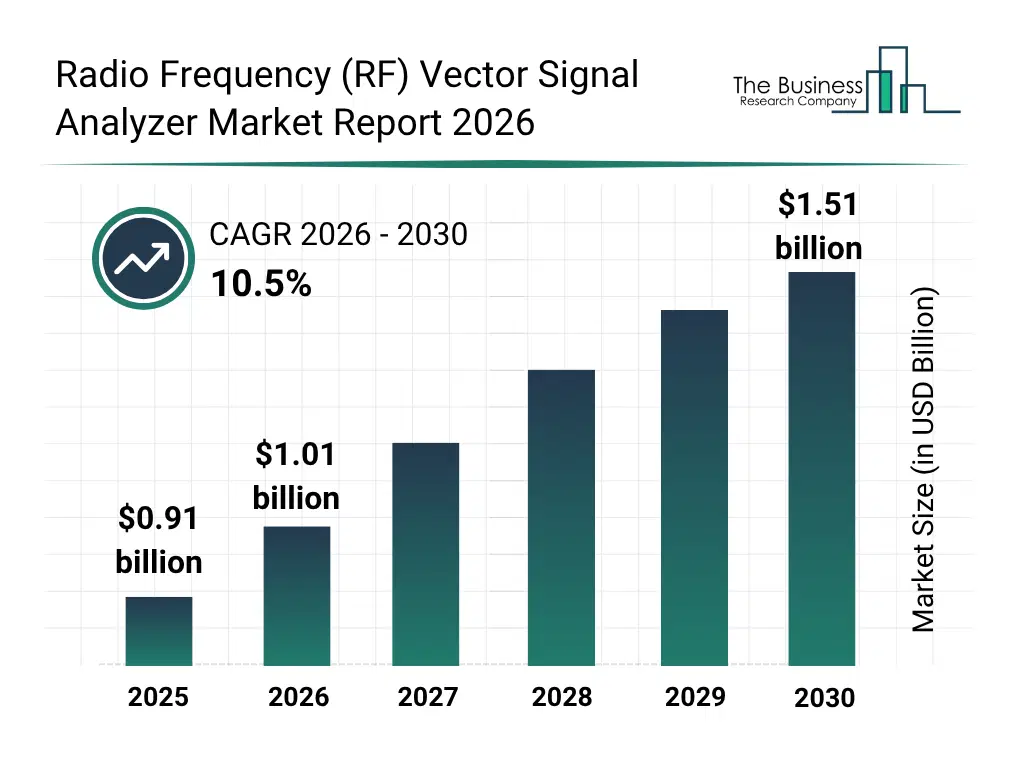
What Is The Radio Frequency (RF) Vector Signal Analyzer Market Size and Share 2026?
The radio frequency (RF) vector signal analyzer market size has grown rapidly in recent years. It will grow from $0.91 billion in 2025 to $1.01 billion in 2026 at a compound annual growth rate (CAGR) of 10.9%. The growth in the historic period can be attributed to growing deployment of wireless communication networks, increasing demand for RF testing equipment, rising investments in semiconductor validation, expanding use of aerospace communication systems, increasing adoption of advanced laboratory testing solutions.What Is The Radio Frequency (RF) Vector Signal Analyzer Market Growth Forecast?
The radio frequency (RF) vector signal analyzer market size is expected to see rapid growth in the next few years. It will grow to $1.51 billion in 2030 at a compound annual growth rate (CAGR) of 10.5%. The growth in the forecast period can be attributed to growing expansion of 5G and future wireless networks, increasing demand for high frequency RF testing, rising adoption of advanced automotive communication systems, expanding investments in next generation semiconductor development, increasing need for precision signal analysis in wireless infrastructure. Major trends in the forecast period include increasing adoption of real time signal analysis solutions, growing development of wideband vector signal analysis, rising demand for high frequency signal measurement, expanding integration of multi channel signal analysis capabilities, increasing focus on advanced modulation analysis performance.
Global Radio Frequency (RF) Vector Signal Analyzer Market Segmentation
2) By Frequency Range: Low Frequency (Direct Current To 1 Gigahertz), Mid Frequency (1 Gigahertz To 6 Gigahertz), High Frequency (6 Gigahertz To 20 Gigahertz), Ultra High Frequency (20 Gigahertz And Above) 3) By Analysis Type: Time Domain Analysis, Frequency Domain Analysis, Modulation Analysis, Waveform Analysis 4) By End User: Telecommunications Companies, Aerospace And Defense Organizations, Automotive Manufacturers, Electronics Manufacturers, Semiconductor Companies, Research Institutes Subsegments: 1) By Portable Vector Signal Analyzers: Handheld Vector Signal Analyzers, Battery Operated Vector Signal Analyzers, Field Testing Vector Signal Analyzers, Wireless Communication Vector Signal Analyzers, Compact Portable Signal Analyzers 2) By Bench Top Vector Signal Analyzers: High Performance Bench Top Analyzers, Multi Channel Bench Top Analyzers, Laboratory Grade Signal Analyzers, High Frequency Bench Top Analyzers, Modulation Analysis Bench Top Analyzers 3) By Embedded Vector Signal Analyzers: Integrated Circuit Embedded Analyzers, Real Time Embedded Signal Analyzers, Industrial Embedded Signal Analyzers, Automotive Embedded Signal Analyzers, Communication System Embedded AnalyzersWhat Are The Drivers Of The Radio Frequency (RF) Vector Signal Analyzer Market?
The increasing demand for IoT devices is expected to propel the growth of the radio frequency (RF) vector signal analyzer market going forward. IoT devices are physical objects embedded with sensors, software, and network connectivity that enable them to collect and exchange data over the internet with minimal human intervention. IoT devices are rising due to the increasing demand for real-time monitoring and data-driven automation, enabling greater operational efficiency and improved decision-making across connected environments. An RF vector signal analyzer supports IoT devices by enabling precise measurement, analysis, and troubleshooting of wireless signals, ensuring reliable communication performance, interference detection, and signal integrity in connected IoT networks. For instance, in April 2025, according to Telefonaktiebolaget LM Ericsson , a Sweden-based telecommunications company, global IoT connections reached 18.8 billion connections in 2024 and are expected to increase to 43.0 billion connections by 2030. Therefore, the increasing demand for IoT devices is driving the growth of the radio frequency (RF) vector signal analyzer industry. The increasing investments in broadband network expansion are expected to propel the growth of the radio frequency (RF) vector signal analyzer market going forward. Broadband network investments involve funding the expansion and modernization of high-speed internet infrastructure to improve connectivity, coverage, and data transmission capabilities. Investments in broadband networks increase the deployment of advanced wireless communication systems, driving demand for RF vector signal analyzers to test, optimize, and ensure reliable signal performance. An RF vector signal analyzer supports broadband network expansion by accurately measuring and analyzing complex radio frequency signals, helping engineers optimize signal quality, reduce interference, and ensure reliable high-speed connectivity across expanding broadband infrastructures. For instance, in April 2024, according to Building Digital UK, a UK-based government agency, in 2024, a record £714 million ($956.60 million) was invested in expanding rural broadband, bringing total investment in next-generation connectivity to £1.3 billion ($1.74 billion). Therefore, the increasing investments in broadband network expansion are driving the growth of the radio frequency (RF) vector signal analyzer industry.Key Players In The Global Radio Frequency (RF) Vector Signal Analyzer Market
Major companies operating in the radio frequency (rf) vector signal analyzer market are Keysight Technologies Inc., Rohde & Schwarz GmbH & Co. KG, Anritsu Corporation, Tektronix Inc., VIAVI Solutions Inc., LitePoint Corporation, Rigol Technologies Co. Ltd., Aaronia AG, CRFS Limited, Signal Hound, Saluki Technology Inc., Nutaq Innovation Inc.
This chart is for illustrative purposes; the full report includes a detailed competitor analysis and comprehensive overview of the top 10 companies in the market.
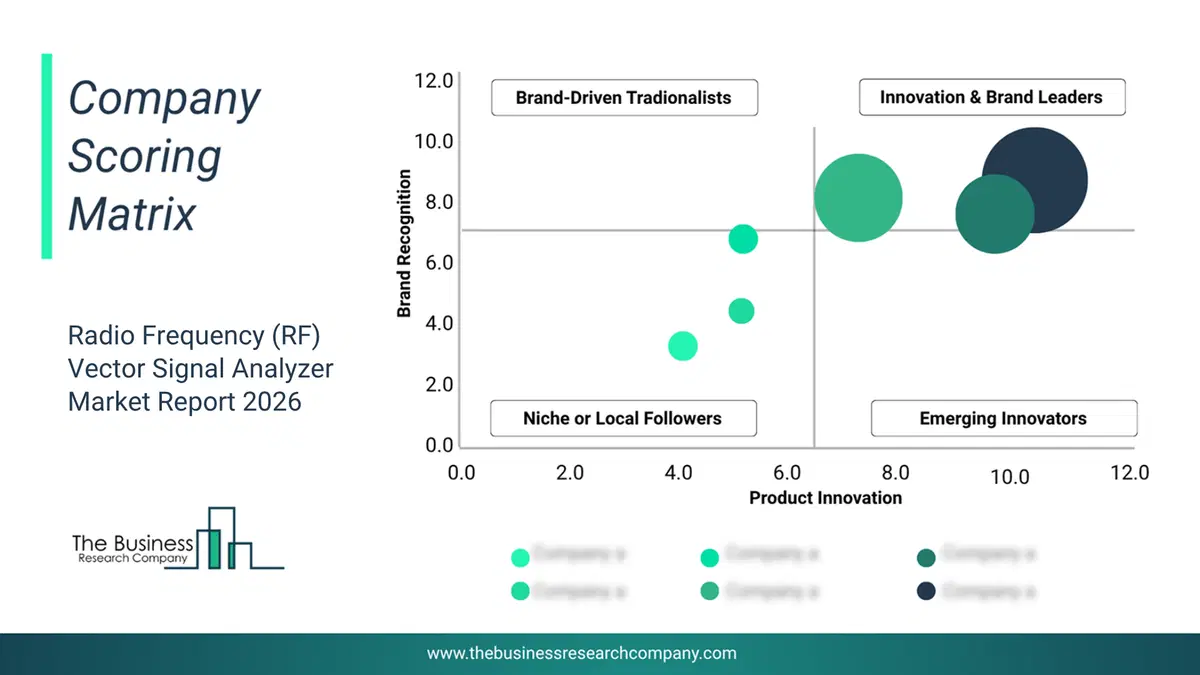
This chart maps companies by product innovation and brand strength, with bubble size indicating relative revenue, helping identify market leaders, challengers, and niche players. This is an illustrative chart; the full report provides a complete and accurate competitive analysis.
Global Radio Frequency (RF) Vector Signal Analyzer Market Trends and Insights
Major companies operating in the radio frequency (RF) vector signal analyzer market are focusing on innovation in multi-channel RF signal analysis to enhance high-frequency signal accuracy, improve multi-signal measurement efficiency, and support the growing complexity of 5G, phased-array, and next-generation wireless communication systems. Multi-channel RF signal analysis is the simultaneous measurement and evaluation of RF signals across multiple channels or frequencies, enabling real-time monitoring, interference detection, performance assessment, and optimization of complex wireless systems. For instance, in April 2024, Tektronix, Inc., a US-based provider of test and measurement solutions, introduced SignalVu Spectrum Analyzer Software Version 5.4 to enhance RF signal analysis and wireless testing capabilities. The solution supports simultaneous analysis of up to eight RF signals and 26 wireless modulation schemes, including 1024QAM for high-bandwidth applications. It also enables analysis of multiple frequency-separated signals through a shared acquisition system. The software integrates with Tektronix oscilloscopes, improving testing efficiency, modulation accuracy, and support for advanced 5G, phased-array, and mixed-signal RF applications.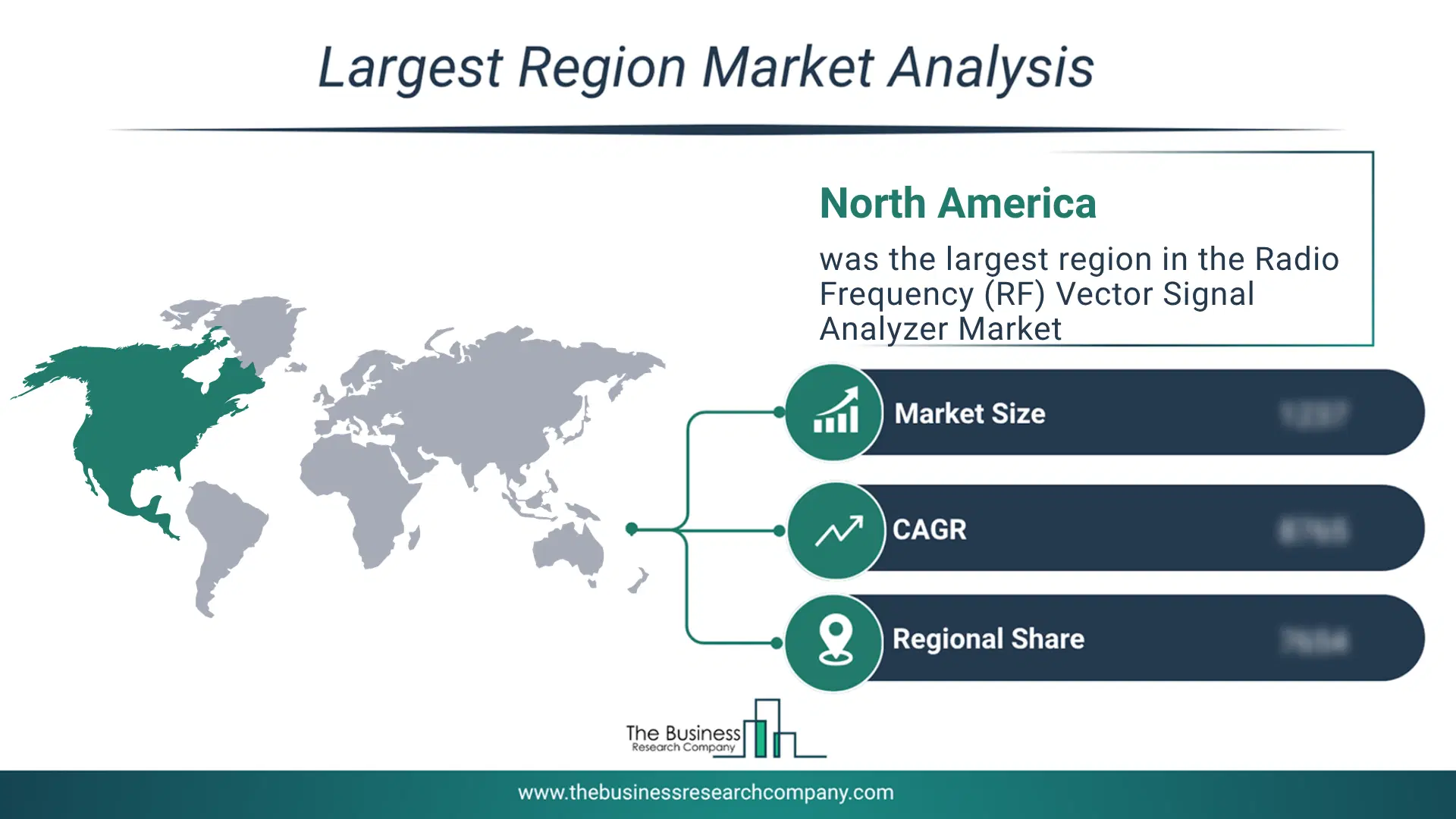
Regional Outlook/Insights
North America was the largest region in the radio frequency (RF) vector signal analyzer market in 2025. Asia-Pacific is expected to be the fastest-growing region in the forecast period. The regions covered in this market report are Asia-Pacific, South East Asia, Western Europe, Eastern Europe, North America, South America, Middle East, Africa. The countries covered in this market report are Australia, Brazil, China, France, Germany, India, Indonesia, Japan, Taiwan, Russia, South Korea, UK, USA, Canada, Italy, Spain.What Defines the Radio Frequency (RF) Vector Signal Analyzer Market?
The radio frequency (RF) vector signal analyzer market consists of sales of handheld RF signal analyzers, real-time signal analyzers, USB-based vector signal analyzers, and modular PXI vector signal analyzers. Values in this market are ‘factory gate’ values, that is the value of goods sold by the manufacturers or creators of the goods, whether to other entities (including downstream manufacturers, wholesalers, distributors and retailers) or directly to end customers. The value of goods in this market includes related services sold by the creators of the goods.How is Market Value Defined and Measured?
The market value is defined as the revenues that enterprises gain from the sale of goods and/or services within the specified market and geography through sales, grants, or donations in terms of the currency (in USD unless otherwise specified). The revenues for a specified geography are consumption values that are revenues generated by organizations in the specified geography within the market, irrespective of where they are produced. It does not include revenues from resales along the supply chain, either further along the supply chain or as part of other products.
This chart presents market attractiveness based on a quantitative evaluation of growth, competition, strategic alignment, and risk, offering a clear view of opportunity areas for decision-making. This chart is for illustrative purposes; the full report contains the complete analysis.

This chart highlights the Total Addressable Market (TAM) by estimating the maximum revenue opportunity using an assumption-driven approach, supporting strategic planning and opportunity sizing across markets. The chart is illustrative; the full report provides a more comprehensive analysis.
What Key Data and Analysis Are Included in the Radio Frequency (RF) Vector Signal Analyzer Market Report 2026?
The radio frequency (rf) vector signal analyzer market research report is one of a series of new reports from The Business Research Company that provides radio frequency (rf) vector signal analyzer market statistics, including radio frequency (rf) vector signal analyzer industry global market size, regional shares, competitors with a radio frequency (rf) vector signal analyzer market share, detailed radio frequency (rf) vector signal analyzer market segments, market trends and opportunities, and any further data you may need to thrive in the radio frequency (rf) vector signal analyzer industry. This radio frequency (rf) vector signal analyzer market research report delivers a complete perspective of everything you need, with an in-depth analysis of the current and future scenario of the industry.Radio Frequency (RF) Vector Signal Analyzer Market Report Forecast Analysis
| Report Attribute | Details |
|---|---|
| Market Size Value In 2026 | $1.01 billion |
| Revenue Forecast In 2030 | $1.51 billion |
| Growth Rate | CAGR of 10.5% from 2026 to 2030 |
| Base Year For Estimation | 2025 |
| Actual Estimates/Historical Data | 2020-2025 |
| Forecast Period | 2026 - 2030 |
| Market Representation | Revenue in USD Billion and CAGR from 2026 to 2030 |
| Segments Covered | Product Type, Frequency Range, Analysis Type, End User |
| Regional Scope | Asia-Pacific, Western Europe, Eastern Europe, North America, South America, Middle East, Africa |
| Country Scope | The countries covered in the report are Australia, Brazil, China, France, Germany, India, Indonesia, Japan, Taiwan, Russia, South Korea, UK, USA, Canada, Italy, Spain. |
| Key Companies Profiled | Keysight Technologies Inc., Rohde & Schwarz GmbH & Co. KG, Anritsu Corporation, Tektronix Inc., VIAVI Solutions Inc., LitePoint Corporation, Rigol Technologies Co. Ltd., Aaronia AG, CRFS Limited, Signal Hound, Saluki Technology Inc., Nutaq Innovation Inc. |
| Customization Scope | Request for Customization |
| Pricing And Purchase Options | Explore Purchase Options |