
Radio Telescope Market Report 2026
Global Outlook – By Type (Single Dish Telescopes, Interferometric Telescopes, Radio Holographic Telescopes, Phased Array Telescopes), By Component (Antenna Systems, Receivers, Signal Processing Units, Control Systems, Data Storage Solutions), By Frequency Range (Low Frequency (30 Mhz - 300 Mhz), Medium Frequency (300 Mhz - 3 Ghz), High Frequency (3 Ghz - 30 Ghz), Very High Frequency (30 Ghz - 300 Ghz)), By Application (Astrophysics, Space Exploration, Satellite Communication, Radio Astronomy, Education And Research), By End-User (Government Research Organizations, Academic And Research Institutes, Military And Defense Agencies, Private Sector And Commercial Enterprises) – Market Size, Trends, Strategies, and Forecast to 2030
Radio Telescope Market Overview
• Radio Telescope market size has reached to $1.55 billion in 2025 • Expected to grow to $2.33 billion in 2030 at a compound annual growth rate (CAGR) of 8.5% • Growth Driver: Rising Interest In Space Exploration Fueling The Market Growth Due To Growing Commercial Space Initiatives • Market Trend: Innovative Antenna Engineering Improves Detection Capabilities • North America was the largest region in 2025 and Asia-Pacific is the fastest growing region.What Is Covered Under Radio Telescope Market?
A radio telescope is a specialized antenna and radio receiver designed to detect and study radio waves from celestial objects. It collects faint signals from stars, galaxies, and other astronomical sources, allowing observation of phenomena invisible in visible light. The collected data is analyzed to understand the structure, composition, and behavior of objects in the universe. The main types of radio telescopes are single dish telescopes, interferometric telescopes, radio holographic telescopes, and phased array telescopes. Single dish telescopes, which have a large parabolic reflector that collects and focuses radio waves, are ideal for sensitive observations of wide sky regions and faint cosmic signals. They typically consist of antenna systems, receivers, signal processing units, control systems, and data storage solutions, and operate across various frequency ranges, including low frequency (30 MHz–300 MHz), medium frequency (300 MHz–3 GHz), high frequency (3 GHz–30 GHz), and very high frequency (30 GHz–300 GHz). These telescopes are used for multiple applications, such as astrophysics, space exploration, satellite communication, radio astronomy, and education and research, and their end-users include government research organizations, academic and research institutes, military and defense agencies, and private sector and commercial enterprises.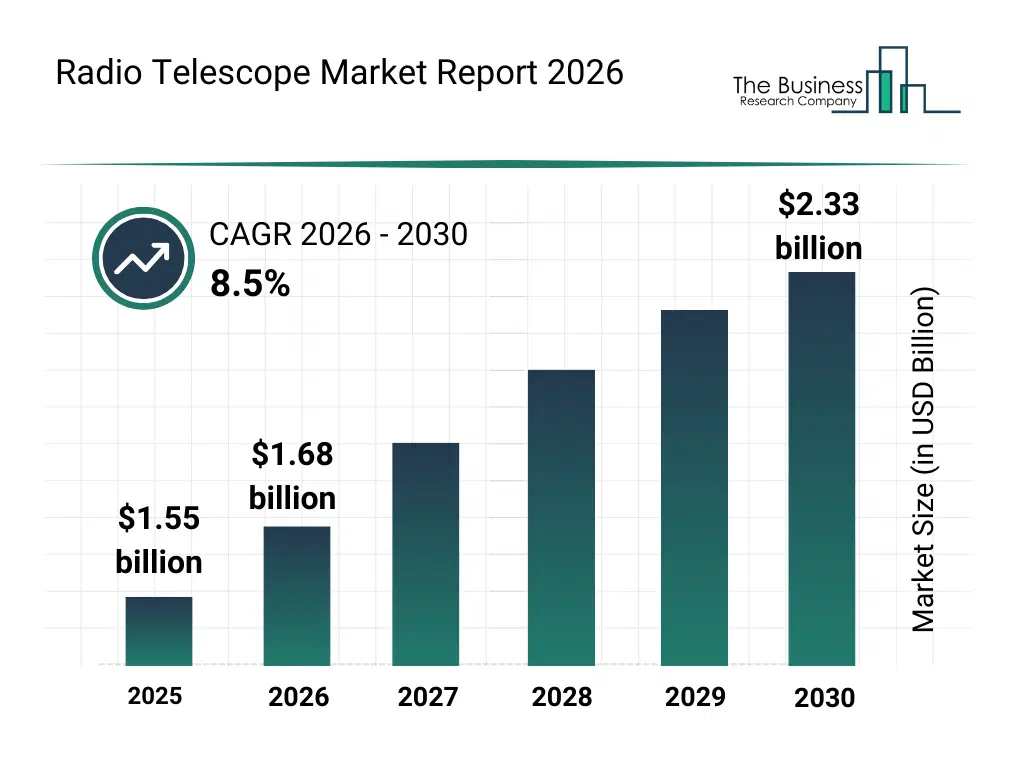
What Is The Radio Telescope Market Size and Share 2026?
The radio telescope market size has grown strongly in recent years. It will grow from $1.55 billion in 2025 to $1.68 billion in 2026 at a compound annual growth rate (CAGR) of 8.4%. The growth in the historic period can be attributed to expansion of astronomical observation programs, development of single-dish and array telescopes, adoption of advanced signal processing equipment, government and defense funding for space research, growth of satellite tracking and communication support.What Is The Radio Telescope Market Growth Forecast?
The radio telescope market size is expected to see strong growth in the next few years. It will grow to $2.33 billion in 2030 at a compound annual growth rate (CAGR) of 8.5%. The growth in the forecast period can be attributed to deployment of next-generation high-sensitivity telescopes, integration with ai-based data analysis, expansion of multi-frequency and interferometric telescope arrays, growth in educational and research programs, adoption of cloud-based data acquisition and processing systems. Major trends in the forecast period include advanced radio frequency signal processing, high-sensitivity low-noise receiver development, multi-band and wideband telescope adoption, integration of remote observation and automation, expansion of educational and research-oriented astronomy programs.
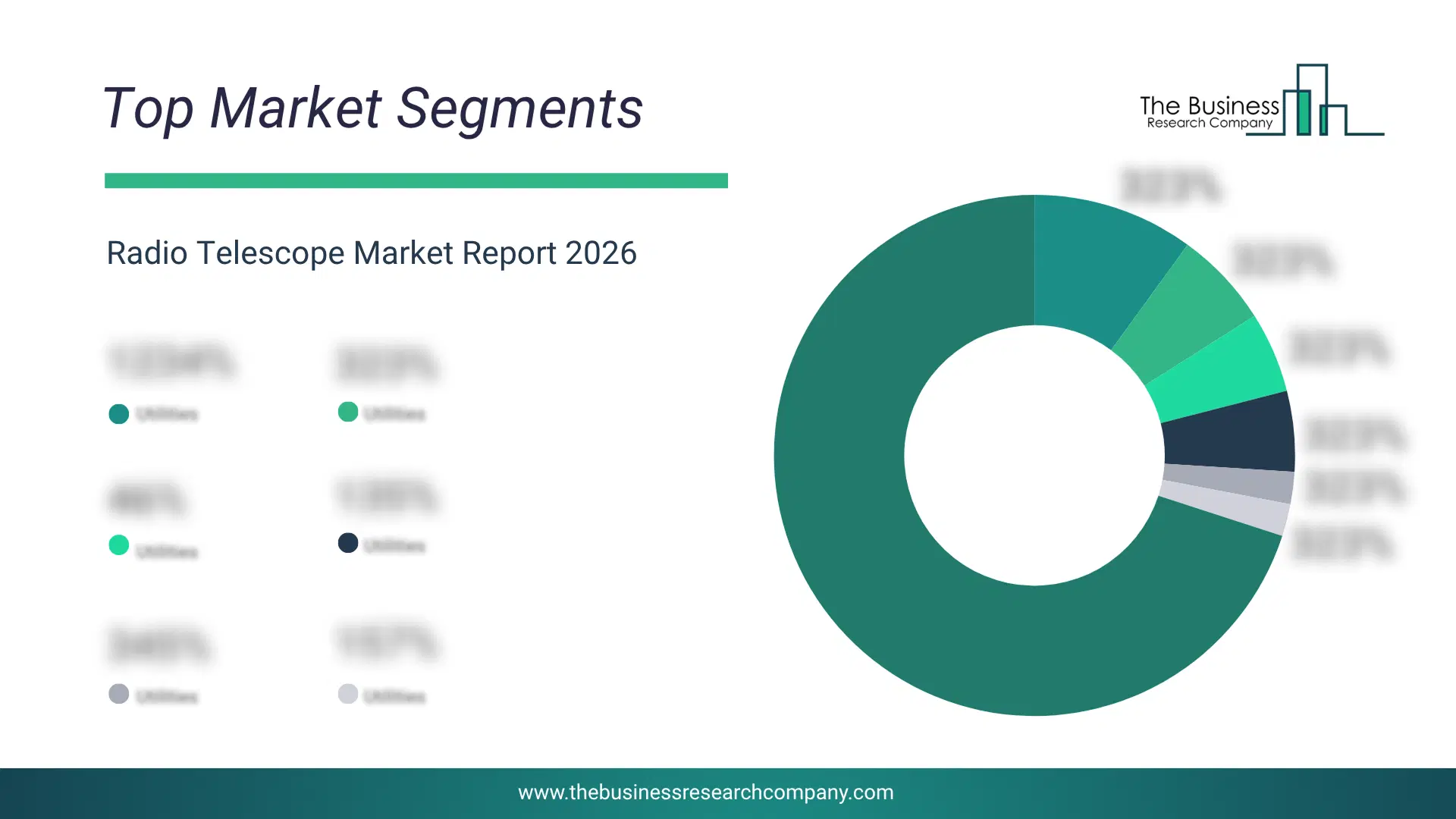
Global Radio Telescope Market Segmentation
1) By Type: Single Dish Telescopes, Interferometric Telescopes, Radio Holographic Telescopes, Phased Array Telescopes 2) By Component: Antenna Systems, Receivers, Signal Processing Units, Control Systems, Data Storage Solutions 3) By Frequency Range: Low Frequency (30 Mhz - 300 Mhz), Medium Frequency (300 Mhz - 3 Ghz), High Frequency (3 Ghz - 30 Ghz), Very High Frequency (30 Ghz - 300 Ghz) 4) By Application: Astrophysics, Space Exploration, Satellite Communication, Radio Astronomy, Education And Research 5) By End-User: Government Research Organizations, Academic And Research Institutes, Military And Defense Agencies, Private Sector And Commercial Enterprises Subsegments: 1) By Single Dish Telescopes: Large Single Dish Telescopes, Small Single Dish Telescopes 2) By Interferometric Telescopes: Very Long Baseline Interferometry (VLBI), Connected Element Interferometry, Aperture Synthesis Interferometry 3) By Radio Holographic Telescopes: Near Field Radio Holography, Far Field Radio Holography, Synthetic Aperture Holography 4) By Phased Array Telescopes: Active Phased Array Telescopes, Passive Phased Array Telescopes, Electronically Steered Phased ArraysWhat Is Driver Of The Radio Telescope Market?
The growing investment in space technologies is expected to propel the growth of the radio telescope market going forward. Space technologies refer to the tools, systems, and innovations such as satellites, spacecraft, launch vehicles, sensors, and orbital platforms used for exploring, monitoring, and utilizing outer space. Investment in space technologies is rising due to the growing commercial opportunities in satellite services, space-based climate monitoring, and space exploration. Investment in space technologies enhances radio telescope capabilities by enabling more advanced antennas, higher-resolution imaging, space-based arrays, and improved data processing for deep-space observation. For instance, in June 2025, according to the European Space Policy Institute (ESPI), an Austria-based think tank that provides strategic analysis and advice on space policy and its global implications, global investment in space ventures totaled $8.02 billion (€6.9 billion) across 265 funding rounds in 2025, reflecting a 6% year-on-year increase. Therefore, the growing investment in space technologies is driving the growth of the radio telescope industry.Key Players In The Global Radio Telescope Market
Major companies operating in the radio telescope market are General Dynamics Corporation, Mitsubishi Electric Corporation, CPI Satcom & Antenna Technologies Inc., MDA Space Ltd., Calian Ltd., SRI International Inc., National Radio Astronomy Observatory, Bushnell Corporation, Celestron LLC, Bresser GmbH, Vixen Co. Ltd., Ranor Inc., Barska, Bosma Machine & Tool Corporation, Takahashi, Sky Watcher, RFOptic Ltd., Lunar Resources Inc., Blue Skies Space Ltd., Telescope Engineering Company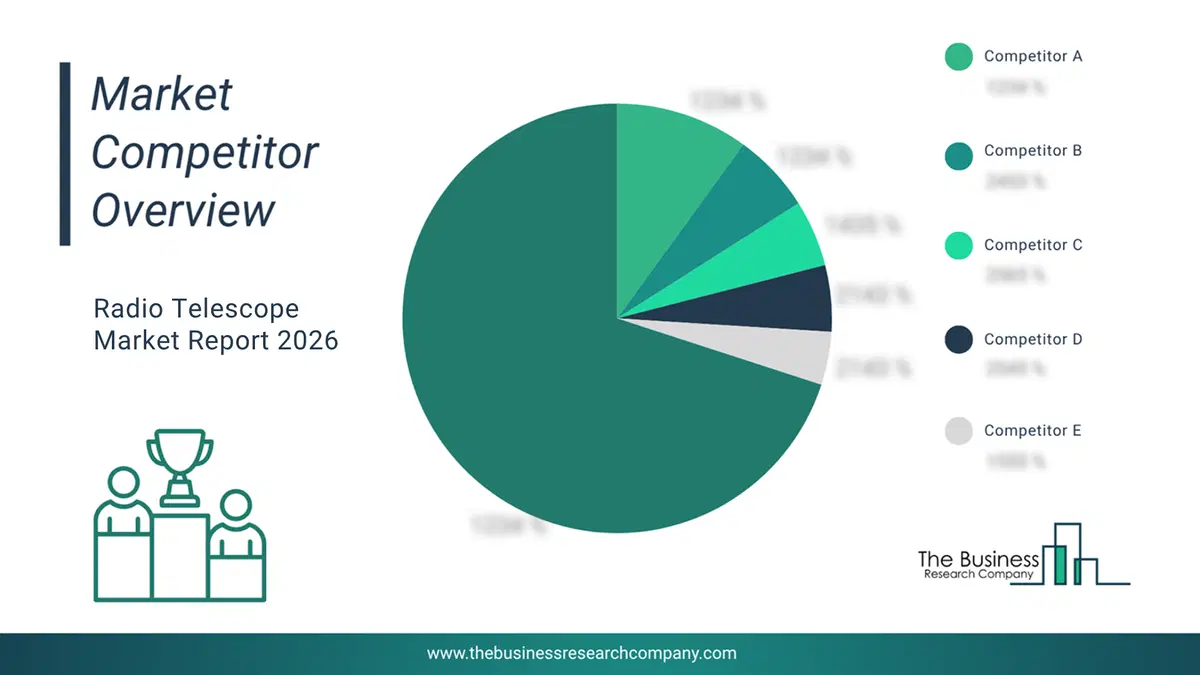
This chart is for illustrative purposes; the full report includes a detailed competitor analysis and comprehensive overview of the top 10 companies in the market.
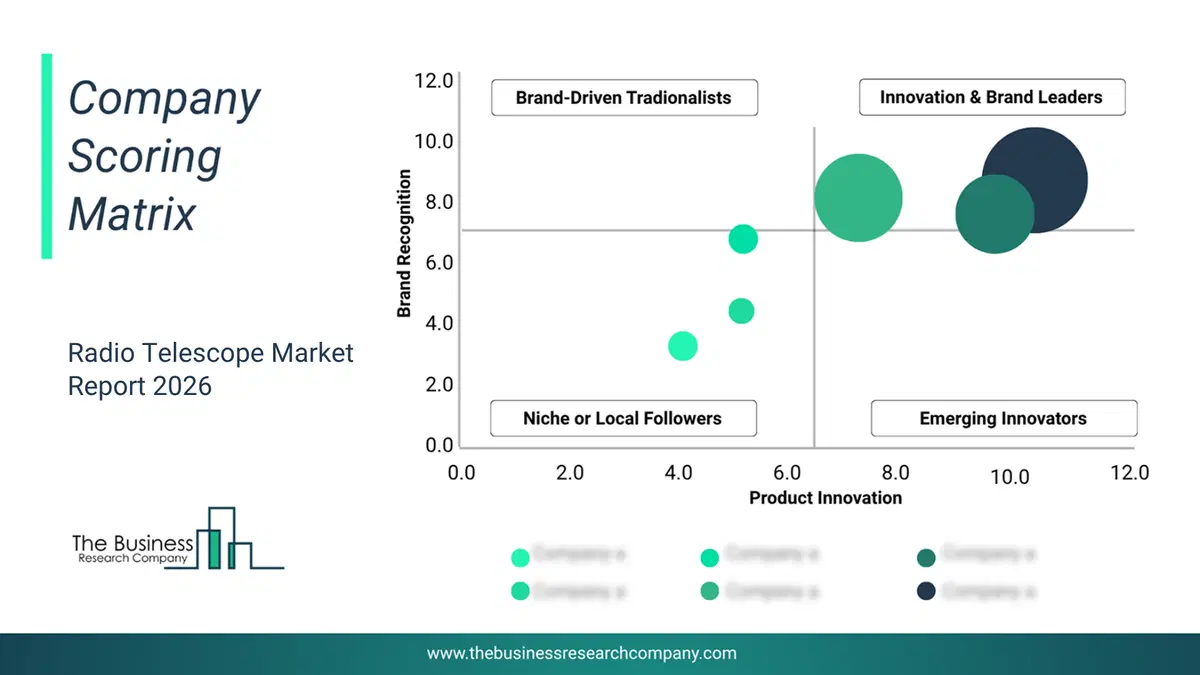
This chart maps companies by product innovation and brand strength, with bubble size indicating relative revenue, helping identify market leaders, challengers, and niche players. This is an illustrative chart; the full report provides a complete and accurate competitive analysis.
Global Radio Telescope Market Trends and Insights
Major companies operating in the radio telescope market are focusing on leveraging innovative solutions such as advanced antenna design to enhance sensitivity, accuracy, and observational capabilities. Advanced antenna design is the creation of antennas using cutting-edge technologies and materials to improve signal reception, precision, and efficiency, helping a radio telescope enhance sensitivity, accuracy, and detect weak or distant cosmic signals. For instance, in September 2024, the Xinjiang Astronomical Observatory (XAO), a China-based research institution, completed the antenna track foundation of the QiTai Radio Telescope (QTT), marking a major milestone toward installing its 110-meter main reflector. This achievement underscores the observatory’s commitment to employing advanced engineering and antenna design techniques to ensure high pointing accuracy, sensitivity, and multi-disciplinary observational capabilities across a wide frequency range of 270 MHz to 115 GHz, enabling astronomers to detect faint and distant cosmic signals, conduct precise measurements of celestial phenomena, and support groundbreaking research in areas such as galaxy formation, star evolution, and molecular cloud studies.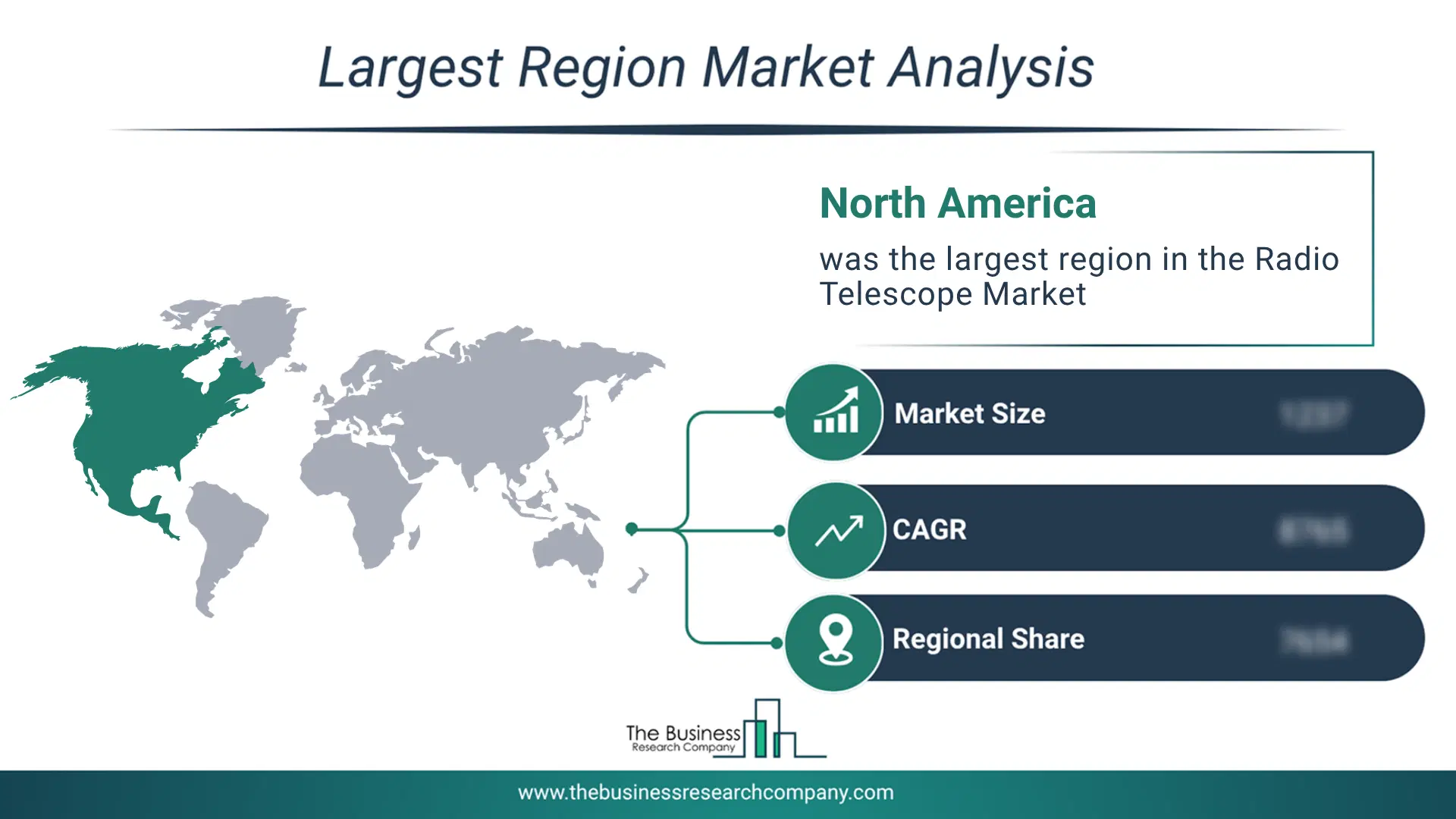
Regional Insights
North America was the largest region in the radio telescope market in 2025. Asia-Pacific is expected to be the fastest-growing region in the forecast period. The regions covered in this market report are Asia-Pacific, South East Asia, Western Europe, Eastern Europe, North America, South America, Middle East, Africa. The countries covered in this market report are Australia, Brazil, China, France, Germany, India, Indonesia, Japan, Taiwan, Russia, South Korea, UK, USA, Canada, Italy, SpainWhat Defines the Radio Telescope Market?
The radio telescope market consists of revenues earned by entities by providing services such as astronomical observations and research, data acquisition and processing, satellite tracking and space communication, consulting and technical support, educational and training programs, and government or defense support. The market value includes the value of related goods sold by the service provider or included within the service offering. The radio telescope market also includes sales of single-dish and array radio telescopes, antennas, feed horns, low-noise amplifiers, receiver systems, signal processors, correlators, spectrometers, data acquisition and storage equipment, high-performance computing systems, telescope control and signal processing software, cryogenic systems, and calibration devices. Values in this market are ‘factory gate’ values, that is the value of goods sold by the manufacturers or creators of the goods, whether to other entities (including downstream manufacturers, wholesalers, distributors and retailers) or directly to end customers. The value of goods in this market includes related services sold by the creators of the goods.How is Market Value Defined and Measured?
The market value is defined as the revenues that enterprises gain from the sale of goods and/or services within the specified market and geography through sales, grants, or donations in terms of the currency (in USD unless otherwise specified). The revenues for a specified geography are consumption values that are revenues generated by organizations in the specified geography within the market, irrespective of where they are produced. It does not include revenues from resales along the supply chain, either further along the supply chain or as part of other products.
This chart presents market attractiveness based on a quantitative evaluation of growth, competition, strategic alignment, and risk, offering a clear view of opportunity areas for decision-making. This chart is for illustrative purposes; the full report contains the complete analysis.

This chart highlights the Total Addressable Market (TAM) by estimating the maximum revenue opportunity using an assumption-driven approach, supporting strategic planning and opportunity sizing across markets. The chart is illustrative; the full report provides a more comprehensive analysis.
What Key Data and Analysis Are Included in the Radio Telescope Market Report 2026?
The radio telescope market research report is one of a series of new reports from The Business Research Company that provides market statistics, including industry global market size, regional shares, competitors with the market share, detailed market segments, market trends and opportunities, and any further data you may need to thrive in the radio telescope industry. The market research report delivers a complete perspective of everything you need, with an in-depth analysis of the current and future state of the industry.Radio Telescope Market Report Forecast Analysis
| Report Attribute | Details |
|---|---|
| Market Size Value In 2026 | $1.68 billion |
| Revenue Forecast In 2030 | $2.33 billion |
| Growth Rate | CAGR of 8.5% from 2026 to 2030 |
| Base Year For Estimation | 2025 |
| Actual Estimates/Historical Data | 2020-2025 |
| Forecast Period | 2026 - 2030 |
| Market Representation | Revenue in USD Billion and CAGR from 2026 to 2030 |
| Segments Covered | Type, Component, Frequency Range, Application, End-User |
| Regional Scope | Asia-Pacific, Western Europe, Eastern Europe, North America, South America, Middle East, Africa |
| Country Scope | The countries covered in the radio telescope market report are Australia, Brazil, China, France, Germany, India, Indonesia, Japan, Taiwan, Russia, South Korea, UK, USA, Canada, Italy, Spain |
| Key Companies Profiled | General Dynamics Corporation, Mitsubishi Electric Corporation, CPI Satcom & Antenna Technologies Inc., MDA Space Ltd., Calian Ltd., SRI International Inc., National Radio Astronomy Observatory, Bushnell Corporation, Celestron LLC, Bresser GmbH, Vixen Co. Ltd., Ranor Inc., Barska, Bosma Machine & Tool Corporation, Takahashi, Sky Watcher, RFOptic Ltd., Lunar Resources Inc., Blue Skies Space Ltd., Telescope Engineering Company |
| Customization Scope | Request for Customization |
| Pricing And Purchase Options | Explore Purchase Options |