
Radiofrequency (RF) Generators For Arrhythmias Market Report 2026
Global Outlook – By Product Type (Unipolar Radiofrequency Generators, Bipolar Radiofrequency Generators, Temperature Controlled Radiofrequency Generators, Irrigated Radiofrequency Generators), By Technology (Conventional Radiofrequency Ablation, Contact Force Sensing Radiofrequency Ablation, Three Dimensional Mapping Integrated Radiofrequency Systems, High Power Radiofrequency Ablation Systems), By Procedure Type (Catheter Ablation Procedures, Surgical Ablation Procedures, Hybrid Ablation Procedures), By Application (Atrial Fibrillation, Atrial Flutter, Supraventricular Tachycardia, Ventricular Tachycardia, Other Applications), By End User (Hospitals, Ambulatory Surgical Centers, Specialty Cardiac Clinics, Research Institutes) – Market Size, Trends, Strategies, and Forecast to 2030
Radiofrequency (RF) Generators For Arrhythmias Market Overview
• Radiofrequency (RF) Generators For Arrhythmias market size has reached to $1.26 billion in 2025 • Expected to grow to $1.97 billion in 2030 at a compound annual growth rate (CAGR) of 9.3% • Growth Driver: Rising Prevalence Of Cardiac Arrhythmias Driving The Market Growth Due To Increasing Need For Catheter-Based Rhythm Management Procedures • Market Trend: Dual-Energy Radiofrequency (RF) And Pulsed Field Ablation Technologies Enhance Precision In Arrhythmia Treatment • Asia-Pacific was the largest region and fastest growing region.What Is Covered Under Radiofrequency (RF) Generators For Arrhythmias Market?
The radiofrequency (RF) generators for arrhythmias are medical energy delivery systems used to create controlled cardiac tissue lesions for correcting abnormal heart rhythms. These devices generate high-frequency electrical energy that is transmitted through specialized electrodes during electrophysiology procedures. They are designed to support precise energy modulation, real-time monitoring, and safe tissue targeting to improve procedural accuracy and patient outcomes in cardiac rhythm management. The main product types of radiofrequency (RF) generators for arrhythmias include unipolar radiofrequency generators, bipolar radiofrequency generators, temperature controlled radiofrequency generators, and irrigated radiofrequency generators. Unipolar radiofrequency generators refer to energy delivery systems used in cardiac ablation procedures to treat abnormal heart rhythms by creating controlled tissue lesions. These systems are categorized by technology including conventional radiofrequency ablation, contact force sensing radiofrequency ablation, three dimensional mapping integrated radiofrequency systems, and high power radiofrequency ablation systems and are used across procedures such as catheter ablation procedures, surgical ablation procedures, and hybrid ablation procedures. The various applications involved are atrial fibrillation, atrial flutter, supraventricular tachycardia, ventricular tachycardia, and others, and they are utilized by end users including hospitals, ambulatory surgical centers, specialty cardiac clinics, and research institutes.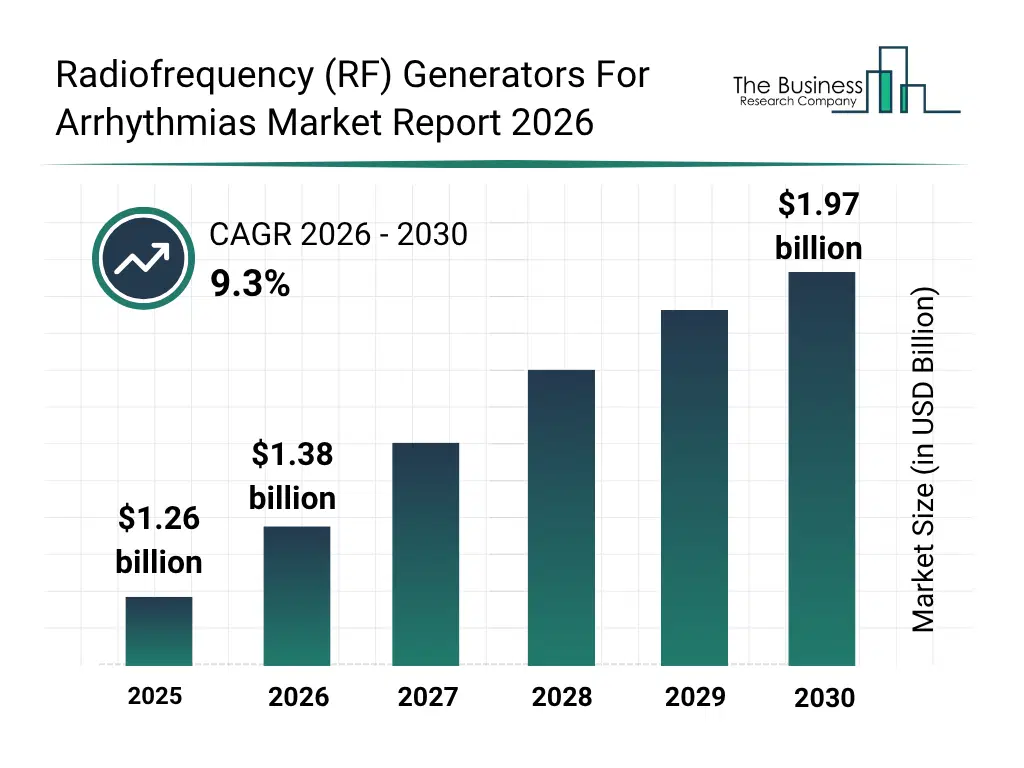
What Is The Radiofrequency (RF) Generators For Arrhythmias Market Size and Share 2026?
The radiofrequency (RF) generators for arrhythmias market size has grown strongly in recent years. It will grow from $1.26 billion in 2025 to $1.38 billion in 2026 at a compound annual growth rate (CAGR) of 9.7%. The growth in the historic period can be attributed to rising prevalence of cardiac arrhythmias and atrial fibrillation, increasing adoption of catheter ablation procedures in hospitals, growth in electrophysiology lab infrastructure development, technological advancements in radiofrequency energy delivery systems, expanding geriatric population with cardiovascular disorders.What Is The Radiofrequency (RF) Generators For Arrhythmias Market Growth Forecast?
The radiofrequency (RF) generators for arrhythmias market size is expected to see strong growth in the next few years. It will grow to $1.97 billion in 2030 at a compound annual growth rate (CAGR) of 9.3%. The growth in the forecast period can be attributed to integration of AI-assisted cardiac mapping and navigation systems, growing shift toward outpatient and ambulatory cardiac procedures, increasing demand for personalized precision cardiac care, expansion of hybrid surgical-electrophysiology treatment models, rising investments in advanced minimally invasive cardiac technologies. Major trends in the forecast period include increasing adoption of contact force sensing radiofrequency ablation systems for improved lesion precision, shift toward high-power short-duration ablation techniques to reduce procedure time, growing preference for temperature-controlled irrigated radiofrequency generators for enhanced safety, rising demand for catheter-based minimally invasive cardiac ablation procedures, expansion of advanced electrophysiology labs supporting complex arrhythmia treatment procedures.
Global Radiofrequency (RF) Generators For Arrhythmias Market Segmentation
1) By Product Type: Unipolar Radiofrequency Generators; Bipolar Radiofrequency Generators; Temperature Controlled Radiofrequency Generators; Irrigated Radiofrequency Generators 2) By Technology: Conventional Radiofrequency Ablation; Contact Force Sensing Radiofrequency Ablation; Three Dimensional Mapping Integrated Radiofrequency Systems; High Power Radiofrequency Ablation Systems 3) By Procedure Type: Catheter Ablation Procedures; Surgical Ablation Procedures; Hybrid Ablation Procedures 4) By Application: Atrial Fibrillation; Atrial Flutter; Supraventricular Tachycardia; Ventricular Tachycardia; Other Applications 5) By End User: Hospitals; Ambulatory Surgical Centers; Specialty Cardiac Clinics; Research Institutes Subsegments: 1) By Unipolar Radiofrequency Generators: Single Channel Unipolar Radiofrequency Generators; Multi Channel Unipolar Radiofrequency Generators; Portable Unipolar Radiofrequency Generators; High Power Unipolar Radiofrequency Generators 2) By Bipolar Radiofrequency Generators: Single Electrode Bipolar Radiofrequency Generators; Dual Electrode Bipolar Radiofrequency Generators; Multi Electrode Bipolar Radiofrequency Generators; High Precision Bipolar Radiofrequency Generators 3) By Temperature Controlled Radiofrequency Generators: Automatic Temperature Controlled Radiofrequency Generators; Real Time Monitoring Temperature Controlled Radiofrequency Generators; Programmable Temperature Controlled Radiofrequency Generators; High Stability Temperature Controlled Radiofrequency Generators 4) By Irrigated Radiofrequency Generators: Open Irrigated Radiofrequency Generators; Closed Irrigated Radiofrequency Generators; Saline Infusion Irrigated Radiofrequency Generators; High Flow Irrigated Radiofrequency GeneratorsWhat Are The Drivers Of The Radiofrequency (RF) Generators For Arrhythmias Market?
The rising prevalence of cardiac arrhythmias is expected to propel the growth of the radiofrequency (RF) generators for arrhythmias market going forward. Cardiac arrhythmias are irregular heart rhythms caused by abnormalities in the electrical impulses that regulate heartbeat patterns. Cardiac arrhythmias are rising due to the growing aging population, as older adults are more vulnerable to electrical conduction disorders and cardiovascular complications. Radiofrequency (RF) generators support the treatment of cardiac arrhythmias by delivering controlled thermal energy through ablation catheters to targeted cardiac tissue responsible for abnormal electrical signals. For instance, in September 2024, according to the National Heart, Lung, and Blood Institute, a US-based government research organization, at least 10.55 million U.S. adults were estimated to have atrial fibrillation in 2024, which was nearly three times higher than earlier projections of around 3.3 million adults estimated for earlier. Therefore, the rising prevalence of cardiac arrhythmias is driving the growth of the radiofrequency (RF) generators for arrhythmias industry. The growing adoption of minimally invasive cardiac procedures is expected to propel the growth of the radiofrequency (RF) generators for arrhythmias market going forward. Minimally invasive cardiac procedures are surgical interventions performed through small incisions or catheter-based techniques to diagnose and treat heart conditions with reduced patient trauma and faster recovery. The growing adoption of minimally invasive cardiac procedures due to the rising prevalence of cardiovascular diseases and arrhythmias is increasing demand for safer treatment options that offer lower complication risks and shorter hospital stays compared to open-heart surgery. The rising number of catheter-based cardiac interventions is driving demand for RF generators, which play a critical role in electrophysiology ablation procedures by delivering energy to eliminate abnormal electrical pathways in the heart. For instance, in March 2025, according to The Society of Thoracic Surgeons (STS), a US-based nonprofit organization dedicated to ensuring the best possible outcomes for surgeries of the heart, lungs, and esophagus, overall cardiac surgical volumes increased by 4.2% in 2023 compared with 2022. Therefore, the growing adoption of minimally invasive cardiac procedures is driving the growth of the radiofrequency (RF) generators for arrhythmias industry.Key Players In The Global Radiofrequency (RF) Generators For Arrhythmias Market
Major companies operating in the radiofrequency (RF) generators for arrhythmias market are Johnson & Johnson Services Inc.; Biosense Webster Inc.; Abbott Laboratories; Medtronic plc; Boston Scientific Corporation; Toray Industries Inc.; AtriCure Inc.; BIOTRONIK SE & Co. KG; Japan Lifeline Co. Ltd.; MicroPort EP MedTech Co. Ltd.; APT Medical Inc.; OSYPKA AGGlobal Radiofrequency (RF) Generators For Arrhythmias Market Trends and Insights
Major companies operating in the radiofrequency (RF) generators for arrhythmias market are focusing on developing advanced solutions, such as dual-energy integration technologies, to enhance procedural precision, improve workflow efficiency, and support safer treatment of complex cardiac arrhythmias. Dual-energy integration refers to the incorporation of both radiofrequency (RF) ablation and pulsed field ablation (PFA) technologies within a single electrophysiology platform or catheter system to enable flexible, precise, and efficient arrhythmia treatment. For instance, in October 2024, Medtronic plc, an Ireland-based medical technology company, received U.S. Food and Drug Administration (FDA) approval for its Affera Mapping and Ablation System along with the Sphere-9 Catheter. The system combines advanced high-density cardiac mapping with both pulsed field and radiofrequency ablation technologies to support improved accuracy during electrophysiology procedures. It helps physicians perform more effective treatments for patients suffering from persistent atrial fibrillation and atrial flutter.Regional Outlook
North America was the largest region in the radiofrequency (RF) generators for arrhythmias market in 2025. Asia-Pacific is expected to be the fastest-growing region in the forecast period. The regions covered in this market report are Asia-Pacific, South East Asia, Western Europe, Eastern Europe, North America, South America, Middle East, Africa. The countries covered in this market report are Australia, Brazil, China, France, Germany, India, Indonesia, Japan, Taiwan, Russia, South Korea, UK, USA, Canada, Italy, Spain.What Defines the Radiofrequency (RF) Generators For Arrhythmias Market?
The radiofrequency (RF) generators for arrhythmias market consists of revenues earned by entities by providing services such as cardiac tissue ablation, electrophysiology energy delivery, real-time impedance monitoring, temperature regulation during procedures, and cardiac rhythm correction. The market value includes the value of related goods sold by the service provider or included within the service offering. The radiofrequency (RF) generators for arrhythmias market also includes sales of radiofrequency ablation generators, electrophysiology catheters, grounding pads, cardiac mapping systems, irrigation pump systems. Values in this market are ‘factory gate’ values, that is, the value of goods sold by the manufacturers or creators of the goods, whether to other entities (including downstream manufacturers, wholesalers, distributors, and retailers) or directly to end customers. The value of goods in this market includes related services sold by the creators of the goods.How is Market Value Defined and Measured?
The market value is defined as the revenues that enterprises gain from the sale of goods and/or services within the specified market and geography through sales, grants, or donations in terms of the currency (in USD unless otherwise specified). The revenues for a specified geography are consumption values that are revenues generated by organizations in the specified geography within the market, irrespective of where they are produced. It does not include revenues from resales along the supply chain, either further along the supply chain or as part of other products.What Key Data and Analysis Are Included in the Radiofrequency (RF) Generators For Arrhythmias Market Report 2026?
The radiofrequency (rf) generators for arrhythmias market research report is one of a series of new reports from The Business Research Company that provides market statistics, including industry global market size, regional shares, competitors with the market share, detailed market segments, market trends and opportunities, and any further data you may need to thrive in the radiofrequency (rf) generators for arrhythmias industry. The market research report delivers a complete perspective of everything you need, with an in-depth analysis of the current and future state of the industry.Radiofrequency (RF) Generators For Arrhythmias Market Report Forecast Analysis
| Report Attribute | Details |
|---|---|
| Market Size Value In 2026 | $1.38 billion |
| Revenue Forecast In 2030 | $1.97 billion |
| Growth Rate | CAGR of 9.3% from 2026 to 2030 |
| Base Year For Estimation | 2025 |
| Actual Estimates/Historical Data | 2020-2025 |
| Forecast Period | 2026 - 2030 |
| Market Representation | Revenue in USD Billion and CAGR from 2026 to 2030 |
| Segments Covered | Product Type, Technology, Procedure Type, Application, End User |
| Regional Scope | Asia-Pacific, Western Europe, Eastern Europe, North America, South America, Middle East, Africa |
| Country Scope | The countries covered in the report are Australia, Brazil, China, France, Germany, India, ... |
| Key Companies Profiled | Johnson & Johnson Services Inc.; Biosense Webster Inc.; Abbott Laboratories; Medtronic plc; Boston Scientific Corporation; Toray Industries Inc.; AtriCure Inc.; BIOTRONIK SE & Co. KG; Japan Lifeline Co. Ltd.; MicroPort EP MedTech Co. Ltd.; APT Medical Inc.; OSYPKA AG |
| Customization Scope | Request for Customization |
| Pricing And Purchase Options | Explore Purchase Options |