
Radiometric Dating Machine Market Report 2026
Global Outlook – By Type (Alpha Counting, Beta Counting, Gamma Counting, Mass Spectrometry), By Method (Radiocarbon Dating, Potassium-Argon Dating, Uranium-Lead System), By End-User (Archaeologists, Geologists, Paleontologists, Other End Users) – Market Size, Trends, Strategies, and Forecast to 2030
Radiometric Dating Machine Market Overview
• Radiometric Dating Machine market size has reached to $1.42 billion in 2025 • Expected to grow to $2.29 billion in 2030 at a compound annual growth rate (CAGR) of 10% • Growth Driver: Impact Of Increased Government Funding On The Radiometric Dating Machine Market • Market Trend: Advancements In Thermal Desorption Spectrometry For Enhanced Radiometric Dating • North America was the largest region in 2025.What Is Covered Under Radiometric Dating Machine Market?
Radiometric dating machines are specialized instruments used to measure the age of geological and archaeological materials by analyzing the decay of radioactive isotopes within samples. These machines are crucial for providing accurate dating in various scientific fields such as geology, paleontology, and archaeology. The main types of radiometric dating machines are alpha counting, beta counting, gamma counting, and mass spectrometry. Alpha counting is a technique used to measure alpha particles, which are a type of radiation emitted by certain radioactive substances. The various methods include radiocarbon dating, potassium-argon dating, and the uranium-lead system used by many end-users, such as archaeologists, geologists, environmental scientists, paleontologists, nuclear scientists, and others.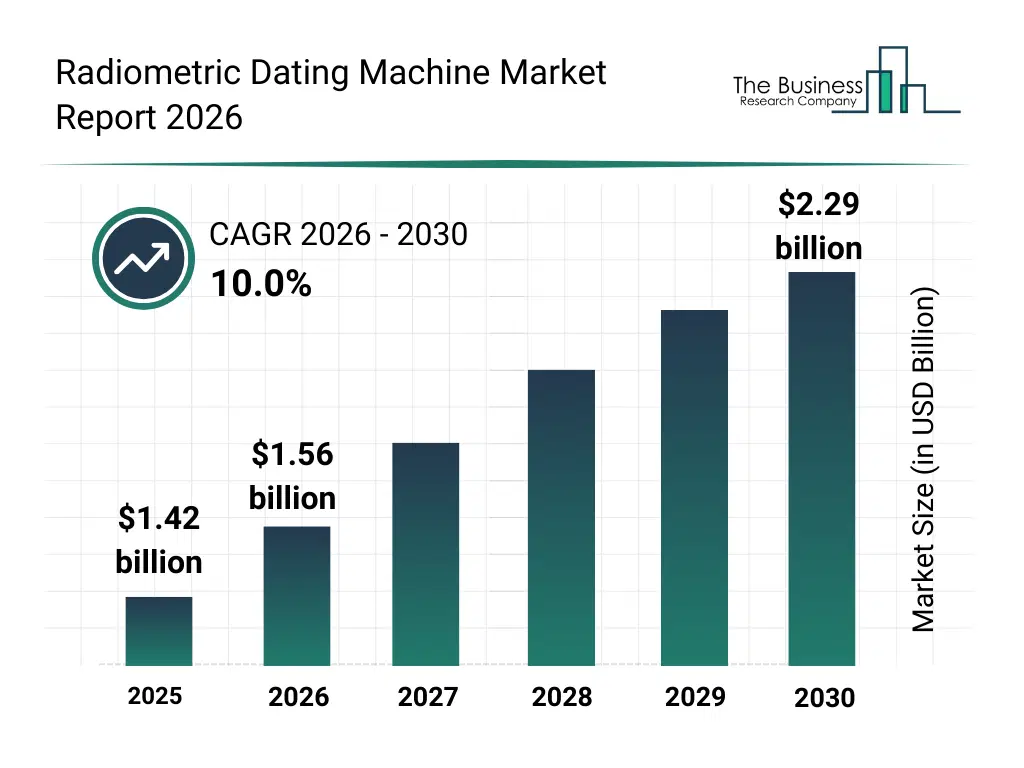
What Is The Radiometric Dating Machine Market Size and Share 2026?
The radiometric dating machine market size has grown rapidly in recent years. It will grow from $1.42 billion in 2025 to $1.56 billion in 2026 at a compound annual growth rate (CAGR) of 10.3%. The growth in the historic period can be attributed to geological research expansion, archaeological discoveries, nuclear research development, academic funding growth, environmental analysis demand.What Is The Radiometric Dating Machine Market Growth Forecast?
The radiometric dating machine market size is expected to see rapid growth in the next few years. It will grow to $2.29 billion in 2030 at a compound annual growth rate (CAGR) of 10.0%. The growth in the forecast period can be attributed to climate research initiatives, planetary science exploration, advanced isotope analysis demand, government research investments, technology upgrades in laboratories. Major trends in the forecast period include advancements in mass spectrometry accuracy, integration of automated sample processing, adoption of high sensitivity detectors, expansion of multidisciplinary research use, growth of portable analytical systems.Tariff Impact On Radiometric Dating Machine Market
Tariffs have affected the radiometric dating machine market by increasing costs of precision detectors, vacuum systems, and analytical electronics. Mass spectrometry based systems are most impacted, especially in asia pacific manufacturing regions. This has raised laboratory equipment costs. At the same time, tariffs are encouraging domestic instrument development and research equipment localization.
Global Radiometric Dating Machine Market Segmentation
1) By Type: Alpha Counting, Beta Counting, Gamma Counting, Mass Spectrometry 2) By Method: Radiocarbon Dating, Potassium-Argon Dating, Uranium-Lead System 3) By End-User: Archaeologists, Geologists, Paleontologists, Other End Users Subsegments: 1) By Alpha Counting: Gas Flow Detectors, Solid-State Detectors, Scintillation Detectors 2) By Beta Counting: Liquid Scintillation Counters, Gas Proportional Counters, Plastic Scintillation Detectors 3) By Gamma Counting: NaI(Tl) Scintillation Detectors, High-Purity Germanium Detectors 4) By Mass Spectrometry: Thermal Ionization Mass Spectrometry (TIMS), Inductively Coupled Plasma Mass Spectrometry (ICP-MS), Secondary Ion Mass Spectrometry (SIMS), Accelerator Mass Spectrometry (AMS)What Are The Drivers Of The Radiometric Dating Machine Market?
An increase in government funding for geological exploration is expected to propel the growth of the radiometric dating machine market going forward. Government funding for geological explorations is the financial assistance provided by the government to study the Earth’s geology, including its structure, resources, and composition. The increase in government funding for geological exploration is mainly driven by the rising demand for vital minerals and resources needed for technological advancement, energy production, and economic security. Government funding aids in using and advancing radiometric dating machines to support research and innovation, enhancing the precision and effectiveness of geological sample dating. For instance, in March 2023, according to the United States Geological Survey, a US-based government agency, the 2024 budget allocated $150.8 million for energy and mineral resources programs, marking a $46.5 million increase compared to the 2023 enacted budget. Therefore, the increase in government funding for geological exploration is driving the growth of the radiometric dating machine industry. The expansion of research institutions and facilities is expected to drive the growth in the radiometric dating machine market going forward. Research institutions and facilities refer to organizations and establishments dedicated to conducting systematic investigations, experiments, and studies in various fields to generate knowledge, develop technologies, and support innovation. The expansion of research institutions and facilities is rising due to increasing global demand for innovation and technological advancement, driving governments and organizations to invest more in research infrastructure to develop new solutions and stay competitive. Radiometric dating machines help research institutions and facilities by providing precise age determination of rocks, minerals, and archaeological samples, enabling accurate reconstruction of geological timelines and advancing scientific studies in fields like geology, paleontology, and archaeology. For instance, in November 2024, according to a report published by the National Center for Science and Engineering Statistics (NCSES), a U.S.-based federal government statistical agency, in FY 2023, 33 institutions reported R&D expenditures of at least $1 billion, up from 29 institutions in FY 2022 and 24 in FY 2021. Therefore, the expansion of research institutions and facilities is driving the radiometric dating machine industry.Key Players In The Global Radiometric Dating Machine Market
Major companies operating in the radiometric dating machine market are Thermo Fisher Scientific Inc., Agilent Technologies Inc., Bruker Corporation, Shimadzu Corporation, JEOL Ltd., PerkinElmer Inc., Oxford Instruments plc, Rigaku Corporation, AMETEK Inc., ORTEC (Ametek brand but ORTEC itself is a company), IonPlus AG, IsotopX Ltd., Nu Instruments Ltd., Spectromat Massenspektrometer GmbH, Canberra Industries Inc., Kromek Group plc, Bertin Instruments, Radiation Monitoring Devices Inc., Ludlum Measurements Inc., Malvern Panalytical Ltd., Hitachi High-Tech Corporation, Horiba Ltd.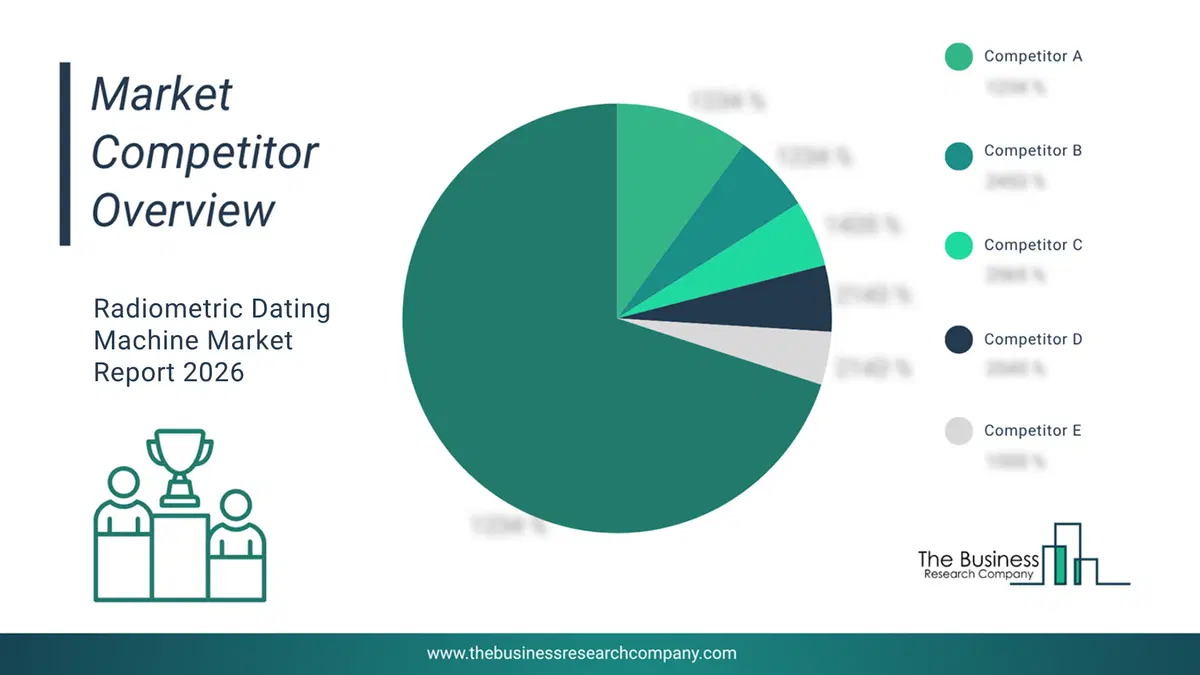
This chart is for illustrative purposes; the full report includes a detailed competitor analysis and comprehensive overview of the top 10 companies in the market.
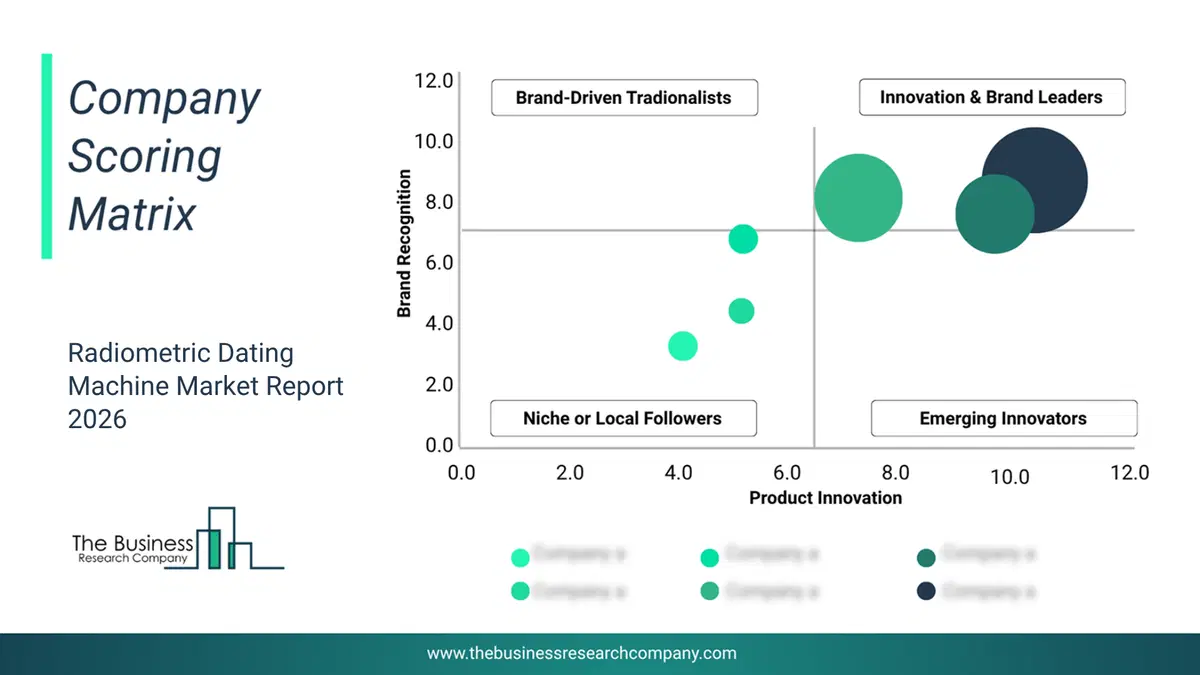
This chart maps companies by product innovation and brand strength, with bubble size indicating relative revenue, helping identify market leaders, challengers, and niche players. This is an illustrative chart; the full report provides a complete and accurate competitive analysis.
Global Radiometric Dating Machine Market Trends and Insights
Major companies operating radiometric dating machines are focused on developing next-generation thermal desorption spectrometry systems to provide more accurate age determinations and better insights into geological and archaeological samples. Thermal desorption spectrometry systems analyze materials by heating them to release volatile compounds, which are then measured using mass spectrometry. For instance, in June 2024, Hiden Analytical, a UK-based manufacturer of scientific instrumentation, launched the TDSLab Series. This series, consisting of the TDSLab-6, TDSLab-9, and TDSLab-20 systems, marks a substantial improvement in thermal desorption spectrometry. This aids in determining chemical composition and properties across fields such as environmental analysis and radiometric dating. The TDSLab Series offers exceptional measurement accuracy, which is essential for in-depth studies of material properties and impurities. The series accommodates a broad range of sample types, making it versatile for various research and industrial uses. It features advanced temperature control mechanisms for precise thermal desorption, crucial for studying materials under specific thermal conditions.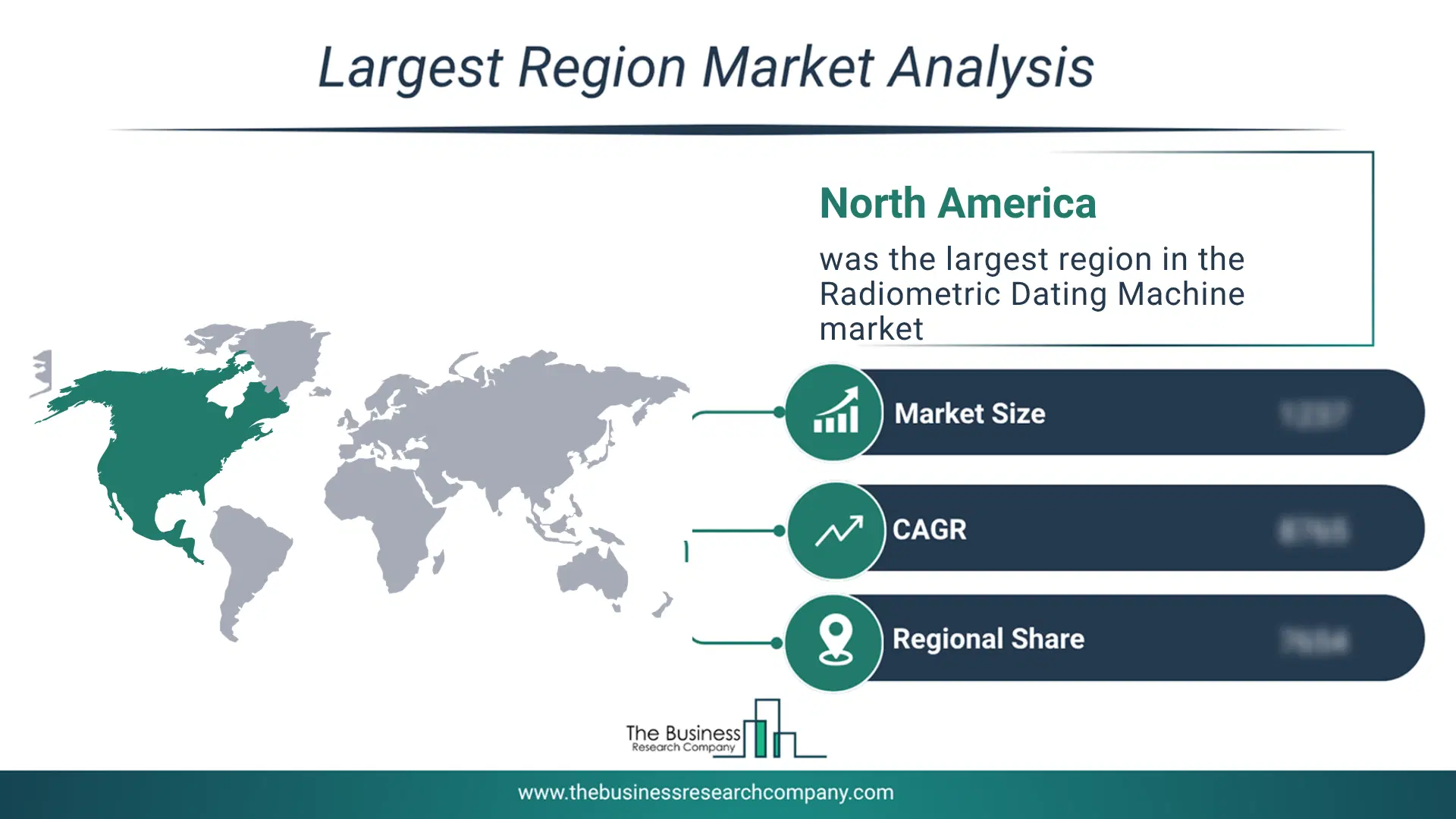
Regional Outlook
North America was the largest region in the radiometric dating machine market in 2025. The regions covered in this market report are Asia-Pacific, South East Asia, Western Europe, Eastern Europe, North America, South America, Middle East, Africa The countries covered in this market report are Australia, Brazil, China, France, Germany, India, Indonesia, Japan, Taiwan, Russia, South Korea, UK, USA, Canada, Italy, Spain.What Defines the Radiometric Dating Machine Market?
The radiometric dating machine market consists of sales of mass spectrometers, detectors, and calibration tools. Values in this market are ‘factory gate’ values, that is, the value of goods sold by the manufacturers or creators of the goods, whether to other entities (including downstream manufacturers, wholesalers, distributors, and retailers) or directly to end customers. The value of goods in this market includes related services sold by the creators of the goods.How is Market Value Defined and Measured?
The market value is defined as the revenues that enterprises gain from the sale of goods and/or services within the specified market and geography through sales, grants, or donations in terms of the currency (in USD unless otherwise specified). The revenues for a specified geography are consumption values that are revenues generated by organizations in the specified geography within the market, irrespective of where they are produced. It does not include revenues from resales along the supply chain, either further along the supply chain or as part of other products.
This chart presents market attractiveness based on a quantitative evaluation of growth, competition, strategic alignment, and risk, offering a clear view of opportunity areas for decision-making. This chart is for illustrative purposes; the full report contains the complete analysis.

This chart highlights the Total Addressable Market (TAM) by estimating the maximum revenue opportunity using an assumption-driven approach, supporting strategic planning and opportunity sizing across markets. The chart is illustrative; the full report provides a more comprehensive analysis.
What Key Data and Analysis Are Included in the Radiometric Dating Machine Market Report 2026?
The radiometric dating machine market research report is one of a series of new reports from The Business Research Company that provides market statistics, including industry global market size, regional shares, competitors with the market share, detailed market segments, market trends and opportunities, and any further data you may need to thrive in the radiometric dating machine industry. The market research report delivers a complete perspective of everything you need, with an in-depth analysis of the current and future state of the industry.Radiometric Dating Machine Market Report Forecast Analysis
| Report Attribute | Details |
|---|---|
| Market Size Value In 2026 | $1.56 billion |
| Revenue Forecast In 2030 | $2.29 billion |
| Growth Rate | CAGR of 10% from 2026 to 2030 |
| Base Year For Estimation | 2025 |
| Actual Estimates/Historical Data | 2020-2025 |
| Forecast Period | 2026 - 2030 |
| Market Representation | Revenue in USD Billion and CAGR from 2026 to 2030 |
| Segments Covered | Type, Method, End-User |
| Regional Scope | Asia-Pacific, Western Europe, Eastern Europe, North America, South America, Middle East, Africa |
| Key Companies Profiled | Thermo Fisher Scientific Inc., Agilent Technologies Inc., Bruker Corporation, Shimadzu Corporation, JEOL Ltd., PerkinElmer Inc., Oxford Instruments plc, Rigaku Corporation, AMETEK Inc., ORTEC (Ametek brand but ORTEC itself is a company), IonPlus AG, IsotopX Ltd., Nu Instruments Ltd., Spectromat Massenspektrometer GmbH, Canberra Industries Inc., Kromek Group plc, Bertin Instruments, Radiation Monitoring Devices Inc., Ludlum Measurements Inc., Malvern Panalytical Ltd., Hitachi High-Tech Corporation, Horiba Ltd. |
| Customization Scope | Request for Customization |
| Pricing And Purchase Options | Explore Purchase Options |