
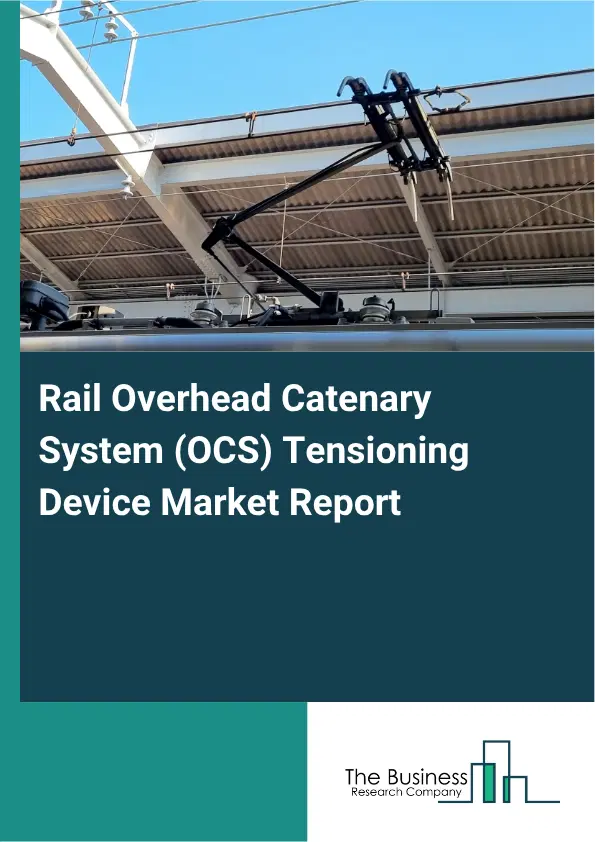
Rail Overhead Catenary System (OCS) Tensioning Device Market Report 2026
Global Outlook – By Product Type (Automatic Tensioning Devices, Manual Tensioning Devices, Hydraulic Tensioning Devices, Other Product Types), By Component (Tensioning System, Monitoring System, Accessories, Other Components), By Application (High-Speed Rail, Metro And Light Rail, Conventional Rail, Other Applications), By End User (Railway Operators, Infrastructure Companies, Other End Users) – Market Size, Trends, Strategies, and Forecast to 2030
Rail Overhead Catenary System (OCS) Tensioning Device Market Overview
• Rail Overhead Catenary System (OCS) Tensioning Device market size has reached to $1.23 billion in 2025 • Expected to grow to $1.74 billion in 2030 at a compound annual growth rate (CAGR) of 7.3% • Growth Driver: Surge In High-Speed Rail Networks Fueling The Growth Of The Market Due To Reducing Travel Time And Faster Intercity Connectivity • Market Trend: Next-Generation Tensioning Technologies Enabling Efficient And Reliable Rail Operations • Asia-Pacific was the largest region and fastest growing region.What Is Covered Under Rail Overhead Catenary System (OCS) Tensioning Device Market?
Rail overhead contact system (OCS) tensioning device refers to a mechanical system used to maintain consistent tension in overhead contact wires to ensure stable electrical contact between the pantograph and the wire. It compensates for temperature variations and mechanical stresses by automatically adjusting wire tension, enhancing reliability, safety, and efficient power transmission in electrified rail networks. The main product types of rail overhead contact system (OCS) tensioning device include automatic tensioning devices, manual tensioning devices, hydraulic tensioning devices, and other product types. Automatic tensioning devices refer to systems that automatically maintain consistent tension in overhead contact wires to ensure reliable electrical connectivity and operational efficiency in railway networks. These consist of components such as tensioning system, monitoring system, accessories, and other components. The key applications of high-speed rail, metro and light rail, conventional rail, and other applications, while the end-use includes railway operators, infrastructure companies, and other end users.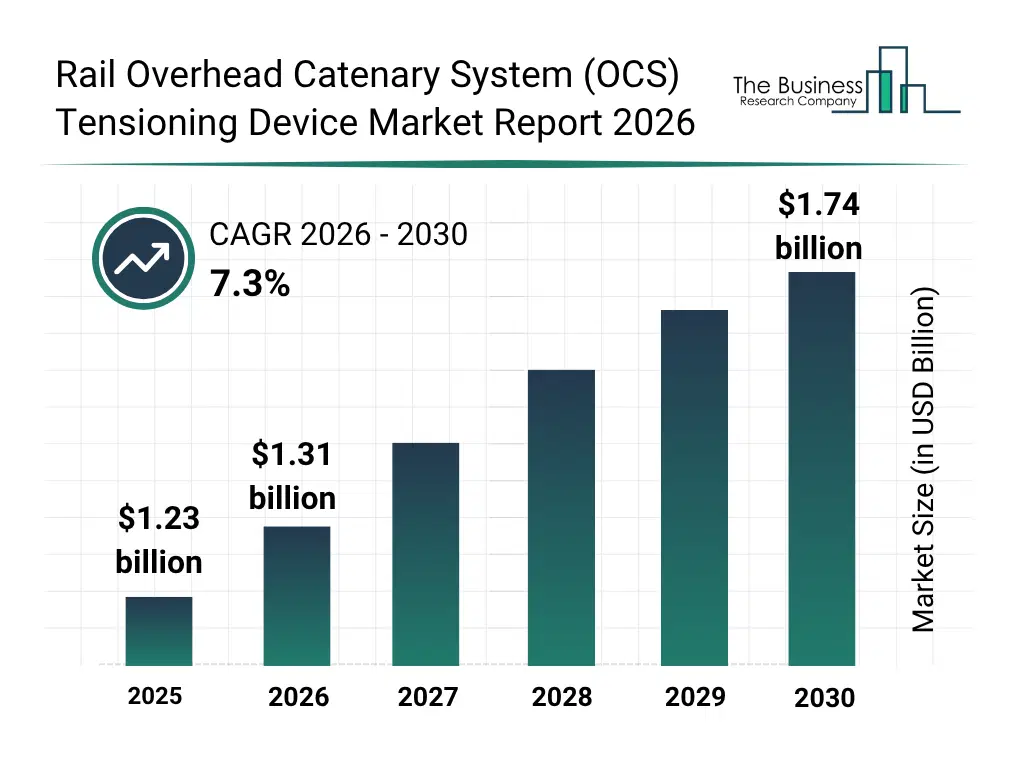
What Is The Rail Overhead Catenary System (OCS) Tensioning Device Market Size and Share 2026?
The rail overhead catenary system (OCS) tensioning device market size has grown strongly in recent years. It will grow from $1.23 billion in 2025 to $1.31 billion in 2026 at a compound annual growth rate (CAGR) of 7.1%. The growth in the historic period can be attributed to expansion of electrified rail networks, increasing rail traffic density, adoption of manual and hydraulic tensioning systems, growth in metro and light rail infrastructure, rising emphasis on safety and reliability in rail operations.What Is The Rail Overhead Catenary System (OCS) Tensioning Device Market Growth Forecast?
The rail overhead catenary system (OCS) tensioning device market size is expected to see strong growth in the next few years. It will grow to $1.74 billion by 2030 at a compound annual growth rate (CAGR) of 7.3%. The growth in the forecast period can be attributed to growing deployment of high-speed and metro rail projects, increasing adoption of automatic and smart tensioning devices, rising need for predictive maintenance solutions, expansion of digital monitoring and control systems, increasing focus on energy efficiency and operational optimization. Major trends in the forecast period include increasing adoption of automatic tensioning devices, rising demand for temperature compensated tensioning systems, growing integration of real-time monitoring and diagnostics, expansion of high-speed and metro rail electrification projects, rising focus on maintenance-free and long-life tensioning solutions.
Global Rail Overhead Catenary System (OCS) Tensioning Device Market Segmentation
1) By Product Type: Automatic Tensioning Devices, Manual Tensioning Devices, Hydraulic Tensioning Devices, Other Product Types 2) By Component: Tensioning System, Monitoring System, Accessories, Other Components 3) By Application: High-Speed Rail, Metro And Light Rail, Conventional Rail, Other Applications 4) By End User: Railway Operators, Infrastructure Companies, Other End Users Subsegments: 1) By Automatic Tensioning Devices: Spring Based Automatic Tensioning Devices, Counterweight Based Automatic Tensioning Devices, Temperature Compensated Automatic Tensioning Devices, Constant Force Automatic Tensioning Devices, Motorized Automatic Tensioning Devices 2) By Manual Tensioning Devices: Screw Type Manual Tensioning Devices, Turnbuckle Type Manual Tensioning Devices, Ratchet Type Manual Tensioning Devices, Lever Operated Manual Tensioning Devices, Hand Winch Operated Manual Tensioning Devices 3) By Hydraulic Tensioning Devices: Single Acting Hydraulic Tensioning Devices, Double Acting Hydraulic Tensioning Devices, Integrated Hydraulic Cylinder Tensioning Devices, Portable Hydraulic Tensioning Devices, Stationary Hydraulic Tensioning Devices 4) By Other Product Types: Pneumatic Tensioning Devices, Electromechanical Tensioning Devices, Gravity Based Tensioning Devices, Hybrid Tensioning Devices, Customized Tensioning DevicesWhat Are The Drivers Of The Rail Overhead Catenary System (OCS) Tensioning Device Market?
The expanding high-speed rail networks are expected to propel the growth of the rail overhead contact system (OCS) tensioning device market going forward. High-speed rail networks refer to advanced railway systems designed to operate passenger trains at significantly higher speeds than conventional rail. The rise in high-speed rail networks is driven by reduced travel time, as they enable faster intercity connectivity and significantly shorten journey durations compared to conventional rail systems. The rail overhead contact system (OCS) tensioning device is used in the high-speed rail networks for maintaining constant tension in overhead lines, ensuring stable current collection and reliable train operation at high speeds. For instance, in July 2025, according to the Railway Pro L.P., a UK-based communication company, Türasaş began production of Turkey’s first domestically manufactured high-speed trainset in 2024, capable of reaching speeds of up to 225 km/h. The country also plans to expand its high-speed rail network to 6,000 kilometers by 2035, including doubling its size by 2027. Therefore, expanding high-speed rail networks are driving the growth of the rail overhead contact system (OCS) tensioning device market. The increasing investments in railway infrastructure are expected to propel the growth of the rail overhead contact system (OCS) tensioning device market going forward. Investments in railway infrastructure refer to the allocation of financial resources toward the development, modernization, maintenance, and expansion of rail networks, including tracks, stations, signaling systems, and electrification, to enhance the capacity, efficiency, and safety of rail transport. Increasing investments in railway infrastructure are primarily driven by rising urbanization, as growing urban populations create higher demand for efficient, high-capacity public transportation systems. Investments in railway infrastructure drive the expansion and modernization of electrified rail networks, thereby increasing the demand for reliable rail overhead contact system (OCS) tensioning devices to ensure consistent wire tension, operational efficiency, and safe power delivery. For instance, in January 2025, according to the State Council Information Office of the People’s Republic of China, a China-based government agency, China Railway projected that fixed-asset investment in the country’s railway sector will reach 590 billion yuan (approximately 82.08 billion U.S. dollars) in 2025, with around 2,600 km of new rail lines expected to become operational within the year. Therefore, increasing investments in railway infrastructure are driving the growth of the rail overhead contact system (OCS) tensioning device marketKey Players In The Global Rail Overhead Catenary System (OCS) Tensioning Device Market
Major companies operating in the rail overhead contact system (OCS) tensioning device market are Siemens AG, CRRC Corporation Limited, Alstom SA, Wabtec Corporation, Delachaux Group, Raychem RPG, Pfisterer Holding AG, Tianjin Keyvia Electric Co. Ltd., Pandrol Limited, Kummler+Matter AG, PPS International Pvt Ltd, Mosdorfer Rail Ltd, Furrer+Frey AG, MAC Products Inc, Bonomi Eugenio S.p.A., Galland SAS, Arca Catenaria S.L., Arthur Flury AG, Ulusoy Raylı Sistemler A.Ş., Sanwa Tekki Corporation.
This chart is for illustrative purposes; the full report includes a detailed competitor analysis and comprehensive overview of the top 10 companies in the market.
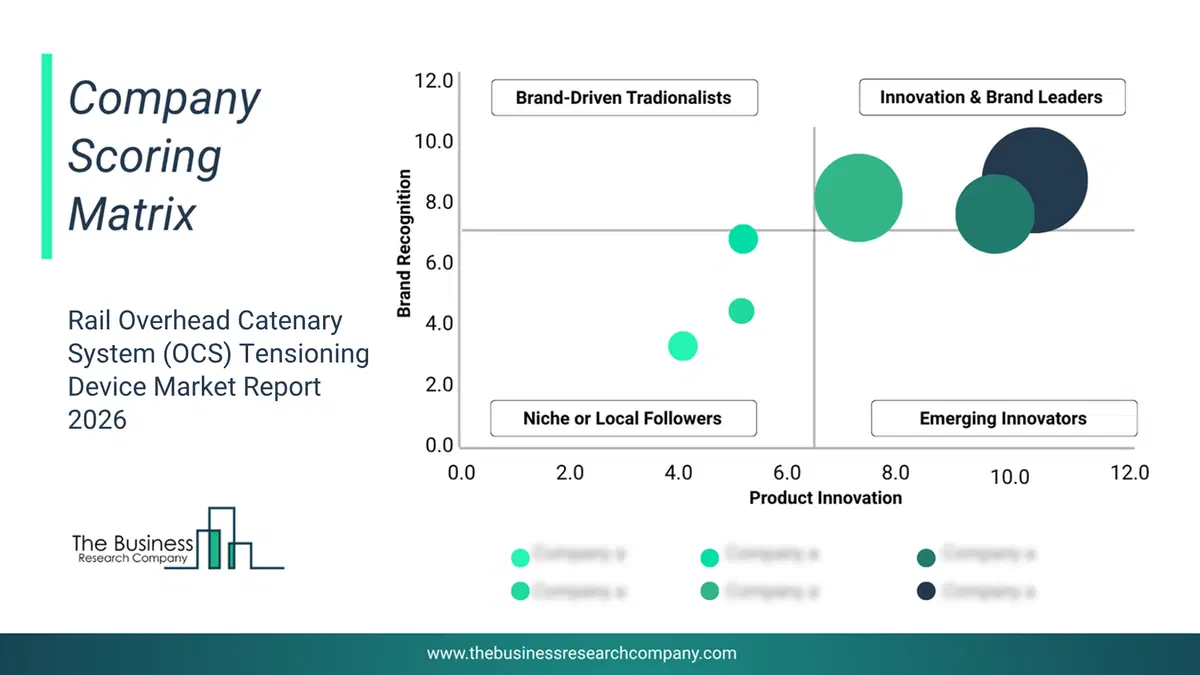
This chart maps companies by product innovation and brand strength, with bubble size indicating relative revenue, helping identify market leaders, challengers, and niche players. This is an illustrative chart; the full report provides a complete and accurate competitive analysis.
Global Rail Overhead Catenary System (OCS) Tensioning Device Market Trends and Insights
Major companies operating in the rail overhead contact system (OCS) tensioning device are focusing on advancements in automatic tensioning devices, such as spring-based automatic tension compensation systems, to ensure consistent wire tension, improve system reliability, and enhance performance under varying environmental and operational conditions. Spring-based automatic tension compensation systems are mechanical systems that use springs to automatically maintain consistent tension in overhead wires by adjusting for changes in temperature, load, and wire elongation. For instance, in May 2025, Mosdorfer Rail Ltd., a UK-based railway infrastructure technology company, launched the tensorex c+ 3d automatic tensioning device. The solution features a three-dimensional pulley design that maintains applied torque through more than 360 degrees of movement, optimized spiral springs that improve torsional performance, and an extended tension length capability up to 1,616 meters, representing about a 40% increase over previous systems. These improvements support longer rail electrification sections and enhance reliability for modern overhead line infrastructure.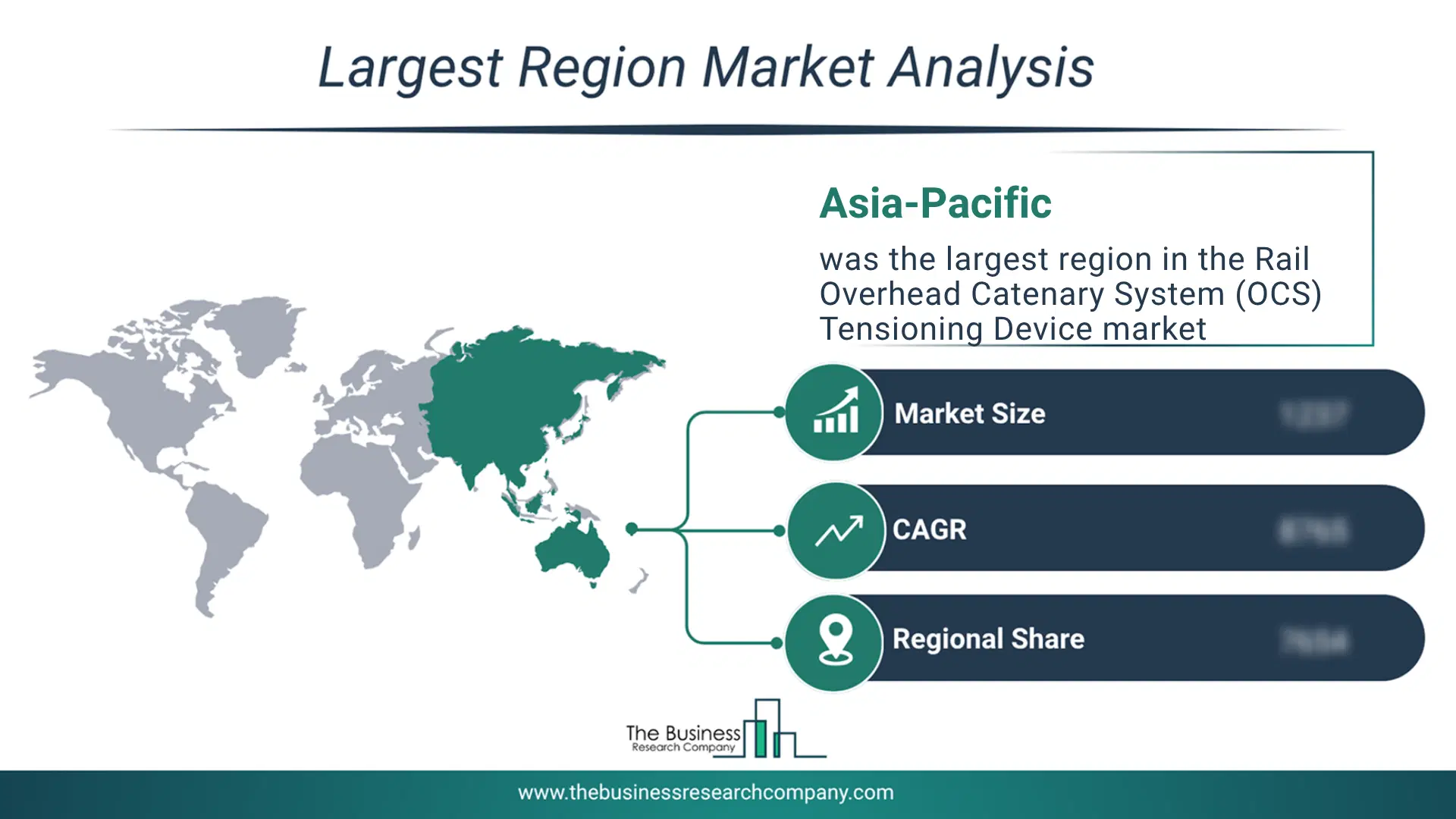
Regional Insights
Asia-Pacific was the largest region in the rail overhead contact system (OCS) tensioning device market in 2025. Asia-Pacific is expected to be the fastest-growing region in the forecast period. The regions covered in this market report are Asia-Pacific, South East Asia, Western Europe, Eastern Europe, North America, South America, Middle East, Africa. The countries covered in this market report are Australia, Brazil, China, France, Germany, India, Indonesia, Japan, Taiwan, Russia, South Korea, UK, USA, Canada, Italy, Spain.What Defines the Rail Overhead Catenary System (OCS) Tensioning Device Market?
The rail overhead contact system (OCS) tensioning device market consists of sales of balance weight tensioning systems, spring-based tensioning mechanisms, pulley regulating equipment, winch-type tensioning equipment, and pneumatic tensioning systems. Values in this market are ‘factory gate’ values, that is, the value of goods sold by the manufacturers or creators of the goods, whether to other entities (including downstream manufacturers, wholesalers, distributors, and retailers) or directly to end customers. The value of goods in this market includes related services sold by the creators of the goods.How is Market Value Defined and Measured?
The market value is defined as the revenues that enterprises gain from the sale of goods and/or services within the specified market and geography through sales, grants, or donations in terms of the currency (in USD unless otherwise specified). The revenues for a specified geography are consumption values that are revenues generated by organizations in the specified geography within the market, irrespective of where they are produced. It does not include revenues from resales along the supply chain, either further along the supply chain or as part of other products.
This chart presents market attractiveness based on a quantitative evaluation of growth, competition, strategic alignment, and risk, offering a clear view of opportunity areas for decision-making. This chart is for illustrative purposes; the full report contains the complete analysis.

This chart highlights the Total Addressable Market (TAM) by estimating the maximum revenue opportunity using an assumption-driven approach, supporting strategic planning and opportunity sizing across markets. The chart is illustrative; the full report provides a more comprehensive analysis.
What Key Data and Analysis Are Included in the Rail Overhead Catenary System (OCS) Tensioning Device Market Report 2026?
The rail overhead catenary system (ocs) tensioning device market research report is one of a series of new reports from The Business Research Company that provides market statistics, including industry global market size, regional shares, competitors with the market share, detailed market segments, market trends and opportunities, and any further data you may need to thrive in the rail overhead catenary system (ocs) tensioning device industry. The market research report delivers a complete perspective of everything you need, with an in-depth analysis of the current and future state of the industry.Rail Overhead Catenary System (OCS) Tensioning Device Market Report Forecast Analysis
| Report Attribute | Details |
|---|---|
| Market Size Value In 2026 | $1.31 billion |
| Revenue Forecast In 2030 | $1.74 billion |
| Growth Rate | CAGR of 7.1% from 2026 to 2030 |
| Base Year For Estimation | 2025 |
| Actual Estimates/Historical Data | 2020-2025 |
| Forecast Period | 2026 - 2030 - 2030 |
| Market Representation | Revenue in USD Billion and CAGR from 2026 to 2030 |
| Segments Covered | Product Type, Component, Application, End User |
| Regional Scope | Asia-Pacific, Western Europe, Eastern Europe, North America, South America, Middle East, Africa |
| Country Scope | The countries covered in the report are Australia, Brazil, China, France, Germany, India, Indonesia, Japan, Taiwan, Russia, South Korea, UK, USA, Canada, Italy, Spain. |
| Key Companies Profiled | Siemens AG, CRRC Corporation Limited, Alstom SA, Wabtec Corporation, Delachaux Group, Raychem RPG, Pfisterer Holding AG, Tianjin Keyvia Electric Co. Ltd., Pandrol Limited, Kummler+Matter AG, PPS International Pvt Ltd, Mosdorfer Rail Ltd, Furrer+Frey AG, MAC Products Inc, Bonomi Eugenio S.p.A., Galland SAS, Arca Catenaria S.L., Arthur Flury AG, Ulusoy Raylı Sistemler A.Ş., Sanwa Tekki Corporation. |
| Customization Scope | Request for Customization |
| Pricing And Purchase Options | Explore Purchase Options |