
Railway Noise Control Barrier Market Report 2026
Global Outlook – By Type (Acoustic Barriers, Noise Absorbing Barriers, Noise Reflecting Barriers, Hybrid Barriers), By Material (Concrete, Metal, Wood, Plastic, Glass, Composite Materials), By Mounting (Ground Mounted, Rail Mounted, Bridge Mounted), By Installation (Permanent Installations, Temporary Installations), By End-User (Railway Operators, Construction Companies, Government Authorities) – Market Size, Trends, Strategies, and Forecast to 2030
Railway Noise Control Barrier Market Overview
• Railway Noise Control Barrier market size has reached to $1.43 billion in 2025 • Expected to grow to $2 billion in 2030 at a compound annual growth rate (CAGR) of 6.9% • Growth Driver: Surge In Rail Expansion Driving The Market Growth Due To Rising Need For Noise Control In Densely Populated Areas • Market Trend: Innovative Mini Absorbent Barriers Offer Sustainable Noise Reduction For Urban Railways • Asia-Pacific was the largest region in 2025 and North America is the fastest growing region.What Is Covered Under Railway Noise Control Barrier Market?
A railway noise control barrier is a specially designed structure placed alongside railway tracks to reduce the transmission of sound generated by passing trains. These barriers are typically made from sound-absorbing or sound-reflecting materials such as concrete, metal, acrylic, or composite panels. The primary purpose of railway noise control barriers is to minimize noise pollution affecting nearby residential, commercial, or natural areas. The main types of railway noise control barriers are acoustic barriers, noise-absorbing barriers, noise-reflecting barriers, and hybrid barriers. Acoustic barriers are sound-absorbing walls designed to reduce train noise in sensitive areas like urban zones and hospitals. It is available in various materials, such as concrete, metal, wood, plastic, glass, and composite materials, with different mountings, including ground-mounted, rail-mounted, and bridge-mounted. It is installed in different installations, such as permanent installations and temporary installations, and is used by various end-users, including railway operators, construction companies, government authorities, environmental agencies, and the private sector.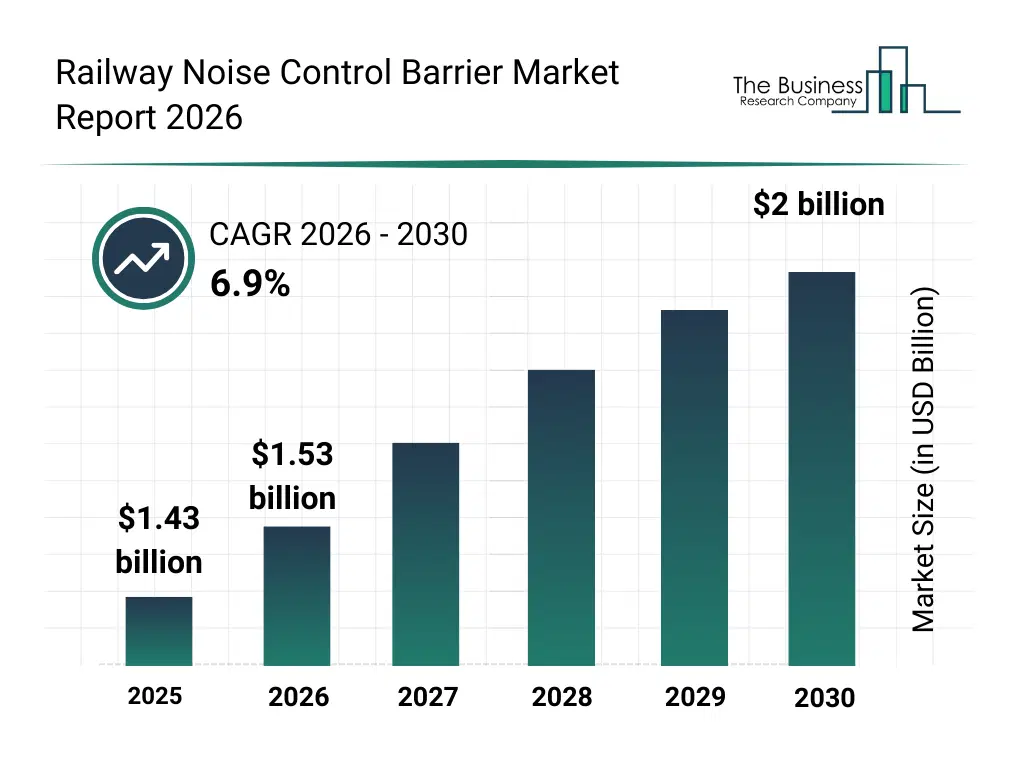
What Is The Railway Noise Control Barrier Market Size and Share 2026?
The railway noise control barrier market size has grown strongly in recent years. It will grow from $1.43 billion in 2025 to $1.53 billion in 2026 at a compound annual growth rate (CAGR) of 7.2%. The growth in the historic period can be attributed to railway network expansion, urbanization near rail lines, environmental noise regulations, public infrastructure investments, growth in passenger rail traffic.What Is The Railway Noise Control Barrier Market Growth Forecast?
The railway noise control barrier market size is expected to see strong growth in the next few years. It will grow to $2 billion in 2030 at a compound annual growth rate (CAGR) of 6.9%. The growth in the forecast period can be attributed to high speed rail development, stricter noise pollution norms, smart city initiatives, demand for sustainable infrastructure, government transport investments. Major trends in the forecast period include rising demand for urban noise mitigation, growing installation along high speed rail corridors, increasing use of composite barrier materials, expansion of rail infrastructure projects, focus on environment friendly barrier designs.Tariff Impact On Railway Noise Control Barrier Market
Tariffs have impacted the railway noise control barrier market by increasing costs of steel, aluminum, and composite panels. Permanent installations are most affected, particularly in Asia Pacific and Europe. Higher material costs have influenced project budgets. However, tariffs have encouraged local sourcing and recycling based material usage.
Global Railway Noise Control Barrier Market Segmentation
1) By Type: Acoustic Barriers, Noise Absorbing Barriers, Noise Reflecting Barriers, Hybrid Barriers 2) By Material: Concrete, Metal, Wood, Plastic, Glass, Composite Materials 3) By Mounting: Ground Mounted, Rail Mounted, Bridge Mounted 4) By Installation: Permanent Installations, Temporary Installations 5) By End-User: Railway Operators, Construction Companies, Government Authorities Subsegments: 1) By Acoustic Barriers: Vertical Panels, Horizontal Panels, Integrated Panels 2) By Noise Absorbing Barriers: Porous Concrete Barriers, Timber Barriers, Recycled Plastic Barriers 3) By Noise Reflecting Barriers: Steel Barriers, Aluminum Barriers, Glass Barriers, Polycarbonate Barriers 4) By Hybrid Barriers: Absorptive-Reflective Composite Barriers, Transparent Sound-Absorbing Barriers, Vegetation-Metal Hybrid BarriersWhat Are The Drivers Of The Railway Noise Control Barrier Market?
The growing demand for rail networks is anticipated to fuel the growth of the railway noise control barrier market going forward. A rail network is a system of interconnected railway lines, tracks, stations, and supporting infrastructure that facilitates the movement of trains for transporting passengers and freight across various geographical regions. The rail networks are growing due to their ability to provide faster, more efficient, and environmentally friendly transportation over long distances. Noise control barriers are essential in rail networks, minimizing noise from rapid train movement to reduce environmental impact. They improve comfort for nearby communities and help meet noise regulation standards, supporting sustainable rail growth. For instance, in February 2025, according to Eurostat, a Europe-based government statistical office, in 2023 the EU railway network comprised approximately 200,947 km of railway lines. Therefore, the growing demand for rail networks boosts the growth of the railway noise control barrier industry. The increase in demand for public transport services is expected to propel the growth of the railway noise control barrier market going forward. Public transport is a system of shared transportation services, including trains, mono rail, accessible to the general public for efficient urban and regional mobility. The demand for public transport is due to the need to address urban congestion, making public transport convenient. Noise control barriers play a crucial role in public transport services like railways by significantly reducing sound pollution in surrounding residential and urban areas. For instance, in April 2024, according to the American Public Transportation Association, a US-based nonprofit organizations, the annual public transit ridership was 7.1 billion total trips in 2023, a 16% increase from 2022. Therefore, the demand for public transport services is driving the growth of the railway noise control barrier industry.Key Players In The Global Railway Noise Control Barrier Market
Major companies operating in the railway noise control barrier market are AIL Sound Walls, Echo Barrier Ltd., PHONOBLOC Noise Barriers (Deltabloc), IAC Acoustics Ltd., Soundim Oy, Pliteq Inc., Metalesa S.A., Quietstone Acoustic Solutions, Envirotech Systems Limited, Greenvent Private Limited, Zak Noise Barrier, Antimo Noise Barrier, ESPL Noise Barrier, Himalayan Acoustics Noise Barrier, MMT Acoustix Noise Barrier, Technicon Acoustics, Active Acoustic Engineers, Trelleborg Applied Technologies, Kantaflex, DDSTHA Mechanicals, Acoustiblok Inc., Noise Barriers International
This chart is for illustrative purposes; the full report includes a detailed competitor analysis and comprehensive overview of the top 10 companies in the market.
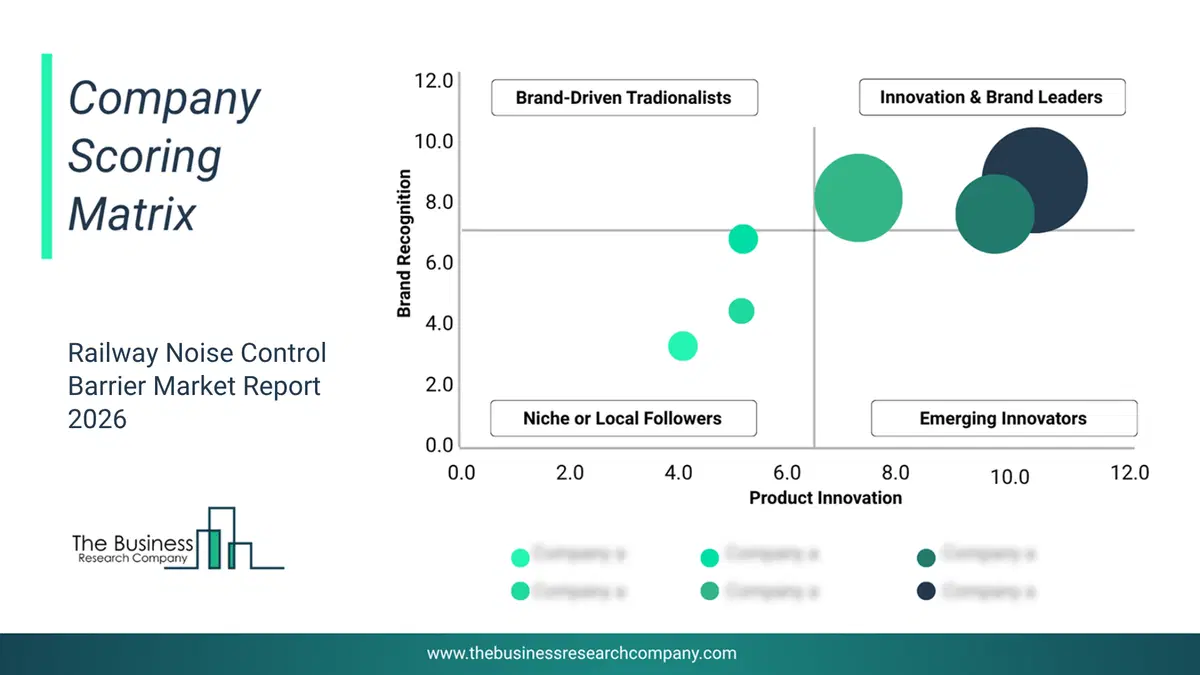
This chart maps companies by product innovation and brand strength, with bubble size indicating relative revenue, helping identify market leaders, challengers, and niche players. This is an illustrative chart; the full report provides a complete and accurate competitive analysis.
Global Railway Noise Control Barrier Market Trends and Insights
Major companies operating in the railway noise control barrier market are focusing on developing advanced products, such as mini absorbent noise barriers to enhance noise reduction in compact urban areas. Mini absorbent noise barriers are compact sound-reducing structures designed to minimize railway noise in confined urban environments. Constructed with sound-absorbing materials, they efficiently control noise while maintaining minimal spatial impact and preserving visibility. For instance, in May 2024, GSF Rail Infra, a Netherlands-based infrastructure manufacturer, launched the SoundSafe Movable Noise Barrier. It has passed all acoustic and environmental standards set by ProRail under the Innovation Partnership for sustainable noise barriers. These 76 cm-high, highly absorbent barriers are made from Canadian larch wood and treated with a lifelong fire retardant. It offers a 50-year maintenance-free lifespan and can be easily folded away during track maintenance. The barrier is fully compostable at the end of its lifecycle and has an environmental cost of only 35% compared to traditional aluminum noise barriers, making it a sustainable and effective alternative to conventional 2.5–3.0 m barriers.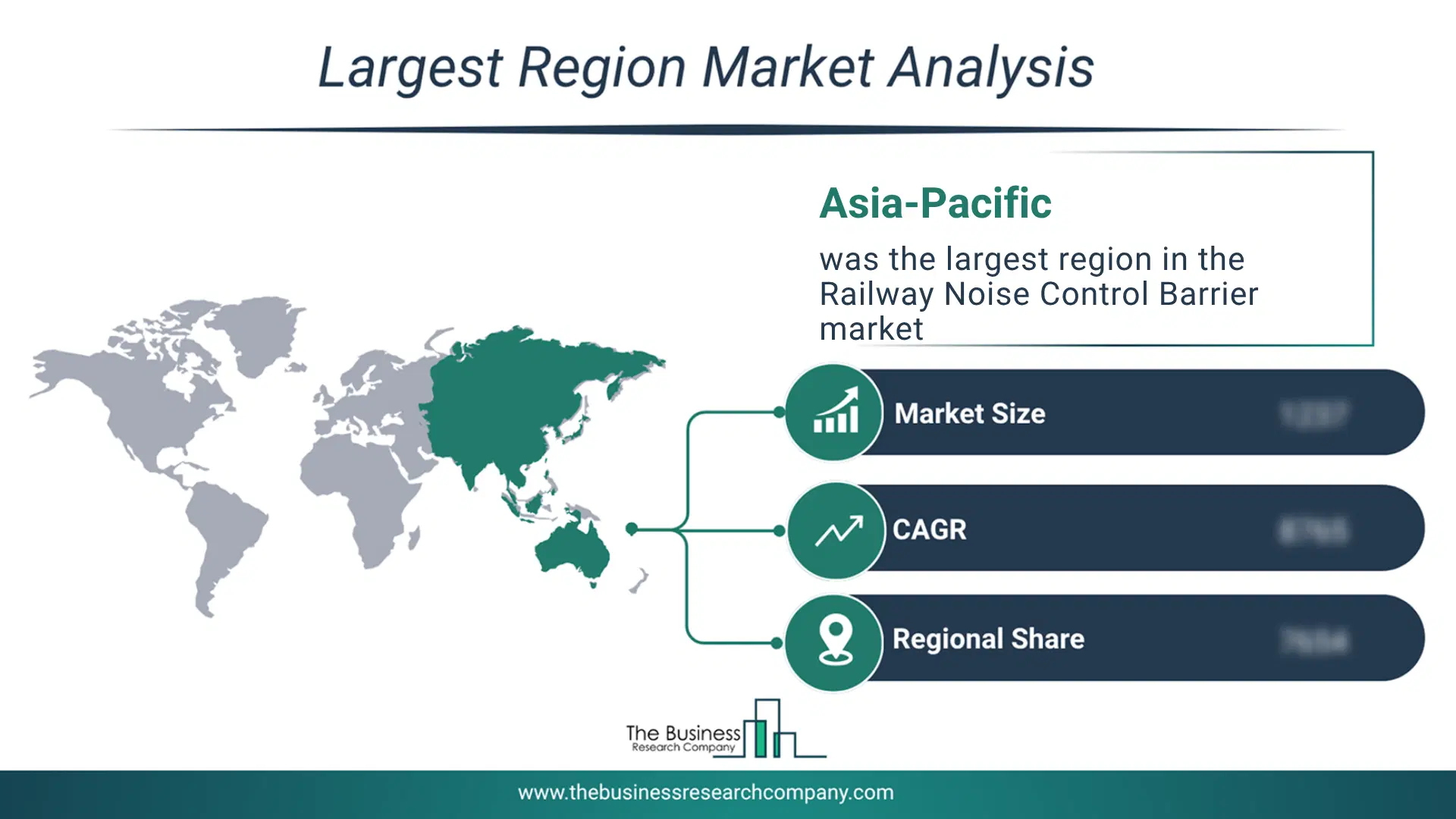
Regional Outlook
Asia-Pacific was the largest region in the railway noise control barrier market in 2025. North America is expected to be the fastest-growing region in the forecast period. The regions covered in this market report are Asia-Pacific, South East Asia, Western Europe, Eastern Europe, North America, South America, Middle East, Africa The countries covered in this market report are Australia, Brazil, China, France, Germany, India, Indonesia, Japan, Taiwan, Russia, South Korea, UK, USA, Canada, Italy, Spain.What Defines the Railway Noise Control Barrier Market?
The railway noise control barrier market consists of sales of trackside soundproofing panels, custom-designed barriers, vibration dampening barriers, modular noise barrier panels and portable or mobile noise barriers. Values in this market are ‘factory gate’ values, that is the value of goods sold by the manufacturers or creators of the goods, whether to other entities (including downstream manufacturers, wholesalers, distributors and retailers) or directly to end customers. The value of goods in this market includes related services sold by the creators of the goods.How is Market Value Defined and Measured?
The market value is defined as the revenues that enterprises gain from the sale of goods and/or services within the specified market and geography through sales, grants, or donations in terms of the currency (in USD unless otherwise specified). The revenues for a specified geography are consumption values that are revenues generated by organizations in the specified geography within the market, irrespective of where they are produced. It does not include revenues from resales along the supply chain, either further along the supply chain or as part of other products.
This chart presents market attractiveness based on a quantitative evaluation of growth, competition, strategic alignment, and risk, offering a clear view of opportunity areas for decision-making. This chart is for illustrative purposes; the full report contains the complete analysis.

This chart highlights the Total Addressable Market (TAM) by estimating the maximum revenue opportunity using an assumption-driven approach, supporting strategic planning and opportunity sizing across markets. The chart is illustrative; the full report provides a more comprehensive analysis.
What Key Data and Analysis Are Included in the Railway Noise Control Barrier Market Report 2026?
The railway noise control barrier market research report is one of a series of new reports from The Business Research Company that provides market statistics, including industry global market size, regional shares, competitors with the market share, detailed market segments, market trends and opportunities, and any further data you may need to thrive in the railway noise control barrier industry. The market research report delivers a complete perspective of everything you need, with an in-depth analysis of the current and future state of the industry.Railway Noise Control Barrier Market Report Forecast Analysis
| Report Attribute | Details |
|---|---|
| Market Size Value In 2026 | $1.53 billion |
| Revenue Forecast In 2030 | $2 billion |
| Growth Rate | CAGR of 6.9% from 2026 to 2030 |
| Base Year For Estimation | 2025 |
| Actual Estimates/Historical Data | 2020-2025 |
| Forecast Period | 2026 - 2030 |
| Market Representation | Revenue in USD Billion and CAGR from 2026 to 2030 |
| Segments Covered | Type, Material, Mounting, Installation, End-User |
| Regional Scope | Asia-Pacific, Western Europe, Eastern Europe, North America, South America, Middle East, Africa |
| Key Companies Profiled | AIL Sound Walls, Echo Barrier Ltd., PHONOBLOC Noise Barriers (Deltabloc), IAC Acoustics Ltd., Soundim Oy, Pliteq Inc., Metalesa S.A., Quietstone Acoustic Solutions, Envirotech Systems Limited, Greenvent Private Limited, Zak Noise Barrier, Antimo Noise Barrier, ESPL Noise Barrier, Himalayan Acoustics Noise Barrier, MMT Acoustix Noise Barrier, Technicon Acoustics, Active Acoustic Engineers, Trelleborg Applied Technologies, Kantaflex, DDSTHA Mechanicals, Acoustiblok Inc., Noise Barriers International |
| Customization Scope | Request for Customization |
| Pricing And Purchase Options | Explore Purchase Options |