
Rare Dermatological Disease Treatment Market Report 2026
Global Outlook – By Indication (Systemic Sclerosis, Epidermolysis Bullosa, Pemphigus Vulgaris, Cutaneous Lupus Erythematosus), By Treatment (Corticosteroid, Immunosuppressants, Anti-Inflammatory Agents, Other Treatments ), By Distribution Channel (Hospital Pharmacies, Retail Pharmacies, Online Pharmacies ), By Technology (Gene Therapy, Stem Cell Therapy, Nanotechnology), By Application (Epidermolysis Bullosa, Ichthyosis, Other Applications) - Market Size, Trends, And Global Forecast 2026-2035
Rare Dermatological Disease Treatment Market Overview
• Rare Dermatological Disease Treatment market size has reached to $5.57 billion in 2025 • Expected to grow to $7.51 billion in 2030 at a compound annual growth rate (CAGR) of 6.1% • Growth Driver: Growing Incidences Of Rare Skin Conditions Driving Demand For Advanced Dermatological Treatments And Increasing Need For Specialized Care • Market Trend: Use Of Redosable Gene Therapy To Improve Wound Healing • North America was the largest region in 2025 and Asia-Pacific is the fastest growing region.What Is Covered Under Rare Dermatological Disease Treatment Market?
Rare dermatological disease treatment refers to medical interventions designed for the diagnosis and management of uncommon skin disorders. These treatments are often specialized due to the rarity and complexity of the conditions. They involve targeted therapies, supportive care, and ongoing monitoring to manage symptoms and maintain skin health. The main indication types in rare dermatological disease treatment include systemic sclerosis, epidermolysis bullosa, pemphigus vulgaris, cutaneous lupus erythematosus. Systemic sclerosis is an uncommon disease that can lead to the hardening of the skin and connective tissues within the body. In some cases, it shows visible signs on the face, hands, feet, and other parts of the body, as the skin becomes thickened and firm. Rare dermatological disease treatment for systemic sclerosis focuses on managing skin fibrosis and vascular complications effectively. The treatment used include corticosteroid, immunosuppressants, anti-inflammatory agents, other treatments, and is distributed through hospital pharmacies, retail pharmacies, online pharmacies. The technology used are gene therapy, stem cell therapy, nanotechnology, that are applied in epidermolysis bullosa, ichthyosis, psoriasis, other rare skin conditions.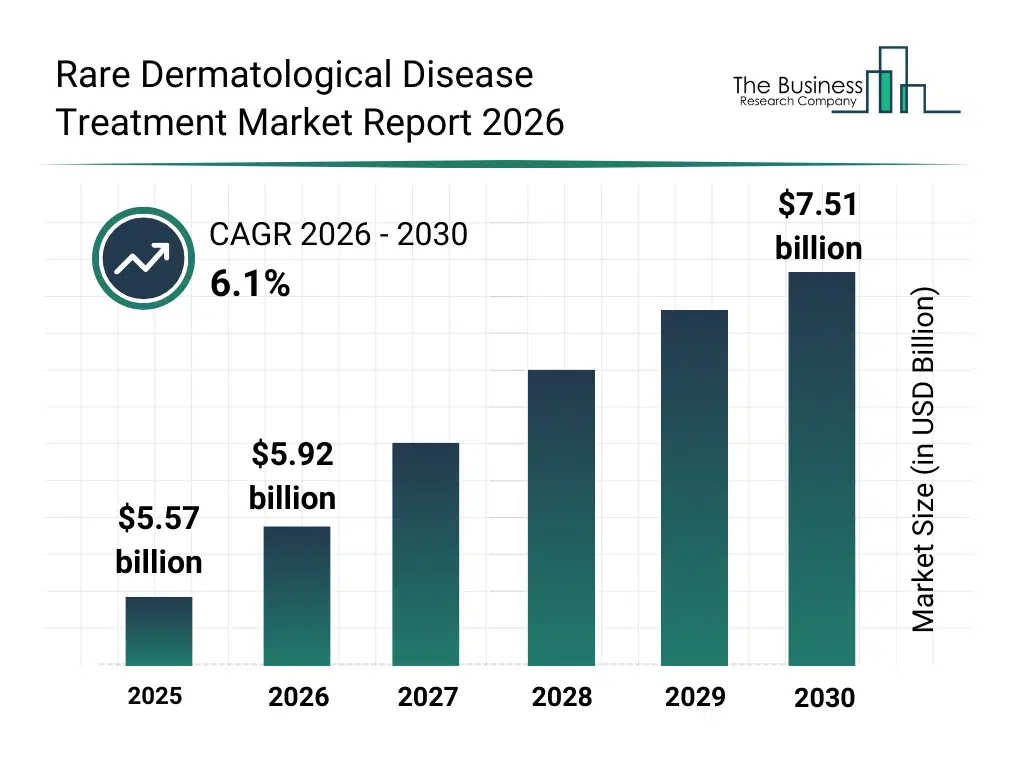
What Is The Rare Dermatological Disease Treatment Market Size and Share 2026?
The rare dermatological disease treatment market size has grown strongly in recent years. It will grow from $5.57 billion in 2025 to $5.92 billion in 2026 at a compound annual growth rate (CAGR) of 6.3%. The growth in the historic period can be attributed to improved understanding of rare skin disease pathophysiology, expansion of orphan drug regulations, increasing specialist dermatology research, growth in biologics manufacturing capabilities, rising awareness of rare dermatological conditions.What Is The Rare Dermatological Disease Treatment Market Growth Forecast?
The rare dermatological disease treatment market size is expected to see strong growth in the next few years. It will grow to $7.51 billion in 2030 at a compound annual growth rate (CAGR) of 6.1%. The growth in the forecast period can be attributed to increasing investments in gene therapy platforms, rising focus on personalized treatment protocols, expansion of clinical research in rare skin disorders, growing use of advanced biologics, increasing regulatory support for orphan therapies. Major trends in the forecast period include increasing development of targeted biologic therapies, rising adoption of gene and cell-based treatments, growing focus on personalized dermatology care, expansion of orphan drug pipelines, enhanced use of advanced diagnostic technologies.
Global Rare Dermatological Disease Treatment Market Segmentation
1) By Indication: Systemic Sclerosis, Epidermolysis Bullosa, Pemphigus Vulgaris, Cutaneous Lupus Erythematosus 2) By Treatment: Corticosteroid, Immunosuppressants, Anti-Inflammatory Agents, Other Treatments 3) By Distribution Channel: Hospital Pharmacies, Retail Pharmacies, Online Pharmacies 4) By Technology: Gene Therapy, Stem Cell Therapy, Nanotechnology 5) By Application: Epidermolysis Bullosa, Ichthyosis, Other Applications Subsegments: 1) By Systemic Sclerosis: Limited Cutaneous Systemic Sclerosis, Diffuse Cutaneous Systemic Sclerosis, Sine Scleroderma 2) By Epidermolysis Bullosa: Epidermolysis Bullosa Simplex, Junctional Epidermolysis Bullosa, Dystrophic Epidermolysis Bullosa, Kindler Syndrome 3) By Pemphigus Vulgaris: Mucosal Pemphigus Vulgaris, Mucocutaneous Pemphigus Vulgaris, Cutaneous Pemphigus Vulgaris 4) By Cutaneous Lupus Erythematosus: Acute Cutaneous Lupus Erythematosus, Subacute Cutaneous Lupus Erythematosus, Chronic Cutaneous Lupus Erythematosus (Discoid Lupus)What Is The Driver Of The Rare Dermatological Disease Treatment Market?
The increasing number of diagnosed cases of rare dermatological disorders is expected to drive the growth of the rare dermatological disease treatment market. Rare skin conditions, such as epidermolysis bullosa, pemphigus vulgaris, and cutaneous lupus erythematosus, affect a small proportion of the population but require specialized care and targeted therapies. Advances in genetic testing, improved disease awareness, and earlier diagnosis have contributed to a higher number of identified cases worldwide. This rising recognition is creating demand for innovative treatments, including gene therapies, advanced biologics, and supportive care solutions, to manage symptoms, promote wound healing, and improve patient outcomes. For instance, in January 2025, according to a CDC, a US-based public health agency, Vyjuvek (beremagene geperpavec-svdt), a redosable gene therapy for dystrophic epidermolysis bullosa, demonstrated significant wound closure in clinical studies, illustrating the impact of innovative therapies on patient care. Therefore, the growing incidences of rare skin conditions are driving the growth of the rare dermatological disease treatment industry.Key Players In The Global Rare Dermatological Disease Treatment Market
Major companies operating in the rare dermatological disease treatment market are Kyowa Kirin, Johnson and Johnson company, F. Hoffmann-La Roche Limited, Merck KGaA, Arcutis Biotherapeutics, Pfizer Inc., Abbvie, Sanofi, Novartis AG, AstraZeneca, Eli lilly and company, Amgen, Bristol Myers Squibb Company, Pierre Fabre Laboratories, LEO Pharma, Almirall, Castle Creek Biosciences, Inc., Azitra, Krystal Biotech, Inc., Avita Medical, NS Pharma, Replay, Eloxx Pharmaceuticals, Kamari Pharma, BPGbioGlobal Rare Dermatological Disease Treatment Market Trends and Insights
Major companies are operating in the rare dermatological disease treatment market focusing on developing smart and advanced gene therapy technologies, such as redosable gene therapy to improve patient outcomes, simplify treatment, and enhance quality of life. A redosable gene therapy delivers functional COL7A1 genes directly to affected skin areas, enabling repeated, noninvasive applications, sustained protein restoration, and accelerated wound closure. For instance, in May 2023, Krystal Biotech, a U.S.-based biotechnology company, launched Vyjuvek (beremagene geperpavec-svdt) for the treatment of dystrophic epidermolysis bullosa. The product demonstrated 65% of treated wounds achieved complete closure at 24 weeks compared to 26% with placebo, allows once-weekly application to selected wounds, and reduces the need for surgical interventions. Vyjuvek also offers a noninvasive clinic-administered option while requiring specialized cold-chain storage to maintain efficacy.What Are Latest Mergers And Acquisitions In The Rare Dermatological Disease Treatment Market?
In March 2025, Scinai Immunotherapeutics, Israel-based provider of immunology biologics and contract development and manufacturing organization services, acquired Pincell srl for an undisclosed amount. Through this acquisition, Scinai aims to strengthen its position in immunology and add PC111, a novel monoclonal antibody in development for pemphigus, Stevens–Johnson syndrome, and toxic epidermal necrolysis. Pincell srl is an Italy-based provider of innovative biologic therapies for severe and rare dermatological conditions.Regional Outlook
North America was the largest region in the personalized genomics market in 2025. Asia-Pacific is expected to be the fastest-growing region in the forecast period. The regions covered in this market report are Asia-Pacific, South East Asia, Western Europe, Eastern Europe, North America, South America, Middle East, Africa. The countries covered in this market report are Australia, Brazil, China, France, Germany, India, Indonesia, Japan, Taiwan, Russia, South Korea, UK, USA, Canada, Italy, Spain.What Defines the Rare Dermatological Disease Treatment Market?
The rare dermatological disease treatment market includes revenues earned by entities by genetic counseling and testing, specialized histopathology, multidisciplinary clinical consultations, patient registry management, and custom-compounded topical formulations. The market value includes the value of related goods sold by the service provider or included within the service offering. The rare dermatological disease treatment market consists of sales of orphan drugs, targeted biologic therapies, advanced topical immune modulators, novel small molecule inhibitors, and specialized wound care and protective dressings. Values in this market are ‘factory gate’ values, that is the value of goods sold by the manufacturers or creators of the goods, whether to other entities (including downstream manufacturers, wholesalers, distributors and retailers) or directly to end customers. The value of goods in this market includes related services sold by the creators of the goods.How is Market Value Defined and Measured?
The market value is defined as the revenues that enterprises gain from the sale of goods and/or services within the specified market and geography through sales, grants, or donations in terms of the currency (in USD unless otherwise specified). The revenues for a specified geography are consumption values that are revenues generated by organizations in the specified geography within the market, irrespective of where they are produced. It does not include revenues from resales along the supply chain, either further along the supply chain or as part of other products.What Key Data and Analysis Are Included in the Rare Dermatological Disease Treatment Market Report 2026?
The rare dermatological disease treatment market research report is one of a series of new reports from The Business Research Company that provides market statistics, including industry global market size, regional shares, competitors with the market share, detailed market segments, market trends and opportunities, and any further data you may need to thrive in the rare dermatological disease treatment industry. The market research report delivers a complete perspective of everything you need, with an in-depth analysis of the current and future state of the industry.Rare Dermatological Disease Treatment Market Report Forecast Analysis
| Report Attribute | Details |
|---|---|
| Market Size Value In 2026 | $5.92 billion |
| Revenue Forecast In 2035 | $7.51 billion |
| Growth Rate | CAGR of 6.3% from 2026 to 2035 |
| Base Year For Estimation | 2025 |
| Actual Estimates/Historical Data | 2020-2025 |
| Forecast Period | 2026 - 2030 - 2035 |
| Market Representation | Revenue in USD Billion and CAGR from 2026 to 2035 |
| Segments Covered | Indication, Treatment, Distribution Channel, Technology, Application |
| Regional Scope | Asia-Pacific, Western Europe, Eastern Europe, North America, South America, Middle East, Africa |
| Country Scope | The countries covered in the report are Australia, Brazil, China, France, Germany, India, ... |
| Key Companies Profiled | Kyowa Kirin, Johnson and Johnson company, F. Hoffmann-La Roche Limited, Merck KGaA, Arcutis Biotherapeutics, Pfizer Inc., Abbvie, Sanofi, Novartis AG, AstraZeneca, Eli lilly and company, Amgen, Bristol Myers Squibb Company, Pierre Fabre Laboratories, LEO Pharma, Almirall, Castle Creek Biosciences, Inc., Azitra, Krystal Biotech, Inc., Avita Medical, NS Pharma, Replay, Eloxx Pharmaceuticals, Kamari Pharma, BPGbio |
| Customization Scope | Request for Customization |
| Pricing And Purchase Options | Explore Purchase Options |