
Rare Earth Magnet Market Report 2026
Global Outlook – By Product Type (Sintered Neodymium-Iron-Boron, Bonded Neodymium-Iron-Boron, Samarium-Cobalt, Praseodymium-Neodymium-Iron-Boron, Dysprosium-Neodymium-Iron-Boron), By Grade (High-Performance, Mid-Performance, Low-Performance), By End User (Automotive, Consumer Electronics, Energy, Healthcare, Industrial Equipment, Other End Users) – Market Size, Trends, Strategies, and Forecast to 2035
Rare Earth Magnet Market Overview
• Rare Earth Magnet market size has reached to $18.86 billion in 2025 • Expected to grow to $26.99 billion in 2030 at a compound annual growth rate (CAGR) of 7.4% • Growth Driver: Rising Electric Vehicle Adoption Fueling The Growth Of The Market Due To Increasing Demand For Efficient Motor Components • Market Trend: Innovative Developments In Sustainable Magnet Alternatives • North America was the largest region in 2025 and Asia-Pacific is the fastest growing region.Market Gains By 2030 – Top Opportunities By Segment
Market Gain identifies the most promising market opportunities by highlighting the segments or products expected to generate the highest incremental revenue growth over the next five years.
What Is Covered Under Rare Earth Magnet Market?
Rare earth magnets are strong permanent magnets made from alloys containing rare earth elements. They are known for their exceptionally high magnetic strength and efficiency. These magnets play a critical role in modern technologies due to their ability to maintain strong magnetism in compact sizes. They are commonly used in advanced electronics, medical equipment, and renewable energy systems. The main product types in rare earth magnets include sintered neodymium-iron-boron, bonded neodymium-iron-boron, samarium-cobalt, praseodymium-neodymium-iron-boron, and dysprosium-neodymium-iron-boron. Sintered NdFeB magnets are high-strength permanent magnets produced via powder metallurgy and are commonly used in demanding applications such as motors, turbines, and data storage. These magnets are available in various grades, including high-performance, mid-performance, and low-performance, and are used across several end-use industries such as automotive, consumer electronics, energy, healthcare, industrial equipment, and others.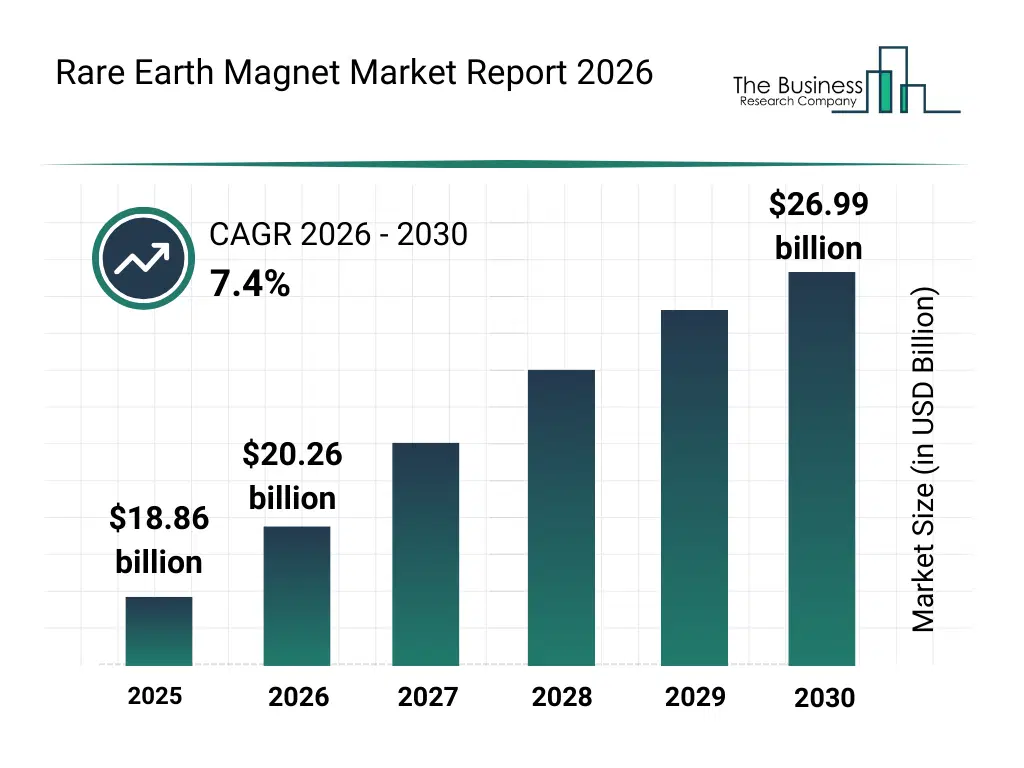
What Is The Rare Earth Magnet Market Size and Share 2026?
The rare earth magnet market size has grown strongly in recent years. It will grow from $18.86 billion in 2025 to $20.26 billion in 2026 at a compound annual growth rate (CAGR) of 7.5%. The growth in the historic period can be attributed to growth in automotive electric motor applications, rising consumer electronics production, increasing renewable energy installations, expansion of medical equipment usage, development of high-strength rare earth alloys.What Is The Rare Earth Magnet Market Growth Forecast?
The rare earth magnet market size is expected to see strong growth in the next few years. It will grow to $26.99 billion in 2030 at a compound annual growth rate (CAGR) of 7.4%. The growth in the forecast period can be attributed to increasing adoption in electric vehicles, rising demand in wind turbine generators, growth in miniaturized electronic devices, expansion in industrial automation equipment, development of heavy rare earth free magnet alternatives. Major trends in the forecast period include rising adoption of high-performance neodymium-iron-boron magnets, increasing use of samarium-cobalt magnets in industrial applications, growing demand for corrosion-resistant rare earth magnets, rising development of low dysprosium content magnets, increasing application in compact and high-efficiency electronics.
Global Rare Earth Magnet Market Segmentation
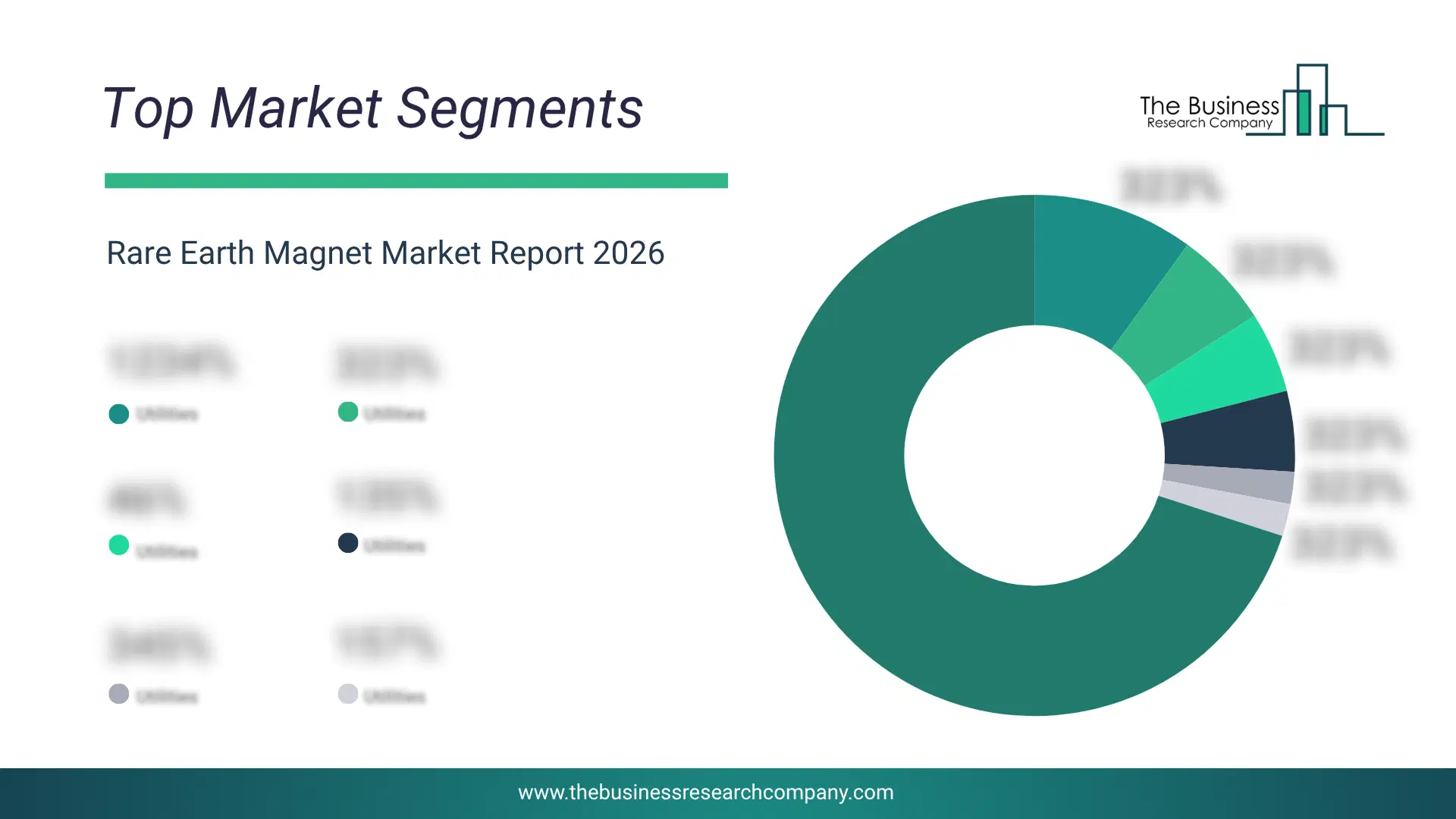
1) By Product Type: Sintered Neodymium-Iron-Boron, Bonded Neodymium-Iron-Boron, Samarium-Cobalt, Praseodymium-Neodymium-Iron-Boron, Dysprosium-Neodymium-Iron-Boron 2) By Grade: High-Performance, Mid-Performance, Low-Performance 3) By End User: Automotive, Consumer Electronics, Energy, Healthcare, Industrial Equipment, Other End Users Subsegments: 1) By Sintered Neodymium-Iron-Boron: High Coercivity Grades, High Remanence Grades, High Operating Temperature Grades, Low Dysprosium Content Grades 2) By Bonded Neodymium-Iron-Boron: Compression Molded, Injection Molded, Extrusion Molded, Calendared 3) By Samarium-Cobalt: Samarium-Cobalt 5 (Smco5), Samarium-Cobalt 17 (Sm2co17) 4) By Praseodymium-Neodymium-Iron-Boron: High Magnetic Energy Product, Corrosion-Resistant Grades, Low-Temperature Coefficient Grades 5) By Dysprosium-Neodymium-Iron-Boron: High Thermal Stability Grades, Heavy Rare Earth Free Alternatives, Dy-Coated Microstructure Grades The top segments in the rare earth magnet market will be: • High-Performance will reach $9669.8 Million by 2025. • Sintered Neodymium-Iron-Boron will reach $8972.1 Million by 2025. • Mid-Performance will reach $5840.5 Million by 2025. • Automotive will reach $5800.1 Million by 2025. • Consumer Electronics will reach $5565 Million by 2025.What Is The Driver Of The Rare Earth Magnet Market?
The increasing adoption of electric vehicles is expected to propel the growth of the rare earth magnet market going forward. Electric vehicles refer to automobiles powered by electric motors using energy stored in rechargeable batteries. The rise in electric vehicles is primarily due to growing environmental concerns, as consumers and governments seek to reduce carbon emissions and reliance on fossil fuels, leading to a shift towards cleaner, more sustainable transportation options. Rare earth magnets help electric vehicles by enabling powerful and compact electric motors, which improve energy efficiency and vehicle performance. For instance, in January 2024, according to the U.S. Energy Information Administration, a US-based government agency, combined sales of hybrid, plug-in hybrid, and battery electric vehicles reached 16.3% of total U.S. light-duty vehicle sales in 2023, up from 12.9% in 2022, reflecting a significant shift toward electrified transportation. Therefore, the increasing adoption of electric vehicles is driving the growth of the rare earth magnet industry.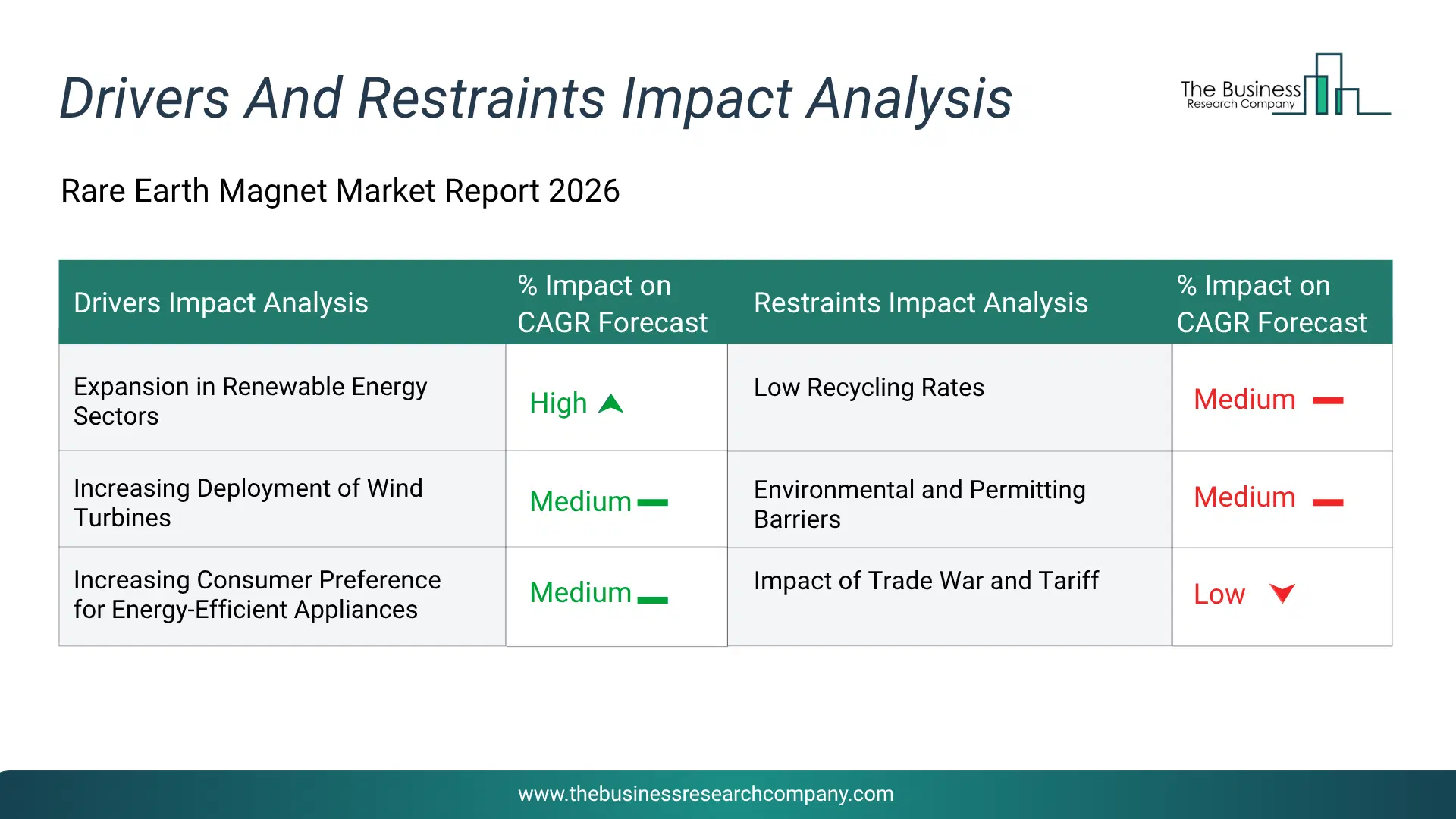
Infographic Chart Showing Key Market Drivers Analysis And Restraints For Rare Earth Magnet Market
The chart presents an impact analysis of key drivers and restraints, quantifying their relative influence on the market's growth rate and helping assess the balance between growth enablers and limiting factors. This chart offers a high-level perspective; the full report contains more detailed insights.
How Will The Drivers Impact Growth In The Global Rare Earth Magnet Market?
• Expansion in Renewable Energy Sectors (High) – The expansion in renewable energy sectors will become a key driver of growth in the rare earth magnet market by 2029. As the adoption of EVs accelerates, the demand for an extensive and reliable charging network intensifies. This necessitates the development of robust electrical systems capable of handling increased loads and ensuring safety. Vacuum interrupters, known for their efficiency and reliability in high-voltage applications, are integral to the protection and operation of these evolving power distribution systems. Their role in safeguarding electrical circuits against faults and ensuring uninterrupted service is becoming increasingly vital as the infrastructure expands. As a result, the expansion in renewable energy sectors is anticipated to contributing to a 2.0% annual growth in the market. • Increasing Deployment of Wind Turbines (Medium) – The increasing deployment of wind turbines will emerge as a major factor driving the expansion of the rare earth magnet market by 2029. The rapid expansion of both onshore and offshore wind installations is driving demand for high-performance permanent magnets used in generators and drive systems, where efficiency, reliability and compact design are critical. As turbine rotor diameters and power ratings continue to scale upward, the requirement for rare earth magnet capable of delivering high magnetic energy density and stable performance under challenging environmental conditions becomes more pronounced. With wind energy emerging as a central pillar of global decarbonization strategies and grid-modernization efforts, the need for advanced magnet solutions that support high torque, low maintenance and long operational life is expected to grow substantially, thereby driving the growth of the rare earth magnet market. Consequently, the increasing deployment of wind turbines is projected to contributing to a 1.5% annual growth in the market. • Increasing Consumer Preference for Energy-Efficient Appliances (Medium) – The increasing consumer preference for energy-efficient appliances will serve as a key growth catalyst for the rare earth magnet market by 2029. As global households and industries continue prioritizing products that reduce electricity consumption, manufacturers are accelerating the shift toward high-efficiency motors and compressors, core components that depend on rare earth permanent magnets to deliver superior performance. Energy-efficient appliances offer lower operating costs, improved durability and reduced environmental impact, making them increasingly attractive to consumers responding to rising energy prices and stricter efficiency regulations. This growing demand encourages producers to integrate advanced magnet-based motor technologies that support higher torque, quieter operation and greater overall efficiency. With energy efficiency becoming a key purchasing criterion across major appliance categories, the reliance on high-performance rare earth magnet is expected to expand significantly, thereby driving the growth of the rare earth magnet market. Therefore, this increasing consumer preference for energy-efficient appliances is projected to supporting to a 0.5% annual growth in the market. • Expanding Robotics Sector (Low) – The expanding robotics sector will become a significant driver contributing to the growth of the rare earth magnet market by 2029. The rapid increase in demand for industrial and collaborative robots across manufacturing systems, driven by automation initiatives and labour-efficiency requirements, is intensifying reliance on high-performance permanent magnets that deliver compact size, high torque density and precise control. Rare earth magnets are essential components in electric motors, actuators and servo systems used in robotic platforms, enabling greater speed, durability and miniaturization. As manufacturers worldwide accelerate robot deployment to support Industry 4.0, smart manufacturing and supply-chain resilience, the demand for advanced magnet materials is expected to rise substantially, thereby driving the overall growth of the rare earth magnet market. Consequently, the expanding robotics sector is projected to contributing to a 0.3% annual growth in the market.How Will The Restraints Impact Growth In The Global Rare Earth Magnet Market?
• Low Recycling Rates (High) – Low recycling rates is expected to restrain market growth during the forecast period. It creates operational, financial, regulatory, or commercial challenges that can increase costs, delay projects, reduce investments, or discourage purchasing decisions depending on the market. These challenges can reduce product adoption, affect business confidence, and limit the ability of companies to expand efficiently across key regions. This can disrupt long-term growth strategies and reduce the ability of companies to capitalize on emerging market opportunities. • Environmental and Permitting Barriers (Medium) – During the forecast period, environmental and permitting barriers is likely to limit market expansion. It creates operational, financial, regulatory, or commercial challenges that can increase costs, delay projects, reduce investments, or discourage purchasing decisions depending on the market. These challenges can reduce product adoption, affect business confidence, and limit the ability of companies to expand efficiently across key regions. As a result, organizations may postpone purchasing decisions, limiting demand across both established and emerging markets. • Impact of Trade War and Tariff (Medium) – The market is expected to face challenges due to impact of trade war and tariff over the forecast period. It creates operational, financial, regulatory, or commercial challenges that can increase costs, delay projects, reduce investments, or discourage purchasing decisions depending on the market. These challenges can reduce product adoption, affect business confidence, and limit the ability of companies to expand efficiently across key regions. This may reduce production efficiency, extend project timelines, and create challenges in meeting evolving customer requirements.Key Players In The Global Rare Earth Magnet Market
Major companies operating in the rare earth magnet market report are Shin-Etsu Chemical Co. Ltd., TDK Corporation, Hitachi Metals, China Northern Rare Earth Group, Beijing Zhong Ke Magnetic Materials, Zhong Ke San Huan High-Tech Co., Ningbo Yunsheng Co. Ltd., Lynas Rare Earths Ltd., MP Materials Corp., Arnold Magnetic Technologies, Bunting Magnetics Co., Goudsmit Magnetics, Eclipse Magnetics Ltd., Electron Energy Corporation, Toshiba Materials Co. Ltd., Adams Magnetic Products, Shenzhen Zhaobao Magnet Co Ltd., Dura Magnetics Inc., Magnet Applications Inc., Ucore Rare Metals Inc., Rare Element Resources Ltd, Earth-Panda Advance Magnetic Material Co. Ltd.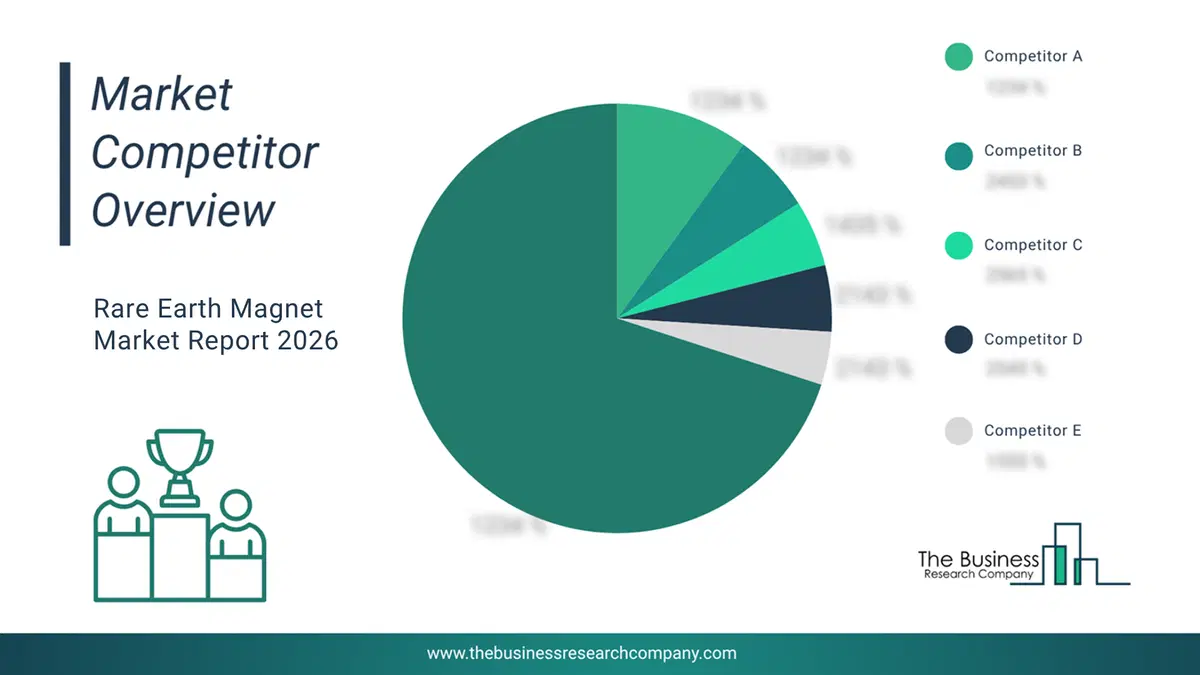
This chart is for illustrative purposes; the full report includes a detailed competitor analysis and comprehensive overview of the top 10 companies in the market.
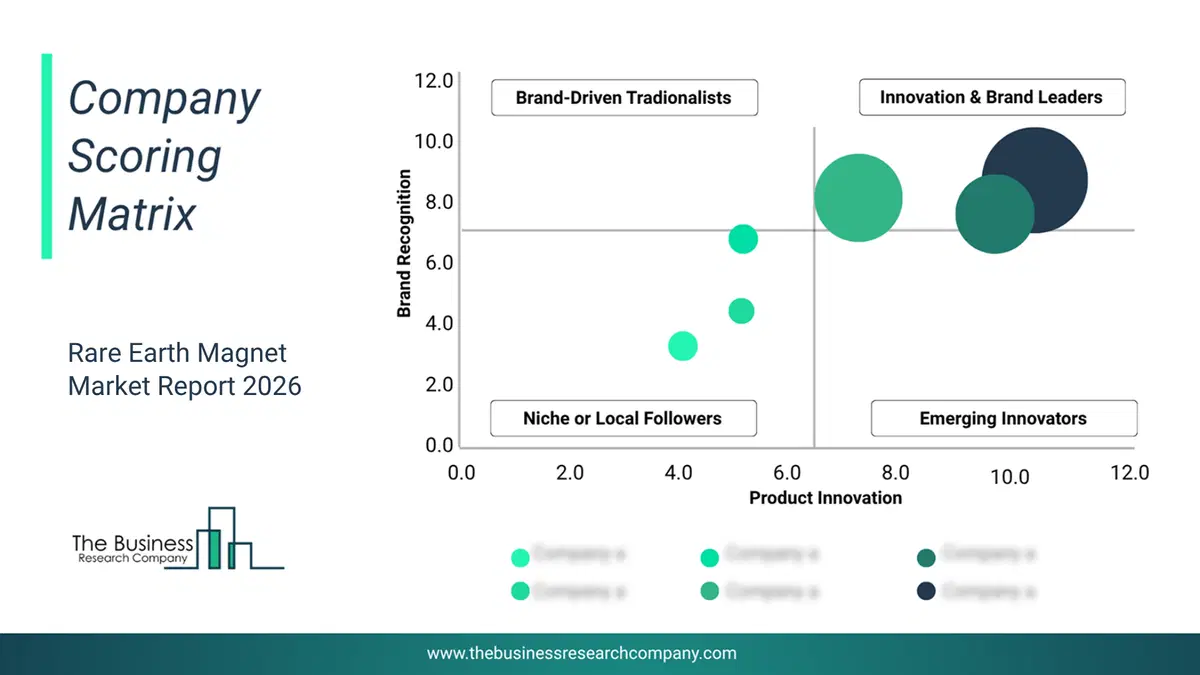
This chart maps companies by product innovation and brand strength, with bubble size indicating relative revenue, helping identify market leaders, challengers, and niche players. This is an illustrative chart; the full report provides a complete and accurate competitive analysis.
Global Rare Earth Magnet Market Trends and Insights
Major companies operating in the rare earth magnet market are focusing on integrating innovative technologies, such as advanced artificial intelligence (AI) technologies, to enhance production efficiency, improve product quality, and optimize supply chain management. Advanced AI technologies help in the rare earth magnet market by optimizing the design and production processes, predicting material behavior, and improving the efficiency of manufacturing operations. AI can be used for precise material modeling, reducing waste, and ensuring higher-quality magnets. For instance, in June 2024, Materials Nexus Limited, a UK-based deep-tech company that specializes in AI-driven material discovery, announced the development of MagNex, a rare earth-free permanent magnet. Created in just three months using the company’s AI-powered platform, the innovation was achieved in collaboration with the Henry Royce Institute and the University of Sheffield. MagNex presents a more sustainable alternative to traditional magnets, offering an 80% reduction in production costs and a 70% decrease in carbon emissions. It is particularly well-suited for high-demand industries such as electric vehicles, wind turbines, robotics, and drones.What Are Latest Mergers And Acquisitions In The Rare Earth Magnet Market?
In April 2025, Realloys Inc., a US-based manufacturing company, acquired PMT Critical Metals for an undisclosed amount. With this acquisition, REalloys aims to strengthen its position as a critical supplier of high-performance magnet materials for U.S. protected markets, including the National Defense Stockpiles, Defense Industrial Base, and Nuclear Industrial Base. PMT Critical Metals is a US-based company specializing in the production of rare earth magnets, which are essential components in various high-tech and clean energy applications.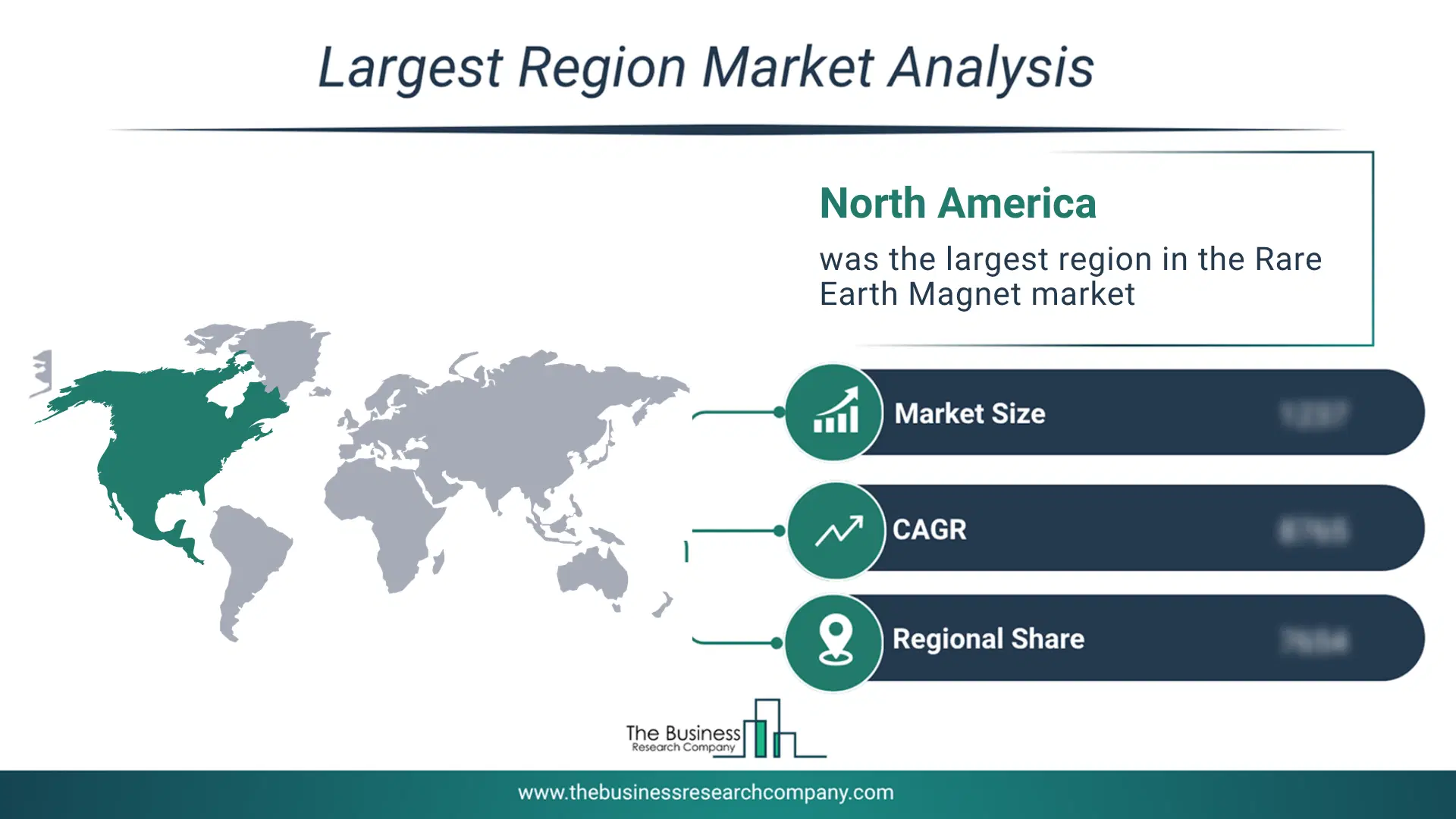
Regional Outlook
North America was the largest region in the rare earth magnet market in 2025. Asia-Pacific is expected to be the fastest-growing region in the forecast period. The regions covered in the rare earth magnet market are Asia-Pacific, South East Asia, Western Europe, Eastern Europe, North America, South America, Middle East, Africa. The countries covered in the rare earth magnet market are Australia, Brazil, China, France, Germany, India, Indonesia, Japan, Taiwan, Russia, South Korea, UK, USA, Canada, Italy, Spain.What Defines the Rare Earth Magnet Market?
The rare earth magnet market consists of sales of neodymium (NdFeB) magnets, samarium-cobalt (SmCo) magnets, cerium magnets, alnico magnets, bonded rare earth magnets, sintered rare earth magnets, and magnetostrictive materials. Values in this market are ‘factory gate’ values, that is, the value of goods sold by the manufacturers or creators of the goods, whether to other entities (including downstream manufacturers, wholesalers, distributors, and retailers) or directly to end customers. The value of goods in this market includes related services sold by the creators of the goods.How is Market Value Defined and Measured?
The market value is defined as the revenues that enterprises gain from the sale of goods and/or services within the specified market and geography through sales, grants, or donations in terms of the currency (in USD unless otherwise specified). The revenues for a specified geography are consumption values that are revenues generated by organizations in the specified geography within the market, irrespective of where they are produced. It does not include revenues from resales along the supply chain, either further along the supply chain or as part of other products.
This chart presents market attractiveness based on a quantitative evaluation of growth, competition, strategic alignment, and risk, offering a clear view of opportunity areas for decision-making. This chart is for illustrative purposes; the full report contains the complete analysis.

This chart highlights the Total Addressable Market (TAM) by estimating the maximum revenue opportunity using an assumption-driven approach, supporting strategic planning and opportunity sizing across markets. The chart is illustrative; the full report provides a more comprehensive analysis.
What Key Data and Analysis Are Included in the Rare Earth Magnet Market Report 2026?
The rare earth magnet market research report is one of a series of new reports from The Business Research Company that provides market statistics, including Market Report 2026?global market size, regional shares, competitors with the market share, detailed market segments, market trends and opportunities, and any further data you may need to thrive in the rare earth magnet Market Report 2026? The market research report delivers a complete perspective of everything you need, with an in-depth analysis of the current and future state of the Market Report 2026?Rare Earth Magnet Market Report Forecast Analysis
| Report Attribute | Details |
|---|---|
| Market Size Value In 2026 | $20.26 billion |
| Revenue Forecast In 2035 | $26.99 billion |
| Growth Rate | CAGR of 7.5% from 2026 to 2035 |
| Base Year For Estimation | 2025 |
| Actual Estimates/Historical Data | 2020-2025 |
| Forecast Period | 2026 - 2030 - 2035 |
| Market Representation | Revenue in USD Billion and CAGR from 2026 to 2035 |
| Segments Covered | Product Type, Grade, End User |
| Regional Scope | Asia-Pacific, Western Europe, Eastern Europe, North America, South America, Middle East, Africa |
| Country Scope | The countries covered in the report are Australia, Brazil, China, France, Germany, India, ... |
| Key Companies Profiled | Shin-Etsu Chemical Co. Ltd., TDK Corporation, Hitachi Metals, China Northern Rare Earth Group, Beijing Zhong Ke Magnetic Materials, Zhong Ke San Huan High-Tech Co., Ningbo Yunsheng Co. Ltd., Lynas Rare Earths Ltd., MP Materials Corp., Arnold Magnetic Technologies, Bunting Magnetics Co., Goudsmit Magnetics, Eclipse Magnetics Ltd., Electron Energy Corporation, Toshiba Materials Co. Ltd., Adams Magnetic Products, Shenzhen Zhaobao Magnet Co Ltd., Dura Magnetics Inc., Magnet Applications Inc., Ucore Rare Metals Inc., Rare Element Resources Ltd, Earth-Panda Advance Magnetic Material Co. Ltd. |
| Customization Scope | Request for Customization |
| Pricing And Purchase Options | Explore Purchase Options |