
Reach Stacker Market Report 2026
Global Outlook – By Capacity (Below 30 Ton, 30-45 Ton, Above 45 Ton), By Propulsion (Internal Combustion Engine, Electric, Hybrid), By Application (Sea Port Or Terminal, Yards Or Landside, Industrial ) – Market Size, Trends, Strategies, and Forecast to 2030
Reach Stacker Market Overview
• Reach Stacker market size has reached to $2.67 billion in 2025 • Expected to grow to $3.56 billion in 2030 at a compound annual growth rate (CAGR) of 6% • Growth Driver: Global Reach Stacker Market Surges On The Back Of Robust Growth In Seaborne Trade • Market Trend: Increasing Focus On Product Innovations To Provide Reliable Services To Their Customers • Asia-Pacific was the largest region in 2025.What Is Covered Under Reach Stacker Market?
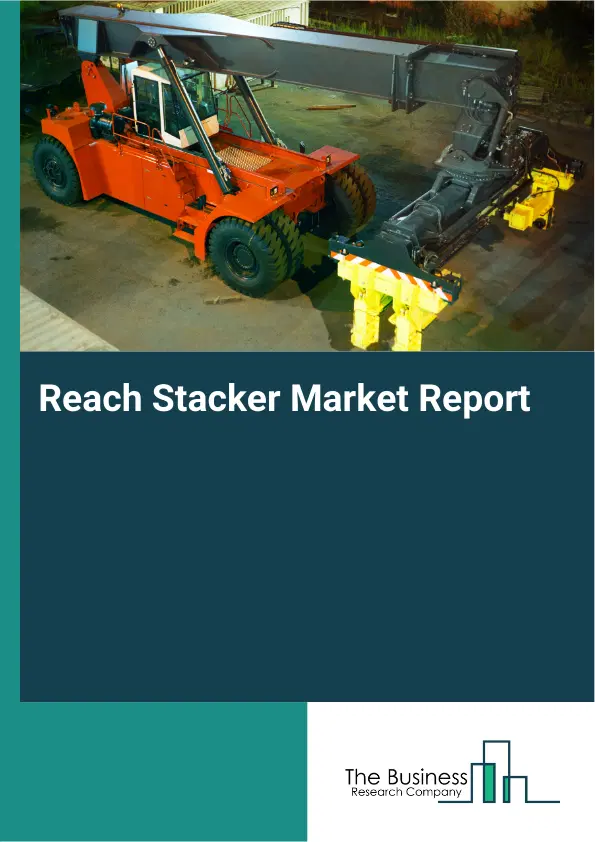
A reach stacker is a vehicle used to transport intermodal cargo containers quickly over short distances in small or medium-sized terminals or ports. Reach stackers are prominently used to stack and handle various types of containers in places such as ports, railroad stations, and industrial sites. The main types of reach stackers are available in the capacity of below 30 tons, 30-45 tons, and above 45 tons. Above 45 tons reach stackers are used for material handling tasks having a maximum load lifting capacity ranging above 45 tons. Propulsion includes internal combustion engines, electric, and hybrid that are used in various applications such as seaports or terminals, yards or landside, and industrial.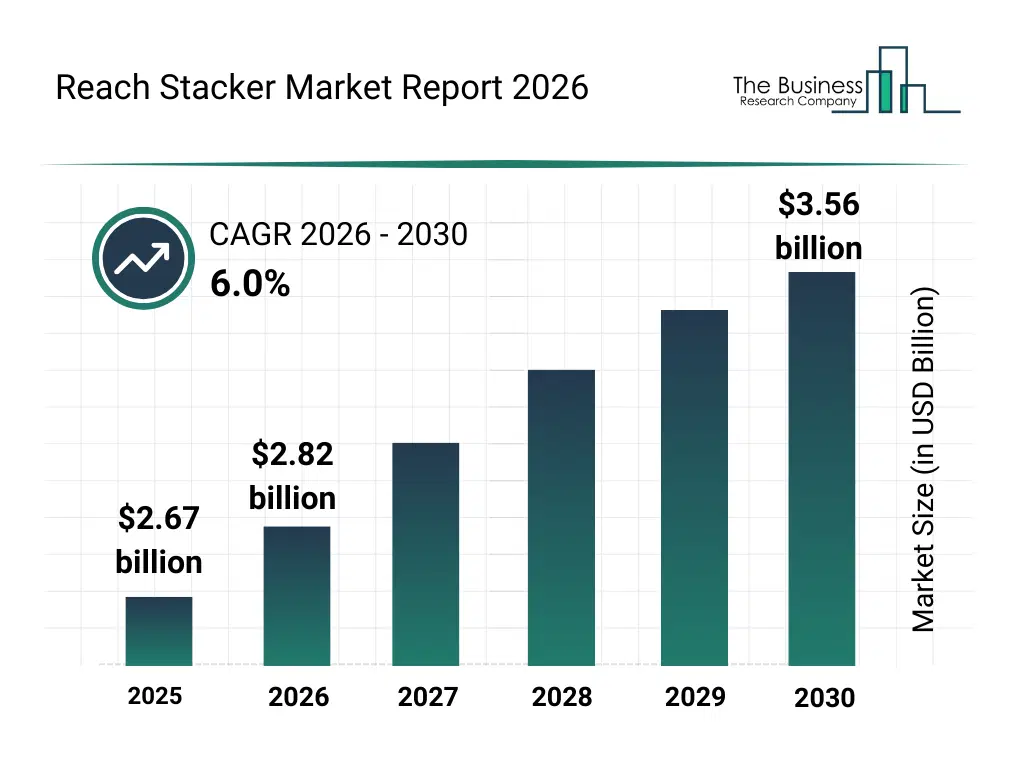
What Is The Reach Stacker Market Size and Share 2026?
The reach stacker market size has grown strongly in recent years. It will grow from $2.67 billion in 2025 to $2.82 billion in 2026 at a compound annual growth rate (CAGR) of 5.7%. The growth in the historic period can be attributed to expansion of containerized trade volumes, growth of port and terminal infrastructure, rising demand for intermodal logistics, increasing use of heavy-duty material handling equipment, availability of diesel-powered reach stackers.What Is The Reach Stacker Market Growth Forecast?
The reach stacker market size is expected to see strong growth in the next few years. It will grow to $3.56 billion in 2030 at a compound annual growth rate (CAGR) of 6.0%. The growth in the forecast period can be attributed to increasing investments in smart ports, rising adoption of low-emission terminal equipment, expansion of inland container depots, growing demand for automation in yards, increasing focus on operational cost reduction. Major trends in the forecast period include increasing adoption of electric and hybrid reach stackers, rising integration of telematics and fleet monitoring, growing demand for high-capacity container handling, expansion of automated port operations, enhanced focus on fuel efficiency.
Global Reach Stacker Market Segmentation
1) By Capacity: Below 30 Ton, 30-45 Ton, Above 45 Ton 2) By Propulsion: Internal Combustion Engine, Electric, Hybrid 3) By Application: Sea Port Or Terminal, Yards Or Landside, Industrial Subsegments: 1) By Below 30 Ton: Small Reach Stackers, Compact Models 2) By 30-45 Ton: Medium Reach Stackers, Standard Models 3) By Above 45 Ton: Heavy-Duty Reach Stackers, Specialized Models For Industrial UseWhat Are The Drivers Of The Reach Stacker Market?
The commendable rise in seaborne trade across the world is propelling the reach stacker market going forward. The seaborne trade is the transportation of goods by ship across the sea, and the trade balance accounts for the difference in the volumes of loaded and discharged goods, which are inextricably linked to the transit policies, enterprises, and facilities of other countries. Reach stacker vehicles are used in sea terminals or ports to transport intermodal cargo containers, and seaborne trade. The use of reach stackers continues to grow, benefiting consumers around the world through lower freight costs, increasing efficiency of shipping as a mode of transportation, and increased economic liberalization. For instance, in October 2023, according to a report published by the United Nations Conference on Trade and Development (UNCTAD), a Switzerland-based international organization, maritime trade volume had a projected growth of 2.4% in 2023, rebounding from a contraction of 0.4% in 2022. Therefore, the rise in seaborne trade across the world is driving the reach stacker industry. The growing exportation of international trade is expected to propel the growth of the reach stacker market going forward. International trade refers to the exchange of goods, services, and capital across national borders which involves the buying and selling of products and services between countries, allowing nations to access resources, goods, and services. Reach stackers play a crucial role in optimizing container handling operations, improving efficiency, and contributing to the smooth flow of goods in international trade and their versatility, speed, and adaptability make them valuable assets in the logistics and transportation industry. For instance, in November 2023, according to the U.S. Census Bureau, a US-based government agency, exportation in the US in March 2023 totaled $256.2 billion, $5.3 billion more than in February 2023. Therefore, the growing exportation of international trade is driving the growth of the reach stacker industry.Key Players In The Global Reach Stacker Market
Major companies operating in the reach stacker market report include Cargotec Corporation, Komatsu Ltd., Dalian Forklift Co. Ltd., Hoist Material Handling Inc., Hyster-Yale Group Inc., Konecranes Oyj, Liebherr Group, Linde Material Handling GmbH, CVS ferrari S.P.A, SANY Group, Task Forklift, Hangcha Forklift, CTR Manufacturing Industries Private Limited, Toyota Material Handling Group, Kalmar, Terex Corporation, Taylor Machine Works Inc., Anhui Heli Co. Ltd., Lonking Holdings Limited, Manitou Group, Doosan Corporation Industrial Vehicle, Hyundai Heavy Industries Co. Ltd., Jungheinrich AG
This chart is for illustrative purposes; the full report includes a detailed competitor analysis and comprehensive overview of the top 10 companies in the market.
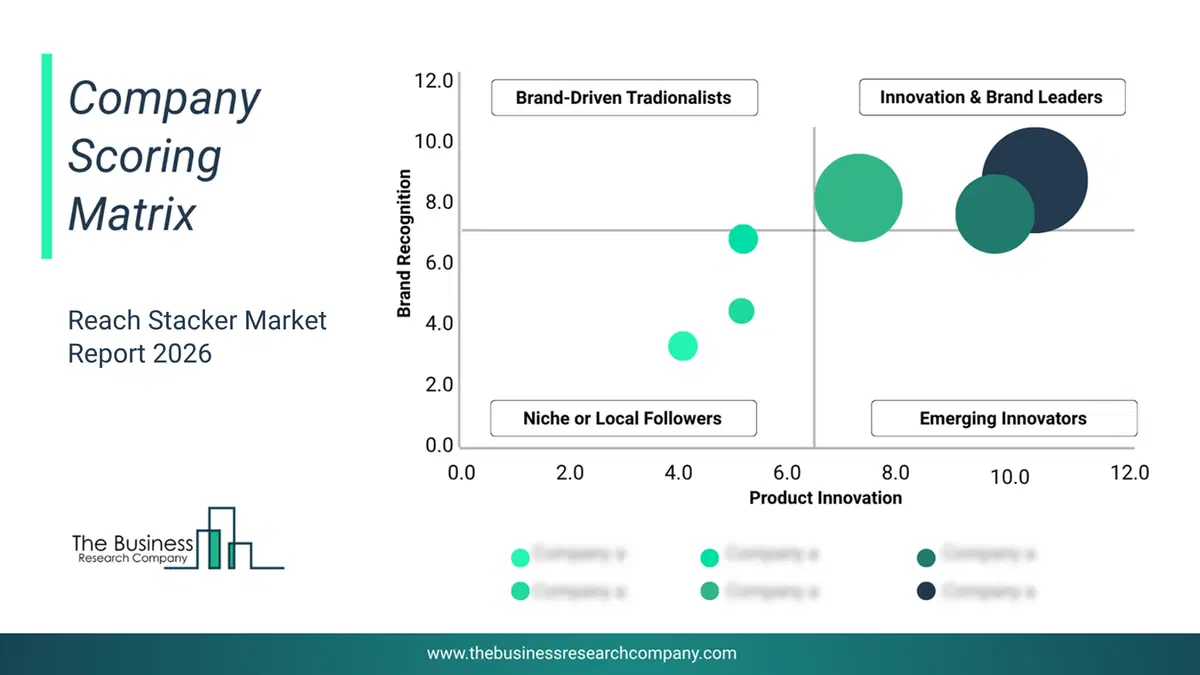
This chart maps companies by product innovation and brand strength, with bubble size indicating relative revenue, helping identify market leaders, challengers, and niche players. This is an illustrative chart; the full report provides a complete and accurate competitive analysis.
Global Reach Stacker Market Trends and Insights
Major companies operating in the reach stacker market are focusing on innovative products such as reach stacker to drive revenues in their market. A reach stacker is a specialized industrial vehicle used for handling and transporting intermodal containers within shipping yards, ports, and logistics facilities. For instance, in March 2023, Konecranes PLC, a Finland-based company that specializes in the manufacturing of lifting equipment and services launched reach stacker. Liftace reach stackers are engineered to be compatible with contemporary drive technology and control systems. They are appropriate for usage in ports, railroads, intermodal terminals, container stackyards, and other logistical locations because of their high loading capacity and high operating speeds. The reach stackers are made to withstand the rigors of expert freight handling and come with a lifting range of 10 to 46 tons. These reach stackers are renowned for their excellent quality, sturdy construction, and dependability.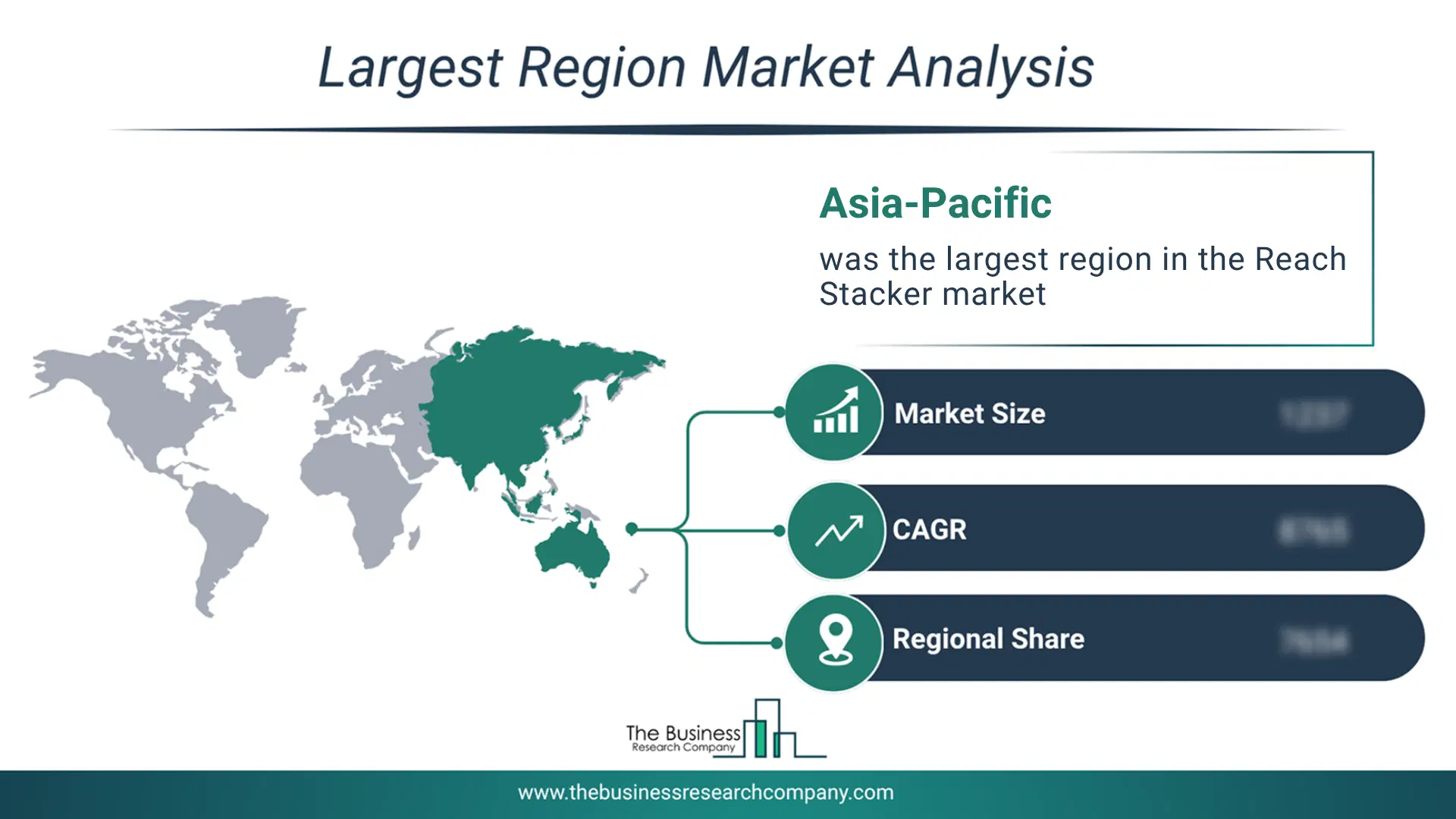
Regional Outlook
Asia-Pacific was the largest region in the reach stacker market in 2025. The regions covered in this market report include Asia-Pacific, South East Asia, Western Europe, Eastern Europe, North America, South America, Middle East, Africa. The countries covered in this market report include Australia, Brazil, China, France, Germany, India, Indonesia, Japan, Taiwan, Russia, South Korea, UK, USA, Canada, Italy, SpainWhat Defines the Reach Stacker Market?
The reach stacker market consists of sales of reach stackers that operate on compressed natural gas and liquified petroleum gas. Values in this market are ‘factory gate’ values, that is the value of goods sold by the manufacturers or creators of the goods, whether to other entities (including downstream manufacturers, wholesalers, distributors, and retailers) or directly to end customers. The value of goods in this market includes related services sold by the creators of the goods.How is Market Value Defined and Measured?
The market value is defined as the revenues that enterprises gain from the sale of goods and/or services within the specified market and geography through sales, grants, or donations in terms of the currency (in USD unless otherwise specified). The revenues for a specified geography are consumption values that are revenues generated by organizations in the specified geography within the market, irrespective of where they are produced. It does not include revenues from resales along the supply chain, either further along the supply chain or as part of other products.
This chart presents market attractiveness based on a quantitative evaluation of growth, competition, strategic alignment, and risk, offering a clear view of opportunity areas for decision-making. This chart is for illustrative purposes; the full report contains the complete analysis.

This chart highlights the Total Addressable Market (TAM) by estimating the maximum revenue opportunity using an assumption-driven approach, supporting strategic planning and opportunity sizing across markets. The chart is illustrative; the full report provides a more comprehensive analysis.
What Key Data and Analysis Are Included in the Reach Stacker Market Report 2026?
The reach stacker market research report is one of a series of new reports from The Business Research Company that provides market statistics, including industry global market size, regional shares, competitors with the market share, detailed market segments, market trends and opportunities, and any further data you may need to thrive in the reach stacker industry. The market research report delivers a complete perspective of everything you need, with an in-depth analysis of the current and future state of the industry.Reach Stacker Market Report Forecast Analysis
| Report Attribute | Details |
|---|---|
| Market Size Value In 2026 | $2.82 billion |
| Revenue Forecast In 2030 | $3.56 billion |
| Growth Rate | CAGR of 5.7% from 2026 to 2030 |
| Base Year For Estimation | 2025 |
| Actual Estimates/Historical Data | 2020-2025 |
| Forecast Period | 2026 - 2030 - 2030 |
| Market Representation | Revenue in USD Billion and CAGR from 2026 to 2030 |
| Segments Covered | Capacity, Propulsion, Application |
| Regional Scope | Asia-Pacific, Western Europe, Eastern Europe, North America, South America, Middle East, Africa |
| Country Scope | The countries covered in the report are Australia, Brazil, China, France, Germany, India, Indonesia, Japan, Taiwan, Russia, South Korea, UK, USA, Canada, Italy, Spain. |
| Key Companies Profiled | Cargotec Corporation, Komatsu Ltd., Dalian Forklift Co. Ltd., Hoist Material Handling Inc., Hyster-Yale Group Inc., Konecranes Oyj, Liebherr Group, Linde Material Handling GmbH, CVS ferrari S.P.A, SANY Group, Task Forklift, Hangcha Forklift, CTR Manufacturing Industries Private Limited, Toyota Material Handling Group, Kalmar, Terex Corporation, Taylor Machine Works Inc., Anhui Heli Co. Ltd., Lonking Holdings Limited, Manitou Group, Doosan Corporation Industrial Vehicle, Hyundai Heavy Industries Co. Ltd., Jungheinrich AG |
| Customization Scope | Request for Customization |
| Pricing And Purchase Options | Explore Purchase Options |