
Real-Time Liquidity Coverage Ratio (LCR) And Net Stable Funding Ratio (NSFR) Dashboards Market Report 2026
Global Outlook – By Component (Software, Services), By Deployment Mode (On-Premises, Cloud), By Functionality (Regulatory Compliance And Reporting, Real-Time Liquidity Monitoring, Scenario Analysis And Stress Testing, Intraday Liquidity Management, Balance Sheet Optimization, Risk Analytics And Early Warning Systems, Treasury And Asset And Liability Management (ALM) Decision Support), By Application (Liquidity Risk Management, Regulatory Compliance, Reporting And Analytics, Other Applications), By End-User (Commercial Banks, Investment Banks, Credit Unions, Other End-Users) – Market Size, Trends, Strategies, and Forecast to 2030
Real-Time Liquidity Coverage Ratio (LCR) And Net Stable Funding Ratio (NSFR) Dashboards Market Overview
• Real-Time Liquidity Coverage Ratio (LCR) And Net Stable Funding Ratio (NSFR) Dashboards market size has reached to $1.29 billion in 2025 • Expected to grow to $2.58 billion in 2030 at a compound annual growth rate (CAGR) of 14.9% • Growth Driver: Increasing Adoption Of Digital Banking Services Fueling The Growth Of The Market Due To Rising Demand For Instant, Efficient, And Secure Liquidity Oversight • Market Trend: • North America was the largest region in 2025 and Asia-Pacific is the fastest growing region.What Is Covered Under Real-Time Liquidity Coverage Ratio (LCR) And Net Stable Funding Ratio (NSFR) Dashboards Market?
Real-time liquidity coverage ratio (LCR) and net stable funding ratio (NSFR) dashboards are digital monitoring tools that provide instant visibility into a bank’s liquidity coverage ratio (LCR) and net stable funding ratio (NSFR). They aggregate data from multiple systems and present liquidity positions, funding gaps, and regulatory compliance status in real time. These support financial institutions proactively manage liquidity risks, ensure adherence to Basel III requirements, and support faster decision-making during volatile market conditions. The main components of real-time liquidity coverage ratio (LCR) and net stable funding ratio (NSFR) dashboards include software and services. Software refers to computer programs and applications that perform defined tasks for users or other programs. Real-time LCR and NSFR dashboards function as software because they provide automated liquidity ratio calculations, visualizations, and analytics to banks and financial institutions. These dashboards are deployed through on-premises and cloud deployment modes, depending on an institution’s security, scalability, and integration requirements. The various functionalities include regulatory compliance and reporting, real-time liquidity monitoring, scenario analysis and stress testing, intraday liquidity management, balance sheet optimization, risk analytics and early warning systems, and ALM (asset and liability management) decision support. The multiple applications encompass liquidity risk management, regulatory compliance, reporting and analytics, and other related use cases, and are utilized by several end-users such as commercial banks, investment banks, credit unions, and others.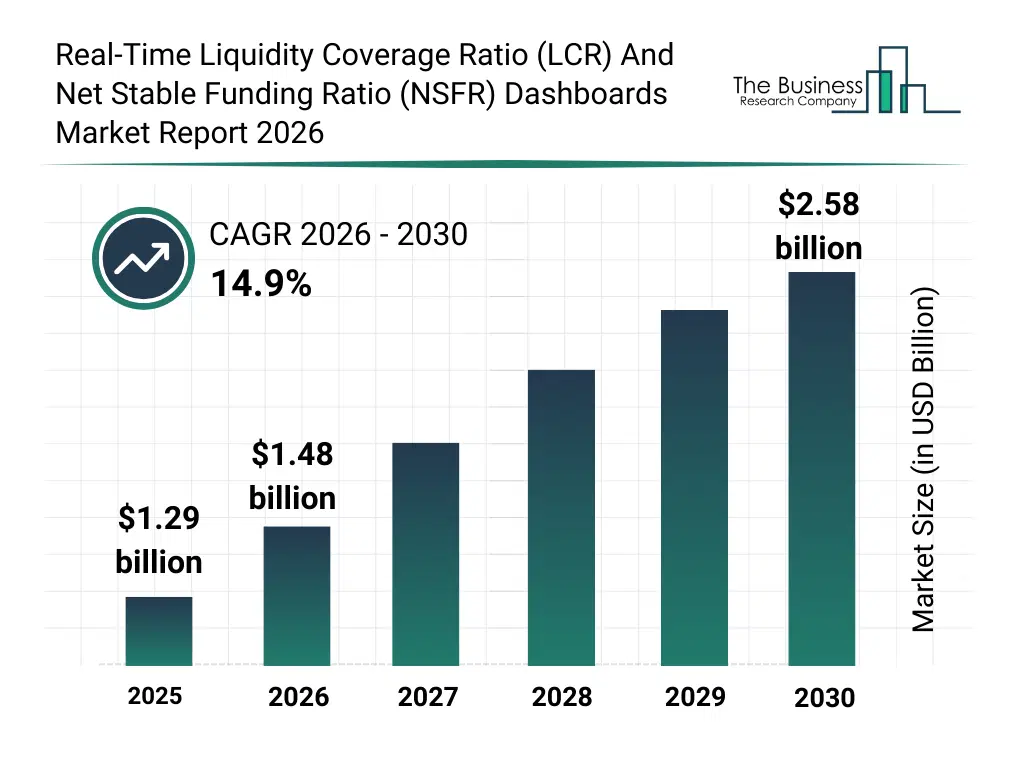
What Is The Real-Time Liquidity Coverage Ratio (LCR) And Net Stable Funding Ratio (NSFR) Dashboards Market Size and Share 2026?
The real-time liquidity coverage ratio (LCR) and net stable funding ratio (NSFR) dashboards market size has grown rapidly in recent years. It will grow from $1.29 billion in 2025 to $1.48 billion in 2026 at a compound annual growth rate (CAGR) of 15.1%. The growth in the historic period can be attributed to increasing regulatory compliance pressure, growing need for liquidity risk oversight, increasing focus on proactive treasury management, growing digital transformation in banking, and rising demand for real-time reporting.What Is The Real-Time Liquidity Coverage Ratio (LCR) And Net Stable Funding Ratio (NSFR) Dashboards Market Growth Forecast?
The real-time liquidity coverage ratio (LCR) and net stable funding ratio (NSFR) dashboards market size is expected to see rapid growth in the next few years. It will grow to $2.58 billion in 2030 at a compound annual growth rate (CAGR) of 14.9%. The growth in the forecast period can be attributed to growing adoption of real-time liquidity analytics, increasing regulatory updates on liquidity norms, rising expansion of digital banking ecosystems, growing need for intraday liquidity visibility, and rising demand for automated compliance workflows. Major trends in the forecast period include technology advancements in liquidity analytics, innovations in real-time risk monitoring tools, developments in AI-driven liquidity forecasting, research and developments in regulatory tech, advancements in predictive liquidity modelling, and innovations in cloud-native treasury systems.
Global Real-Time Liquidity Coverage Ratio (LCR) And Net Stable Funding Ratio (NSFR) Dashboards Market Segmentation
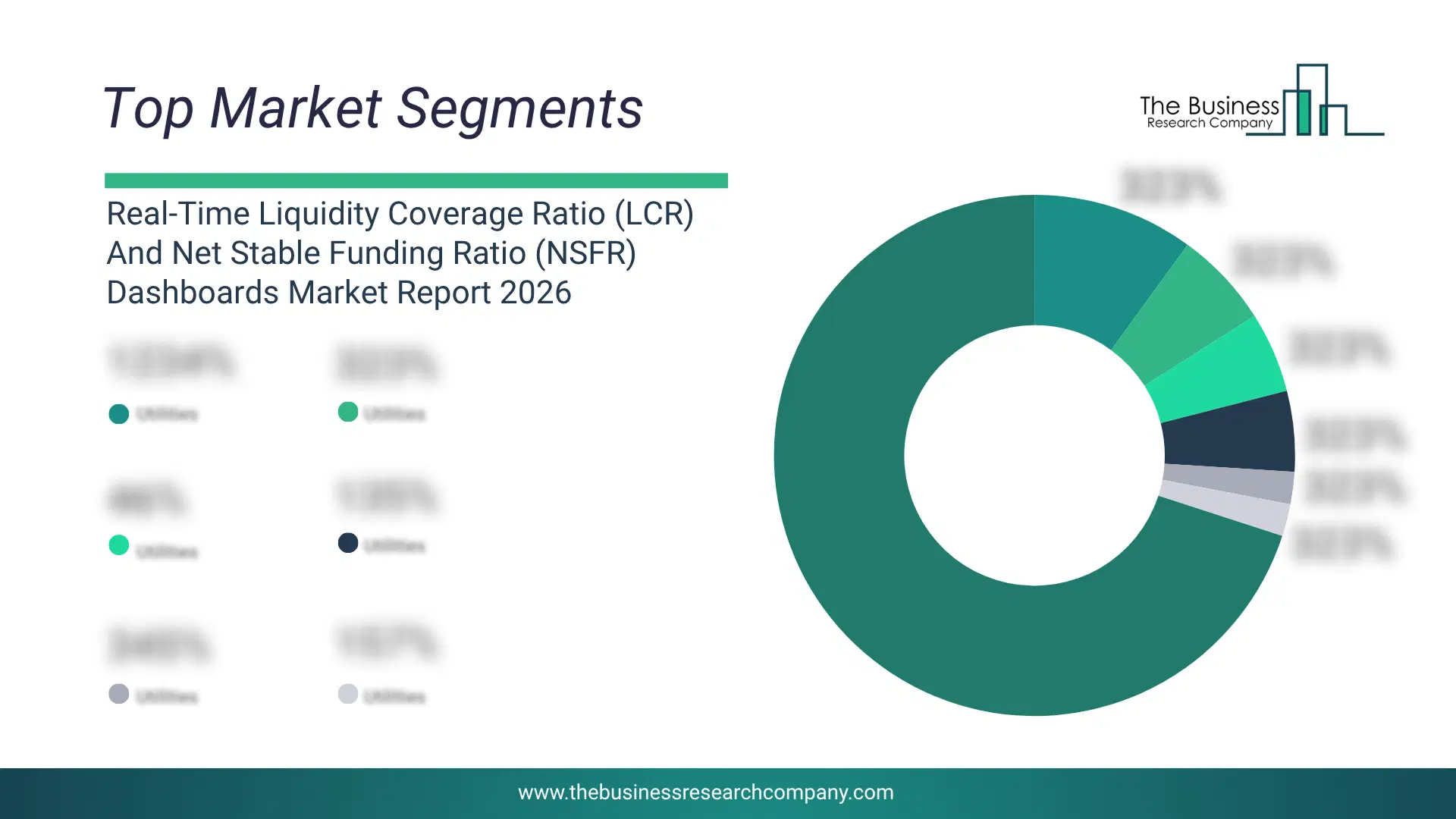
1) By Component: Software, Services 2) By Deployment Mode: On-Premises, Cloud 3) By Functionality: Regulatory Compliance And Reporting, Real-Time Liquidity Monitoring, Scenario Analysis And Stress Testing, Intraday Liquidity Management, Balance Sheet Optimization, Risk Analytics And Early Warning Systems, Treasury And Asset And Liability Management (ALM) Decision Support 4) By Application: Liquidity Risk Management, Regulatory Compliance, Reporting And Analytics, Other Applications 5) By End-User: Commercial Banks, Investment Banks, Credit Unions, Other End-Users Subsegments: 1) By Software: Liquidity Coverage Ratio Calculation Engine, Net Stable Funding Ratio Calculation Engine, Data Visualization Modules, Real-Time Data Aggregation Tools, Risk Analytics Software 2) By Services: Implementation Services, Integration Services, Maintenance And Support Services, Training And Advisory Services, Regulatory Compliance ConsultingWhat Are The Drivers Of The Real-Time Liquidity Coverage Ratio (LCR) And Net Stable Funding Ratio (NSFR) Dashboards Market?
The increasing adoption of digital banking services is expected to propel the growth of the real-time liquidity coverage ratio (LCR) and net stable funding ratio (NSFR) dashboards market going forward. Digital banking services refer to the delivery of banking products and financial services through digital channels such as mobile apps, websites, and internet platforms, enabling customers to perform transactions, access accounts, and manage finances remotely and conveniently. The increasing adoption of digital banking services is driven by the need for seamless, on-the-go access to financial services with enhanced speed, convenience, and security. Real-time liquidity coverage ratio (LCR) and net stable funding ratio (NSFR) dashboards strengthen digital banking services by delivering instant visibility into liquidity positions, enabling banks to manage rapid transaction flows efficiently. They support seamless digital operations through automated monitoring, reduce compliance risks with real-time regulatory insights, and enhance decision-making during fast-moving market conditions. For instance, in April 2024, according to UK Finance, a UK-based trade association, digital-only bank accounts increased to 36% in 2024, marking an increase from 24% in 2023. Therefore, the increasing adoption of digital banking services is driving the growth of the real-time liquidity coverage ratio (LCR) and net stable funding ratio (NSFR) dashboards industry. The rising adoption of cloud-based solutions is expected to propel the growth of the real-time liquidity coverage ratio (LCR) and net stable funding ratio (NSFR) dashboards market going forward. Cloud-based solutions refer to information technology (IT) services, storage, and applications that are hosted on remote servers and accessed over the internet, enabling scalability, flexibility, and cost efficiency. The rise in adoption of cloud-based solutions is due to scalability and flexibility, as they allow businesses to easily adjust resources on demand without heavy upfront infrastructure costs. Real-time liquidity coverage ratio (LCR) and net stable funding ratio (NSFR) dashboards enhance cloud-based solutions by providing instant visibility into liquidity and funding positions across the organization. They reduce manual monitoring by delivering automated calculations and real-time alerts, improving financial decision-making and regulatory compliance. For instance, in December 2023, according to Eurostat, a Luxembourg-based government agency, the proportion of enterprises utilizing cloud computing services rose by 4.2 percentage points in 2023, with the most purchased services being e-mail (82.7%), followed by file storage (68.0%) and office software (66.3%). Therefore, the rising adoption of cloud-based solutions is driving the growth of the real-time liquidity coverage ratio (LCR) and net stable funding ratio (NSFR) dashboards industry.Key Players In The Global Real-Time Liquidity Coverage Ratio (LCR) And Net Stable Funding Ratio (NSFR) Dashboards Market
Major companies operating in the real-time liquidity coverage ratio (lcr) and net stable funding ratio (nsfr) dashboards market are Oracle Corporation, SAP SE, Fiserv Inc., S&P Global Market Intelligence LLC, London Stock Exchange Group plc, Wolters Kluwer N.V., Broadridge Financial Solutions, SAS Institute Inc., SS&C Technologies Holdings Inc., Finastra Group Holdings Ltd., Temenos AG, Murex S.A.S., Kyriba Corporation, Serrala Group GmbH, KX Systems Inc., Bloomberg L.P., LYSIAN NXT CO. LTD., MORS Software Oy, ION Investment Group Limited, Moody’s Analytics Inc.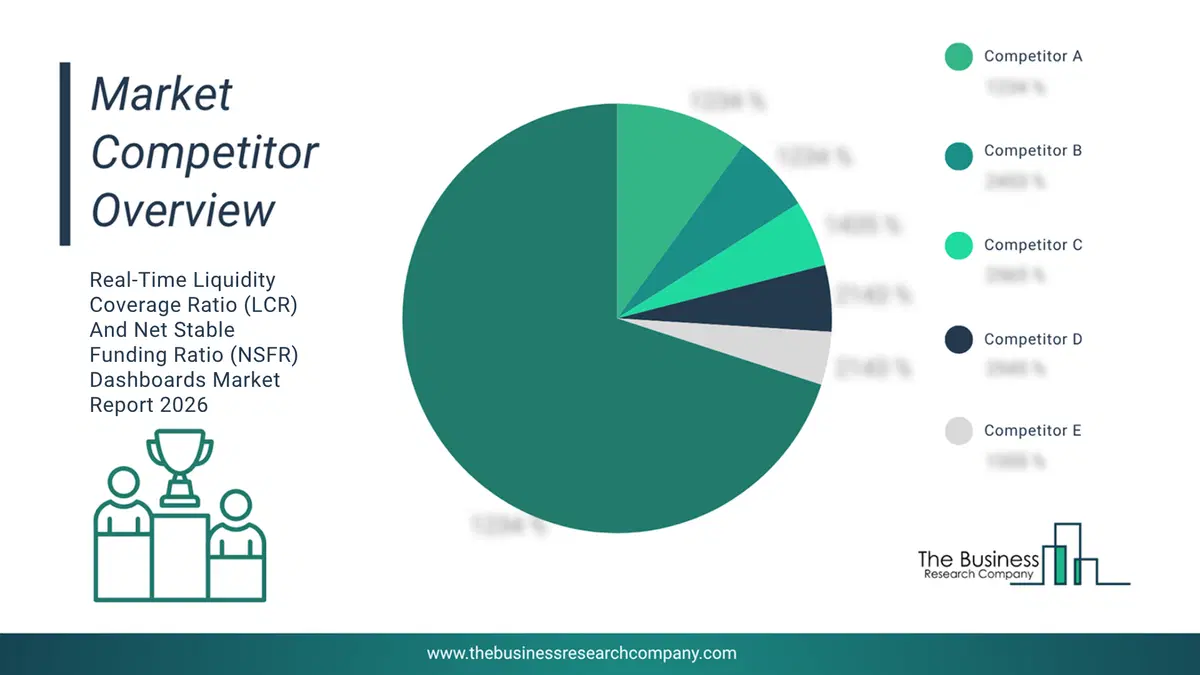
This chart is for illustrative purposes; the full report includes a detailed competitor analysis and comprehensive overview of the top 10 companies in the market.
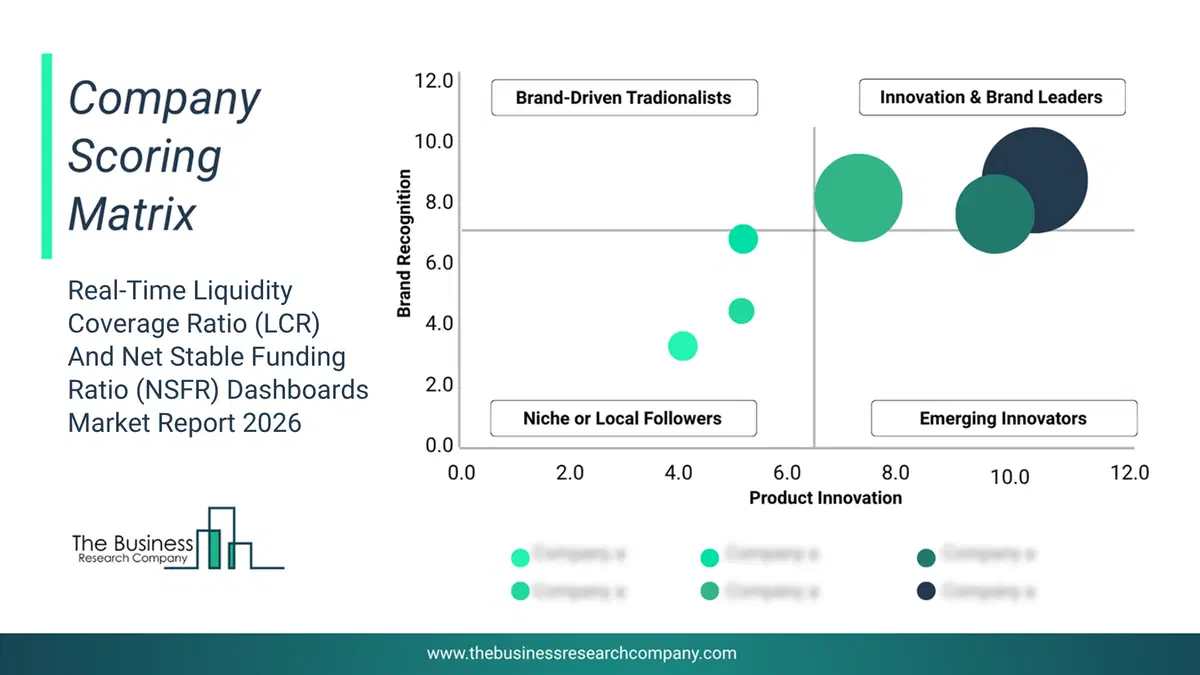
This chart maps companies by product innovation and brand strength, with bubble size indicating relative revenue, helping identify market leaders, challengers, and niche players. This is an illustrative chart; the full report provides a complete and accurate competitive analysis.
What Are Latest Mergers And Acquisitions In The Real-Time Liquidity Coverage Ratio (LCR) And Net Stable Funding Ratio (NSFR) Dashboards Market?
In November 2023, Nasdaq Inc., a US-based provider of exchange, data, analytics, and financial technology platforms, acquired Adenza Group Inc. from Thoma Bravo for $10.5 billion. With this acquisition, Nasdaq aims to expand its financial software portfolio, enhancing regulatory, compliance, and risk management capabilities to offer integrated real time liquidity, capital, and regulatory dashboards. Adenza Group Inc. is a US-based fintech company providing real time LCR and NSFR dashboards for liquidity and funding monitoring.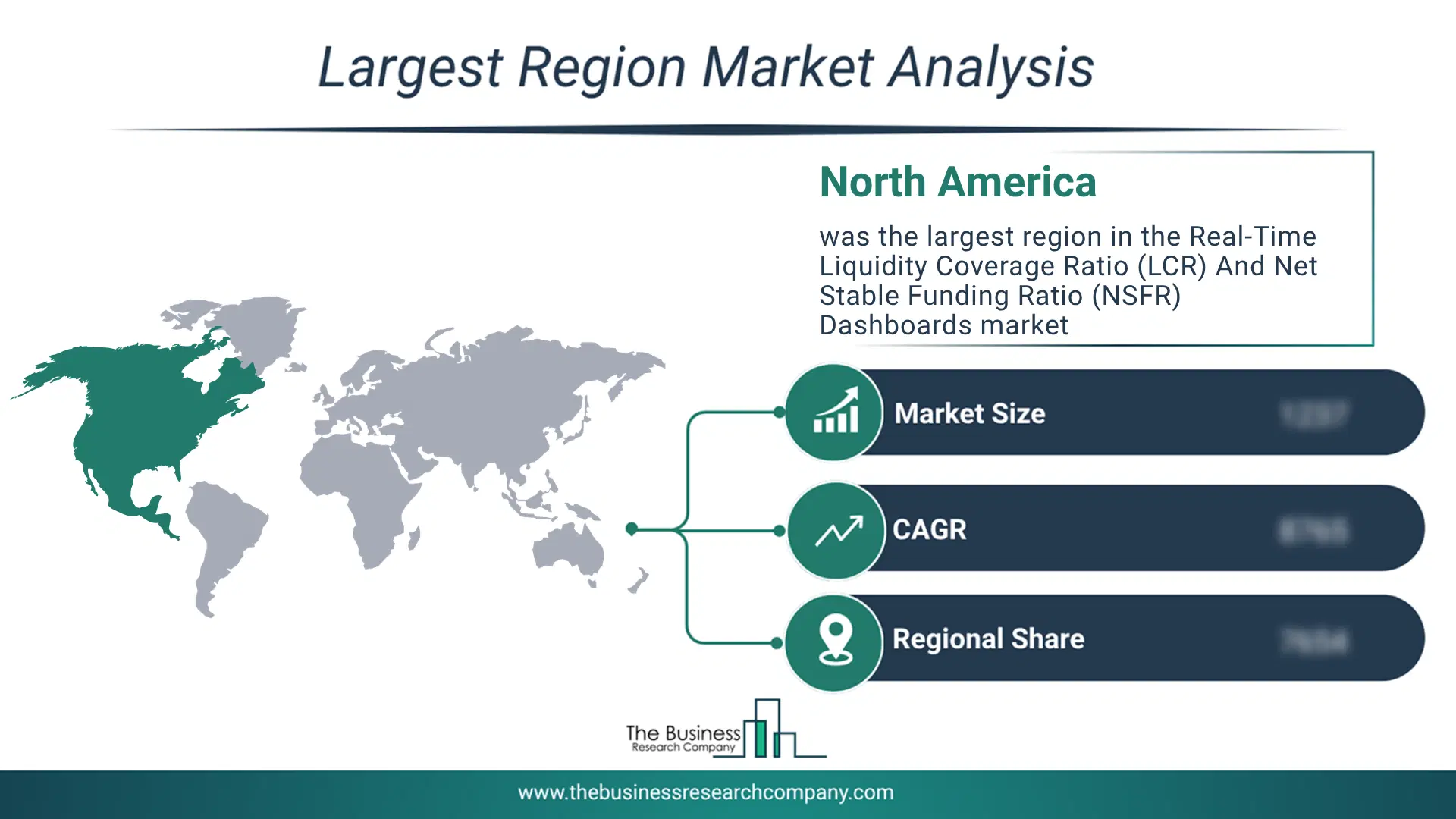
Regional Insights
North America was the largest region in the real-time liquidity coverage ratio (LCR) and net stable funding ratio (NSFR) dashboards market in 2025. Asia-Pacific is expected to be the fastest-growing region in the forecast period. The regions covered in this market report are Asia-Pacific, South East Asia, Western Europe, Eastern Europe, North America, South America, Middle East, Africa. The countries covered in this market report are Australia, Brazil, China, France, Germany, India, Indonesia, Japan, Taiwan, Russia, South Korea, UK, USA, Canada, Italy, Spain.What Defines the Real-Time Liquidity Coverage Ratio (LCR) And Net Stable Funding Ratio (NSFR) Dashboards Market?
The real-time liquidity coverage ratio (LCR) and net stable funding ratio (NSFR) dashboards market includes revenues earned by entities through data aggregation and analytics services, dashboard implementation and customization services, integration with core banking systems, and ongoing software support and maintenance services. The market value includes the value of related goods sold by the service provider or included within the service offering. Only goods and services traded between entities or sold to end consumers are included.How is Market Value Defined and Measured?
The market value is defined as the revenues that enterprises gain from the sale of goods and/or services within the specified market and geography through sales, grants, or donations in terms of the currency (in USD unless otherwise specified). The revenues for a specified geography are consumption values that are revenues generated by organizations in the specified geography within the market, irrespective of where they are produced. It does not include revenues from resales along the supply chain, either further along the supply chain or as part of other products.
This chart presents market attractiveness based on a quantitative evaluation of growth, competition, strategic alignment, and risk, offering a clear view of opportunity areas for decision-making. This chart is for illustrative purposes; the full report contains the complete analysis.

This chart highlights the Total Addressable Market (TAM) by estimating the maximum revenue opportunity using an assumption-driven approach, supporting strategic planning and opportunity sizing across markets. The chart is illustrative; the full report provides a more comprehensive analysis.
What Key Data and Analysis Are Included in the Real-Time Liquidity Coverage Ratio (LCR) And Net Stable Funding Ratio (NSFR) Dashboards Market Report 2026?
The real-time liquidity coverage ratio (lcr) and net stable funding ratio (nsfr) dashboards market research report is one of a series of new reports from The Business Research Company that provides market statistics, including industry global market size, regional shares, competitors with the market share, detailed market segments, market trends and opportunities, and any further data you may need to thrive in the real-time liquidity coverage ratio (lcr) and net stable funding ratio (nsfr) dashboards industry. The market research report delivers a complete perspective of everything you need, with an in-depth analysis of the current and future state of the industry.Real-Time Liquidity Coverage Ratio (LCR) And Net Stable Funding Ratio (NSFR) Dashboards Market Report Forecast Analysis
| Report Attribute | Details |
|---|---|
| Market Size Value In 2026 | $1.48 billion |
| Revenue Forecast In 2030 | $2.58 billion |
| Growth Rate | CAGR of 15.1% from 2026 to 2030 |
| Base Year For Estimation | 2025 |
| Actual Estimates/Historical Data | 2020-2025 |
| Forecast Period | 2026 - 2030 |
| Market Representation | Revenue in USD Billion and CAGR from 2026 to 2030 |
| Segments Covered | Component, Deployment Mode, Functionality, Application, End-User |
| Regional Scope | Asia-Pacific, Western Europe, Eastern Europe, North America, South America, Middle East, Africa |
| Country Scope | The countries covered in the report are Australia, Brazil, China, France, Germany, India, Indonesia, Japan, Taiwan, Russia, South Korea, UK, USA, Canada, Italy, Spain. |
| Key Companies Profiled | Oracle Corporation, SAP SE, Fiserv Inc., S&P Global Market Intelligence LLC, London Stock Exchange Group plc, Wolters Kluwer N.V., Broadridge Financial Solutions, SAS Institute Inc., SS&C Technologies Holdings Inc., Finastra Group Holdings Ltd., Temenos AG, Murex S.A.S., Kyriba Corporation, Serrala Group GmbH, KX Systems Inc., Bloomberg L.P., LYSIAN NXT CO. LTD., MORS Software Oy, ION Investment Group Limited, Moody’s Analytics Inc. |
| Customization Scope | Request for Customization |
| Pricing And Purchase Options | Explore Purchase Options |