
Receiver-In-The-Ear (RITE) Hearing Aid Market Report 2026
Global Outlook – By Product Type (Behind The Ear Hearing Aids, In The Ear Hearing Aids, In The Canal Hearing Aids, Completely In Canal Hearing Aids, Receiver In Canal Hearing Aids), By Technology (Analog Hearing Aids, Digital Hearing Aids, Smart Hearing Aids, Bluetooth Enabled Hearing Aids, Rechargeable Hearing Aids), By Price Range (Low End (Below 1,000 United States Dollars), Mid Range (1,000 United States Dollars To 3,000 United States Dollars), Premium (3,000 United States Dollars To 5,000 United States Dollars), Luxury (Above 5,000 United States Dollars)), By Distribution Channel (Retail Outlets, Online Sales Channels, Specialized Audiology Clinics, Hospitals And Medical Institutions, Direct To Consumer Brands), By End User (Adults, Children, Senior Citizens, Individuals With Hearing Impairment, Professionals In High Noise Environments) – Market Size, Trends, Strategies, and Forecast to 2030
Receiver-In-The-Ear (RITE) Hearing Aid Market Overview
• Receiver-In-The-Ear (RITE) Hearing Aid market size has reached to $6.34 billion in 2025 • Expected to grow to $9.83 billion in 2030 at a compound annual growth rate (CAGR) of 9.1% • Growth Driver: Increasing Prevalence Of Hearing Loss Driving The Market Due To Rising Aging Population • Market Trend: Innovation In AI-Powered Disposable Battery Hearing Technologies Enhancing Speech Clarity And Adaptive Listening Performance • North America was the largest region in 2025 and Asia-Pacific is the fastest growing region.What Is Covered Under Receiver-In-The-Ear (RITE) Hearing Aid Market?
Receiver-in-the-ear (RITE) hearing aids are compact electronic hearing devices designed to improve hearing by amplifying sound and delivering it directly into the ear canal through an external receiver. These devices separate the speaker from the main body of the hearing aid, enabling enhanced sound quality, reduced feedback, and a more comfortable fit. They are developed with advanced digital sound processing technologies to improve speech clarity, noise reduction, and overall hearing performance. The main product types of receiver-in-the-ear (RITE) hearing aid include behind the ear hearing aids, in the ear hearing aids, in the canal hearing aids, completely in canal hearing aids, and receiver in canal hearing aids. Behind the ear hearing aids refer to hearing devices in which the main electronic components are housed in a casing worn behind the ear, while sound is delivered into the ear canal through a custom earmold or a thin tube, providing amplification for individuals with mild to profound hearing loss. These hearing aids utilize analog hearing aids, digital hearing aids, smart hearing aids, Bluetooth enabled hearing aids, and rechargeable hearing aids technologies and are available across low end (below 1,000 United States dollars), mid range (1,000 United States dollars to 3,000 United States dollars), premium (3,000 United States dollars to 5,000 United States dollars), and luxury (above 5,000 United States dollars) price ranges. They are distributed through retail outlets, online sales channels, specialized audiology clinics, hospitals and medical institutions, and direct to consumer brands and are utilized by end users such as adults, children, senior citizens, individuals with hearing impairment, and professionals in high noise environments.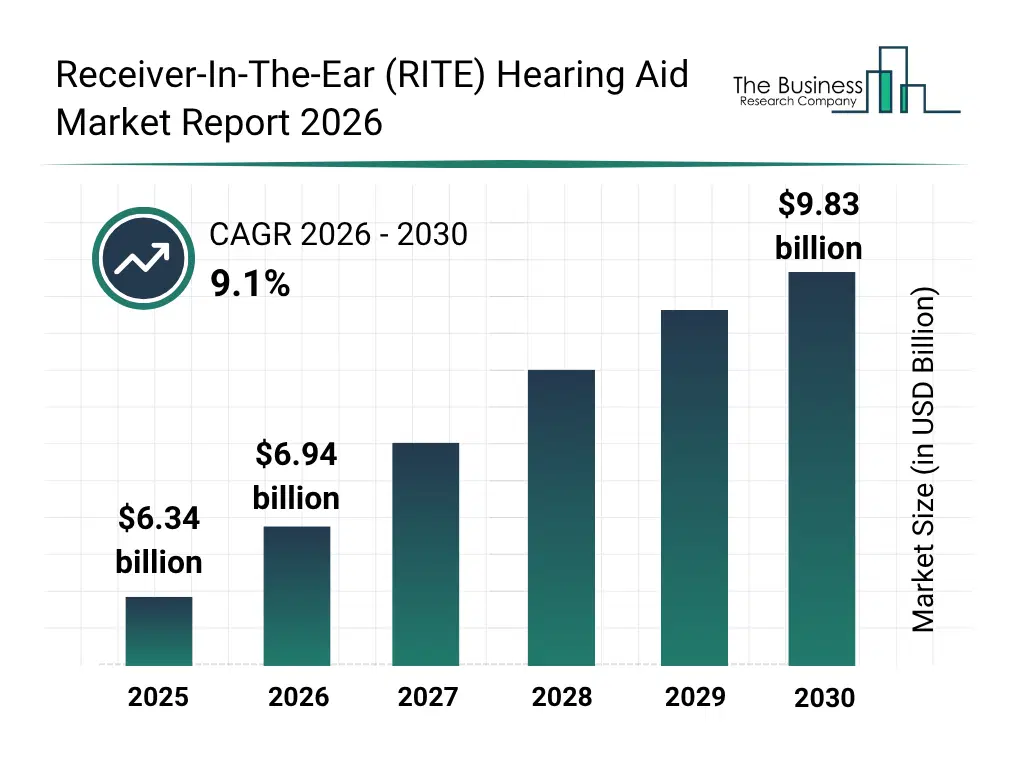
What Is The Receiver-In-The-Ear (RITE) Hearing Aid Market Size and Share 2026?
The receiver-in-the-ear (RITE) hearing aid market size has grown strongly in recent years. It will grow from $6.34 billion in 2025 to $6.94 billion in 2026 at a compound annual growth rate (CAGR) of 9.5%. The growth in the historic period can be attributed to increasing prevalence of hearing impairment among aging populations, growing awareness about hearing health solutions, rising adoption of digital hearing aid technologies, expanding availability of audiology services, increasing demand for improved speech clarity and sound amplification.What Is The Receiver-In-The-Ear (RITE) Hearing Aid Market Growth Forecast?
The receiver-in-the-ear (RITE) hearing aid market size is expected to see strong growth in the next few years. It will grow to $9.83 billion in 2030 at a compound annual growth rate (CAGR) of 9.1%.The growth in the forecast period can be attributed to growing demand for smart hearing aid devices, rising preference for rechargeable hearing solutions, increasing adoption of personalized hearing technologies, expanding use of wireless connectivity features, growing investments in advanced hearing care solutions. Major trends in the forecast period include increasing adoption of receiver in the ear hearing aids with improved sound personalization, growing demand for compact and comfortable hearing aid designs, rising integration of advanced noise reduction and speech enhancement features, expanding development of rechargeable receiver in the ear hearing aid solutions, increasing preference for discreet hearing devices with enhanced user convenience.
Global Receiver-In-The-Ear (RITE) Hearing Aid Market Segmentation
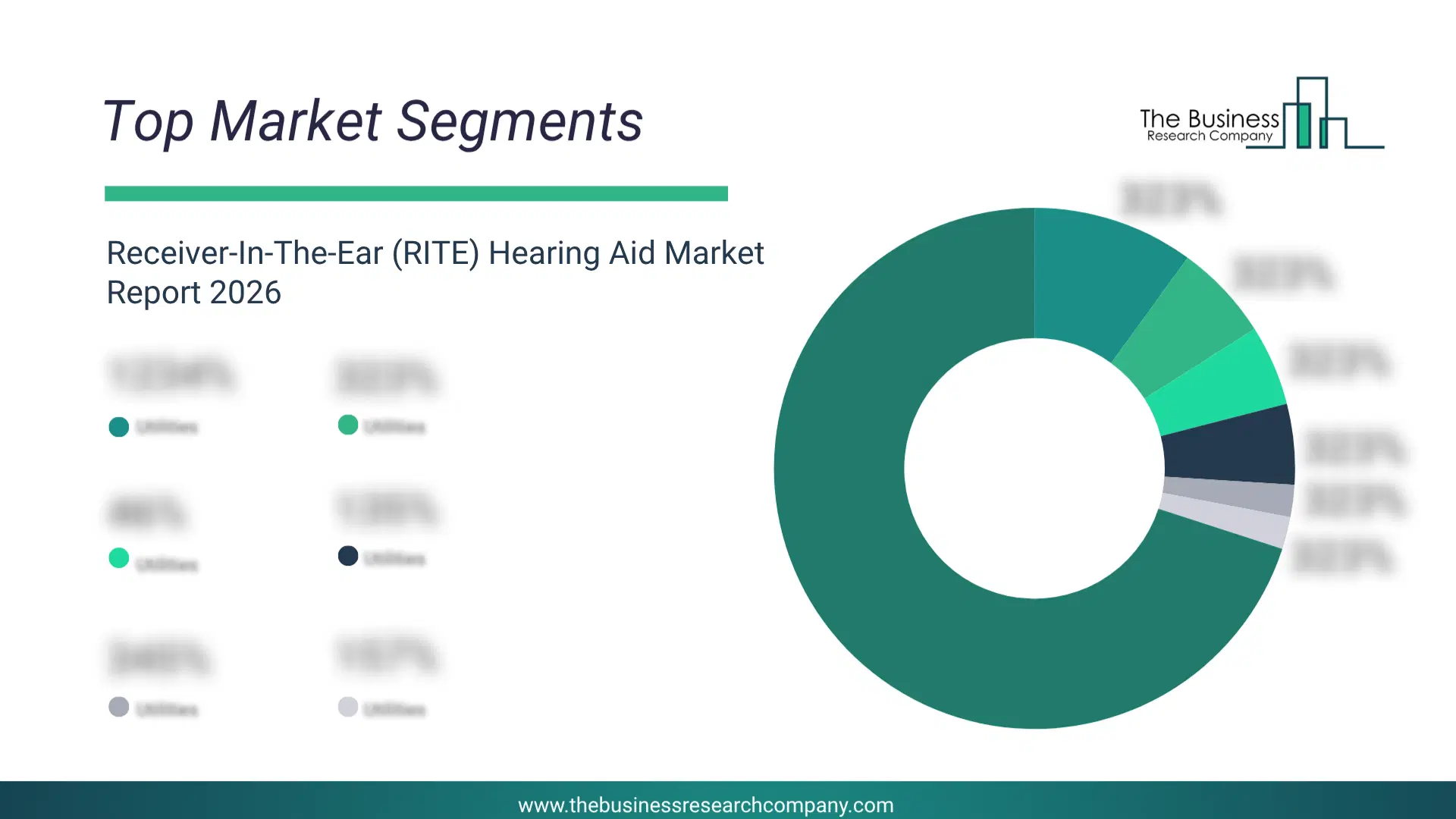
2) By Technology: Analog Hearing Aids, Digital Hearing Aids, Smart Hearing Aids, Bluetooth Enabled Hearing Aids, Rechargeable Hearing Aids 3) By Price Range: Low End (Below 1,000 United States Dollars), Mid Range (1,000 United States Dollars To 3,000 United States Dollars), Premium (3,000 United States Dollars To 5,000 United States Dollars), Luxury (Above 5,000 United States Dollars) 4) By Distribution Channel: Retail Outlets, Online Sales Channels, Specialized Audiology Clinics, Hospitals And Medical Institutions, Direct To Consumer Brands 5) By End User: Adults, Children, Senior Citizens, Individuals With Hearing Impairment, Professionals In High Noise Environments Subsegments: 1) By Behind The Ear Hearing Aids: Standard Behind The Ear Hearing Aids, Mini Behind The Ear Hearing Aids, Rechargeable Behind The Ear Hearing Aids, Bluetooth Enabled Behind The Ear Hearing Aids 2) By In The Ear Hearing Aids: Full Shell In The Ear Hearing Aids, Half Shell In The Ear Hearing Aids, Custom Molded In The Ear Hearing Aids, Digital In The Ear Hearing Aids 3) By In The Canal Hearing Aids: Custom Fit In The Canal Hearing Aids, Wireless In The Canal Hearing Aids, Rechargeable In The Canal Hearing Aids, Noise Reduction In The Canal Hearing Aids 4) By Completely In Canal Hearing Aids: Invisible Completely In Canal Hearing Aids, Custom Molded Completely In Canal Hearing Aids, Digital Completely In Canal Hearing Aids, High Gain Completely In Canal Hearing Aids 5) By Receiver In Canal Hearing Aids: Open Fit Receiver In Canal Hearing Aids, Rechargeable Receiver In Canal Hearing Aids, Bluetooth Enabled Receiver In Canal Hearing Aids, Advanced Noise Filtering Receiver In Canal Hearing AidsWhat Are The Drivers Of The Receiver-In-The-Ear (RITE) Hearing Aid Market?
The increasing prevalence of hearing loss is expected to propel the growth of the receiver-in-the-ear (RITE) hearing aid market going forward. Hearing loss is a medical condition where an individual experiences reduced ability to perceive sounds, ranging from mild difficulty in hearing conversations to complete deafness. The prevalence of hearing loss is rising due to population aging, as the natural degeneration of inner ear structures over time makes older adults more susceptible to hearing impairment. Receiver-in-the-ear (RITE) hearing aid helps individuals with hearing loss by delivering clearer, more natural sound quality directly into the ear canal, improving speech understanding, reducing background noise interference, and enhancing overall communication and daily listening experiences. For instance, in March 2026, according to the World Health Organization (WHO), a Switzerland-based intergovernmental organization, hearing loss is projected to affect around 2.5 billion people worldwide by 2050, with more than 700 million individuals requiring hearing rehabilitation, and if left unaddressed, it could lead to an annual global economic burden of nearly $1 trillion. Therefore, the increasing prevalence of hearing loss is driving the growth of the receiver-in-the-ear (RITE) hearing aid industry. The rising healthcare expenditure is expected to propel the growth of the receiver-in-the-ear (RITE) hearing aid market going forward. Healthcare expenditure refers to the total amount of money spent by individuals, organizations, and governments on medical services, healthcare products, and activities aimed at maintaining or improving health. Healthcare expenditure is rising due to the increasing prevalence of chronic diseases, which requires ongoing medical treatments, frequent healthcare visits, and long-term management, thereby driving up overall healthcare spending. Higher healthcare expenditure supports the growth of receiver-in-the-ear (RITE) hearing aids by enabling greater investment in hearing care services and advanced audiology technologies, making these devices more accessible and improving patient outcomes. For instance, in April 2026, according to the Office for National Statistics, a UK-based government agency, healthcare expenditure accounted for 11.4% of gross domestic product (GDP) in 2025, up from 11.1% in 2024. Therefore, the rising healthcare expenditure is driving the growth of the receiver-in-the-ear (RITE) hearing aid industry.Key Players In The Global Receiver-In-The-Ear (RITE) Hearing Aid Market
Major companies operating in the receiver-in-the-ear (rite) hearing aid market are Sonova Holding AG, Demant A/S, WS Audiology A/S, Starkey Laboratories Inc., Amplifon S.p.A., Rion Co. Ltd., Horentek, Audifon GmbH & Co. KG, Audina Hearing Instruments Inc., Arphi Electronics Private Limited, GN Store Nord A/S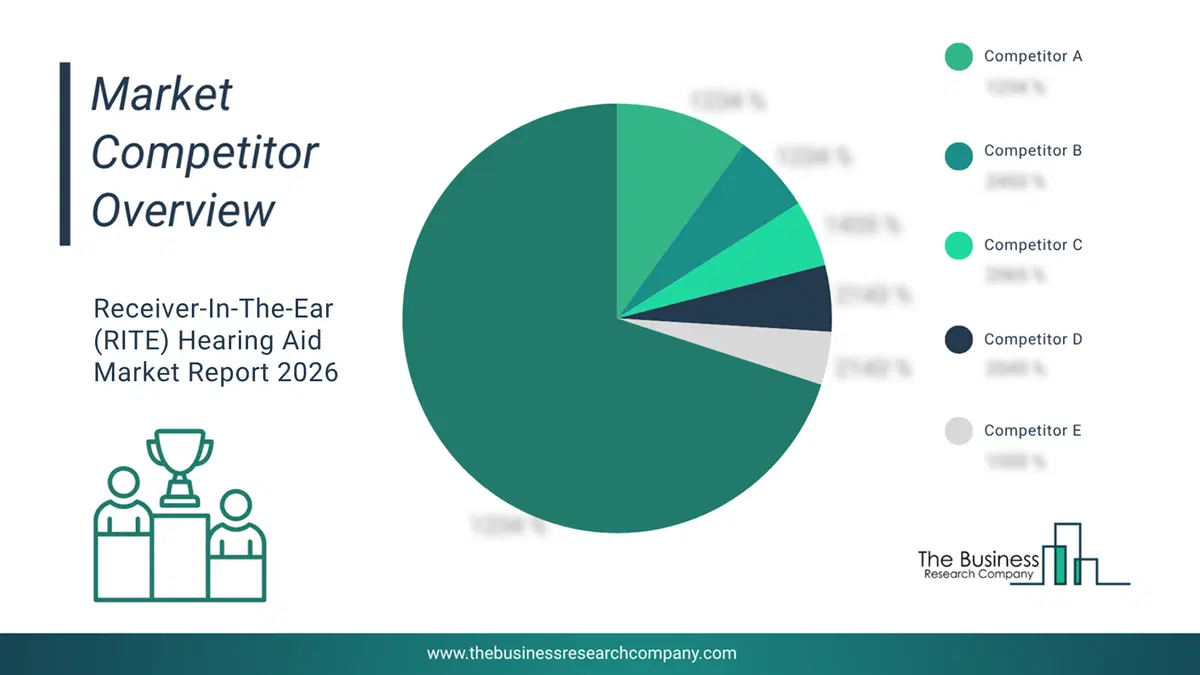
This chart is for illustrative purposes; the full report includes a detailed competitor analysis and comprehensive overview of the top 10 companies in the market.
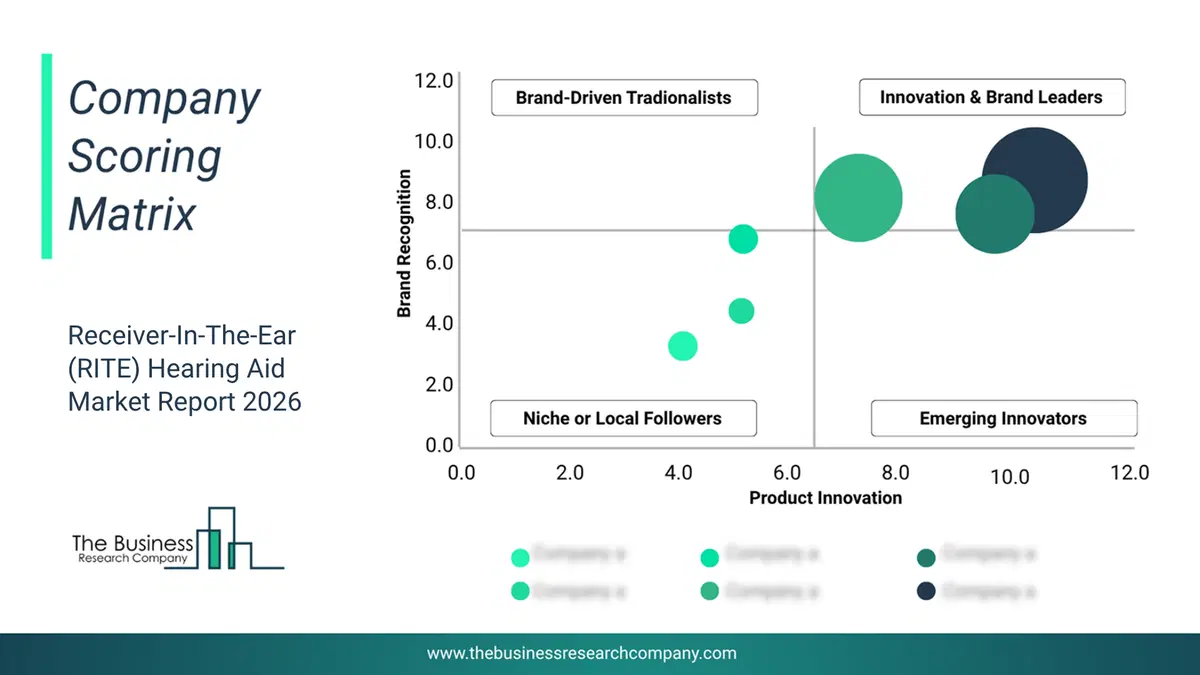
This chart maps companies by product innovation and brand strength, with bubble size indicating relative revenue, helping identify market leaders, challengers, and niche players. This is an illustrative chart; the full report provides a complete and accurate competitive analysis.
Global Receiver-In-The-Ear (RITE) Hearing Aid Market Trends and Insights
Major companies operating in the receiver-in-the-ear (RITE) hearing aid hearing aid market are focusing on developing innovative products, such as AI-disposable battery hearing aids to enhance speech clarity, adaptive sound processing, and listening comfort in complex acoustic environments. AI-powered disposable battery hearing aids are advanced hearing assistance devices that combine artificial intelligence-based sound optimization technologies with traditional zinc-air battery systems, enabling automatic adjustment to changing sound environments while maintaining the convenience of replaceable batteries preferred by many users over rechargeable alternatives. For instance, in April 2026, Oticon Inc., a Denmark-based hearing aid manufacturer, launched the Verit family of premium hearing aids featuring disposable zinc-air batteries. The product line incorporates the company’s BrainHearing technology platform, including MoreSound Intelligence 3.0, MoreSound Amplifier 3.0, and MoreSound Optimizer to improve speech understanding and sound clarity in noisy environments. Built on the Sirius platform, the hearing aids use second-generation AI sound processing to automatically adapt to dynamic listening conditions while integrating stabilization technologies to reduce sudden noises and wind interference. Additionally, the devices reportedly suppress unwanted sounds by up to 12 dB and provide improved speech clarity compared to the company’s earlier premium hearing aid models.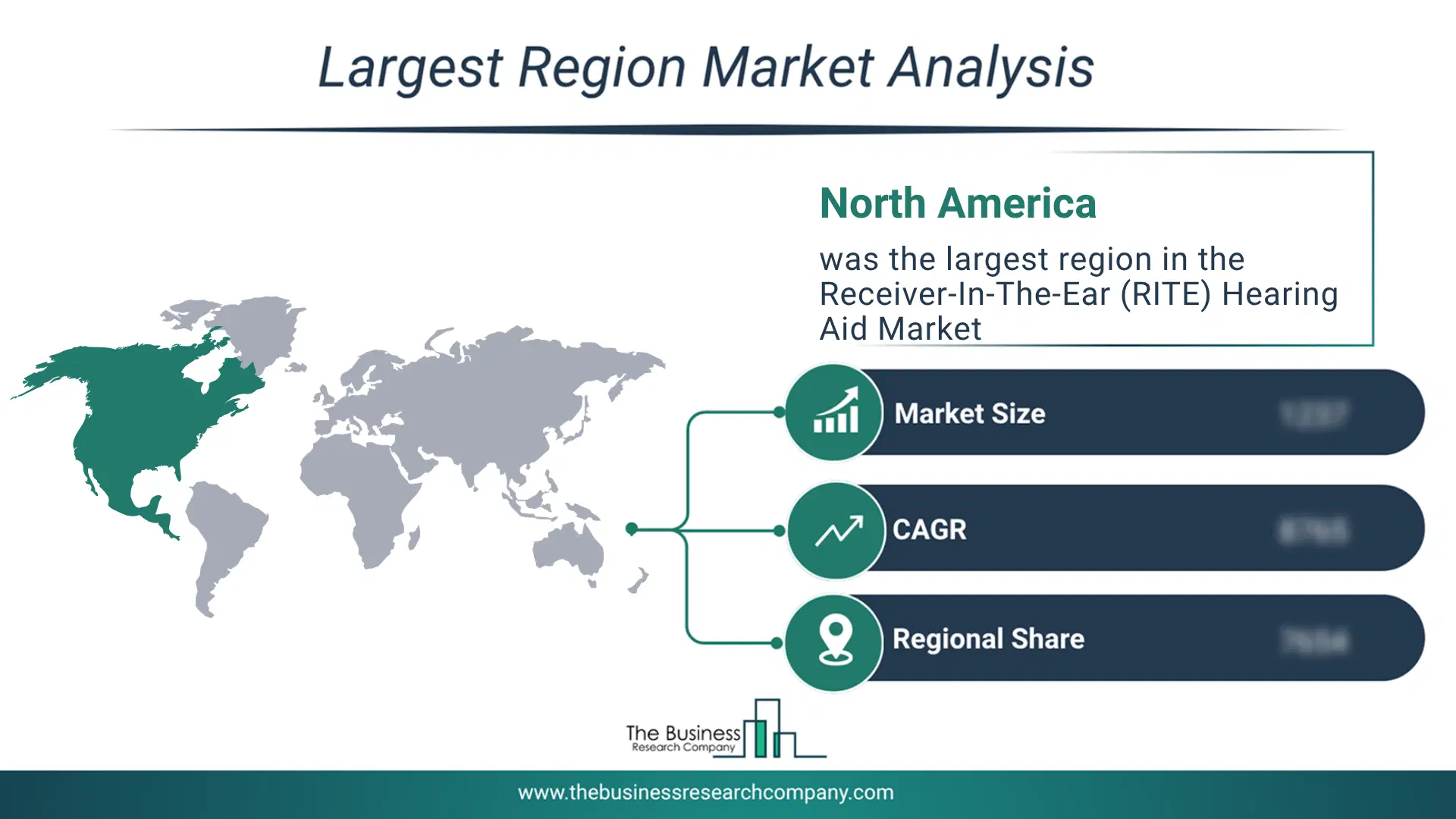
Regional Outlook/Insights
North America was the largest region in the receiver-in-the-ear (RITE) hearing aid market in 2025. Asia-Pacific is expected to be the fastest-growing region in the forecast period. The regions covered in this market report are Asia-Pacific, South East Asia, Western Europe, Eastern Europe, North America, South America, Middle East, Africa. The countries covered in this market report are Australia, Brazil, China, France, Germany, India, Indonesia, Japan, Taiwan, Russia, South Korea, UK, USA, Canada, Italy, Spain.What Defines the Receiver-In-The-Ear (RITE) Hearing Aid Market?
The receiver-in-the-ear (RITE) hearing aid market consists of sales of digital RITE hearing aids, rechargeable RITE hearing aids, wireless-enabled hearing aids, Bluetooth-compatible hearing aids, open-fit hearing aids, behind-the-ear receiver systems, hearing aid receivers, charging units, and related hearing assistance accessories. Values in this market are ‘factory gate’ values, that is, the value of goods sold by the manufacturers or creators of the goods, whether to other entities (including downstream manufacturers, wholesalers, distributors, and retailers) or directly to end customers. The value of goods in this market includes related services sold by the creators of the goods.How is Market Value Defined and Measured?
The market value is defined as the revenues that enterprises gain from the sale of goods and/or services within the specified market and geography through sales, grants, or donations in terms of the currency (in USD unless otherwise specified). The revenues for a specified geography are consumption values that are revenues generated by organizations in the specified geography within the market, irrespective of where they are produced. It does not include revenues from resales along the supply chain, either further along the supply chain or as part of other products.
This chart presents market attractiveness based on a quantitative evaluation of growth, competition, strategic alignment, and risk, offering a clear view of opportunity areas for decision-making. This chart is for illustrative purposes; the full report contains the complete analysis.

This chart highlights the Total Addressable Market (TAM) by estimating the maximum revenue opportunity using an assumption-driven approach, supporting strategic planning and opportunity sizing across markets. The chart is illustrative; the full report provides a more comprehensive analysis.
What Key Data and Analysis Are Included in the Receiver-In-The-Ear (RITE) Hearing Aid Market Report 2026?
The receiver-in-the-ear (rite) hearing aid market research report is one of a series of new reports from The Business Research Company that provides receiver-in-the-ear (rite) hearing aid market statistics, including receiver-in-the-ear (rite) hearing aid industry global market size, regional shares, competitors with a receiver-in-the-ear (rite) hearing aid market share, detailed receiver-in-the-ear (rite) hearing aid market segments, market trends and opportunities, and any further data you may need to thrive in the receiver-in-the-ear (rite) hearing aid industry. This receiver-in-the-ear (rite) hearing aid market research report delivers a complete perspective of everything you need, with an in-depth analysis of the current and future scenario of the industry.Receiver-In-The-Ear (RITE) Hearing Aid Market Report Forecast Analysis
| Report Attribute | Details |
|---|---|
| Market Size Value In 2026 | $6.94 billion |
| Revenue Forecast In 2030 | $9.83 billion |
| Growth Rate | CAGR of 9.1% from 2026 to 2030 |
| Base Year For Estimation | 2025 |
| Actual Estimates/Historical Data | 2020-2025 |
| Forecast Period | 2026 - 2030 |
| Market Representation | Revenue in USD Billion and CAGR from 2026 to 2030 |
| Segments Covered | Product Type, Technology, Price Range, Distribution Channel, End User |
| Regional Scope | Asia-Pacific, Western Europe, Eastern Europe, North America, South America, Middle East, Africa |
| Country Scope | The countries covered in the report are Australia, Brazil, China, France, Germany, India, Indonesia, Japan, Taiwan, Russia, South Korea, UK, USA, Canada, Italy, Spain. |
| Key Companies Profiled | Sonova Holding AG, Demant A/S, WS Audiology A/S, Starkey Laboratories Inc., Amplifon S.p.A., Rion Co. Ltd., Horentek, Audifon GmbH & Co. KG, Audina Hearing Instruments Inc., Arphi Electronics Private Limited, GN Store Nord A/S |
| Customization Scope | Request for Customization |
| Pricing And Purchase Options | Explore Purchase Options |