
Rechargeable Thin Film Battery Market Report 2026
Global Outlook – By Technology (Solid-State Batteries, Thin-Film Lithium Batteries, Polymer-Based Batteries, High-Energy Density Batteries), By Capacity (Below 100 Milliampere-Hour (mAh), 100 Milliampere-Hour (mAh) To 500 Milliampere-Hour (mAh), 500 Milliampere-Hour (mAh) To 1000 Milliampere-Hour (mAh), Above 1000 Milliampere-Hour (mAh)), By Form Factor (Flexible Batteries, Rigid Batteries), By Distribution Channel (Direct Sales, Distributors And Wholesalers, Online Sales), By Application (Consumer Electronics, Medical Devices, Smart Cards, Wearable Devices, Wireless Sensors, Internet Of Things (IoT) Devices) – Market Size, Trends, Strategies, and Forecast to 2030
Rechargeable Thin Film Battery Market Overview
• Rechargeable Thin Film Battery market size has reached to $0.24 billion in 2025 • Expected to grow to $0.99 billion in 2030 at a compound annual growth rate (CAGR) of 33.1% • Growth Driver: The Rising Demand For Wearable Electronics Driving The Market Growth Through Increasing Adoption Of Smart And Connected Devices • Market Trend: Innovations In Ultra-Thin Lithium-Ion Rechargeable Battery Technology Enable Compact And High-Performance Energy Storage • Asia-Pacific was the largest region and fastest growing region.What Is Covered Under Rechargeable Thin Film Battery Market?
A rechargeable thin-film battery is an ultra-thin, solid-state energy storage device produced by depositing microscopic layers of electrodes and electrolytes onto a substrate. It provides lightweight, efficient, and reliable rechargeable power with high energy density, long cycle life, low self-discharge, and enhanced safety. Rechargeable thin-film batteries enable compact and durable energy storage solutions for applications with stringent space and weight requirements. The main technologies in the rechargeable thin film battery market include solid-state batteries, thin-film lithium batteries, polymer-based batteries, and high-energy density batteries. Solid-state batteries refer to batteries that use a solid electrolyte instead of a liquid or gel electrolyte, providing enhanced safety, stability, and energy density in compact applications. These batteries are available in capacities below 100 milliampere-hour (mAh), 100 milliampere-hour (mAh) to 500 milliampere-hour (mAh), 500 milliampere-hour (mAh) to 1000 milliampere-hour (mAh), and above 1000 milliampere-hour (mAh) and available in flexible and rigid form factors. They are distributed through direct sales, distributors and wholesalers, and online sales and are used in consumer electronics, medical devices, smart cards, wearable devices, wireless sensors, and Internet of Things (IoT) devices.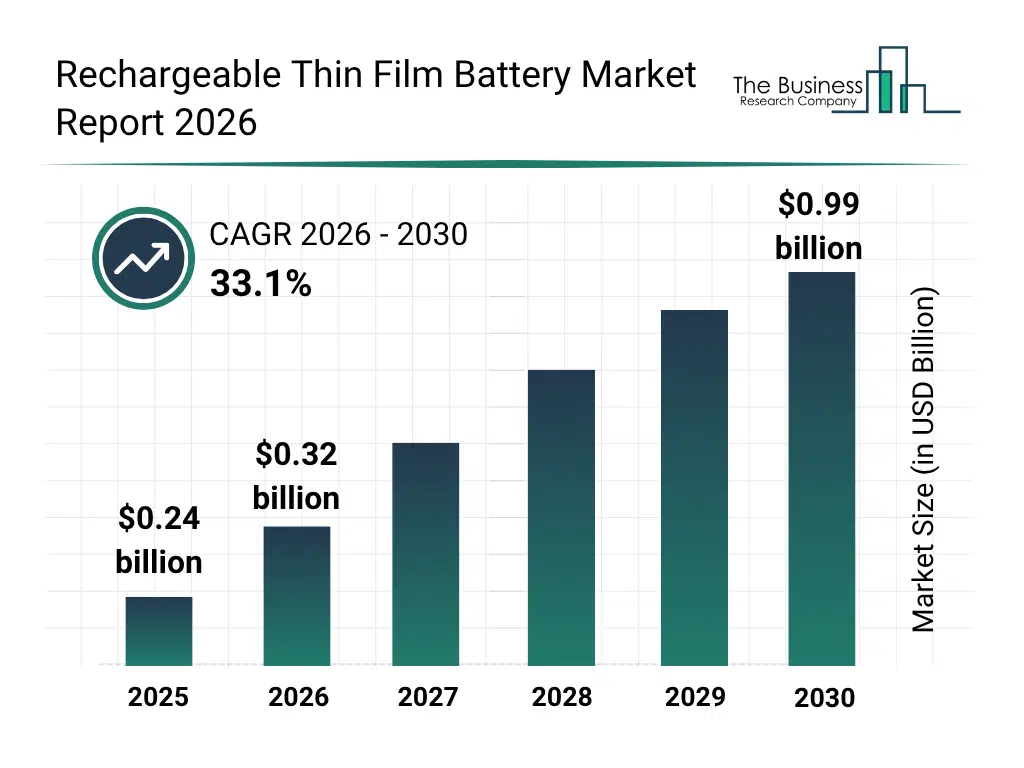
What Is The Rechargeable Thin Film Battery Market Size and Share 2026?
The rechargeable thin film battery market size has grown exponentially in recent years. It will grow from $0.24 billion in 2025 to $0.32 billion in 2026 at a compound annual growth rate (CAGR) of 33.6%. The growth in the historic period can be attributed to increasing demand for compact electronic devices, rising adoption of wearable devices, growing deployment of wireless sensors, increasing demand for smart cards, expanding use of medical monitoring devices.What Is The Rechargeable Thin Film Battery Market Growth Forecast?
The rechargeable thin film battery market size is expected to see exponential growth in the next few years. It will grow to $0.99 billion in 2030 at a compound annual growth rate (CAGR) of 33.1%. The growth in the forecast period can be attributed to growing adoption of IoT devices, rising demand for flexible electronics, increasing deployment of miniature medical devices, growing need for lightweight energy storage, expanding demand for high-energy-density rechargeable batteries. Major trends in the forecast period include increasing demand for ultra-thin energy storage, rising adoption of flexible rechargeable batteries, growing demand for high energy density battery solutions, increasing use of solid-state electrolytes, growing demand for long-cycle-life rechargeable batteries.Tariff Impact On Rechargeable Thin Film Battery Market
Tariffs are impacting the rechargeable thin film battery market by increasing the cost of imported battery materials, semiconductor components, specialized substrates, electrolytes, and manufacturing equipment required for thin-film battery production. This is affecting thin-film lithium batteries, solid-state batteries, flexible batteries, and applications such as wearable devices, medical devices, smart cards, and IoT devices, particularly in regions dependent on imported battery components such as Asia-Pacific, North America, and Europe. Technology-intensive segments are most affected due to their reliance on specialized materials and global supply chains. However, tariffs can also encourage domestic battery manufacturing, regional supplier diversification, local material sourcing, and expansion of rechargeable energy-storage production capacity.
Global Rechargeable Thin Film Battery Market Segmentation
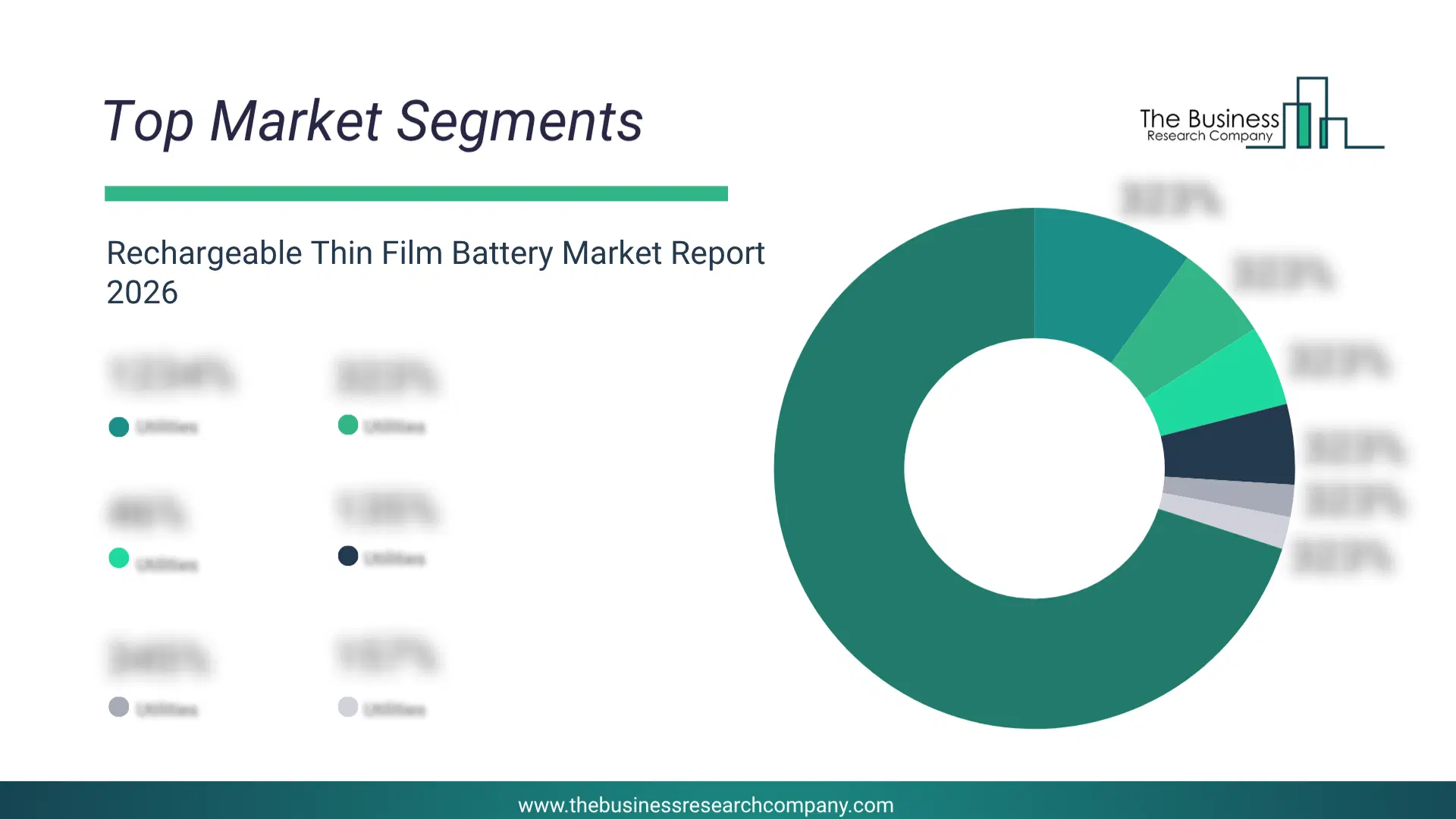
1) By Technology: Solid-State Batteries, Thin-Film Lithium Batteries, Polymer-Based Batteries, High-Energy Density Batteries 2) By Capacity: Below 100 Milliampere-Hour (mAh), 100 Milliampere-Hour (mAh) To 500 Milliampere-Hour (mAh), 500 Milliampere-Hour (mAh) To 1000 Milliampere-Hour (mAh), Above 1000 Milliampere-Hour (mAh) 3) By Form Factor: Flexible Batteries, Rigid Batteries 4) By Distribution Channel: Direct Sales, Distributors And Wholesalers, Online Sales 5) By Application: Consumer Electronics, Medical Devices, Smart Cards, Wearable Devices, Wireless Sensors, Internet Of Things (IoT) Devices Subsegments: 1) By Solid-State Batteries: Sulfide Solid-State Batteries, Oxide Solid-State Batteries, Halide Solid-State Batteries 2) By Thin-Film Lithium Batteries: Lithium Cobalt Oxide Thin-Film Batteries, Lithium Phosphate Thin-Film Batteries, Lithium Manganese Oxide Thin-Film Batteries 3) By Polymer-Based Batteries: Gel Polymer Batteries, Solid Polymer Electrolyte Batteries, Polymer Composite Batteries 4) By High-Energy Density Batteries: Lithium Metal Batteries, Lithium Sulfur Batteries, Multivalent Ion BatteriesWhat Are The Drivers Of The Rechargeable Thin Film Battery Market?
The rising demand for wearable electronics is expected to propel the growth of the rechargeable thin film battery market going forward. Wearable electronics are compact electronic devices worn on the body that use sensors, connectivity features, and embedded technologies to monitor activities, health conditions, and user interactions. Wearable electronics are rising due to increasing demand for continuous health and fitness monitoring, which enables real-time tracking of personal wellness and supports preventive healthcare. The rapid growth of wearable electronics is increasing demand for rechargeable thin-film batteries as these devices require ultra-thin, lightweight, and flexible power sources that can fit compact form factors while providing reliable rechargeable energy for continuous operation. For instance, in December 2025, according to the Organisation for Economic Co-operation and Development (OECD), a France-based, an intergovernmental organization, more than 400 million people worldwide use smartwatches, with the global user base expected to approach 500 million in 2025. Therefore, the rising demand for wearable electronics is driving the growth of the rechargeable thin film battery industry. The expansion of IoT and connected devices is expected to propel the growth of the rechargeable thin film battery market going forward. The expansion of IoT and connected devices refers to the increasing deployment of internet-connected sensors, wearables, smart home devices, industrial equipment, and other electronic devices that communicate and exchange data over networks. The expansion is rising as digital connectivity is becoming embedded across homes, healthcare, industry, and infrastructure, increasing the number of small connected electronic devices that require compact and reliable power sources. The increasing adoption of Internet of Things (IoT) devices supports rechargeable thin-film batteries by driving demand for compact, lightweight, and reliable power sources that enable continuous operation of connected devices and sensors. For instance, In April 2026, according to the Department for Science, Innovation & Technology, a UK-based government department, forecasts indicate that the global Internet of Things (IoT) market is expected to reach 24.1 billion connected devices by 2030, generating more than $1,490 billion (£1.1 trillion) in annual revenue. Therefore, the expansion of IoT and connected devices is driving the growth of the rechargeable thin film battery industry.Key Players In The Global Rechargeable Thin Film Battery Market
Major companies operating in the rechargeable thin film battery market are Murata Manufacturing Co. Ltd., STMicroelectronics NV, TDK Corporation, VARTA AG, ProLogium Technology Co. Ltd., Ilika plc, Ensurge Micropower ASA, Ion Storage Systems Inc., Cymbet Corporation, Jenax Inc., Blue Spark Technologies Inc., BrightVolt Inc., LionVolt BV, Prieto Battery Inc., Excellatron Solid State LLC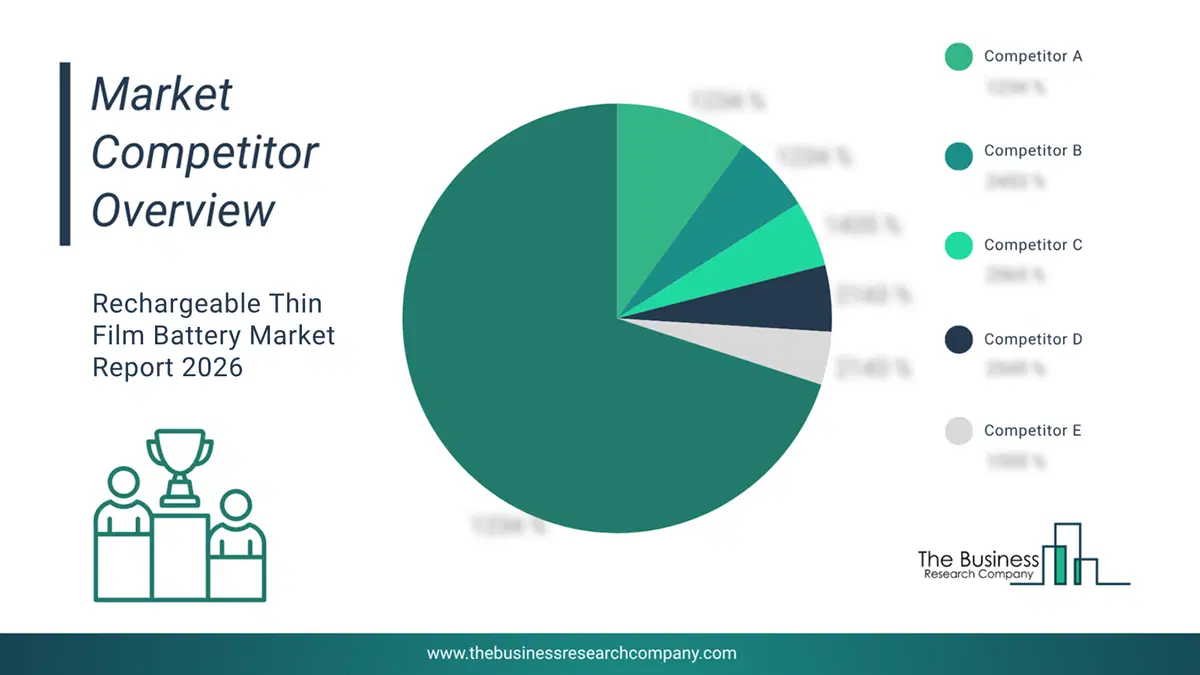
This chart is for illustrative purposes; the full report includes a detailed competitor analysis and comprehensive overview of the top 10 companies in the market.
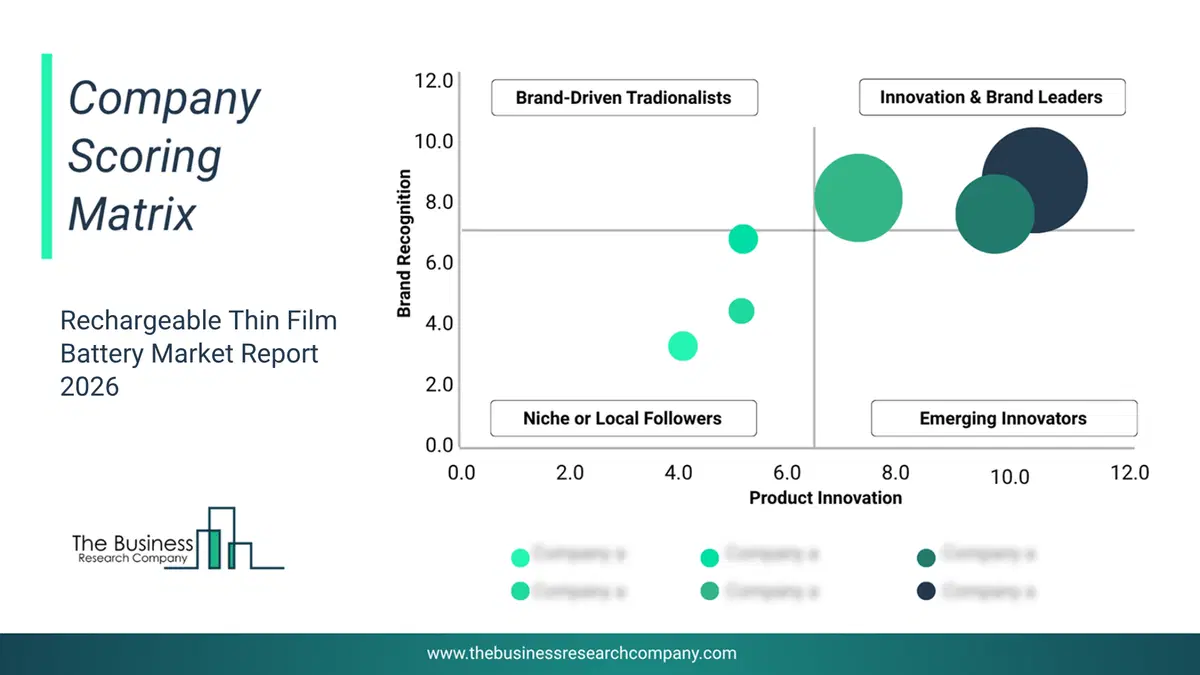
This chart maps companies by product innovation and brand strength, with bubble size indicating relative revenue, helping identify market leaders, challengers, and niche players. This is an illustrative chart; the full report provides a complete and accurate competitive analysis.
Global Rechargeable Thin Film Battery Market Trends and Insights
Major companies operating in the rechargeable thin film battery market are focusing on developing advanced ultra-thin lithium-ion rechargeable batteries to enable compact device designs, improve energy storage performance, enhance heat resistance, and extend battery life. Ultra-thin lithium-ion rechargeable batteries refer to compact rechargeable energy storage devices designed with a thin form factor while providing high capacity, high output, and long operating life for space-constrained applications. For instance, in November 2025, NGK INSULATORS, LTD., a Japan-based ceramics and electronic components company, launched EnerCera, an ultra-thin and compact lithium-ion rechargeable battery series. It is developed using NGK’s proprietary crystal-oriented ceramic positive electrode plate in a semi-solid battery. EnerCera combines high capacity, high output, heat resistance, and long life in an ultra-thin form factor, with low ignition risk, making it suitable for wearable devices and healthcare applications.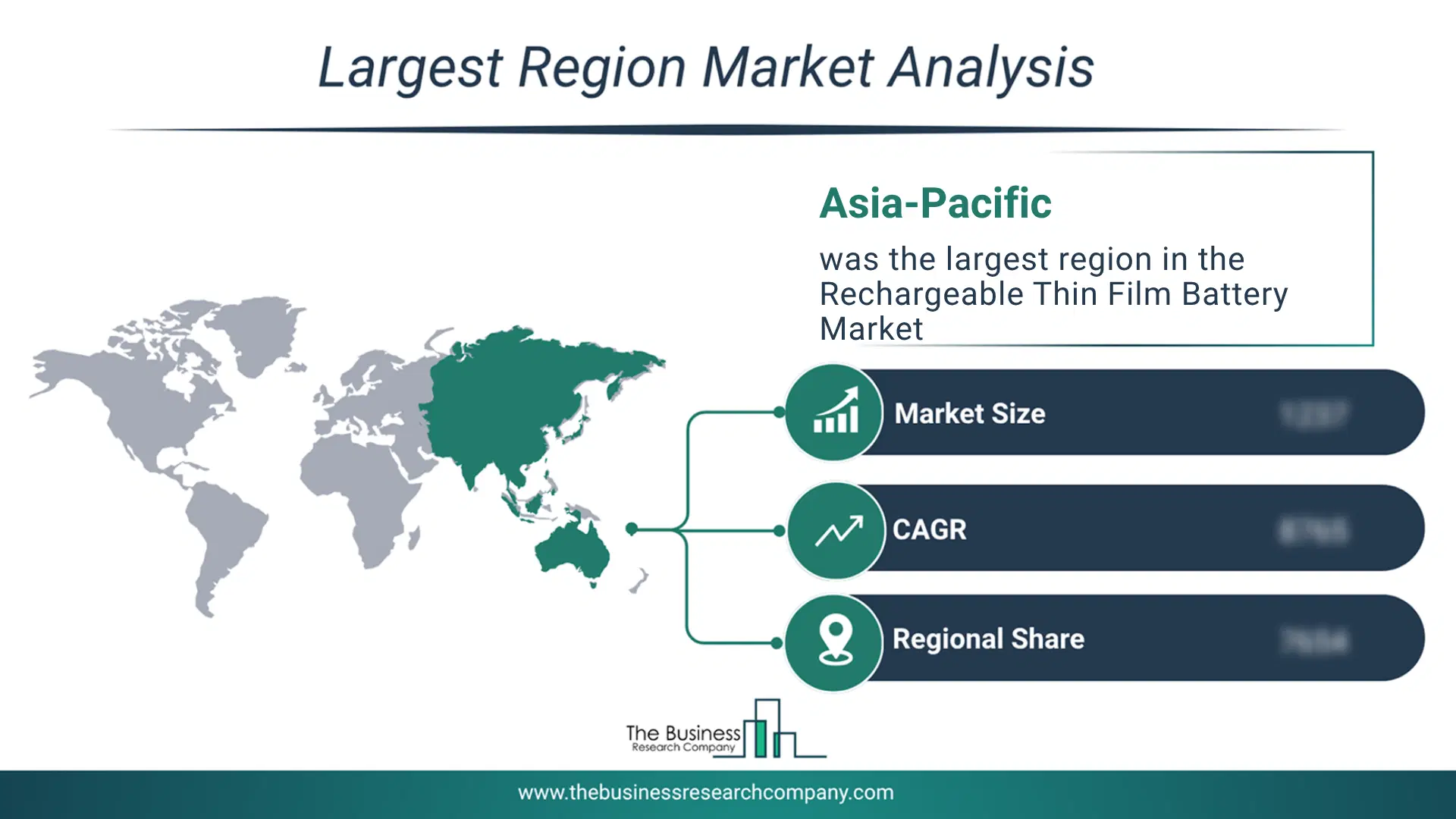
Regional Outlook
Asia-Pacific was the largest region in the rechargeable thin film battery market in 2025. Asia-Pacific is expected to be the fastest-growing region in the forecast period. The regions covered in this market report are Asia-Pacific, South East Asia, Western Europe, Eastern Europe, North America, South America, Middle East, Africa. The countries covered in this market report are Australia, Brazil, China, France, Germany, India, Indonesia, Japan, Taiwan, Russia, South Korea, UK, USA, Canada, Italy, Spain.What Defines the Rechargeable Thin Film Battery Market?
The rechargeable thin film battery market consists of sales of solid-state rechargeable thin film batteries, lithium-based thin film batteries, flexible thin film batteries, and ultra-thin microbatteries. Values in this market are ‘factory gate’ values, that is the value of goods sold by the manufacturers or creators of the goods, whether to other entities (including downstream manufacturers, wholesalers, distributors and retailers) or directly to end customers. The value of goods in this market includes related services sold by the creators of the goods.How is Market Value Defined and Measured?
The market value is defined as the revenues that enterprises gain from the sale of goods and/or services within the specified market and geography through sales, grants, or donations in terms of the currency (in USD unless otherwise specified). The revenues for a specified geography are consumption values that are revenues generated by organizations in the specified geography within the market, irrespective of where they are produced. It does not include revenues from resales along the supply chain, either further along the supply chain or as part of other products.
This chart presents market attractiveness based on a quantitative evaluation of growth, competition, strategic alignment, and risk, offering a clear view of opportunity areas for decision-making. This chart is for illustrative purposes; the full report contains the complete analysis.

This chart highlights the Total Addressable Market (TAM) by estimating the maximum revenue opportunity using an assumption-driven approach, supporting strategic planning and opportunity sizing across markets. The chart is illustrative; the full report provides a more comprehensive analysis.
What Key Data and Analysis Are Included in the Rechargeable Thin Film Battery Market Report 2026?
The rechargeable thin film battery market research report is one of a series of new reports from The Business Research Company that provides market statistics, including industry global market size, regional shares, competitors with the market share, detailed market segments, market trends and opportunities, and any further data you may need to thrive in the rechargeable thin film battery industry. The market research report delivers a complete perspective of everything you need, with an in-depth analysis of the current and future state of the industry.Rechargeable Thin Film Battery Market Report Forecast Analysis
| Report Attribute | Details |
|---|---|
| Market Size Value In 2026 | $0.32 billion |
| Revenue Forecast In 2030 | $0.99 billion |
| Growth Rate | CAGR of 33.1% from 2026 to 2030 |
| Base Year For Estimation | 2025 |
| Actual Estimates/Historical Data | 2020-2025 |
| Forecast Period | 2026 - 2030 |
| Market Representation | Revenue in USD Billion and CAGR from 2026 to 2030 |
| Segments Covered | Technology, Capacity, Form Factor, Distribution Channel, Application |
| Regional Scope | Asia-Pacific, Western Europe, Eastern Europe, North America, South America, Middle East, Africa |
| Country Scope | The countries covered in the report are Australia, Brazil, China, France, Germany, India, Indonesia, Japan, Taiwan, Russia, South Korea, UK, USA, Canada, Italy, Spain. |
| Key Companies Profiled | Murata Manufacturing Co. Ltd., STMicroelectronics NV, TDK Corporation, VARTA AG, ProLogium Technology Co. Ltd., Ilika plc, Ensurge Micropower ASA, Ion Storage Systems Inc., Cymbet Corporation, Jenax Inc., Blue Spark Technologies Inc., BrightVolt Inc., LionVolt BV, Prieto Battery Inc., Excellatron Solid State LLC |
| Customization Scope | Request for Customization |
| Pricing And Purchase Options | Explore Purchase Options |