
Reconstituted Wood Market Report 2026
Global Outlook – By Product Type (Particleboard, Medium Density Fiberboard (MDF), High Density Fiberboard (HDF), Oriented Strand Board (OSB), Plywood, Laminated Veneer Lumber (LVL), Cross-Laminated Timber (CLT), Other Product Types), By Adhesive Type (Urea-Formaldehyde (UF), Phenol-Formaldehyde (PF), Melamine-Formaldehyde (MF), Methylene Diphenyl Diisocyanate (MDI), Bio-Based Adhesives, Other Adhesive Types), By Surface Treatment (Raw Or Unfinished, Laminated, Veneered, Coated, Other Surface Treatments), By Distribution Channel (Direct Sales, Distributors Or Wholesalers, Retail Stores, E-Commerce, Other Distribution Channels), By End-Use (Construction, Furniture Manufacturing, Flooring, Packaging, Transportation, Other End-Users) – Market Size, Trends, Strategies, and Forecast to 2030
Reconstituted Wood Market Overview
• Reconstituted Wood market size has reached to $149.58 billion in 2025 • Expected to grow to $203.11 billion in 2030 at a compound annual growth rate (CAGR) of 6.5% • Growth Driver: Increasing Demand For Sustainable Buildings Fueling The Growth Of The Market Due To Rising Environmental Regulations And Eco-Friendly Construction Practices • Market Trend: Innovative Veneer Solutions Enhance Aesthetic And Sustainability • North America was the largest region in 2025.What Is Covered Under Reconstituted Wood Market?
Reconstituted wood is a man-made material produced by breaking down natural wood into smaller components such as fibers, chips, strands, or veneers, which are then bonded together using heat, pressure, and adhesives. This process creates boards or panels with uniform density and strength, offering greater design flexibility and efficient use of raw materials compared to solid wood. The main product types of reconstituted wood are particleboard, medium-density fiberboard (MDF), high-density fiberboard (HDF), oriented strand board (OSB), plywood, laminated veneer lumber (LVL), cross-laminated timber (CLT), and other reconstituted wood products. Particleboard is an engineered wood product made by compressing wood chips and resin into flat sheets, commonly used for furniture and construction. It includes various adhesive types, such as urea-formaldehyde (UF), phenol-formaldehyde (PF), melamine-formaldehyde (MF), methylene diphenyl diisocyanate (MDI), bio-based adhesives, and others, and used for surface treatments including raw or unfinished, laminated, veneered, coated, and others. It is distributed through direct sales, distributors or wholesalers, retail stores, e-commerce, and others, catering to diverse end users including construction, furniture manufacturing, flooring, packaging, transportation, and others.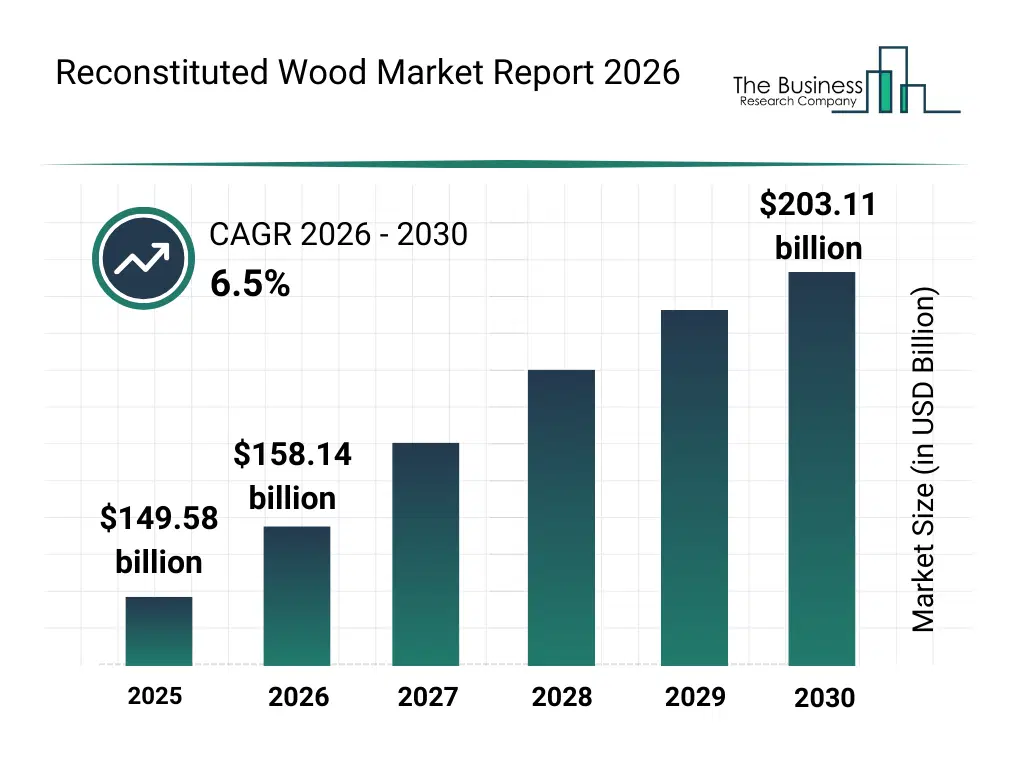
What Is The Reconstituted Wood Market Size and Share 2026?
The reconstituted wood market size has grown strongly in recent years. It will grow from $149.58 billion in 2025 to $158.14 billion in 2026 at a compound annual growth rate (CAGR) of 5.7%. The growth in the historic period can be attributed to expansion of furniture and interior applications, growth in construction material demand, increased utilization of wood residues, adoption of composite wood technologies, availability of advanced adhesive systems.What Is The Reconstituted Wood Market Growth Forecast?
The reconstituted wood market size is expected to see strong growth in the next few years. It will grow to $203.11 billion in 2030 at a compound annual growth rate (CAGR) of 6.5%. The growth in the forecast period can be attributed to increasing demand for sustainable building materials, rising adoption of low-emission adhesives, expansion of engineered wood in structural applications, growing focus on circular material usage, increasing use in modular construction. Major trends in the forecast period include increasing use of engineered wood panels, rising demand for uniform density wood products, growing adoption in furniture manufacturing, expansion of sustainable wood utilization practices, enhanced focus on material efficiency.
Global Reconstituted Wood Market Segmentation
1) By Product Type: Particleboard, Medium Density Fiberboard (MDF), High Density Fiberboard (HDF), Oriented Strand Board (OSB), Plywood, Laminated Veneer Lumber (LVL), Cross-Laminated Timber (CLT), Other Product Types 2) By Adhesive Type: Urea-Formaldehyde (UF), Phenol-Formaldehyde (PF), Melamine-Formaldehyde (MF), Methylene Diphenyl Diisocyanate (MDI), Bio-Based Adhesives, Other Adhesive Types 3) By Surface Treatment: Raw Or Unfinished, Laminated, Veneered, Coated, Other Surface Treatments 4) By Distribution Channel: Direct Sales, Distributors Or Wholesalers, Retail Stores, E-Commerce, Other Distribution Channels 5) By End-Use: Construction, Furniture Manufacturing, Flooring, Packaging, Transportation, Other End-Users Subsegments: 1) By Particleboard: Standard Particleboard, Fire-Resistant Particleboard, Moisture-Resistant Particleboard 2) By Medium Density Fiberboard (MDF): Standard Medium Density Fiberboard, Moisture-Resistant Medium Density Fiberboard, Fire-Retardant Medium Density Fiberboard 3) By High Density Fiberboard (HDF): Flooring Grade High Density Fiberboard, Door Skin High Density Fiberboard, Decorative High Density Fiberboard 4) By Oriented Strand Board (OSB): Oriented Strand Board-1, Oriented Strand Board-2, Oriented Strand Board-3 5) By Plywood: Softwood Plywood, Hardwood Plywood, Tropical Plywood 6) By Laminated Veneer Lumber (LVL): Laminated Veneer Lumber Beams, Laminated Veneer Lumber Headers, Laminated Veneer Lumber Rim Boards 7) By Cross-Laminated Timber (CLT): Residential Cross-Laminated Timber Panels, Non-Residential Cross-Laminated Timber Panels, Customized Cross-Laminated Timber Solutions 8) By Other Product Types: Hardboard, Waferboard, Composite Wood PanelsWhat Is The Driver Of The Reconstituted Wood Market?
The increasing demand for sustainable buildings is expected to propel the growth of the reconstituted wood market going forward. Sustainable buildings are eco-friendly structures designed to minimize environmental impact, reduce energy and resource use, and promote occupant well-being. The demand for sustainable buildings is increasing due to increasing environmental regulations aimed at reducing carbon emissions in the construction sector. Reconstituted wood aids in sustainable buildings by utilizing recycled wood materials, reducing the need for solid timber. It offers durable and cost-effective construction solutions while minimizing environmental impact and promoting resource efficiency. For instance, in February 2024, according to the US Green Building Council, a US-based non-profit organization that promotes eco-friendly building and created the leadership in energy and environmental design (LEED) certification system for green construction, in 2023, there was a 9% rise in LEED certifications from the previous year, along with 21 additional certifications for single-family homes. Further, the new LEED project registrations jumped by 51%, showing remarkable growth. Therefore, the increasing demand for sustainable buildings is driving the growth of the reconstituted wood industry.Key Players In The Global Reconstituted Wood Market
Major companies operating in the reconstituted wood market are Daiken Corporation, West Fraser Timber Co. Ltd., Georgia-Pacific LLC, Boise Cascade Company, Canfor Corporation, Fritz EGGER GmbH & Co. OG, Kronospan Holdings Limited, Celulosa Arauco y Constitución S.A., Roseburg Forest Products Co., Tolko Industries Ltd., Dongwha Enterprise Co. Ltd., Pfleiderer Group S.A., Action TESA Pvt. Ltd., Masisa S.A., Greenpanel Industries Ltd., Norbord Inc., Lampert Lumber Co., Uniboard Canada Inc., Rushil Décor Ltd., Sierra Pine Milling Co., Nelson Pine Industries Ltd., Swiss Krono Group, Duratex S.A.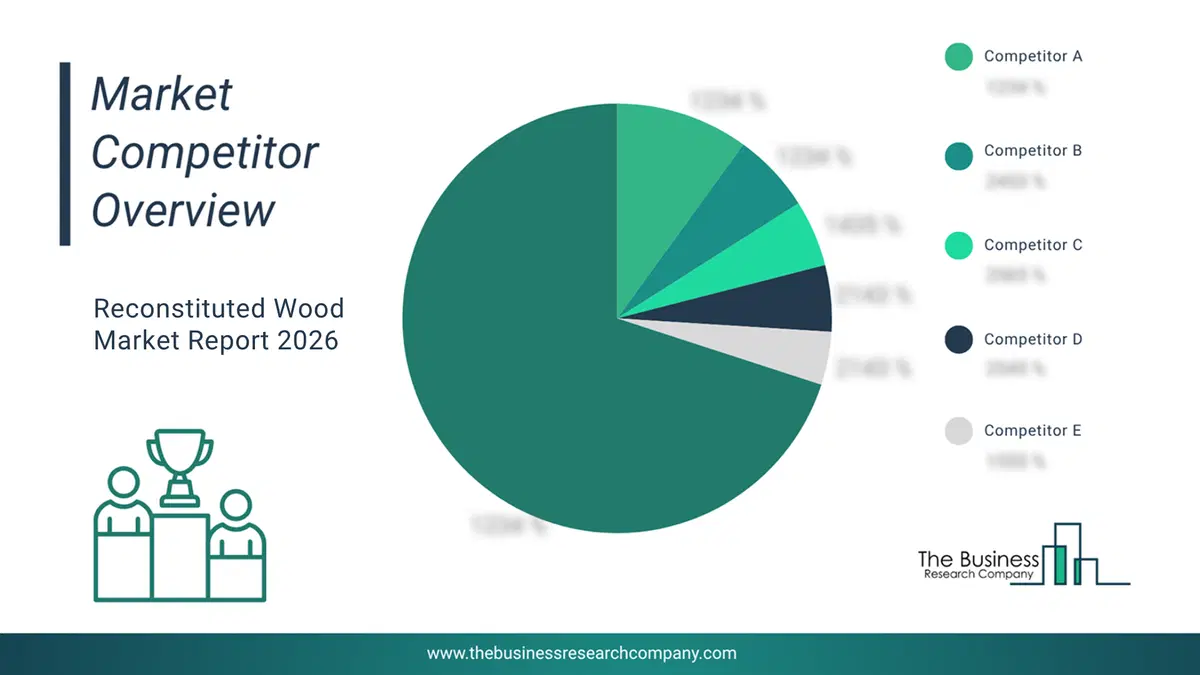
This chart is for illustrative purposes; the full report includes a detailed competitor analysis and comprehensive overview of the top 10 companies in the market.
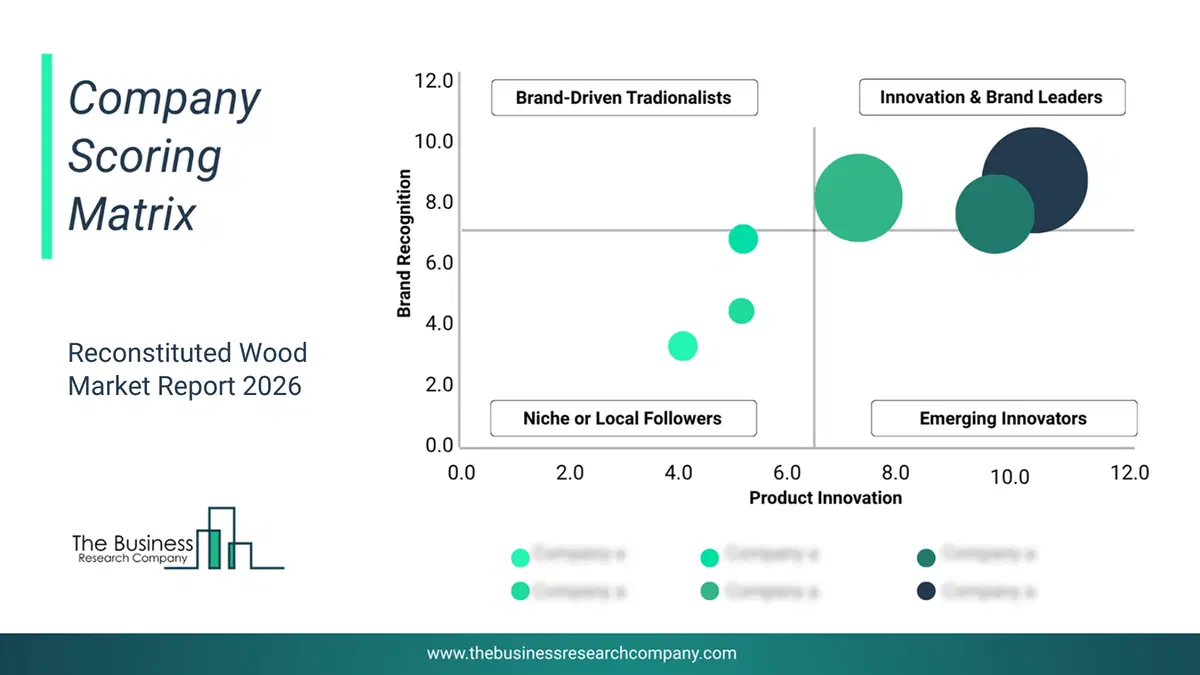
This chart maps companies by product innovation and brand strength, with bubble size indicating relative revenue, helping identify market leaders, challengers, and niche players. This is an illustrative chart; the full report provides a complete and accurate competitive analysis.
Global Reconstituted Wood Market Trends and Insights
Major companies operating in the reconstituted wood market are focusing on developing innovative and sustainable products, such as reconstituted veneer doors and drawers, to enhance aesthetic appeal, reduce environmental impact, and offer cost-effective solutions. Reconstituted veneer doors and drawers refer to furniture components made by applying engineered wood veneers onto substrates such as medium-density fiberboard (MDF) or particleboard to replicate the look of natural wood while offering cost-effectiveness and sustainability. For instance, in August 2023, Meridian Products, a US-based custom plastic injection molding company, launched its first line of reconstituted veneer doors and drawers. These products are created from man-made sheets of real, renewable wood and mimic the appearance of premium and rare wood species. This new product line combines the beauty of natural wood with the durability and affordability of engineered materials. The reconstituted veneer technology ensures uniform grain patterns, fewer defects, and a more sustainable alternative to traditional solid wood, reducing waste in production.What Are Latest Mergers And Acquisitions In The Reconstituted Wood Market?
In May 2024, Star Equity Holdings Inc., a US-based diversified holding company providing building-solutions, energy services and investment management, acquired Timber Technologies LLC for US$ 23 million in a cash-free, debt-free transaction. With this acquisition, Star Equity aimed to expand into the engineered wood products market, diversify its Building Solutions division beyond traditional construction, and enhance cash flow and profitability. Timber Technologies LLC. is a US-based manufacturer of glue-laminated timber (glulam) products supplying structural columns, beams, and architectural wood components for agricultural, industrial, infrastructure, and commercial/residential building applications.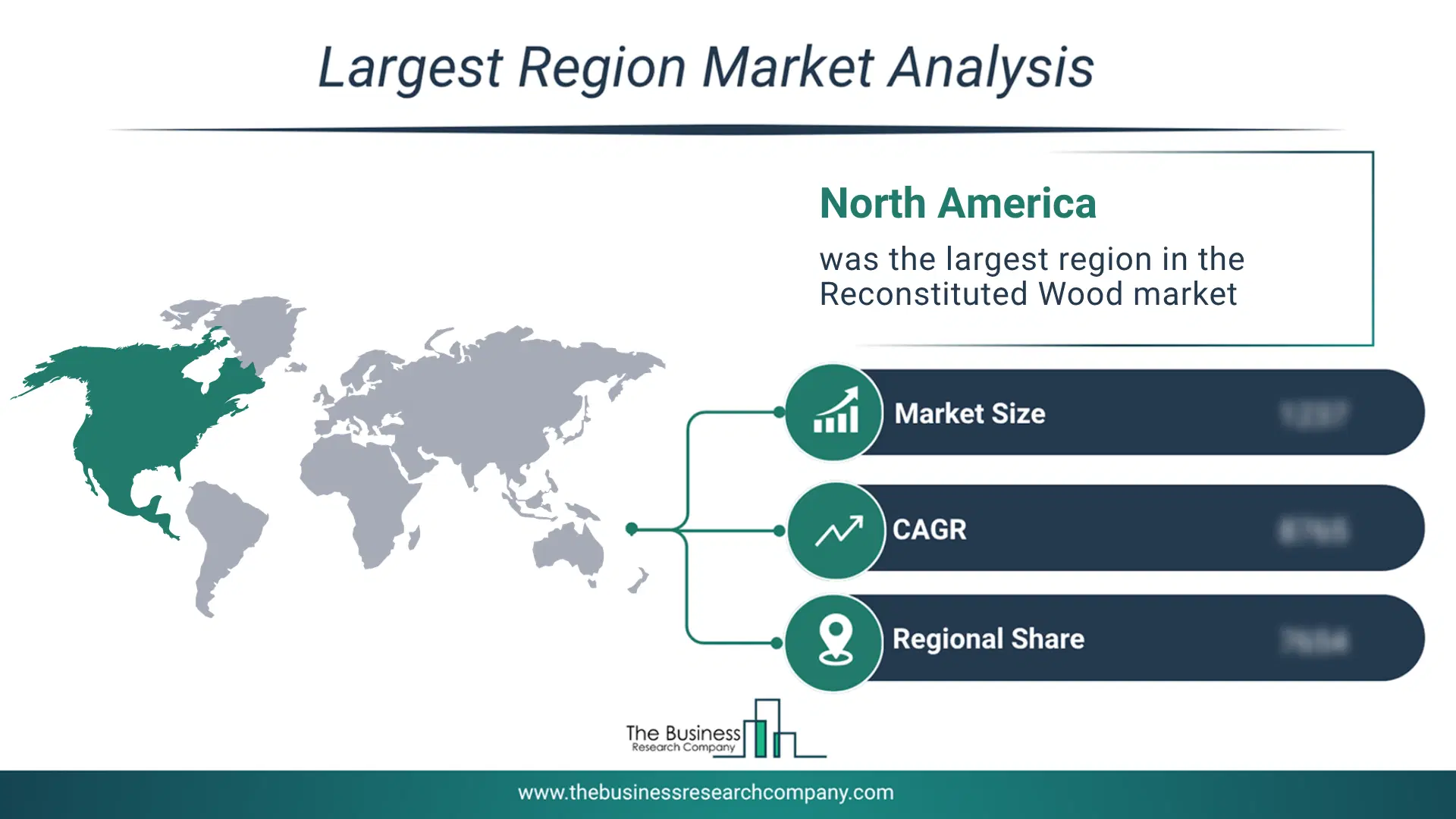
Regional Outlook
North America was the largest region in the reconstituted wood market in 2025. The regions covered in this market report are Asia-Pacific, South East Asia, Western Europe, Eastern Europe, North America, South America, Middle East, Africa. The countries covered in this market report are Australia, Brazil, China, France, Germany, India, Indonesia, Japan, Taiwan, Russia, South Korea, UK, USA, Canada, Italy, Spain.What Defines the Reconstituted Wood Market?
The reconstituted wood market consists of sales of medium-density fiberboard, wood-plastic composites, hardboard, waferboard, oriented strand board, and composite wood panels. Values in this market are ‘factory gate’ values, that is, the value of goods sold by the manufacturers or creators of the goods, whether to other entities (including downstream manufacturers, wholesalers, distributors, and retailers) or directly to end customers. The value of goods in this market includes related services sold by the creators of the goods.How is Market Value Defined and Measured?
The market value is defined as the revenues that enterprises gain from the sale of goods and/or services within the specified market and geography through sales, grants, or donations in terms of the currency (in USD unless otherwise specified). The revenues for a specified geography are consumption values that are revenues generated by organizations in the specified geography within the market, irrespective of where they are produced. It does not include revenues from resales along the supply chain, either further along the supply chain or as part of other products.
This chart presents market attractiveness based on a quantitative evaluation of growth, competition, strategic alignment, and risk, offering a clear view of opportunity areas for decision-making. This chart is for illustrative purposes; the full report contains the complete analysis.

This chart highlights the Total Addressable Market (TAM) by estimating the maximum revenue opportunity using an assumption-driven approach, supporting strategic planning and opportunity sizing across markets. The chart is illustrative; the full report provides a more comprehensive analysis.
What Key Data and Analysis Are Included in the Reconstituted Wood Market Report 2026?
The reconstituted wood market research report is one of a series of new reports from The Business Research Company that provides market statistics, including Market Report 2026?global market size, regional shares, competitors with the market share, detailed market segments, market trends and opportunities, and any further data you may need to thrive in the reconstituted wood Market Report 2026? The market research report delivers a complete perspective of everything you need, with an in-depth analysis of the current and future state of the Market Report 2026?Reconstituted Wood Market Report Forecast Analysis
| Report Attribute | Details |
|---|---|
| Market Size Value In 2026 | $158.14 billion |
| Revenue Forecast In 2030 | $203.11 billion |
| Growth Rate | CAGR of 5.7% from 2026 to 2030 |
| Base Year For Estimation | 2025 |
| Actual Estimates/Historical Data | 2020-2025 |
| Forecast Period | 2026 - 2030 |
| Market Representation | Revenue in USD Billion and CAGR from 2026 to 2030 |
| Segments Covered | Product Type, Adhesive Type, Surface Treatment, Distribution Channel, End-Use |
| Regional Scope | Asia-Pacific, Western Europe, Eastern Europe, North America, South America, Middle East, Africa |
| Country Scope | The countries covered in the report are Australia, Brazil, China, France, Germany, India, Indonesia, Japan, Taiwan, Russia, South Korea, UK, USA, Canada, Italy, Spain. |
| Key Companies Profiled | Daiken Corporation, West Fraser Timber Co. Ltd., Georgia-Pacific LLC, Boise Cascade Company, Canfor Corporation, Fritz EGGER GmbH & Co. OG, Kronospan Holdings Limited, Celulosa Arauco y Constitución S.A., Roseburg Forest Products Co., Tolko Industries Ltd., Dongwha Enterprise Co. Ltd., Pfleiderer Group S.A., Action TESA Pvt. Ltd., Masisa S.A., Greenpanel Industries Ltd., Norbord Inc., Lampert Lumber Co., Uniboard Canada Inc., Rushil Décor Ltd., Sierra Pine Milling Co., Nelson Pine Industries Ltd., Swiss Krono Group, Duratex S.A. |
| Customization Scope | Request for Customization |
| Pricing And Purchase Options | Explore Purchase Options |