
Recovered Carbon Black Market Report 2026
Global Outlook – By Type (Commodity Grade Recovered Carbon Black, Specialty Grade Recovered Carbon Black, Conductive Grade Recovered Carbon Black, Other Types), By Process Technology (Pyrolysis Based Recovery, Thermal Decomposition Recovery, Advanced Upgraded Recovery Processes), By Distribution Channel (Direct Sales, Distributors And Suppliers), By Application (Tires, Non Tire Rubber, Plastics, Inks, Adhesives And Sealants, Other Applications), By End Use Industry (Automotive, Tire Manufacturing, Industrial Manufacturing, Construction, Packaging, Printing And Coatings, Other End Use Industries) – Market Size, Trends, Strategies, and Forecast to 2030
Recovered Carbon Black Market Report 2026 Market Overview
• Recovered Carbon Black Market Report 2026 market size has reached to $0.17 billion in 2025 • Expected to grow to $0.59 billion in 2030 at a compound annual growth rate (CAGR) of 28.2% • Growth Driver: Rising Tire Recycling And Waste Tire Management Initiatives Driving The Market Due To Growing Environmental Concerns And Circular Economy Adoption • Market Trend: Innovations In Recovered Carbon Black Technology Support Sustainable Tire Recycling And Circular Economy Initiatives • North America was the largest region in 2025 and Asia-Pacific is the fastest growing region.What Is Covered Under Recovered Carbon Black Market?
Recovered carbon black (RCB) is a sustainable form of carbon black produced by processing end-of-life tires and rubber waste through thermal decomposition methods in the absence of oxygen. It serves as an eco-friendly alternative to virgin carbon black, helping reduce dependence on fossil-based raw materials and lowering overall carbon emissions. The main types of recovered carbon black include commodity grade recovered carbon black, specialty grade recovered carbon black, conductive grade recovered carbon black, and other types. Commodity grade recovered carbon black refers to lower cost carbon black recovered from end-of-life tires and rubber products, primarily used in bulk industrial applications. These products are processed using pyrolysis based recovery, thermal decomposition recovery, and advanced upgraded recovery processes and are distributed through direct sales and distributors and suppliers. The various applications involved are tires, non tire rubber, plastics, inks, adhesives and sealants, and others, and they are used by several end use industries such as automotive, tire manufacturing, industrial manufacturing, construction, packaging, printing and coatings, and others.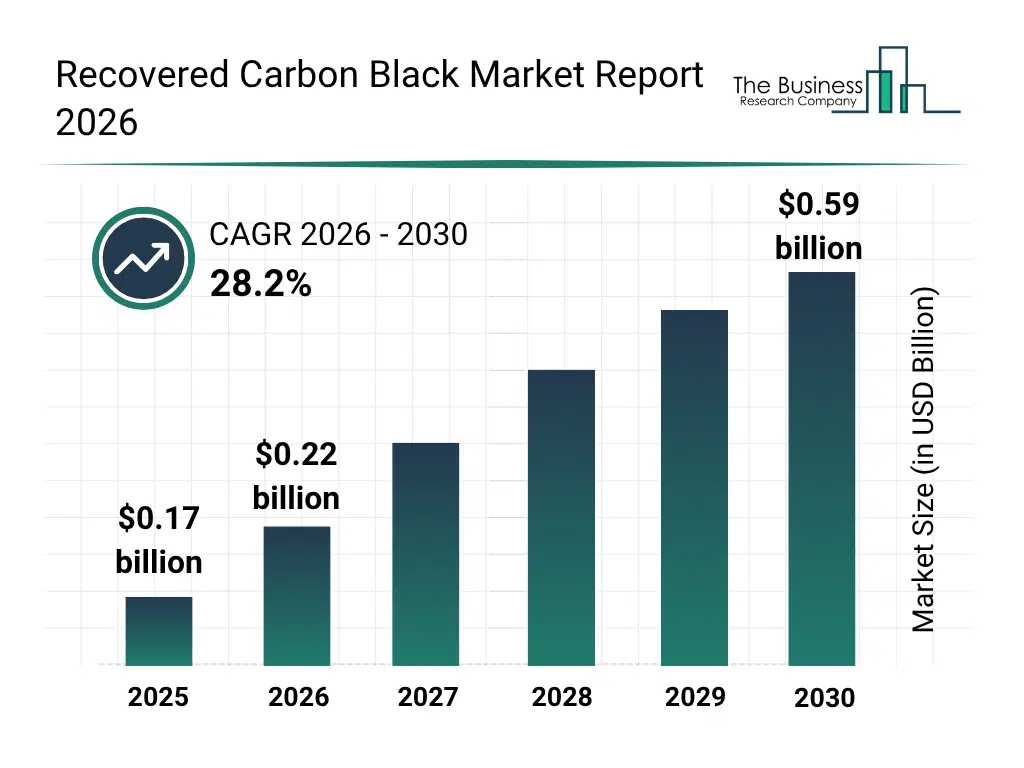
What Is The Recovered Carbon Black Market Size and Share 2026?
The recovered carbon black market size has grown exponentially in recent years. It will grow from $0.17 billion in 2025 to $0.22 billion in 2026 at a compound annual growth rate (CAGR) of 28.0%. The growth in the historic period can be attributed to growth of tire and rubber waste generation, rising environmental regulations on landfill and incineration waste, increasing adoption of basic tire pyrolysis systems, demand for low cost carbon black alternatives, expansion of automotive tire replacement market.What Is The Recovered Carbon Black Market Growth Forecast?
The recovered carbon black market size is expected to see exponential growth in the next few years. It will grow to $0.59 billion in 2030 at a compound annual growth rate (CAGR) of 28.2%. The growth in the forecast period can be attributed to rising demand for sustainable and circular economy materials, expansion of electric vehicle tire and lightweight rubber applications, increasing adoption of advanced recycling technologies, growth in conductive materials for batteries and electronics, stricter carbon emission reduction mandates. Major trends in the forecast period include advanced pyrolysis optimization for higher yield recovered carbon black production, development of low ash and high purity recovered carbon black grades for specialty applications, integration of circular rubber recycling systems in tire manufacturing ecosystems, expansion of conductive recovered carbon black for battery and electronic applications, process intensification technologies improving thermal decomposition efficiency and emission control.
Global Recovered Carbon Black Market Segmentation
1) By Type: Commodity Grade Recovered Carbon Black, Specialty Grade Recovered Carbon Black, Conductive Grade Recovered Carbon Black, Other Types 2) By Process Technology: Pyrolysis Based Recovery, Thermal Decomposition Recovery, Advanced Upgraded Recovery Processes 3) By Distribution Channel: Direct Sales, Distributors And Suppliers 4) By Application: Tires, Non Tire Rubber, Plastics, Inks, Adhesives And Sealants, Other Applications 5) By End Use Industry: Automotive, Tire Manufacturing, Industrial Manufacturing, Construction, Packaging, Printing And Coatings, Other End Use Industries Subsegments: 1) By Commodity Grade Recovered Carbon Black: General Rubber Reinforcement Grade, Tire Manufacturing Grade, Industrial Rubber Products Grade, Basic Plastic Compounding Grade, Standard Pigment Grade 2) By Specialty Grade Recovered Carbon Black: High Purity Recovered Carbon Black, Low Ash Content Recovered Carbon Black, Fine Particle Recovered Carbon Black, High Reinforcement Recovered Carbon Black, Premium Pigment Recovered Carbon Black 3) By Conductive Grade Recovered Carbon Black: Conductive Plastic Grade, Conductive Rubber Grade, Antistatic Compound Grade, Battery Material Grade, Electronic Components Grade 4) By Other Types: Thermal Recovered Carbon Black, Activated Recovered Carbon Black, Surface Modified Recovered Carbon Black, Blended Recovered Carbon Black, Custom Formulation Recovered Carbon BlackWhat Is The Driver Of The Recovered Carbon Black Market?
The rising tire recycling and waste tire management initiatives are expected to propel the growth of the recovered carbon black market going forward. Tire recycling and waste tire management initiatives are systems and processes designed to collect, process, and repurpose end-of-life tires to reduce environmental pollution and promote resource recovery. Tire recycling and waste tire management initiatives are increasing mainly due to growing environmental concerns, as unmanaged tire waste can cause pollution, fire risks, and landfill burden, driving the need for sustainable disposal and material recovery. Recovered carbon black (rCB) supports tire recycling and waste tire management by converting end-of-life tires into a valuable raw material that can replace virgin carbon black, thereby reducing landfill waste, lowering environmental pollution, and enabling a circular economy for tire materials. For instance, in October 2024, according to the U.S. Tire Manufacturers Association (USTMA), a US-based tire industry association, in 2023, approximately 28% of end-of-life tires were processed into ground rubber through recycling. Therefore, the rising tire recycling and waste tire management initiatives are driving the growth of the recovered carbon black industry.Key Players In The Global Recovered Carbon Black Market
Major companies operating in the recovered carbon black market report are Alpha Carbone SAS, Bolder Industries Inc., Contec S.A., DVA Renewable Energy JSC, Ecolomondo Corporation, Enrestec Inc., Gravita Recycling Private Limited, Hi-Green Carbon Ltd., Klean Industries Inc., Pyrum Innovations AG, Reoil Sp. z o.o., Scandinavian Enviro Systems AB, Wastefront AS
This chart is for illustrative purposes; the full report includes a detailed competitor analysis and comprehensive overview of the top 10 companies in the market.
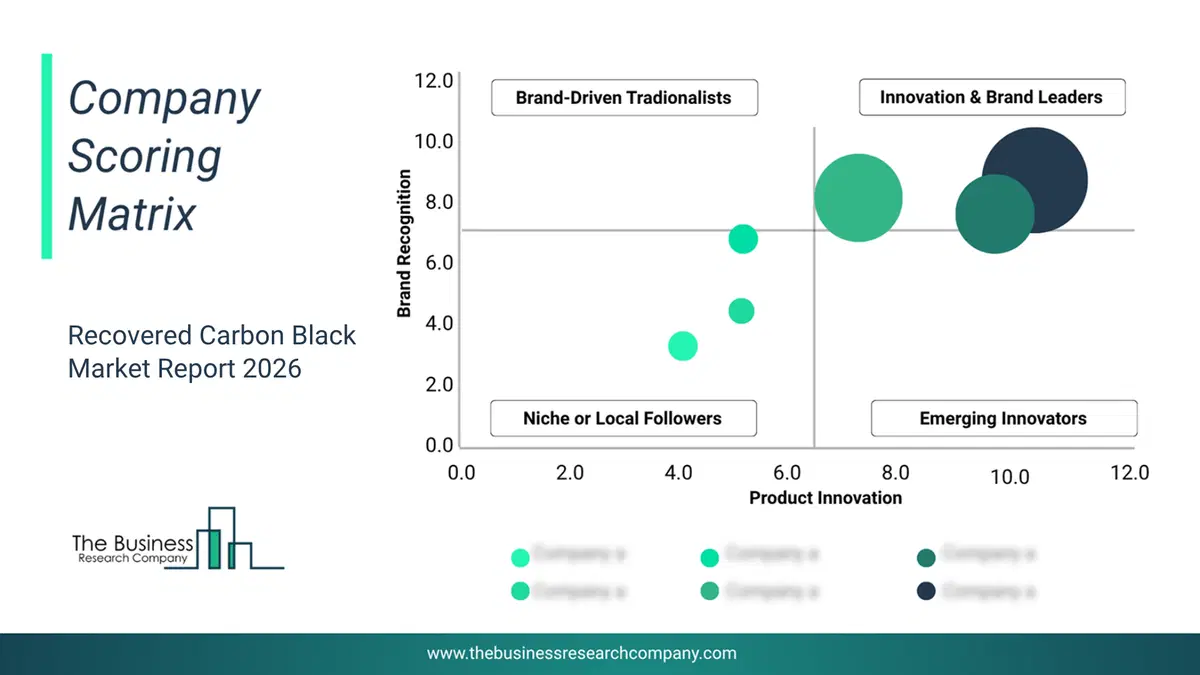
This chart maps companies by product innovation and brand strength, with bubble size indicating relative revenue, helping identify market leaders, challengers, and niche players. This is an illustrative chart; the full report provides a complete and accurate competitive analysis.
Global Recovered Carbon Black Market Trends and Insights
Major companies operating in the recovered carbon black market are focusing on developing advanced tire recycling technologies, such as high-performing and environmentally friendly recovered carbon black, to enhance circular economy initiatives, reduce dependence on virgin carbon black, and support sustainable manufacturing practices. High-performing and environmentally friendly recovered carbon black is a sustainable material derived from recycled end-of-life tires that delivers performance comparable to conventional carbon black while reducing waste, carbon emissions, and dependence on virgin fossil-based resources. For instance, in January 2025, Epsilon Carbon Pvt. Ltd., an India-based carbon products and sustainable materials company, launched Terrablack, a new sustainable carbon black product line made using recovered carbon black (rCB) and tire-derived oil (TDO), targeting both tire and non-tire rubber applications. The grades are designed for both tire and non-tire rubber applications, aiming to partially replace conventional virgin carbon black while maintaining high performance in properties such as wear resistance, resilience, and durability.What Are Latest Mergers And Acquisitions In The Recovered Carbon Black Market?
In June 2024, International CSRC Investment Holdings Co., Ltd., a Taiwan-based battery manufacturing company that offers recovered carbon black, partnered with The SHEICO Group to establish a large-scale eco-friendly recovered carbon black production facility in North America to advance circular economy practices and sustainable tire material production. With this partnership, companies aim to expand sustainable recovered carbon black production capacity, promote circular economy practices in tire recycling, and reduce reliance on virgin carbon black through large-scale eco-friendly manufacturing. SHEICO Group is a Taiwan-based manufacturer of water sports apparel.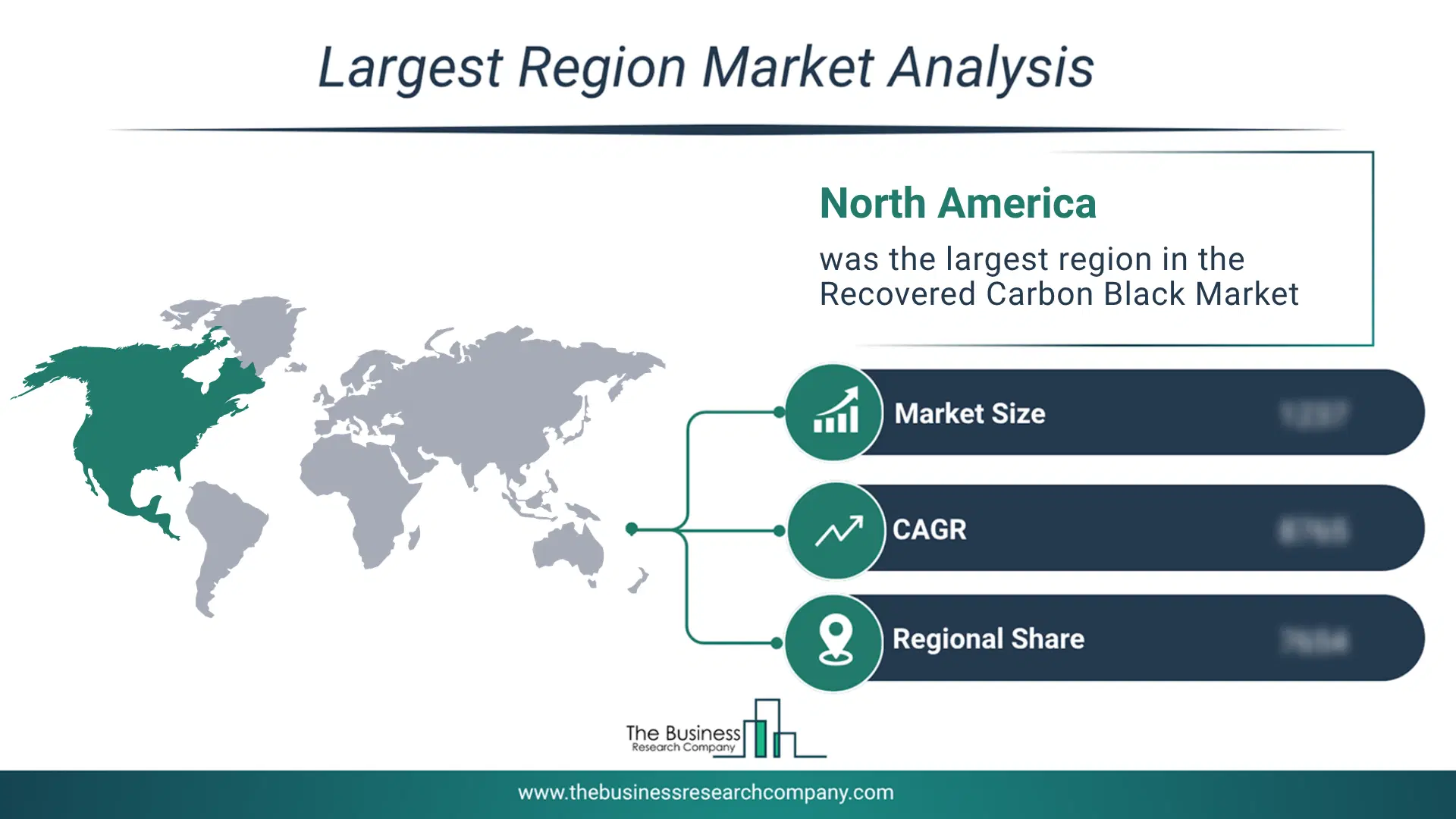
Regional Outlook
North America was the largest region in the recovered carbon black market in 2025. Asia-Pacific is expected to be the fastest-growing region in the forecast period. The regions covered in this market report are Asia-Pacific, South East Asia, Western Europe, Eastern Europe, North America, South America, Middle East, Africa. The countries covered in this market report are Australia, Brazil, China, France, Germany, India, Indonesia, Japan, Taiwan, Russia, South Korea, UK, USA, Canada, Italy, Spain.What Defines the Recovered Carbon Black Market?
The recovered carbon black market consists of sales of ultrafine recovered carbon black, surface-modified recovered carbon black, and high-purity recovered carbon black. Values in this market are ‘factory gate’ values, that is, the value of goods sold by the manufacturers or creators of the goods, whether to other entities (including downstream manufacturers, wholesalers, distributors, and retailers) or directly to end customers. The value of goods in this market includes related services sold by the creators of the goods.How is Market Value Defined and Measured?
The market value is defined as the revenues that enterprises gain from the sale of goods and/or services within the specified market and geography through sales, grants, or donations in terms of the currency (in USD unless otherwise specified). The revenues for a specified geography are consumption values that are revenues generated by organizations in the specified geography within the market, irrespective of where they are produced. It does not include revenues from resales along the supply chain, either further along the supply chain or as part of other products.
This chart presents market attractiveness based on a quantitative evaluation of growth, competition, strategic alignment, and risk, offering a clear view of opportunity areas for decision-making. This chart is for illustrative purposes; the full report contains the complete analysis.

This chart highlights the Total Addressable Market (TAM) by estimating the maximum revenue opportunity using an assumption-driven approach, supporting strategic planning and opportunity sizing across markets. The chart is illustrative; the full report provides a more comprehensive analysis.
What Key Data and Analysis Are Included in the Recovered Carbon Black Market Report 2026?
The recovered carbon black market research report is one of a series of new reports from The Business Research Company that provides market statistics, including industry global market size, regional shares, competitors with the market share, detailed market segments, market trends and opportunities, and any further data you may need to thrive in the recovered carbon black industry. The market research report delivers a complete perspective of everything you need, with an in-depth analysis of the current and future state of the industry.Recovered Carbon Black Market Report Forecast Analysis
| Report Attribute | Details |
|---|---|
| Market Size Value In 2026 | $0.22 billion |
| Revenue Forecast In 2030 | $0.59 billion |
| Growth Rate | CAGR of 28.2% from 2026 to 2030 |
| Base Year For Estimation | 2025 |
| Actual Estimates/Historical Data | 2020-2025 |
| Forecast Period | 2026 - 2030 |
| Market Representation | Revenue in USD Billion and CAGR from 2026 to 2030 |
| Segments Covered | Type, Process Technology, Distribution Channel, Application, End Use Industry |
| Regional Scope | Asia-Pacific, Western Europe, Eastern Europe, North America, South America, Middle East, Africa |
| Country Scope | The countries covered in the report are Australia, Brazil, China, France, Germany, India, Indonesia, Japan, Taiwan, Russia, South Korea, UK, USA, Canada, Italy, Spain. |
| Key Companies Profiled | Alpha Carbone SAS, Bolder Industries Inc., Contec S.A., DVA Renewable Energy JSC, Ecolomondo Corporation, Enrestec Inc., Gravita Recycling Private Limited, Hi-Green Carbon Ltd., Klean Industries Inc., Pyrum Innovations AG, Reoil Sp. z o.o., Scandinavian Enviro Systems AB, Wastefront AS |
| Customization Scope | Request for Customization |
| Pricing And Purchase Options | Explore Purchase Options |