
Recycled Carbon Fiber Market Report 2026
Global Outlook – By Product Type (Chopped Carbon Fiber, Milled Carbon Fiber, Carbon Fiber Mat, Other Product Types), By Source (Automotive Scrap, Aerospace Scrap, Other Sources), By Recycling Method (Mechanical Recycling, Chemical Recycling, Pyrolysis, Solvolysis, Other Recycling Method Types), By Application (Injection Molding Compounds, Compression Molding, Sheet Molding Compounds, Three Dimensional Printing, Structural Components, Non Structural Components, Tooling, Other Applications), By End-Use Industry (Automotive And Transportation, Aerospace And Defense, Wind Energy, Consumer Goods, Sporting Goods, Industrial Equipment, Construction, Marine, Electrical And Electronics, Other End-Use Industries) – Market Size, Trends, Strategies, and Forecast to 2035
Recycled Carbon Fiber Market Overview
• Recycled Carbon Fiber market size has reached to $0.16 billion in 2025 • Expected to grow to $0.31 billion in 2030 at a compound annual growth rate (CAGR) of 14.3% • Growth Driver: Rising Electric Vehicle Adoption Driving The Market Growth Due To Increasing Demand For Efficient Power Conversion And Energy Management • Market Trend: Advancements In Sustainable Composite Reinforcement Solutions • Europe was the largest region in 2025 and Asia-Pacific is the fastest growing region.What Is Covered Under Recycled Carbon Fiber Market?
Recycled carbon fiber refers to carbon fiber recovered from manufacturing scrap or end-of-life composite materials through mechanical, thermal, or chemical recycling processes. It can retain useful strength, stiffness, and lightweight characteristics of the original carbon fiber, providing a potential alternative to virgin carbon fiber in applications where its recovered properties are suitable. The main product types of recycled carbon fiber include chopped carbon fiber, milled carbon fiber, carbon fiber mat, and other product types. Chopped carbon fiber refers to reclaimed carbon fiber strands that are cut into shorter lengths for incorporation into composite materials and other applications. These fibers are sourced from automotive scrap, aerospace scrap, and other sources and are recovered using mechanical recycling, chemical recycling, pyrolysis, solvolysis, and other recycling methods. They find application in injection molding compounds, compression molding, sheet molding compounds, three dimensional printing, structural components, non structural components, tooling, and others, serving end use industries including automotive and transportation, aerospace and defense, wind energy, consumer goods, sporting goods, industrial equipment, construction, marine, electrical and electronics, and others.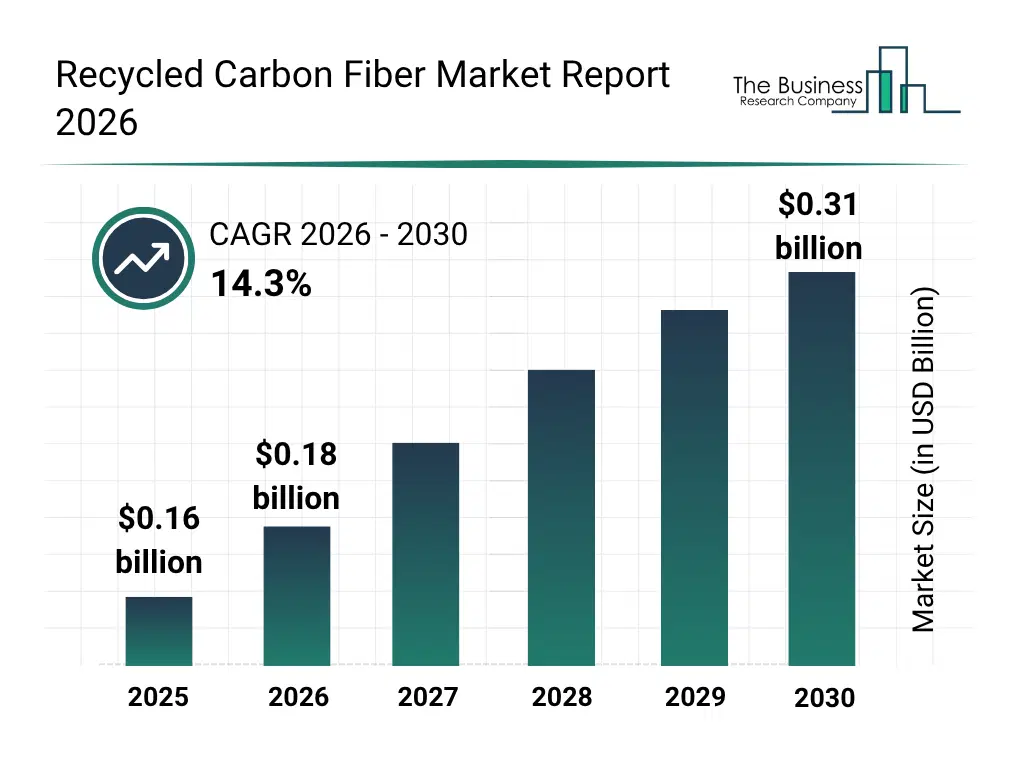
What Is The Recycled Carbon Fiber Market Size and Share 2026?
The recycled carbon fiber market size has grown rapidly in recent years. It will grow from $0.16 billion in 2025 to $0.18 billion in 2026 at a compound annual growth rate (CAGR) of 14.0%. The growth in the historic period can be attributed to increasing carbon fiber manufacturing scrap, rising demand for lightweight materials, growing adoption of recycled materials in automotive applications, increasing aerospace composite waste, rising environmental regulations on composite waste.What Is The Recycled Carbon Fiber Market Growth Forecast?
The recycled carbon fiber market size is expected to see rapid growth in the next few years. It will grow to $0.31 billion in 2030 at a compound annual growth rate (CAGR) of 14.3%. The growth in the forecast period can be attributed to expansion of electric vehicle production, increasing demand for sustainable composite materials, growing adoption of recycled carbon fiber in additive manufacturing, rising investments in advanced recycling technologies, increasing use of circular material supply chains. Major trends in the forecast period include advanced recycling technologies, high-quality fiber recovery, closed-loop carbon fiber recycling, recycled carbon fiber composite development, carbon fiber waste reduction.Tariff Impact On Recycled Carbon Fiber Market
Tariffs are impacting the recycled carbon fiber market by increasing the cost of imported carbon fiber scrap, recycling equipment, processing machinery, and composite manufacturing inputs. Automotive and transportation, aerospace and defense, and industrial applications may experience greater cost pressures, particularly in North America, Europe, and Asia-Pacific due to globally interconnected material and equipment supply chains. However, tariffs may encourage domestic recycling capacity, localized sourcing of carbon fiber waste, and investments in regional processing facilities, supporting circular supply chains and reducing dependence on imported virgin carbon fiber.
Global Recycled Carbon Fiber Market Segmentation
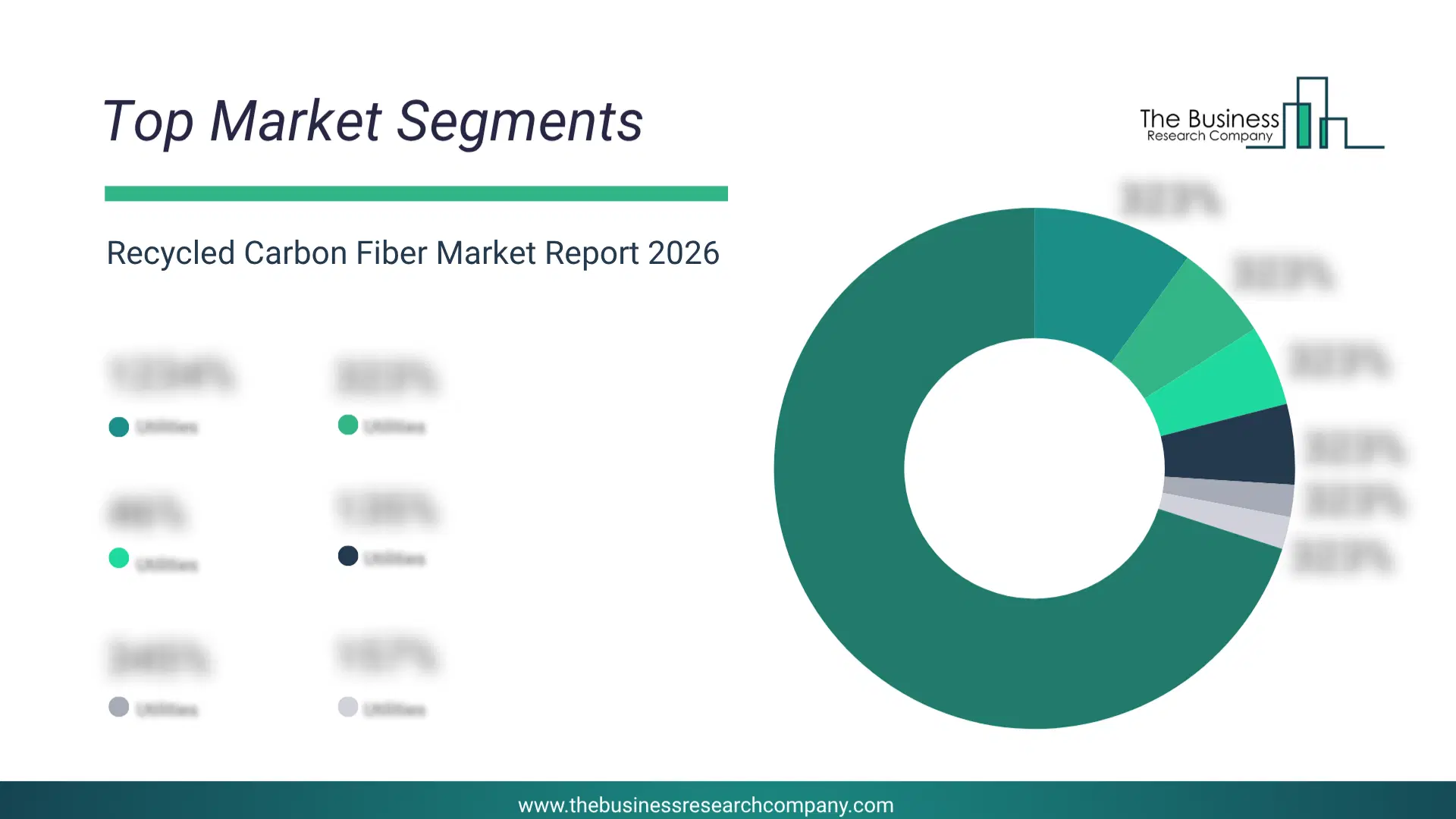
2) By Source: Automotive Scrap, Aerospace Scrap, Other Sources 3) By Recycling Method: Mechanical Recycling, Chemical Recycling, Pyrolysis, Solvolysis, Other Recycling Method Types 4) By Application: Injection Molding Compounds, Compression Molding, Sheet Molding Compounds, Three Dimensional Printing, Structural Components, Non Structural Components, Tooling, Other Applications 5) By End-Use Industry: Automotive And Transportation, Aerospace And Defense, Wind Energy, Consumer Goods, Sporting Goods, Industrial Equipment, Construction, Marine, Electrical And Electronics, Other End-Use Industries Subsegments: 1) By Chopped Carbon Fiber: Short Chopped Carbon Fiber, Long Chopped Carbon Fiber, Surface Treated Chopped Carbon Fiber, Untreated Chopped Carbon Fiber 2) By Milled Carbon Fiber: Fine Milled Carbon Fiber, Medium Milled Carbon Fiber, Coarse Milled Carbon Fiber, Surface Modified Milled Carbon Fiber 3) By Carbon Fiber Mat: Nonwoven Carbon Fiber Mat, Needle Punched Carbon Fiber Mat, Random Fiber Carbon Fiber Mat, Thermoplastic Bonded Carbon Fiber Mat 4) By Other Product Types: Recycled Carbon Fiber Pellets, Recycled Carbon Fiber Powder, Recycled Carbon Fiber Fabric, Recycled Carbon Fiber PreformsWhat Is The Driver Of The Recycled Carbon Fiber Market?
The rising adoption of electric vehicles (EVs) is expected to propel the growth of the recycled carbon fiber market going forward. Electric vehicles are automobiles powered wholly or partially by electric motors using energy stored in rechargeable battery systems. The adoption of electric vehicles is increasing due to growing environmental concerns, as consumers, businesses, and governments seek to reduce greenhouse gas emissions, improve air quality, and decrease dependence on fossil fuels through cleaner and more sustainable transportation solutions. Rising adoption of electric vehicles is driving demand for recycled carbon fiber by increasing the need for lightweight, high-strength, and sustainable materials that improve vehicle energy efficiency, extend driving range, and reduce manufacturing costs and carbon emissions. For instance, in May 2026, according to the International Energy Agency (IEA), a France-based intergovernmental energy organization, global electric car production reached nearly 22 million units in 2025, representing an increase of more than 25% compared with 2024. Therefore, the rising adoption of electric vehicles is driving the growth of the recycled carbon fiber industry.Key Players In The Global Recycled Carbon Fiber Market
Major companies operating in the recycled carbon fiber market are Toray Industries Inc., Mitsubishi Chemical Corporation, Syensqo SA/NV, Teijin Limited, SGL Carbon SE, Procotex Corporation SA, Gen 2 Carbon Limited, Fairmat SAS, Sigmatex Limited, Adherent Technologies Inc., Vartega Inc., Carbon Conversion Group, Alpha Recyclage Composites SAS, Carbon Fiber Remanufacturing Inc., Hadeg Recycling GmbH, Carbon Fiber Recycle Industry Co Ltd., Shocker Composites LLC, Carbon Fiber Recycling Inc., Shria Recycled Carbon, Carbon Clean Tech AG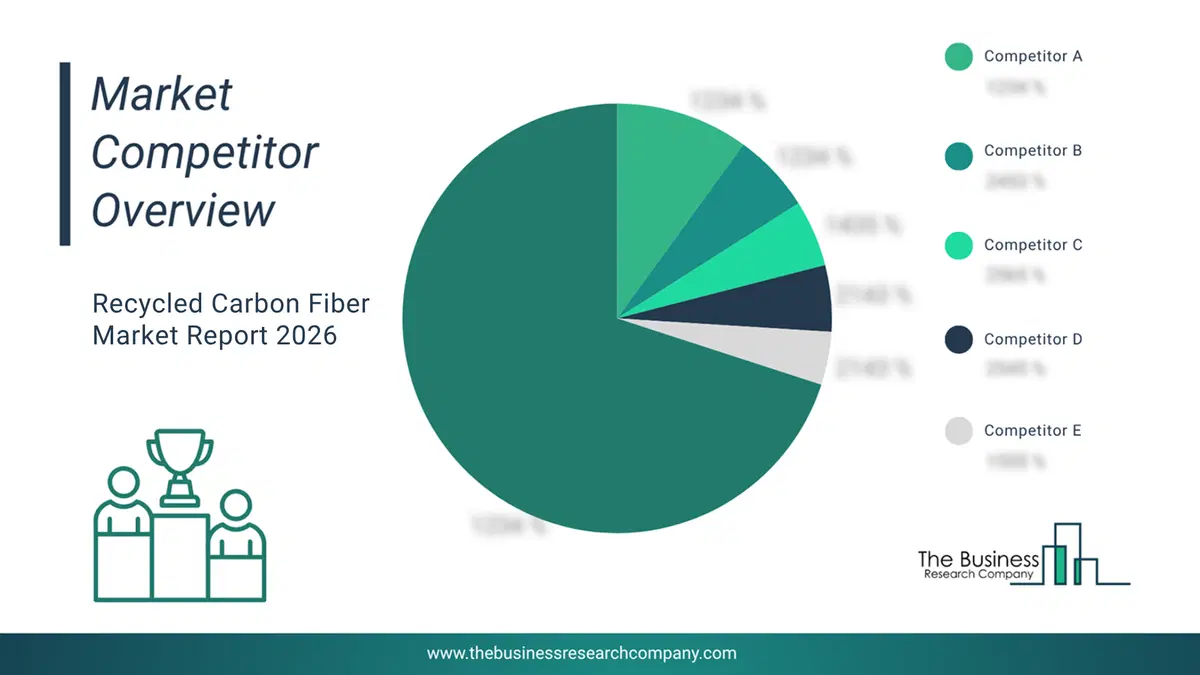
This chart is for illustrative purposes; the full report includes a detailed competitor analysis and comprehensive overview of the top 10 companies in the market.
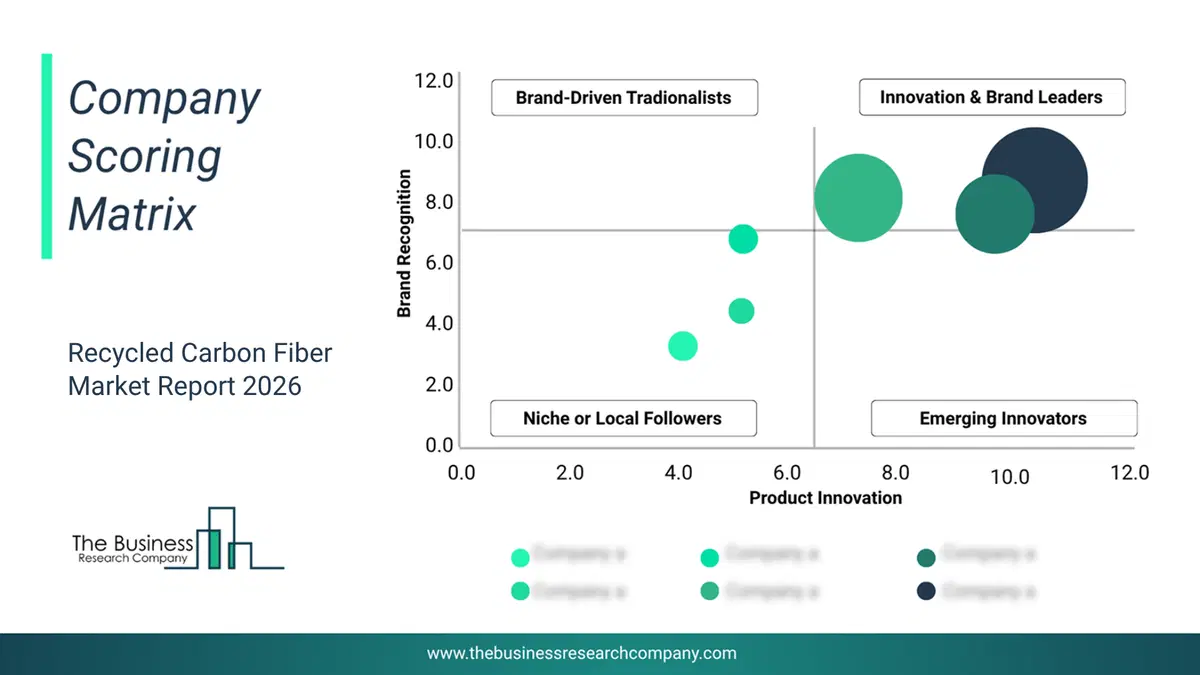
This chart maps companies by product innovation and brand strength, with bubble size indicating relative revenue, helping identify market leaders, challengers, and niche players. This is an illustrative chart; the full report provides a complete and accurate competitive analysis.
Global Recycled Carbon Fiber Market Trends and Insights
Major companies operating in the recycled carbon fiber market are focusing on developing innovative products, such as milled recycled carbon fiber (rCF), to enhance sustainable composite manufacturing, reduce production costs, and support circular economy initiatives. Milled recycled carbon fiber is a finely processed reinforcement material produced by recovering carbon fibers from end-of-life composites, prepreg scrap, and dry fiber waste, offering mechanical properties comparable to conventional milled virgin carbon fiber while significantly lowering carbon emissions and material costs. For instance, in November 2025, Carbon Fiber Recycling LLC, a US-based carbon fiber recycling technology company, launched Pure rCF, an innovative line of sustainable milled recycled carbon fiber available in custom filament lengths. The product is manufactured from 100% recycled carbon fiber recovered from cured composites, prepreg scrap, and dry-fiber waste using the company's proprietary closed-loop recycling process. It is precision milled to customer specifications and delivers mechanical performance comparable to virgin milled carbon fiber while reducing carbon dioxide emissions by more than 99%. The material is offered in multiple filament lengths for injection molding, bulk molding compounds, 3D printing, and other additive manufacturing processes. It also provides substantial cost savings compared with virgin carbon fiber and is designed for applications across automotive lightweighting, aerospace interiors, sporting goods, and civil construction, supporting manufacturers in achieving both performance and sustainability goals.What Are Latest Mergers And Acquisitions In The Recycled Carbon Fiber Market?
In June 2025, Syensqo SA/NV, a Belgium-based specialty chemicals company, partnered with Fairmat to establish a long-term carbon fiber composites recycling agreement. Through this partnership, Syensqo aims to recycle carbon fiber composite waste generated from its manufacturing operations into high-value recycled materials, supporting circular economy objectives, reducing landfill waste, and lowering the environmental footprint of composite production. FAIRMAT SAS is a France-based company specializing in the recycling of carbon fiber composite materials into high-performance recycled products.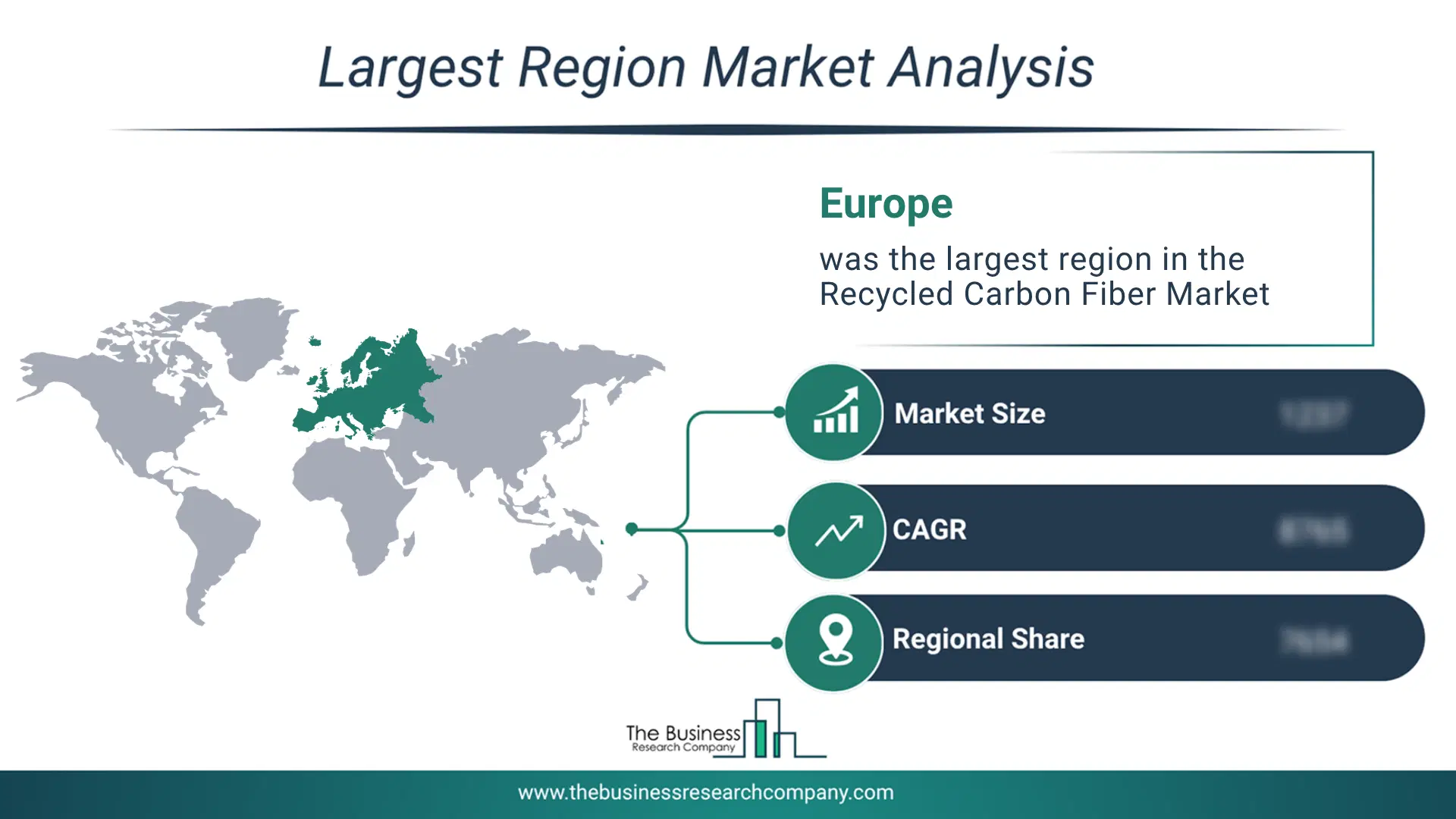
Regional Outlook/Insights
Europe was the largest region in the recycled carbon fiber market in 2025. Asia-Pacific is expected to be the fastest-growing region in the forecast period. The regions covered in this market report are Asia-Pacific, South East Asia, Western Europe, Eastern Europe, North America, South America, Middle East, Africa. The countries covered in this market report are Australia, Brazil, China, France, Germany, India, Indonesia, Japan, Taiwan, Russia, South Korea, UK, USA, Canada, Italy, Spain.What Defines the Recycled Carbon Fiber Market?
The recycled carbon fiber market consists of sales of nonwoven fabrics, pellets and compounds, fiber yarns, fiber veils, and fiber reinforcement tapes. Values in this market are ‘factory gate’ values, that is, the value of goods sold by the manufacturers or creators of the goods, whether to other entities (including downstream manufacturers, wholesalers, distributors, and retailers) or directly to end customers. The value of goods in this market includes related services sold by the creators of the goods.How is Market Value Defined and Measured?
The market value is defined as the revenues that enterprises gain from the sale of goods and/or services within the specified market and geography through sales, grants, or donations in terms of the currency (in USD unless otherwise specified). The revenues for a specified geography are consumption values that are revenues generated by organizations in the specified geography within the market, irrespective of where they are produced. It does not include revenues from resales along the supply chain, either further along the supply chain or as part of other products.
This chart presents market attractiveness based on a quantitative evaluation of growth, competition, strategic alignment, and risk, offering a clear view of opportunity areas for decision-making. This chart is for illustrative purposes; the full report contains the complete analysis.

This chart highlights the Total Addressable Market (TAM) by estimating the maximum revenue opportunity using an assumption-driven approach, supporting strategic planning and opportunity sizing across markets. The chart is illustrative; the full report provides a more comprehensive analysis.
What Key Data and Analysis Are Included in the Recycled Carbon Fiber Market Report 2026?
The recycled carbon fiber market research report is one of a series of new reports from The Business Research Company that provides market statistics, including industry global market size, regional shares, competitors with the market share, detailed market segments, market trends and opportunities, and any further data you may need to thrive in the recycled carbon fiber industry. The market research report delivers a complete perspective of everything you need, with an in-depth analysis of the current and future state of the industry.Recycled Carbon Fiber Market Report Forecast Analysis
| Report Attribute | Details |
|---|---|
| Market Size Value In 2026 | $0.18 billion |
| Revenue Forecast In 2030 | $0.31 billion |
| Growth Rate | CAGR of 14.3% from 2026 to 2035 |
| Base Year For Estimation | 2025 |
| Actual Estimates/Historical Data | 2020-2025 |
| Forecast Period | 2026 - 2030 |
| Market Representation | Revenue in USD Billion and CAGR from 2026 to 2030 |
| Segments Covered | Product Type, Source, Recycling Method, Application, End-Use Industry |
| Regional Scope | Asia-Pacific, Western Europe, Eastern Europe, North America, South America, Middle East, Africa |
| Country Scope | The countries covered in the report are Australia, Brazil, China, France, Germany, India, Indonesia, Japan, Taiwan, Russia, South Korea, UK, USA, Canada, Italy, Spain. |
| Customization Scope | Request for Customization |
| Pricing And Purchase Options | Explore Purchase Options |