
Red Biotechnology Market Report 2026
Global Outlook – By Product (Monoclonal Antibodies, Polyclonal Antibodies, Recombinant Proteins, Vaccines, Cell-Based Immunotherapy Products, Gene Therapy Products, Cell Therapy Products, Tissue-Engineered Products, Other Products), By Application (Drug Discovery And Development, Animal Biotechnology, Medical Biotechnology, Clinical Biotechnology, Other Applications), By End-User (Biopharmaceutical Industry, Contract Manufacturing Organization (CMO) And Contract Research Organization (CRO) Research Institutes, Other End Users) - Market Size, Trends, Strategies, and Forecast to 2030
Red Biotechnology Market Overview
• Red Biotechnology market size has reached to $629.69 billion in 2025 • Expected to grow to $1018.05 billion in 2030 at a compound annual growth rate (CAGR) of 9.8% • Growth Driver: Demand For Personalized Medicine Drives Growth In The Red Biotechnology Market • Market Trend: Innovative Innovations In Biosimilar Development Enhance Treatment Accessibility And Therapeutic Advancements In Autoimmune Disorders • North America was the largest region in 2025 and Asia-Pacific is the fastest growing region.What Is Covered Under Red Biotechnology Market?
Red biotechnology is a branch of biotechnology that focuses on medical and pharmaceutical applications. It involves the use of biological systems and organisms to develop products and technologies for healthcare purposes, such as the production of pharmaceuticals, diagnostic tests, and therapies aimed at treating diseases and improving human health. The main products of red biotechnology are monoclonal antibodies, polyclonal antibodies, recombinant proteins, vaccines, cell-based immunotherapy products, gene therapy products, cell therapy products, tissue-engineered products, and others. Monoclonal antibodies refer to laboratory-made proteins that mimic the immune system's ability to fight off harmful pathogens and are used for targeted therapies in treating various diseases, including cancer and autoimmune disorders. It has applications in drug discovery and development, animal biotechnology, environmental biotechnology, medical biotechnology, industrial biotechnology, agricultural biotechnology, and others, for multiple end-users such as the biopharmaceutical industry, contract manufacturing organization (CMO) and contract research organization (CRO) research institutes, and others.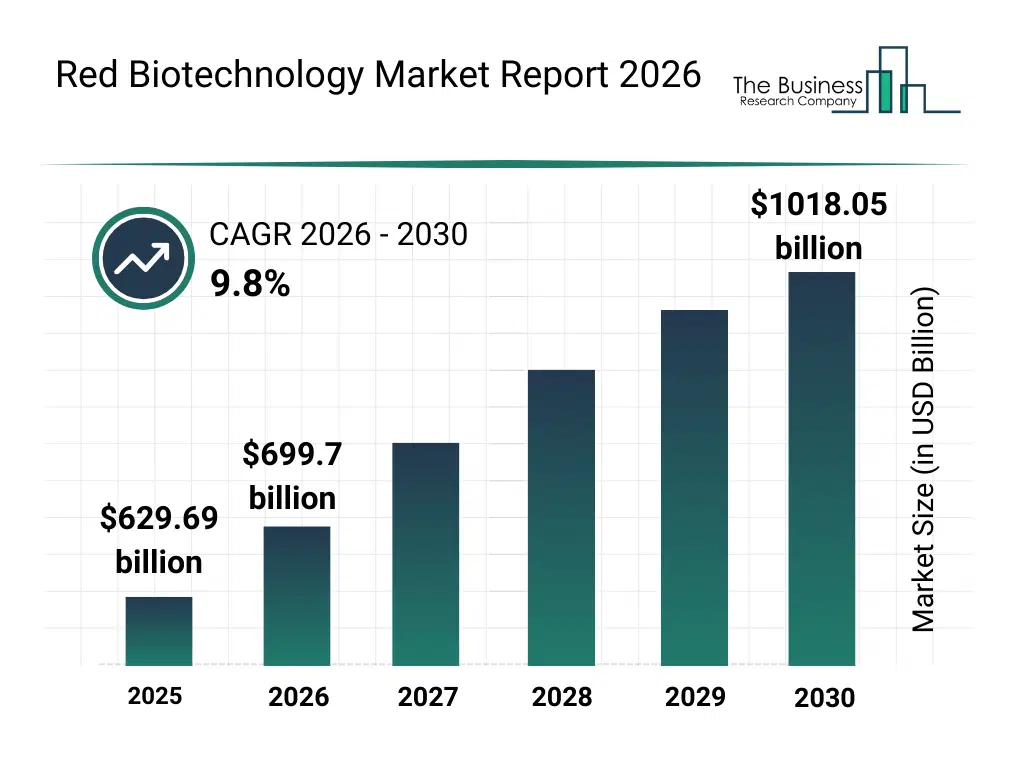
What Is The Red Biotechnology Market Size and Share 2026?
The red biotechnology market size has grown rapidly in recent years. It will grow from $629.69 billion in 2025 to $699.7 billion in 2026 at a compound annual growth rate (CAGR) of 11.1%. The growth in the historic period can be attributed to expansion of pharmaceutical biotechnology research, increasing demand for biologic drugs, growth of academic research institutions, early adoption of recombinant technologies, rising prevalence of chronic diseases.What Is The Red Biotechnology Market Growth Forecast?
The red biotechnology market size is expected to see strong growth in the next few years. It will grow to $1018.05 billion in 2030 at a compound annual growth rate (CAGR) of 9.8%. The growth in the forecast period can be attributed to increasing investments in gene therapy pipelines, expansion of regenerative medicine applications, growing adoption of precision medicine, rising focus on rare disease treatments, advancement of biologics manufacturing technologies. Major trends in the forecast period include increasing development of advanced biologics, rising adoption of gene and cell therapies, growing use of recombinant protein technologies, expansion of personalized medicine solutions, enhanced focus on translational research.
Global Red Biotechnology Market Segmentation
1) By Product: Monoclonal Antibodies, Polyclonal Antibodies, Recombinant Proteins, Vaccines, Cell-Based Immunotherapy Products, Gene Therapy Products, Cell Therapy Products, Tissue-Engineered Products, Other Products 2) By Application: Drug Discovery And Development, Animal Biotechnology, Medical Biotechnology, Clinical Biotechnology, Other Applications 3) By End-User: Biopharmaceutical Industry, Contract Manufacturing Organization (CMO) And Contract Research Organization (CRO) Research Institutes, Other End Users Subsegments: 1) By Monoclonal Antibodies: Therapeutic Monoclonal Antibodies, Diagnostic Monoclonal Antibodies, Biosimilars Of Monoclonal Antibodies, Targeted Monoclonal Antibodies (For Cancer, Autoimmune Diseases) 2) By Polyclonal Antibodies: Diagnostic Polyclonal Antibodies, Therapeutic Polyclonal Antibodies, Research Polyclonal Antibodies 3) By Recombinant Proteins: Enzyme Replacement Therapies, Growth Factors And Hormones, Clotting Factor Products, Interferons And Cytokines 4) By Vaccines: Preventive Vaccines (For Influenza, Covid-19, Hpv), Therapeutic Vaccines (Cancer Vaccines), Dna Or Rna-Based Vaccines, Protein Subunit Vaccines 5) By Cell-Based Immunotherapy Products: Car-T-Cell Therapies, T-Cell Receptor Therapies, Nk Cell Therapies, Dendritic Cell-Based Immunotherapies 6) By Gene Therapy Products: Gene Editing (Crispr-Based Therapies), Viral Vector-Based Gene Therapies, Gene Silencing Therapies, In Vivo Gene Therapy Products 7) By Cell Therapy Products: Stem Cell Therapies, Regenerative Cell Therapies (Mesenchymal Stem Cells), Autologous Cell Therapies, Allogeneic Cell Therapies 8) By Tissue-Engineered Products: Skin And Cartilage Engineered Products, Bone And Muscle Regenerative Products, Cardiovascular Tissue Engineering, Neural Tissue Engineering 9) By Other Products: Blood And Blood Components (E.g., Blood Substitutes), Protein Therapeutics, Diagnostic Kits And Tools (Biomarkers, Assays), Regenerative Medicine ProductsWhat Is The Driver Of The Red Biotechnology Market?
The growing demand for personalized medicine is expected to propel the growth of the red biotechnology market going forward. Personalized medicine refers to tailoring medical treatment to individual characteristics, such as genetics or lifestyle, to optimize effectiveness and minimize adverse effects. The growing demand for personalized medicine is driven by its potential to provide more effective treatments, advancements in genomics, increasing disease complexity, and regulatory support. Red biotechnology enables the development of personalized medicines by utilizing genetic information to tailor treatments to an individual patient's specific genetic makeup and disease characteristics. For instance, in February 2024, according to the Personalized Medicine Coalition, a US-based non-profit organization, the FDA approved 16 novel personalized therapies for patients with rare diseases in 2023, compared to six in 2022. Therefore, the growing demand for personalized medicine is driving the growth of the red biotechnology industry.Key Players In The Global Red Biotechnology Market
Major companies operating in the red biotechnology market are Pfizer Inc., F. Hoffmann-La Roche AG, Bayer AG, Bristol-Myers Squibb Company, GSK plc., Takeda Pharmaceutical Company Limited, Eli Lilly and Company, Gilead Sciences, Amgen Inc., Merck KGaA, Moderna Inc., Regeneron Pharmaceuticals Inc., Astellas Pharma Inc., Biogen Inc., Boehringer Ingelheim International GmbH, BioMarin Pharmaceutical Inc., Vir Biotechnology, Alnylam Pharmaceuticals, Inc., Ultragenyx Pharmaceutical, BioCryst Pharmaceuticals, Sangamo Therapeutics, Inc., Denali Therapeutics, Atara Biotherapeutics, Beam Therapeutics, Umoja Biopharma
This chart is for illustrative purposes; the full report includes a detailed competitor analysis and comprehensive overview of the top 10 companies in the market.
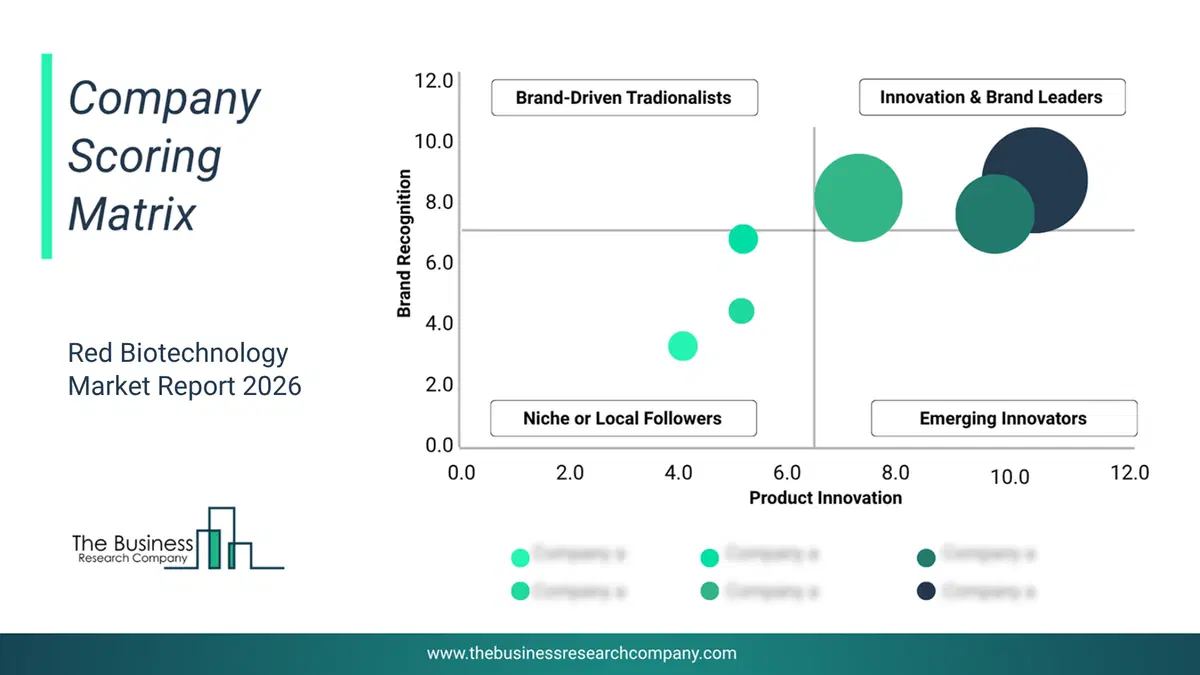
This chart maps companies by product innovation and brand strength, with bubble size indicating relative revenue, helping identify market leaders, challengers, and niche players. This is an illustrative chart; the full report provides a complete and accurate competitive analysis.
Global Red Biotechnology Market Trends and Insights
Major companies operating in the red biotechnology market are increasingly focusing on developing advanced biosimilar therapies to improve treatment accessibility, enhance patient comfort, and ensure clinical equivalence to reference biologics. These innovations aim to reduce treatment costs, broaden patient access, and introduce formulation improvements that support better adherence. For instance, in February 2024, Alvotech, an Iceland-based biotechnology company that collaborated with Teva Pharmaceuticals, a US-based biopharmaceutical company, received US FDA approval for SIMLANDI (adalimumab-ryvk), the first high-concentration, citrate-free, interchangeable biosimilar to Humira (adalimumab). It is developed for chronic inflammatory conditions such as rheumatoid arthritis. SIMLANDI offers a clinically comparable alternative while incorporating features such as a higher-concentration formulation and reduced injection-site discomfort, thereby supporting wider adoption, improved patient experience, and enhanced long-term therapeutic compliance.What Are Latest Mergers And Acquisitions In The Red Biotechnology Market?
In March 2023, Ipsen Biopharmaceuticals Inc., a US-based biopharmaceutical company, acquired Albireo Pharma Inc. for an undisclosed amount. This acquisition enriches Ipsen's Rare Disease portfolio by adding promising therapeutics for pediatric and adult rare cholestatic liver diseases, as well as innovative pipeline potential and scientific and commercial capabilities. Albireo Pharma Inc., a US-based biopharmaceutical company, specializes in developing novel bile acid modulators for treating orphan pediatric liver diseases.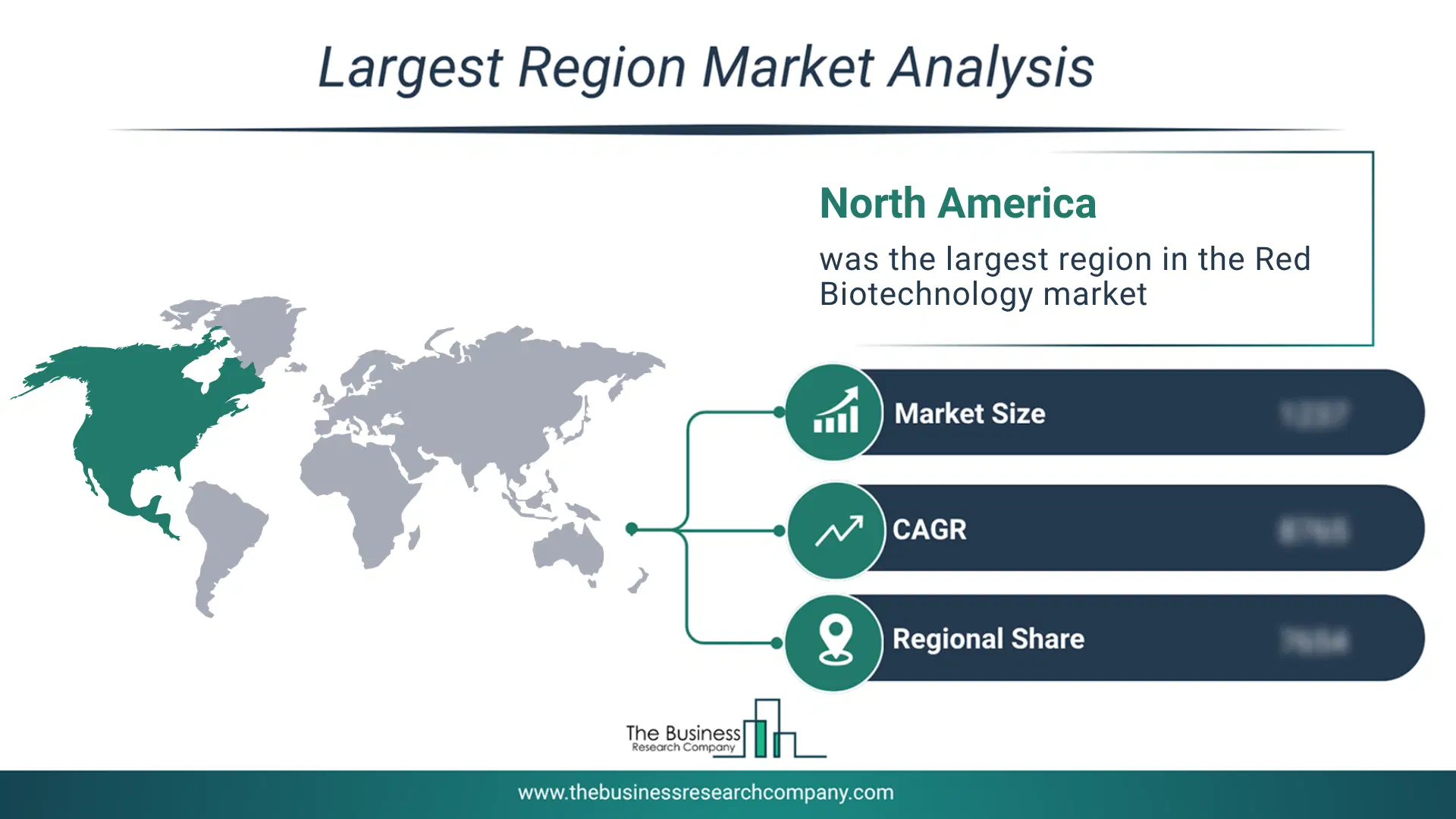
Regional Outlook
North America was the largest region in the red biotechnology market in 2025. Asia-Pacific is expected to be the fastest-growing region in the forecast period. The regions covered in this market report are Asia-Pacific, South East Asia, Western Europe, Eastern Europe, North America, South America, Middle East, Africa. The countries covered in this market report are Australia, Brazil, China, France, Germany, India, Indonesia, Japan, Taiwan, Russia, South Korea, UK, USA, Canada, Italy, Spain.What Defines the Red Biotechnology Market?
The red biotechnology market consists of sales of diagnostic testing kits, biological sensors, regenerative medicine, and antibiotics. Values in this market are ‘factory gate’ values, that is, the value of goods sold by the manufacturers or creators of the goods, whether to other entities (including downstream manufacturers, wholesalers, distributors and retailers) or directly to end customers. The value of goods in this market includes related services sold by the creators of the goods.How is Market Value Defined and Measured?
The market value is defined as the revenues that enterprises gain from the sale of goods and/or services within the specified market and geography through sales, grants, or donations in terms of the currency (in USD unless otherwise specified). The revenues for a specified geography are consumption values that are revenues generated by organizations in the specified geography within the market, irrespective of where they are produced. It does not include revenues from resales along the supply chain, either further along the supply chain or as part of other products.
This chart presents market attractiveness based on a quantitative evaluation of growth, competition, strategic alignment, and risk, offering a clear view of opportunity areas for decision-making. This chart is for illustrative purposes; the full report contains the complete analysis.

This chart highlights the Total Addressable Market (TAM) by estimating the maximum revenue opportunity using an assumption-driven approach, supporting strategic planning and opportunity sizing across markets. The chart is illustrative; the full report provides a more comprehensive analysis.
What Key Data and Analysis Are Included in the Red Biotechnology Market Report 2026?
The red biotechnology market research report is one of a series of new reports from The Business Research Company that provides market statistics, including industry global market size, regional shares, competitors with the market share, detailed market segments, market trends and opportunities, and any further data you may need to thrive in the red biotechnology industry. The market research report delivers a complete perspective of everything you need, with an in-depth analysis of the current and future state of the industry.Red Biotechnology Market Report Forecast Analysis
| Report Attribute | Details |
|---|---|
| Market Size Value In 2026 | $699.7 billion |
| Revenue Forecast In 2030 | $1018.05 billion |
| Growth Rate | CAGR of 9.8% from 2026 to 2030 |
| Base Year For Estimation | 2025 |
| Actual Estimates/Historical Data | 2020-2025 |
| Forecast Period | 2026 - 2030 |
| Market Representation | Revenue in USD Billion and CAGR from 2026 to 2030 |
| Segments Covered | Product, Application, End-User |
| Regional Scope | Asia-Pacific, Western Europe, Eastern Europe, North America, South America, Middle East, Africa |
| Country Scope | The countries covered in the report are Australia, Brazil, China, France, Germany, India, Indonesia, Japan, Taiwan, Russia, South Korea, UK, USA, Canada, Italy, Spain |
| Key Companies Profiled | Pfizer Inc., F. Hoffmann-La Roche AG, Bayer AG, Bristol-Myers Squibb Company, GSK plc., Takeda Pharmaceutical Company Limited, Eli Lilly and Company, Gilead Sciences, Amgen Inc., Merck KGaA, Moderna Inc., Regeneron Pharmaceuticals Inc., Astellas Pharma Inc., Biogen Inc., Boehringer Ingelheim International GmbH, BioMarin Pharmaceutical Inc., Vir Biotechnology, Alnylam Pharmaceuticals, Inc., Ultragenyx Pharmaceutical, BioCryst Pharmaceuticals, Sangamo Therapeutics, Inc., Denali Therapeutics, Atara Biotherapeutics, Beam Therapeutics, Umoja Biopharma |
| Customization Scope | Request for Customization |
| Pricing And Purchase Options | Explore Purchase Options |