

Reduced Caffeine Beverages Market Report 2026
Global Outlook – By Product Type (Reduced Caffeine Coffee, Reduced Caffeine Tea, Reduced Caffeine Soft Drinks, Reduced Caffeine Energy Drinks, Other Product Types), By Distribution Channel (Supermarkets Or Hypermarkets, Convenience Stores, Online Retail, Specialty Stores, Other Distribution Channels), By End User (Adults, Teenagers, Elderly, Other End Users) – Market Size, Trends, Strategies, and Forecast to 2035
Reduced Caffeine Beverages Market Overview
• Reduced Caffeine Beverages market size has reached to $4.47 billion in 2025 • Expected to grow to $6.41 billion in 2030 at a compound annual growth rate (CAGR) of 7.5% • Growth Driver: Increasing Prevalence Of Lifestyle Diseases Driving The Market Growth Due To Rising Focus On Preventive Health Management • Market Trend: Natural Ingredient-Based Coffee Alternatives Gaining Consumer Attention • North America was the largest region in 2025 and Asia-Pacific is the fastest growing region.What Is Covered Under Reduced Caffeine Beverages Market?
Reduced caffeine beverages refer to drinks that are formulated with lower caffeine content compared to their conventional counterparts while maintaining desired taste, aroma, and functional beverage characteristics. These beverages are developed using controlled extraction, blending, or decaffeination techniques to regulate caffeine levels without compromising overall product quality. They are designed to offer moderated stimulant effects and support a balanced consumption experience across different beverage formulations. The main product types of reduced caffeine beverages include reduced caffeine coffee, reduced caffeine tea, reduced caffeine soft drinks, reduced caffeine energy drinks, and other product types. Reduced caffeine coffee refers to coffee beverages formulated with lower caffeine content to provide a milder stimulant effect while maintaining flavor and aroma. They are distributed through supermarkets or hypermarkets, convenience stores, online retail, specialty stores, and other distribution channels, and they are used by several end users such as adults, teenagers, elderly, and others.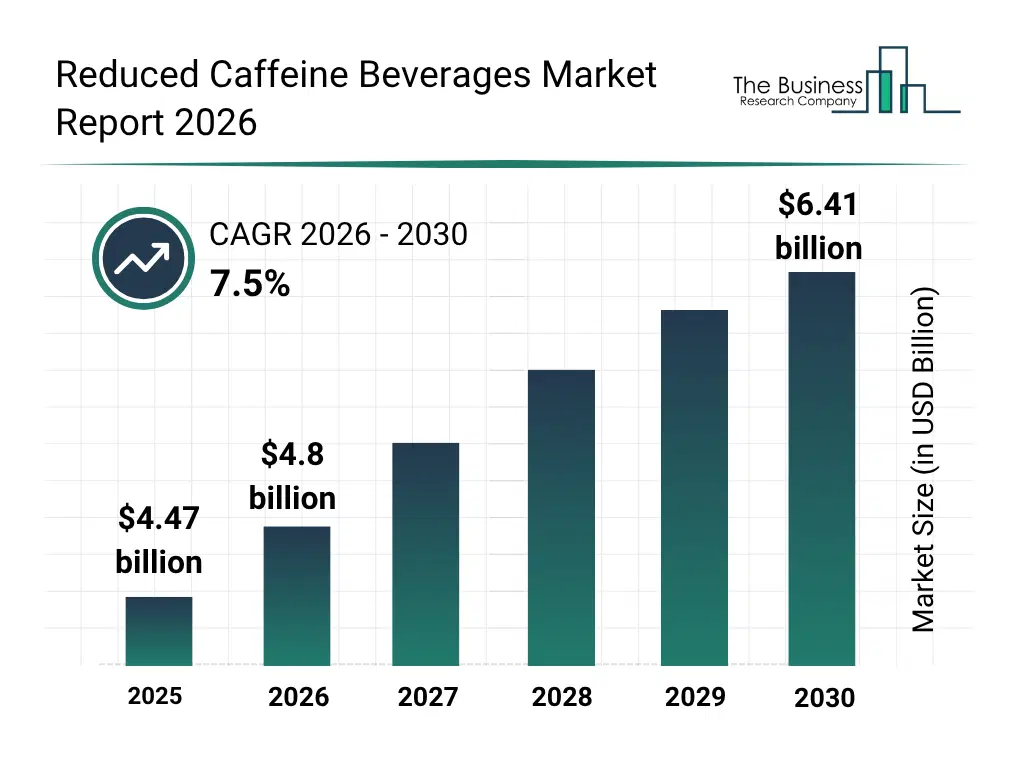
What Is The Reduced Caffeine Beverages Market Size and Share 2026?
The reduced caffeine beverages market size has grown strongly in recent years. It will grow from $4.47 billion in 2025 to $4.8 billion in 2026 at a compound annual growth rate (CAGR) of 7.3%. The growth in the historic period can be attributed to high global coffee and tea consumption culture, rising demand for energy drinks among young population, increasing awareness of caffeine related health concerns, growth of packaged beverage industry, expansion of urban retail beverage availability.What Is The Reduced Caffeine Beverages Market Growth Forecast?
The reduced caffeine beverages market size is expected to see strong growth in the next few years. It will grow to $6.41 billion in 2030 at a compound annual growth rate (CAGR) of 7.5%. The growth in the forecast period can be attributed to rising health consciousness and sleep wellness trends, increasing demand for functional and adaptive beverages, growth in personalized nutrition and dietary customization, expansion of natural ingredient based beverage innovation, stricter labeling and caffeine content transparency regulations. Major trends in the forecast period include rising demand for functional beverages with controlled stimulant intake targeting health conscious consumers, growth in decaffeinated and half caffeine hybrid beverage formulations across coffee and tea segments, increasing product innovation in low caffeine energy drinks with natural stimulants, expansion of clean label and plant based reduced caffeine beverage offerings, rising preference for personalized nutrition based beverage consumption patterns.
Global Reduced Caffeine Beverages Market Segmentation
1) By Product Type: Reduced Caffeine Coffee, Reduced Caffeine Tea, Reduced Caffeine Soft Drinks, Reduced Caffeine Energy Drinks, Other Product Types 2) By Distribution Channel: Supermarkets Or Hypermarkets, Convenience Stores, Online Retail, Specialty Stores, Other Distribution Channels 3) By End User: Adults, Teenagers, Elderly, Other End Users Subsegments: 1) By Reduced Caffeine Coffee: Decaffeinated Roasted Coffee Beans, Half Caff Ground Coffee, Instant Decaf Coffee, Low Caffeine Espresso Blends, Cold Brew Reduced Caffeine Coffee, Coffee Pods 2) By Reduced Caffeine Tea: Decaffeinated Black Tea, Decaffeinated Green Tea, Low Caffeine White Tea, Herbal Tea Blends With Trace Caffeine, Half Caffeine Chai Blends, Cold Brew Decaf Tea 3) By Reduced Caffeine Soft Drinks: Caffeine Free Cola Variants, Low Caffeine Citrus Sodas, Reduced Caffeine Flavored Carbonated Drinks, Diet Soft Drinks With Reduced Caffeine, Energy Soda Hybrids, Functional Sparkling Beverages 4) By Reduced Caffeine Energy Drinks: Low Caffeine Energy Shots, Hybrid Energy Drinks, Electrolyte Based Low Caffeine Energy Drinks, Natural Stimulant Based Drinks, Sugar Free Low Caffeine Energy Drinks, Sports Energy Crossover Drinks 5) By Other Product Types: Reduced Caffeine Chocolate Beverages, Low Caffeine Plant Based Drinks, Functional Wellness Drinks, Reduced Caffeine Flavored Waters, Caffeine Controlled Protein Drinks, Specialty Ayurvedic BeveragesWhat Is The Driver Of The Reduced Caffeine Beverages Market?
The increasing prevalence of lifestyle diseases is expected to propel the growth of the reduced caffeine beverages market going forward. Lifestyle diseases are chronic health conditions such as obesity, diabetes, and cardiovascular disorders that are primarily caused by unhealthy diet, physical inactivity, and other behavioral factors. The prevalence of lifestyle diseases is rising due to increasing sedentary behavior, as reduced physical activity slows metabolism, contributes to weight gain, and elevates the risk of chronic conditions such as obesity, diabetes, and cardiovascular diseases. Reduced caffeine beverages help manage lifestyle diseases by lowering excessive caffeine intake, which can support better sleep quality, reduce stress levels, and contribute to improved cardiovascular and metabolic health over time. For instance, in June 2024, according to the National Health Service, a UK-based government department, around 3.62 million individuals registered with a general practitioner (GP) were diagnosed with non-diabetic hyperglycemia or pre-diabetes in 2023, marking an increase from 3.07 million cases in 2022. Therefore, the increasing prevalence of lifestyle diseases is driving the growth of the reduced caffeine beverages industry.Key Players In The Global Reduced Caffeine Beverages Market
Major companies operating in the reduced caffeine beverages market are Nestlé S.A., PepsiCo Inc., Starbucks Corporation, Tata Consumer Products Limited, R. C. Bigelow Inc., Dilmah Ceylon Tea Company PLC, Luigi Lavazza S.p.A., Verve Coffee Roasters LLC, Traditional Medicinals Inc., Harney & Sons Fine Teas Inc., Counter Culture Coffee Inc., Republic of Tea Inc., Tchibo GmbH, Four Sigmatic Inc., MUD\WTR Inc., Teeccino Caffé Inc., Crio Bru LLC, Rasa LLC, Dandy Blend LLC, Arbor Teas Inc.Global Reduced Caffeine Beverages Market Trends and Insights
Major companies operating in the reduced caffeine beverages market are focusing on developing innovative products such as, plant-based caffeine-free coffee alternatives to cater to consumers seeking lower stimulant intake without compromising on taste and functional benefits. Plant-based caffeine-free coffee alternatives are beverages made from natural ingredients such as roasted grains, nuts, seeds, legumes, or botanicals that mimic coffee’s flavor and aroma without caffeine, helping consumers avoid side effects such as jitteriness, sleep disruption, and increased heart rate while still enjoying a coffee-like experience. For instance, in January 2024, Kamana, a US-based beverage brand, launched a mesquite-based caffeine-free coffee alternative designed to replicate the taste and aroma of traditional coffee while eliminating caffeine, helping consumers avoid side effects such as jitteriness, sleep disruption, and increased heart rate while supporting a smoother and more balanced beverage experience. The beverage is crafted using roasted mesquite pods, which naturally impart a slightly sweet, earthy flavor profile along with mild cocoa-like and caramel undertones, creating a coffee-like sensory experience without the need for coffee beans. It is positioned as a functional and wellness-oriented drink suitable for individuals seeking to reduce caffeine intake while still maintaining familiar coffee rituals such as brewing and hot consumptionWhat Are Latest Mergers And Acquisitions In The Reduced Caffeine Beverages Market?
In January 2026, Explorer Cold Brew, a US-based coffee manufacturing company, acquired Savorista for an undisclosed amount. With this acquisition, Explorer Cold Brew aims to strengthen its position in the growing caffeine-conscious coffee segment by expanding into decaffeinated and half-caffeinated offerings and building a broader portfolio that caters to consumers seeking more control over caffeine intake. Savorista is a US-based specialty coffee company that specializes in providing premium decaffeinated and half-caffeinated coffee products designed to deliver full-flavor coffee experiences with reduced or no caffeine.Regional Outlook/Insights
North America was the largest region in the reduced caffeine beverages market in 2025. Asia-Pacific is expected to be the fastest-growing region in the forecast period. The regions covered in this market report are Asia-Pacific, South East Asia, Western Europe, Eastern Europe, North America, South America, Middle East, Africa. The countries covered in this market report are Australia, Brazil, China, France, Germany, India, Indonesia, Japan, Taiwan, Russia, South Korea, UK, USA, Canada, Italy, Spain.What Defines the Reduced Caffeine Beverages Market?
The reduced caffeine beverages market consists of sales of ready-to-drink reduced caffeine formulations, carbonated and non-carbonated low caffeine drinks, flavored reduced caffeine beverages, plant-based low caffeine drinks, and functional beverages with reduced stimulant content. Values in this market are ‘factory gate’ values, that is, the value of goods sold by the manufacturers or creators of the goods, whether to other entities (including downstream manufacturers, wholesalers, distributors, and retailers) or directly to end customers. The value of goods in this market includes related services sold by the creators of the goods.How is Market Value Defined and Measured?
The market value is defined as the revenues that enterprises gain from the sale of goods and/or services within the specified market and geography through sales, grants, or donations in terms of the currency (in USD unless otherwise specified). The revenues for a specified geography are consumption values that are revenues generated by organizations in the specified geography within the market, irrespective of where they are produced. It does not include revenues from resales along the supply chain, either further along the supply chain or as part of other products.What Key Data and Analysis Are Included in the Reduced Caffeine Beverages Market Report 2026?
The reduced caffeine beverages market research report is one of a series of new reports from The Business Research Company that provides market statistics, including industry global market size, regional shares, competitors with the market share, detailed market segments, market trends and opportunities, and any further data you may need to thrive in the reduced caffeine beverages industry. The market research report delivers a complete perspective of everything you need, with an in-depth analysis of the current and future state of the industry.Reduced Caffeine Beverages Market Report Forecast Analysis
| Report Attribute | Details |
|---|---|
| Market Size Value In 2026 | $4.8 billion |
| Revenue Forecast In 2035 | $6.41 billion |
| Growth Rate | CAGR of 7.5% from 2026 to 2035 |
| Base Year For Estimation | 2025 |
| Actual Estimates/Historical Data | 2020-2025 |
| Forecast Period | 2026 - 2030 - 2035 |
| Market Representation | Revenue in USD Billion and CAGR from 2026 to 2035 |
| Segments Covered | Product Type, Distribution Channel, End User |
| Regional Scope | Asia-Pacific, Western Europe, Eastern Europe, North America, South America, Middle East, Africa |
| Country Scope | The countries covered in the report are Australia, Brazil, China, France, Germany, India, Indonesia, Japan, Taiwan, Russia, South Korea, UK, USA, Canada, Italy, Spain. |
| Key Companies Profiled | Nestlé S.A., PepsiCo Inc., Starbucks Corporation, Tata Consumer Products Limited, R. C. Bigelow Inc., Dilmah Ceylon Tea Company PLC, Luigi Lavazza S.p.A., Verve Coffee Roasters LLC, Traditional Medicinals Inc., Harney & Sons Fine Teas Inc., Counter Culture Coffee Inc., Republic of Tea Inc., Tchibo GmbH, Four Sigmatic Inc., MUD\WTR Inc., Teeccino Caffé Inc., Crio Bru LLC, Rasa LLC, Dandy Blend LLC, Arbor Teas Inc. |
| Customization Scope | Request for Customization |
| Pricing And Purchase Options | Explore Purchase Options |