
Refrigeration Coolers Market Report 2026
Global Outlook – By Product Type (Evaporators And Air Coolers, Condensers, Compressors, Magnetic Cooling Modules, Controls And Accessories, Other Product Types), By Refrigerant (Ammonia (NH₃), Carbon Dioxide (CO₂), HFC And HFO Blends, Hydrocarbons (R-290, R-600a), Other Refrigerants), By System Type (Self-contained (Plug-in), Remote Condensing Units, Centralized Rack Systems, Hybrid Or Transcritical CO₂ Systems, Other System Types), By Distribution (Direct Sales, Distributors And Wholesalers, Retail Sales, Online Sales), By End-User (Food And Beverage Processing, Cold-storage And Logistics, Supermarkets And Hypermarkets, Pharmaceuticals And Life-sciences, Data Centers And Electronics Cooling, Other End-user Applications) – Market Size, Trends, Strategies, and Forecast to 2035
Refrigeration Coolers Market Overview
• Refrigeration Coolers market size has reached to $4.27 billion in 2025 • Expected to grow to $7.93 billion in 2030 at a compound annual growth rate (CAGR) of 13.2% • Growth Driver: Surge In Demand For Processed And Frozen Food Products Fueling The Growth Of The Market Due To Increasing Urbanization And Growing Preference For Convenient, Time-saving Meal Solutions • Market Trend: Innovations In Artificial Intelligence (AI) Cooling Technology Enhance Energy Efficiency And Temperature Optimization In Refrigeration Systems • North America was the largest region in 2025 and Asia-Pacific is the fastest growing region.What Is Covered Under Refrigeration Coolers Market?
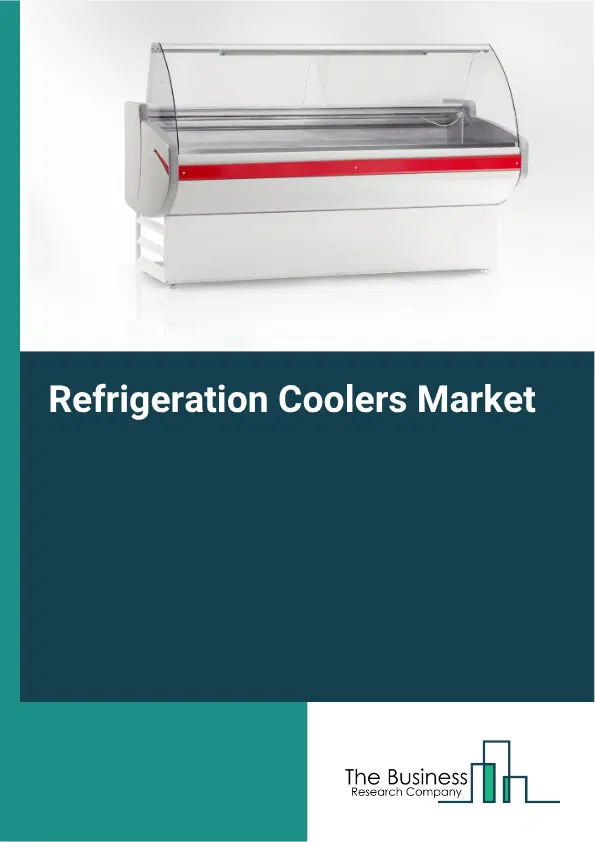
Refrigeration coolers are mechanical systems designed to remove heat from enclosed spaces or products to maintain low and controlled temperatures. They operate using refrigeration cycles that typically involve compression, condensation, expansion, and evaporation of refrigerants. These systems are widely used to preserve perishable goods and maintain temperature stability in various storage and transport conditions. The main product types of refrigeration coolers include evaporators and air coolers, condensers, compressors, magnetic cooling modules, controls and accessories, and other product types. Evaporators and air coolers refer to heat exchange components used to remove heat from enclosed spaces by circulating refrigerant and maintaining low temperatures. The different refrigerants include ammonia (nh₃), carbon dioxide (co₂), hfc and hfo blends, hydrocarbons (r-290, r-600a), and other refrigerants and the various system types include self-contained (plug-in), remote condensing units, centralised rack systems, hybrid or transcritical co₂ systems, and other system types. The various distribution channels include direct sales, distributors and wholesalers, retail sales, and online sales, and they are used by several end users such as food and beverage processing, cold-storage and logistics, supermarkets and hypermarkets, pharmaceuticals and life-sciences, data centres and electronics cooling, and other end-user applications.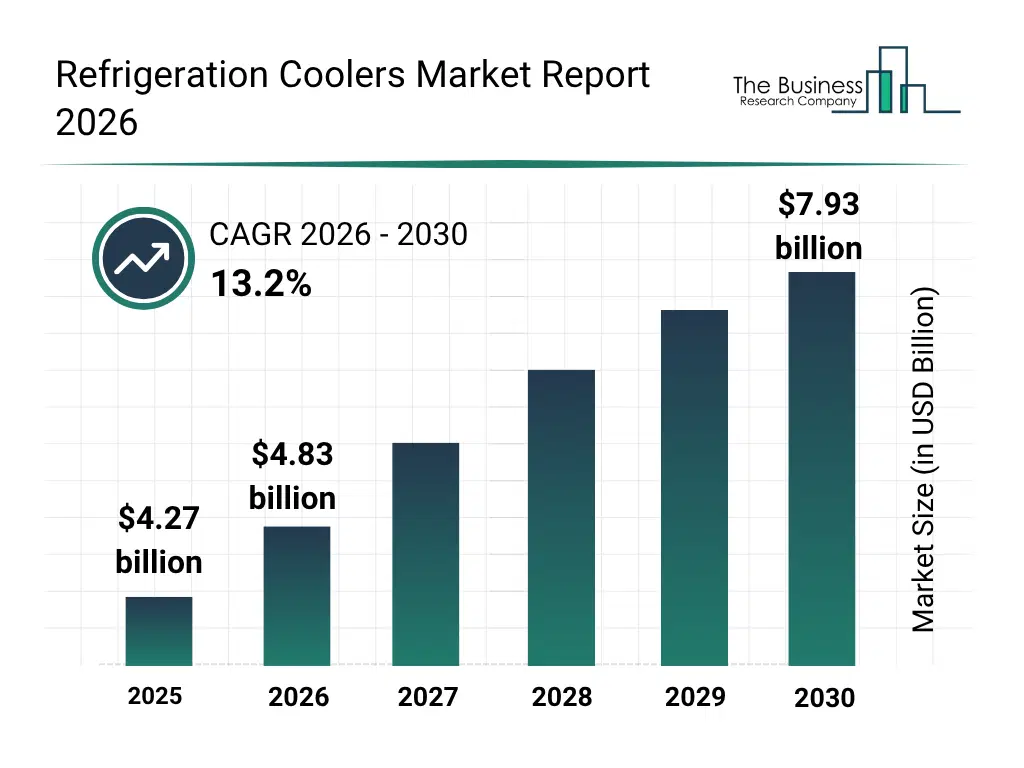
What Is The Refrigeration Coolers Market Size and Share 2026?
The refrigeration coolers market size has grown rapidly in recent years.It will grow from $4.27 billion in 2025 to $4.83 billion in 2026 at a compound annual growth rate (CAGR) of 13.0%. The growth in the historic period can be attributed to rising demand for cold-chain logistics infrastructure, expansion of food and beverage processing industries, increasing use of refrigeration systems in supermarkets and hypermarkets, growing pharmaceutical cold-storage requirements, advancements in compressor and condenser technologies.What Is The Refrigeration Coolers Market Growth Forecast?
The refrigeration coolers market size is expected to see rapid growth in the next few years.It will grow to $7.93 billion by 2030 at a compound annual growth rate (CAGR) of 13.2%. The growth in the forecast period can be attributed to increasing adoption of smart refrigeration monitoring systems, growing investments in sustainable refrigerant technologies, rising demand for energy-efficient industrial cooling systems, expansion of data centre cooling applications, increasing integration of automated temperature control solutions.Major trends in the forecast period include increasing adoption of natural and low-global-warming-potential refrigerants in refrigeration coolers, growing demand for energy-efficient cooling systems in cold-storage and food processing facilities, rising deployment of modular and compact refrigeration coolers for space-constrained applications, expansion of transcritical CO₂ refrigeration systems across commercial and industrial sectors, increasing focus on high-performance cooling systems for temperature-sensitive product storage.
Global Refrigeration Coolers Market Segmentation
1) By Product Type: Evaporators And Air Coolers, Condensers, Compressors, Magnetic Cooling Modules, Controls And Accessories, Other Product Types 2) By Refrigerant: Ammonia (NH₃), Carbon Dioxide (CO₂), HFC And HFO Blends, Hydrocarbons (R-290, R-600a), Other Refrigerants 3) By System Type: Self-contained (Plug-in), Remote Condensing Units, Centralized Rack Systems, Hybrid Or Transcritical CO₂ Systems, Other System Types 4) By Distribution: Direct Sales, Distributors And Wholesalers, Retail Sales, Online Sales 5) By End-User: Food And Beverage Processing, Cold-storage And Logistics, Supermarkets And Hypermarkets, Pharmaceuticals And Life-sciences, Data Centers And Electronics Cooling, Other End-user Applications Subsegments: 1) By Evaporators And Air Coolers: Plate Evaporators, Finned Tube Evaporators, Unit Coolers, Forced Air Coolers, Shell And Tube Evaporators 2) By Condensers: Air Cooled Condensers, Water Cooled Condensers, Evaporative Condensers, Microchannel Condensers 3) By Compressors: Reciprocating Compressors, Screw Compressors, Scroll Compressors, Centrifugal Compressors, Rotary Compressors 4) By Magnetic Cooling Modules: Active Magnetic Regenerator Modules, Magnetic Refrigeration Plates, Magnetic Heat Exchange Modules, Solid State Cooling Modules 5) By Controls And Accessories: Temperature Controllers, Pressure Controllers, Expansion Valves, Sensors And Transmitters, Control Panels 6) By Other Product Types: Thermal Storage Units, Refrigerant Distribution Systems, Cooling Fans And Blowers, Insulation ComponentsWhat Is The Driver Of The Refrigeration Coolers Market?
The rising demand for processed and frozen food products is expected to propel the growth of the refrigeration coolers industry going forward.Processed and frozen food refer to food items that have been modified, packaged, or preserved to extend shelf life and improve convenience.The rising demand for processed food and frozen food is driven by increasing urbanization and busy lifestyles, as consumers seek convenient, time-saving meal options.Refrigeration coolers help maintain the quality and safety of processed food and frozen food by providing consistent low-temperature storage and transportation conditions, thereby extending shelf life and supporting rising consumer demand.For instance, in October 2023, according to the Food Industry Association, a US-based organizations representing the frozen food supply chain and the broader food retail sector, respectively, US retail frozen food sales grew from USD 72.2 billion in 2022 to USD 74.2 billion in 2023.Therefore, the rising demand for processed and frozen food products is driving the growth of the refrigeration coolers industry.Key Players In The Global Refrigeration Coolers Market
Major companies operating in the refrigeration coolers market are Panasonic Holdings Corporation, Haier Smart Home Co. Ltd., Johnson Controls International plc, Carrier Global Corporation, Emerson Electric Co., Danfoss A S, Dover Corporation, Kelvion Holding GmbH, True Manufacturing Company Inc., EVAPCO Inc., Güntner GmbH and Co KG, Roen Est Srl, Koller Refrigeration and Equipment Ltd., Everest Refrigeration Co Inc., Daikin Industries Ltd., Epta SpA, Western Refrigeration Private Limited, Skycon Equipments LLP, Arctic Refrigeration Pvt Ltd, Thermokey SpAGlobal Refrigeration Coolers Market Trends and Insights
Major companies operating in the refrigeration coolers market are focusing on developing advanced cooling solutions, such as artificial intelligence-driven hybrid cooling systems, to enhance temperature stability, improve energy efficiency, and extend the freshness of stored food products. Artificial intelligence-driven hybrid cooling systems refer to advanced refrigeration technologies that use artificial intelligence to intelligently control and optimize multiple cooling mechanisms for improved efficiency, temperature stability, and energy savings. For instance, in December 2024, Samsung Electronics, a South Korea-based technology company, introduced its latest refrigerators at CES 2025, showcasing an advanced AI Hybrid Cooling technology. The system is designed to enhance user convenience by optimizing cooling performance and energy usage. It intelligently regulates compressor activity and cooling cycles to ensure stable and uniform internal temperatures. This helps in reducing overall energy consumption while maintaining better freshness and preservation of stored food. Overall, the innovation reflects Samsung’s focus on smart, efficient, and energy-saving refrigeration solutions.What Are Latest Mergers And Acquisitions In The Refrigeration Coolers Market?
In December 2024, Panasonic Corporation, a Japan‑based industrial technology and appliance manufacturer, acquired Area Cooling Solutions Sp. z o. o. for an undisclosed amount. Through this acquisition, Panasonic aims to strengthen its refrigeration capabilities by integrating Area Cooling’s industrial and commercial refrigeration equipment and expanding its portfolio of cold chain solutions. Area Cooling Solutions Sp. z o. o. is a Poland‑based company that provides refrigeration equipment, spare parts, and environmentally friendly systems such as inverter‑controlled and CO₂ condensing units.Regional Insights
North America was the largest region in the refrigeration coolers market in 2025. Asia-Pacific is expected to be the fastest-growing region in the forecast period. The regions covered in this market report are Asia-Pacific, South East Asia, Western Europe, Eastern Europe, North America, South America, Middle East and Africa. The countries covered in this market report are Australia, Brazil, China, France, Germany, India, Indonesia, Japan, Taiwan, Russia, South Korea, UK, USA, Canada, Italy, Spain.What Defines the Refrigeration Coolers Market?
The refrigeration coolers market consists of sales of display refrigeration cabinets, walk-in cold rooms, blast chillers, and refrigerated display cases. Values in this market are ‘factory gate’ values, that is, the value of goods sold by the manufacturers or creators of the goods, whether to other entities (including downstream manufacturers, wholesalers, distributors, and retailers) or directly to end customers. The value of goods in this market includes related services sold by the creators of the goods.What is the Market Assessment and Strategic Outlook for the Refrigeration Coolers Industry?
The refrigeration coolers market research report is one of a series of new reports from The Business Research Company that provides market statistics, including industry global market size, regional shares, competitors with the market share, detailed market segments, market trends and opportunities, and any further data you may need to thrive in the refrigeration coolers industry. The market research report delivers a complete perspective of everything you need, with an in-depth analysis of the current and future state of the industry.What is the Market Assessment and Strategic Outlook for the Refrigeration Coolers Market Report 2026?
The refrigeration coolers market research report is one of a series of new reports from The Business Research Company that provides refrigeration coolers market statistics, including refrigeration coolers industry global market size, regional shares, competitors with a refrigeration coolers market share, detailed refrigeration coolers market segments, market trends and opportunities, and any further data you may need to thrive in the refrigeration coolers industry. This refrigeration coolers market research report delivers a complete perspective of everything you need, with an in-depth analysis of the current and future scenario of the industry.Refrigeration Coolers Market Report Forecast Analysis
| Report Attribute | Details |
|---|---|
| Market Size Value In 2026 | $4.83 billion |
| Revenue Forecast In 2035 | $7.93 billion |
| Growth Rate | CAGR of 13.2% from 2026 to 2035 |
| Base Year For Estimation | 2025 |
| Actual Estimates/Historical Data | 2020-2025 |
| Forecast Period | 2026 - 2030 - 2035 |
| Market Representation | Revenue in USD Billion and CAGR from 2026 to 2035 |
| Segments Covered | Product Type, Refrigerant, System Type, Distribution, End-User |
| Regional Scope | Asia-Pacific, Western Europe, Eastern Europe, North America, South America, Middle East, Africa |
| Country Scope | The countries covered in the report are Australia, Brazil, China, France, Germany, India, Indonesia, Japan, Taiwan, Russia, South Korea, UK, USA, Canada, Italy, Spain. |
| Key Companies Profiled | Panasonic Holdings Corporation, Haier Smart Home Co. Ltd., Johnson Controls International plc, Carrier Global Corporation, Emerson Electric Co., Danfoss A S, Dover Corporation, Kelvion Holding GmbH, True Manufacturing Company Inc., EVAPCO Inc., Güntner GmbH and Co KG, Roen Est Srl, Koller Refrigeration and Equipment Ltd., Everest Refrigeration Co Inc., Daikin Industries Ltd., Epta SpA, Western Refrigeration Private Limited, Skycon Equipments LLP, Arctic Refrigeration Pvt Ltd, Thermokey SpA |
| Customization Scope | Request for Customization |
| Pricing And Purchase Options | Explore Purchase Options |