
Regenerative Braking Systems Market Report 2026
Global Outlook – By Component (Battery, Motor, Electronic Control Unit (ECU), Flywheel), By Propulsion (Battery Electric Vehicle (BEV), Plug-In Hybrid Electric Vehicle (PHEV), Fuel Cell Electric Vehicle (FCEV)), By Vehicle Type (Passenger Car (PC), Light Commercial Vehicle (LCV), Heavy Commercial Vehicle (HCV)) – Market Size, Trends, Strategies, and Forecast to 2030
Regenerative Braking Systems Market Overview
• Regenerative Braking Systems market size has reached to $8.5 billion in 2025 • Expected to grow to $15.3 billion in 2030 at a compound annual growth rate (CAGR) of 12.5% • Growth Driver: Surge In Energy-Efficient Transportation Fueling The Growth Of The Market Due To Rising Adoption Of Electric And Hybrid Vehicles • Market Trend: Innovative Energy Recovery Technology Enhances Braking Efficiency And Vehicle Performance • Asia-Pacific was the largest region in 2025 and North America is the fastest growing region.What Is Covered Under Regenerative Braking Systems Market?
Regenerative braking systems are a type of braking technology used in vehicles that convert kinetic energy (the energy of motion) into electrical energy during braking. Instead of traditional braking systems that use friction to stop the vehicle and dissipate energy as heat, regenerative braking captures some energy and stores it in the vehicle's battery for later use. Regenerative braking systems help to improve energy efficiency, extend the driving range of electric vehicles, and reduce wear on traditional braking components. The main components of regenerative braking systems are the battery, motor, electronic control unit (ECU), and flywheel. In regenerative braking systems, the battery stores electrical energy converted from the vehicle's kinetic energy during braking. The various propulsion systems involved are battery electric vehicles (BEV), plug-in hybrid electric vehicles (PHEV), fuel cell electric vehicles (FCEV) used for passenger cars (pc), light commercial vehicles (CV), and heavy commercial vehicles (HCV).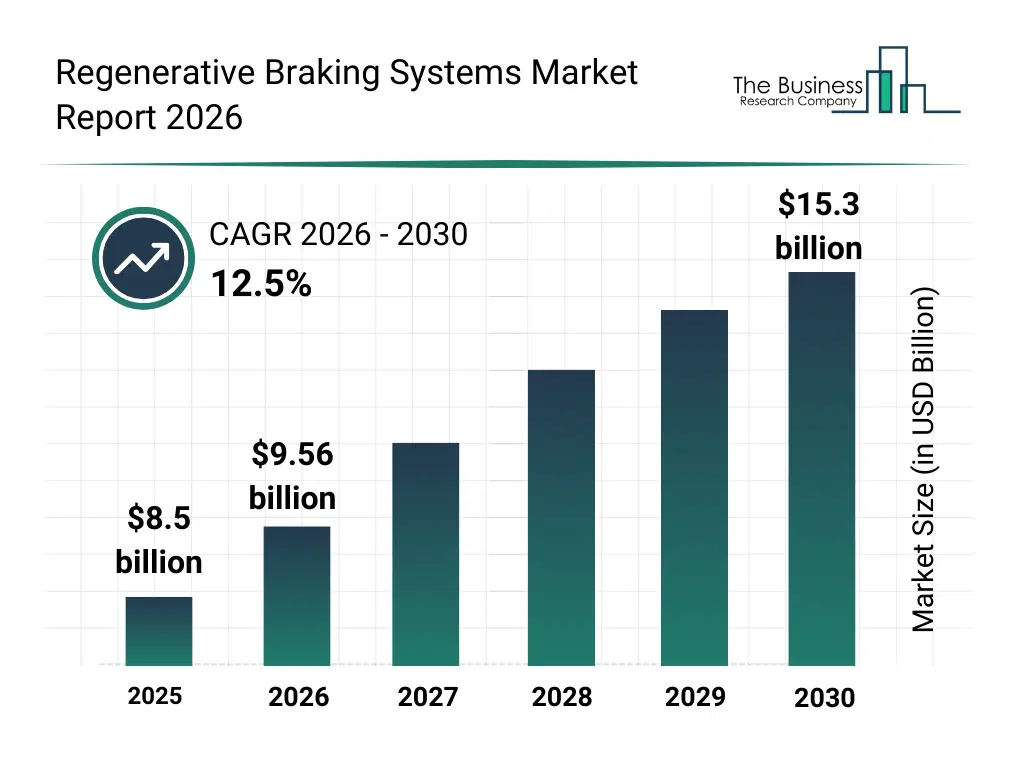
What Is The Regenerative Braking Systems Market Size and Share 2026?
The regenerative braking systems market size has grown rapidly in recent years. It will grow from $8.5 billion in 2025 to $9.56 billion in 2026 at a compound annual growth rate (CAGR) of 12.5%. The growth in the historic period can be attributed to expansion of electric vehicle production, rising demand for energy-efficient vehicle systems, improvements in battery technologies, adoption of hybrid vehicles, advancements in power electronics.What Is The Regenerative Braking Systems Market Growth Forecast?
The regenerative braking systems market size is expected to see rapid growth in the next few years. It will grow to $15.3 billion in 2030 at a compound annual growth rate (CAGR) of 12.5%. The growth in the forecast period can be attributed to increasing penetration of electric mobility, rising demand for extended vehicle range, expansion of autonomous vehicle platforms, growing investments in vehicle electrification, increasing focus on energy efficiency optimization. Major trends in the forecast period include advancements in energy recovery efficiency, integration with advanced battery management systems, growing adoption in electric and hybrid vehicles, development of high-performance power electronics, enhanced software-based braking control.
Global Regenerative Braking Systems Market Segmentation
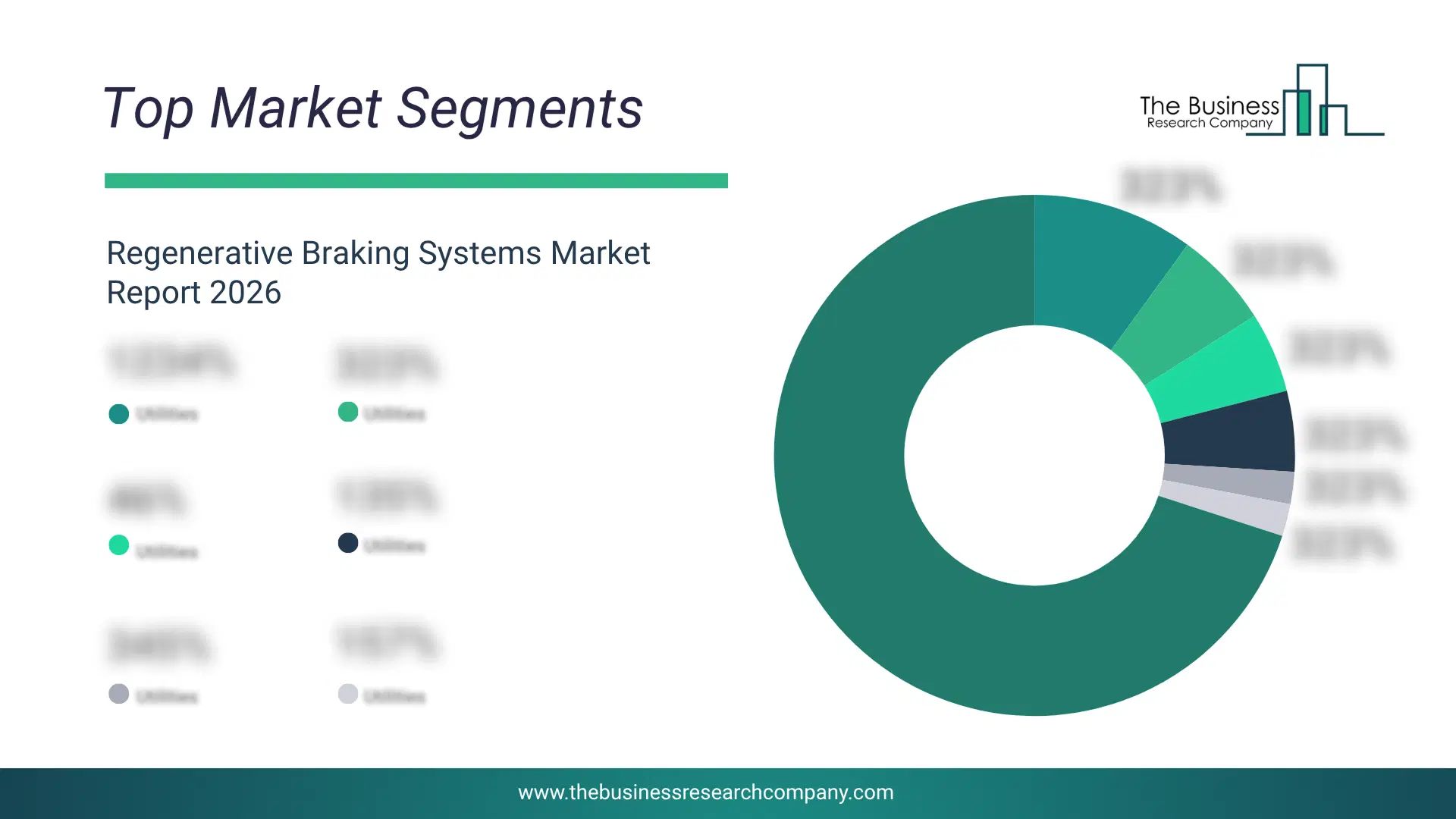
1) By Component: Battery, Motor, Electronic Control Unit (ECU), Flywheel 2) By Propulsion: Battery Electric Vehicle (BEV), Plug-In Hybrid Electric Vehicle (PHEV), Fuel Cell Electric Vehicle (FCEV) 3) By Vehicle Type: Passenger Car (PC), Light Commercial Vehicle (LCV), Heavy Commercial Vehicle (HCV) Subsegments: 1) By Battery: Lithium-Ion Battery, Nickel-Metal Hydride Battery, Lead Acid Battery, Solid-State Battery 2) By Motor: Permanent Magnet Synchronous Motor (PMSM), Induction Motor, Switched Reluctance Motor, Axial Flux Motor 3) By Electronic Control Unit (ECU): Motor Control Electronic Control Unit (ECU), Battery Management Electronic Control Unit (ECU), Integrated Control Electronic Control Unit (ECU), Adaptive Control Electronic Control Unit (ECU) 4) By Flywheel: Composite Flywheel, Steel Flywheel, Carbon Fiber Flywheel, High-Speed FlywheelWhat Is The Driver Of The Regenerative Braking Systems Market?
The growing demand for energy-efficient transportation solutions is expected to propel the growth of the regenerative braking systems market going forward. Energy-efficient transportation solutions are vehicles and systems that use less energy while traveling, helping to reduce fuel consumption and emissions. The common energy-efficient transportation solutions are electric vehicles, hybrid vehicles, electric buses, electric trains, and more. The growing demand for energy-efficient transportation solutions is due to increasing environmental concerns and the rising cost of fossil fuels. As awareness of climate change and air pollution grows, people and governments increasingly seek ways to reduce carbon emissions and their ecological footprint, leading to a shift toward cleaner, energy-efficient transportation options. Regenerative braking systems are used in energy-efficient transportation solutions by capturing and converting the kinetic energy typically lost as heat during braking into electrical energy. For instance, in March 2025, according to the International Energy Agency, a France-based intergovernmental organization for monitoring and analyzing global energy use, the platform reported that global electric car sales exceeded 17 million in 2024, a big jump compared to 2023 driven by the shift toward energy-efficient transportation solutions. Therefore, the growing demand for energy-efficient transportation solutions is driving the growth of the regenerative braking systems industry.Key Players In The Global Regenerative Braking Systems Market
Major companies operating in the regenerative braking systems market report include Volkswagen AG, General Motors Company, Honda Motor Co Ltd, SAIC Motor Corporation Limited, Hyundai Motor Company, Robert Bosch GmbH, Tesla Inc, Nissan Motor Co Ltd, Kia Corporation, BYD Company Limited, Tata Motors Limited, Renault Group, Volvo Group, Denso Corporation, Continental AG, Mitsubishi Electric Corporation, Mazda Motor Corporation, Suzuki Motor Corporation, Subaru Corporation, Aisin Corporation, Geely Automobile Holdings Limited, Mitsubishi Motors Corporation, Stellantis NV, Toyota Motor Corporation, Mahindra and Mahindra Limited, BorgWarner Inc, Hitachi Astemo Ltd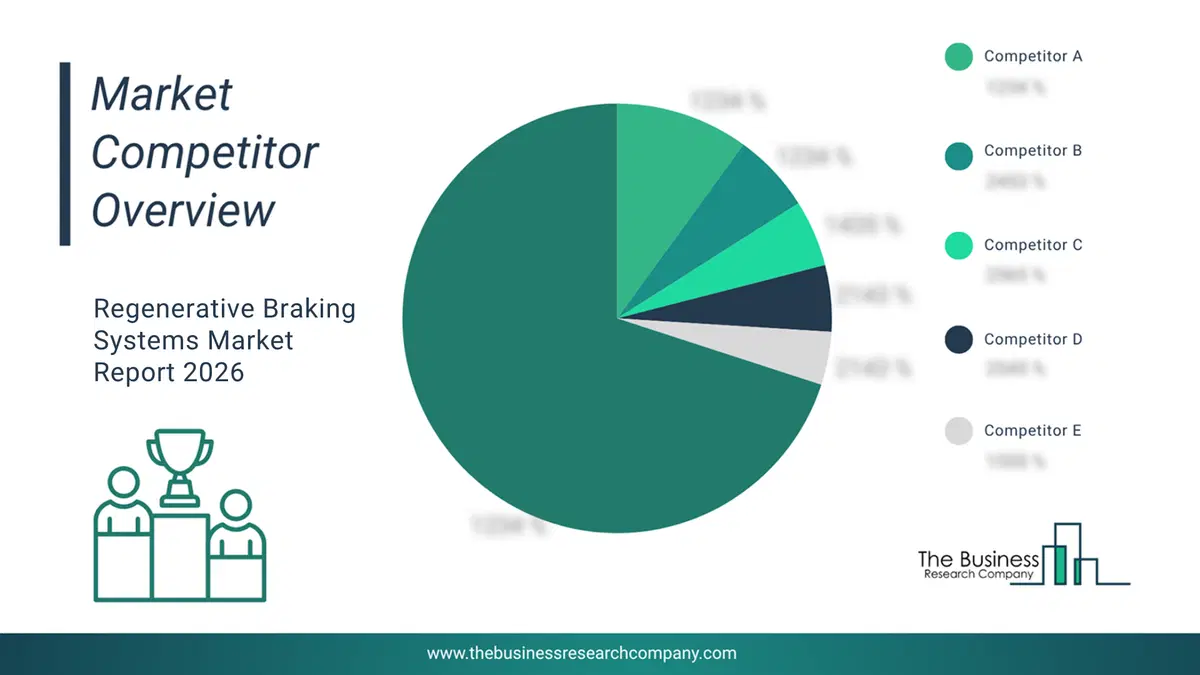
This chart is for illustrative purposes; the full report includes a detailed competitor analysis and comprehensive overview of the top 10 companies in the market.
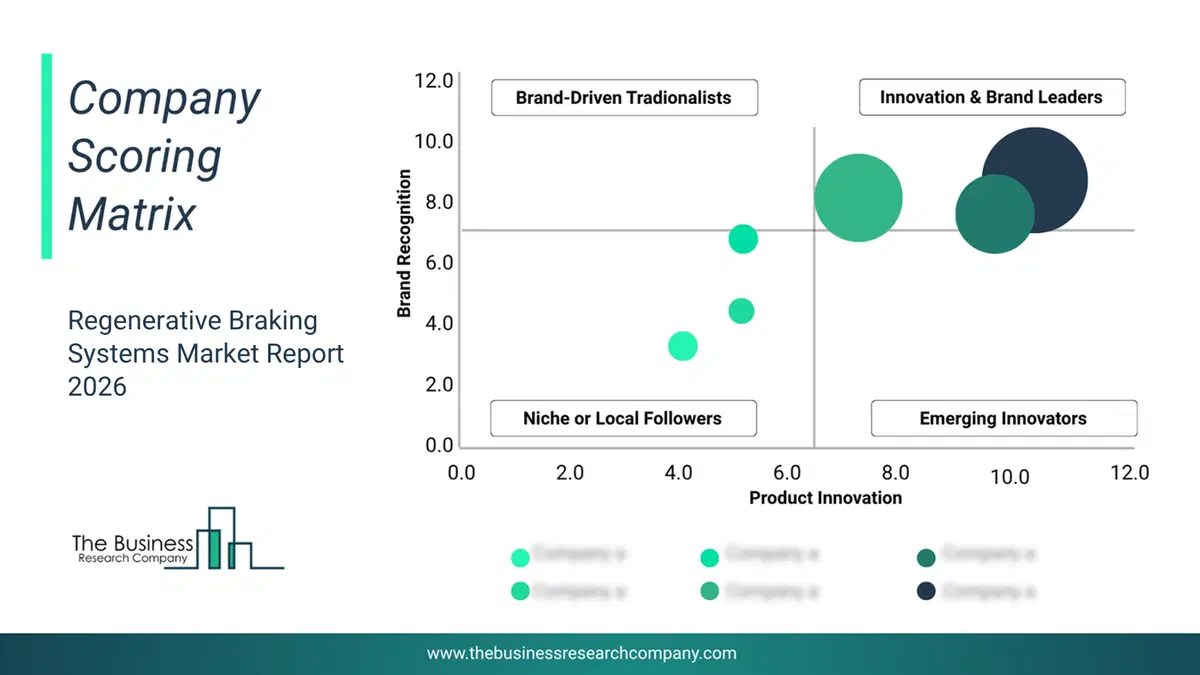
This chart maps companies by product innovation and brand strength, with bubble size indicating relative revenue, helping identify market leaders, challengers, and niche players. This is an illustrative chart; the full report provides a complete and accurate competitive analysis.
Global Regenerative Braking Systems Market Trends and Insights
Major companies operating in the regenerative braking systems market are focusing on developing innovative technological products, such as advanced energy recovery technology, to improve braking efficiency and energy regeneration. Advanced energy recovery technology is a system that captures and reuses energy lost during braking to enhance efficiency. It helps vehicles save power, extend driving range, and reduce brake wear. For instance, in September 2024, Cummins Inc., a US-based public manufacturing company, launched the integrated brake chopper & resistor (iBCR), a new endurance braking system to enhance the safety and efficiency of commercial electric vehicles. This innovative system optimized braking performance by integrating advanced energy recovery technology, allowing vehicles to capture and reuse braking energy more effectively.What Are Latest Mergers And Acquisitions In The Regenerative Braking Systems Market?
In June 2023, ZF Friedrichshafen AG, a Germany-based automotive supplier company specializing in driveline and chassis technology as well as active and passive safety systems, partnered with Tevva Motors Ltd for the development of advanced braking solutions. Through this partnership, ZF aims to integrate its Electronic Brake System (EBS) with Tevva’s electric truck platform to enable a regenerative braking system that blends electric-motor energy recovery with conventional friction brakes, thereby improving energy efficiency, extending driving range, and ensuring safe and reliable deceleration. Tevva Motors Ltd is a UK-based electric truck manufacturer company specializing in zero-emission commercial vehicles.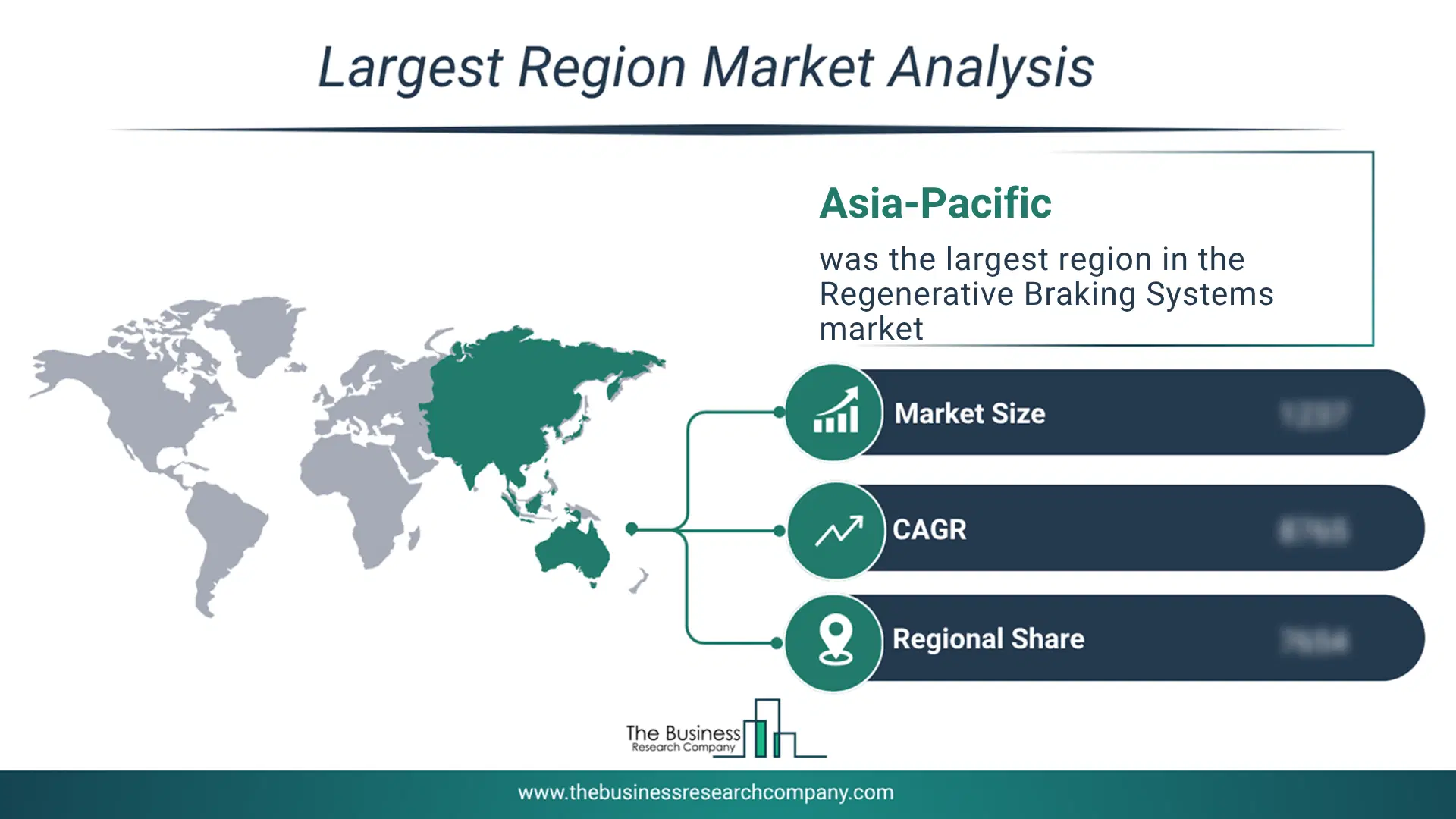
Regional Outlook
Asia-Pacific was the largest region in the regenerative braking systems market in 2025. North America is expected to be the fastest-growing region in the forecast period. The regions covered in this market report include Asia-Pacific, South East Asia, Western Europe, Eastern Europe, North America, South America, Middle East, Africa. The countries covered in this market report include Australia, Brazil, China, France, Germany, India, Indonesia, Japan, Taiwan, Russia, South Korea, UK, USA, Canada, Italy, SpainWhat Defines the Regenerative Braking Systems Market?
The regenerative braking systems market consists of sales of electric motors, batteries, control units, brake calipers, brake pads, flywheels, hydraulic pumps, and energy storage systems. Values in this market are ‘factory gate’ values, that is, the value of goods sold by the manufacturers or creators of the goods, whether to other entities (including downstream manufacturers, wholesalers, distributors and retailers) or directly to end customers. The value of goods in this market includes related services sold by the creators of the goods.How is Market Value Defined and Measured?
The market value is defined as the revenues that enterprises gain from the sale of goods and/or services within the specified market and geography through sales, grants, or donations in terms of the currency (in USD unless otherwise specified). The revenues for a specified geography are consumption values that are revenues generated by organizations in the specified geography within the market, irrespective of where they are produced. It does not include revenues from resales along the supply chain, either further along the supply chain or as part of other products.
This chart presents market attractiveness based on a quantitative evaluation of growth, competition, strategic alignment, and risk, offering a clear view of opportunity areas for decision-making. This chart is for illustrative purposes; the full report contains the complete analysis.

This chart highlights the Total Addressable Market (TAM) by estimating the maximum revenue opportunity using an assumption-driven approach, supporting strategic planning and opportunity sizing across markets. The chart is illustrative; the full report provides a more comprehensive analysis.
What Key Data and Analysis Are Included in the Regenerative Braking Systems Market Report 2026?
The regenerative braking systems market research report is one of a series of new reports from The Business Research Company that provides market statistics, including industry global market size, regional shares, competitors with the market share, detailed market segments, market trends and opportunities, and any further data you may need to thrive in the regenerative braking systems industry. The market research report delivers a complete perspective of everything you need, with an in-depth analysis of the current and future state of the industry.Regenerative Braking Systems Market Report Forecast Analysis
| Report Attribute | Details |
|---|---|
| Market Size Value In 2026 | $9.56 billion |
| Revenue Forecast In 2030 | $15.3 billion |
| Growth Rate | CAGR of 12.5% from 2026 to 2030 |
| Base Year For Estimation | 2025 |
| Actual Estimates/Historical Data | 2020-2025 |
| Forecast Period | 2026 - 2030 - 2030 |
| Market Representation | Revenue in USD Billion and CAGR from 2026 to 2030 |
| Segments Covered | Component, Propulsion, Vehicle Type |
| Regional Scope | Asia-Pacific, Western Europe, Eastern Europe, North America, South America, Middle East, Africa |
| Country Scope | The countries covered in the report are Australia, Brazil, China, France, Germany, India, Indonesia, Japan, Taiwan, Russia, South Korea, UK, USA, Canada, Italy, Spain. |
| Key Companies Profiled | Volkswagen AG, General Motors Company, Honda Motor Co Ltd, SAIC Motor Corporation Limited, Hyundai Motor Company, Robert Bosch GmbH, Tesla Inc, Nissan Motor Co Ltd, Kia Corporation, BYD Company Limited, Tata Motors Limited, Renault Group, Volvo Group, Denso Corporation, Continental AG, Mitsubishi Electric Corporation, Mazda Motor Corporation, Suzuki Motor Corporation, Subaru Corporation, Aisin Corporation, Geely Automobile Holdings Limited, Mitsubishi Motors Corporation, Stellantis NV, Toyota Motor Corporation, Mahindra and Mahindra Limited, BorgWarner Inc, Hitachi Astemo Ltd |
| Customization Scope | Request for Customization |
| Pricing And Purchase Options | Explore Purchase Options |