
Regional Air Mobility Market Report 2026
Global Outlook – By Vehicle Type (Fixed Wing Aircraft, Rotorcraft, Hybrid Aircraft), By Propulsion Type (Conventional Fuel Based, Hybrid Electric, Fully Electric, Hydrogen Powered), By Range (Short Range (Up To One Hundred Fifty Kilometers), Medium Range (One Hundred Fifty To Five Hundred Kilometers), Extended Range (Above Five Hundred Kilometers)), By End User (Commercial, Government And Defense, Private Piloted, Autonomous) – Market Size, Trends, Strategies, and Forecast to 2030
Regional Air Mobility Market Overview
• Regional Air Mobility market size has reached to $22 billion in 2025 • Expected to grow to $36.19 billion in 2030 at a compound annual growth rate (CAGR) of 10.4% • Growth Driver: Increasing Urban Congestion Pressure Driving The Market Growth Due To Road Overcrowding And Extended Commute Times • Market Trend: Innovation In Regional Air Mobility Driving Next Generation Hybrid Evtol Passenger And Cargo Connectivity • North America was the largest region in 2025 and Asia-Pacific is the fastest growing region.What Is Covered Under Regional Air Mobility Market?
Regional air mobility refers to the provision of short- to medium-range air connectivity solutions that improve access between geographically dispersed locations through advanced aviation systems and supporting infrastructure. It integrates digital platforms, air traffic management technologies, and aviation support networks to enable efficient, reliable, and flexible regional transportation operations. Regional air mobility enhances regional connectivity, optimizes travel efficiency, and supports the development of interconnected transportation ecosystems. The main vehicle types of regional air mobility include fixed wing aircraft, rotorcraft, and hybrid aircraft. Fixed wing aircraft refer to aircraft that generate lift through stationary wings and are designed for efficient regional transportation by providing higher speed, longer range, and improved energy efficiency compared to traditional rotor-based aircraft. These vehicles utilize propulsion types including conventional fuel based, hybrid electric, fully electric, and hydrogen powered systems. They operate across short range (up to one hundred fifty kilometers), medium range (one hundred fifty to five hundred kilometers), and extended range (above five hundred kilometers) and are utilized by end users including commercial, government and defense, private piloted, and autonomous.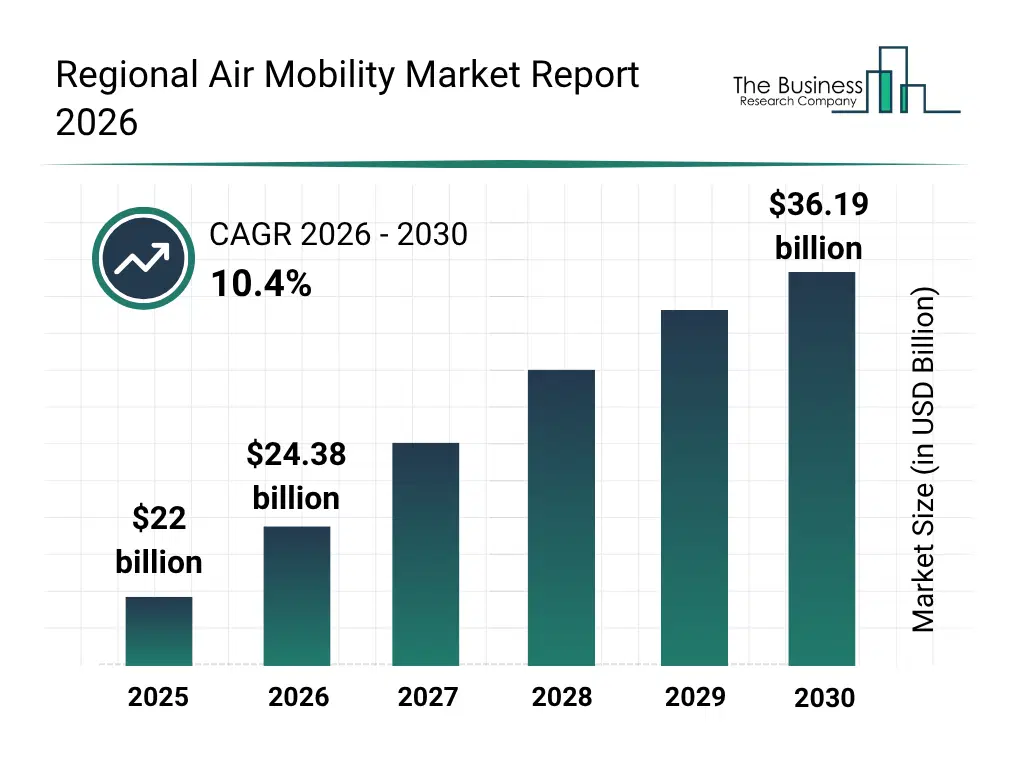
What Is The Regional Air Mobility Market Size and Share 2026?
The regional air mobility market size has grown rapidly in recent years. It will grow from $22 billion in 2025 to $24.38 billion in 2026 at a compound annual growth rate (CAGR) of 10.8%. The growth in the historic period can be attributed to increasing demand for improved regional connectivity, growing need for faster transportation alternatives, rising investments in aviation infrastructure development, expanding regional airport networks, increasing government initiatives supporting regional air transportation.What Is The Regional Air Mobility Market Growth Forecast?
The regional air mobility market size is expected to see rapid growth in the next few years. It will grow to $36.19 billion in 2030 at a compound annual growth rate (CAGR) of 10.4%.The growth in the forecast period can be attributed to growing adoption of electric and hybrid aircraft technologies, rising demand for sustainable regional transportation solutions, increasing deployment of autonomous aviation systems, expanding investments in advanced air mobility infrastructure, growing integration of digital aviation management platforms. Major trends in the forecast period include increasing adoption of advanced regional aircraft for improved short distance connectivity, growing development of electric vertical takeoff and landing aircraft for regional transportation, rising integration of digital air traffic management systems for efficient operations, expanding deployment of flexible air mobility networks across underserved regions, increasing development of hybrid propulsion aircraft for regional travel efficiency.
Global Regional Air Mobility Market Segmentation
2) By Propulsion Type: Conventional Fuel Based, Hybrid Electric, Fully Electric, Hydrogen Powered 3) By Range: Short Range (Up To One Hundred Fifty Kilometers), Medium Range (One Hundred Fifty To Five Hundred Kilometers), Extended Range (Above Five Hundred Kilometers) 4) By End User: Commercial, Government And Defense, Private Piloted, Autonomous Subsegments: 1) By Fixed Wing Aircraft: Turboprop Aircraft, Regional Jet Aircraft, Electric Fixed Wing Aircraft, Hybrid Electric Fixed Wing Aircraft 2) By Rotorcraft: Conventional Helicopters, Electric Vertical Takeoff And Landing Aircraft, Hybrid Electric Vertical Takeoff And Landing Aircraft, Tiltrotor Aircraft 3) By Hybrid Aircraft: Lift Plus Cruise Aircraft, Tilt Wing Aircraft, Compound Aircraft, Blended Wing Body AircraftWhat Is The Driver Of The Regional Air Mobility Market?
The increasing urban congestion pressure is expected to propel the growth of the regional air mobility market going forward. Urban congestion refers to the excessive buildup of vehicles and population density in cities, leading to slower traffic movement, longer travel times, and reduced overall transport efficiency. Urban congestion pressure is rising due to rapid urbanization as more people migrate to cities for jobs and better opportunities, increasing population density and the number of vehicles on already limited road infrastructure, which leads to overcrowded roads and slower traffic flow. Urban congestion pressure is driving the growth of the regional air mobility by increasing the demand for faster, more efficient, and traffic-free transportation alternatives that bypass ground-level road congestion and significantly reduce travel time across urban and intercity routes. For instance, in May 2024, according to the Department for Transport, a UK-based ministerial department, in 2023, vehicles traveled a total of 330.8 billion miles on roads in Great Britain, marking a 2.2% increase from 2022. Therefore, increasing urban congestion pressure is driving the growth of the regional air mobility industry.Key Players In The Global Regional Air Mobility Market
Major companies operating in the regional air mobility market are AURA AERO SAS, Airbus SE, Archer Aviation Inc., BETA Technologies Inc., Cranfield Aerospace Solutions Ltd., Costruzioni Aeronautiche Tecnam S.p.A., Daher Aerospace SAS, EHang Holding, Embraer S.A., Eve Air Mobility, Horizon Aircraft Ltd., Joby Aviation Inc., Lilium Jet, Odys Aviation Inc., Pilatus Aircraft Ltd., SkyDrive Inc., Vertical Aerospace Ltd., Volocopter GmbH, Boeing, Textron Inc., Heart Aerospace, Electra.aero, Supernal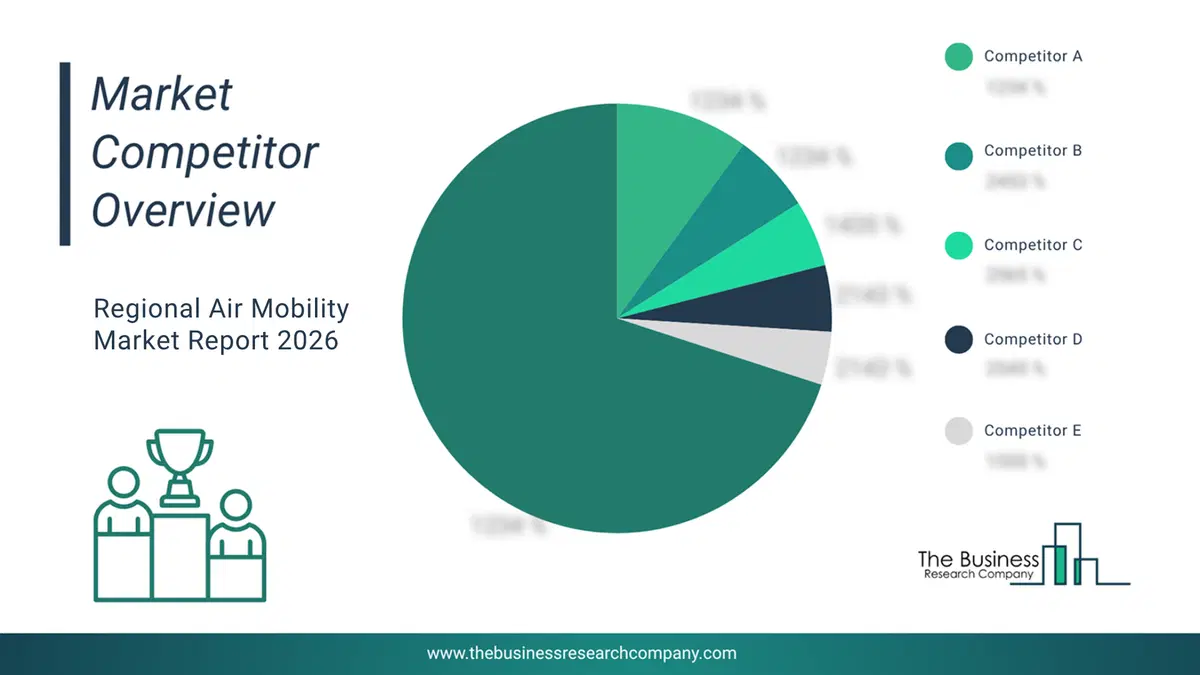
This chart is for illustrative purposes; the full report includes a detailed competitor analysis and comprehensive overview of the top 10 companies in the market.
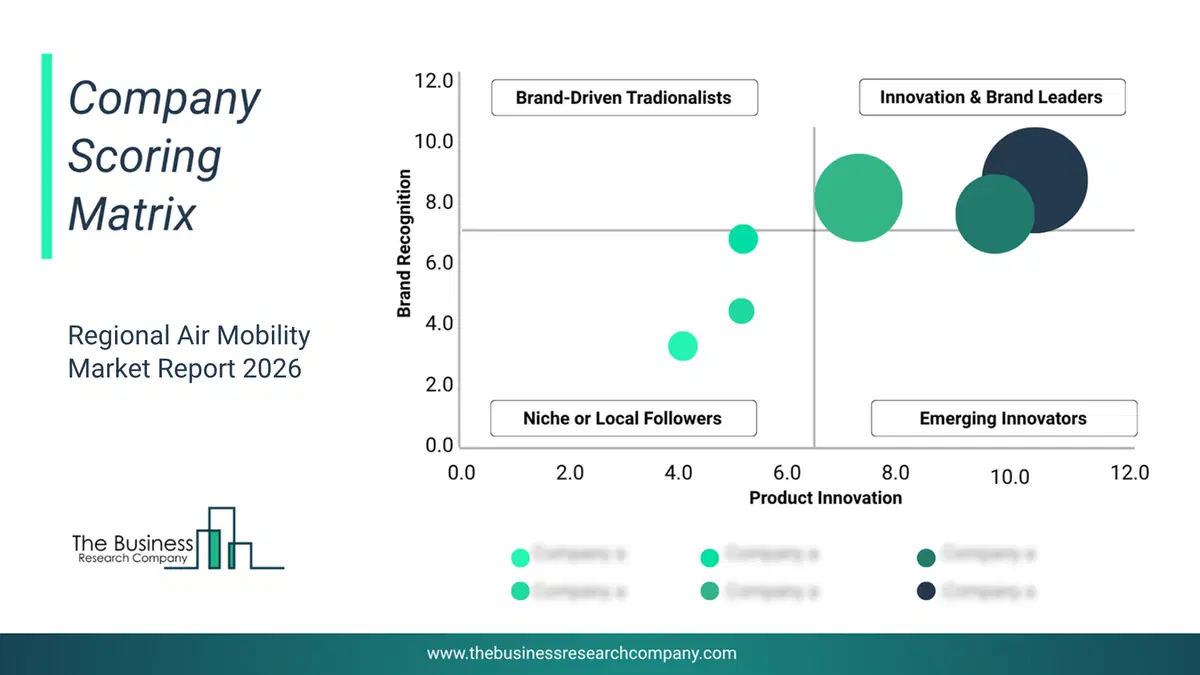
This chart maps companies by product innovation and brand strength, with bubble size indicating relative revenue, helping identify market leaders, challengers, and niche players. This is an illustrative chart; the full report provides a complete and accurate competitive analysis.
Global Regional Air Mobility Market Trends and Insights
Major companies operating in the regional air mobility market are focusing on developing innovative solutions, such as hybrid electric vertical take-off and landing (eVTOL) aircraft to enhance intercity connectivity, reduce carbon emissions, and improve operational efficiency in passenger and cargo transportation. Hybrid eVTOL aircraft are advanced air mobility systems that combine electric propulsion with conventional turbine or fuel-based engines, often supported by hydrogen fuel cells, enabling vertical take-off and landing capabilities along with extended range, higher payload capacity, and improved energy efficiency compared to traditional helicopters and short-haul aircraft. For instance, in March 2023, Lyte Aviation Ltd., a UK-based advanced air mobility company, introduced its LA-44 SkyBus and SkyTruck program, a 40-seat hybrid eVTOL aircraft designed for both passenger and cargo operations. The aircraft features a hybrid propulsion architecture combining turbine engines powered by sustainable aviation fuel with hydrogen fuel cell–powered electric motors, enabling a range of up to 1,000 km and a maximum speed of 300 km/h while delivering significantly improved fuel efficiency compared to conventional helicopters. The design also includes a 4.5-tonne payload capacity, underslung cargo capability, and compatibility with existing aviation infrastructure, positioning it as a scalable solution for regional passenger transport and time-sensitive logistics.What Are Latest Mergers And Acquisitions In The Regional Air Mobility Market?
In July 2023, Surf Air Mobility Inc., a US-based aviation technology company, acquired Southern Airways Corporation for an undisclosed amount. With this acquisition, Surf Air Mobility aimed to create a nationwide regional air mobility platform, expand its commuter airline network, and accelerate the deployment of its electrified aviation and Aircraft-as-a-Service (ACaaS) strategy. Southern Airways Corporation is a US-based regional airline company that specializes in providing scheduled commuter air transportation services, essential air service (EAS) routes, and regional connectivity solutions across underserved markets in the United States.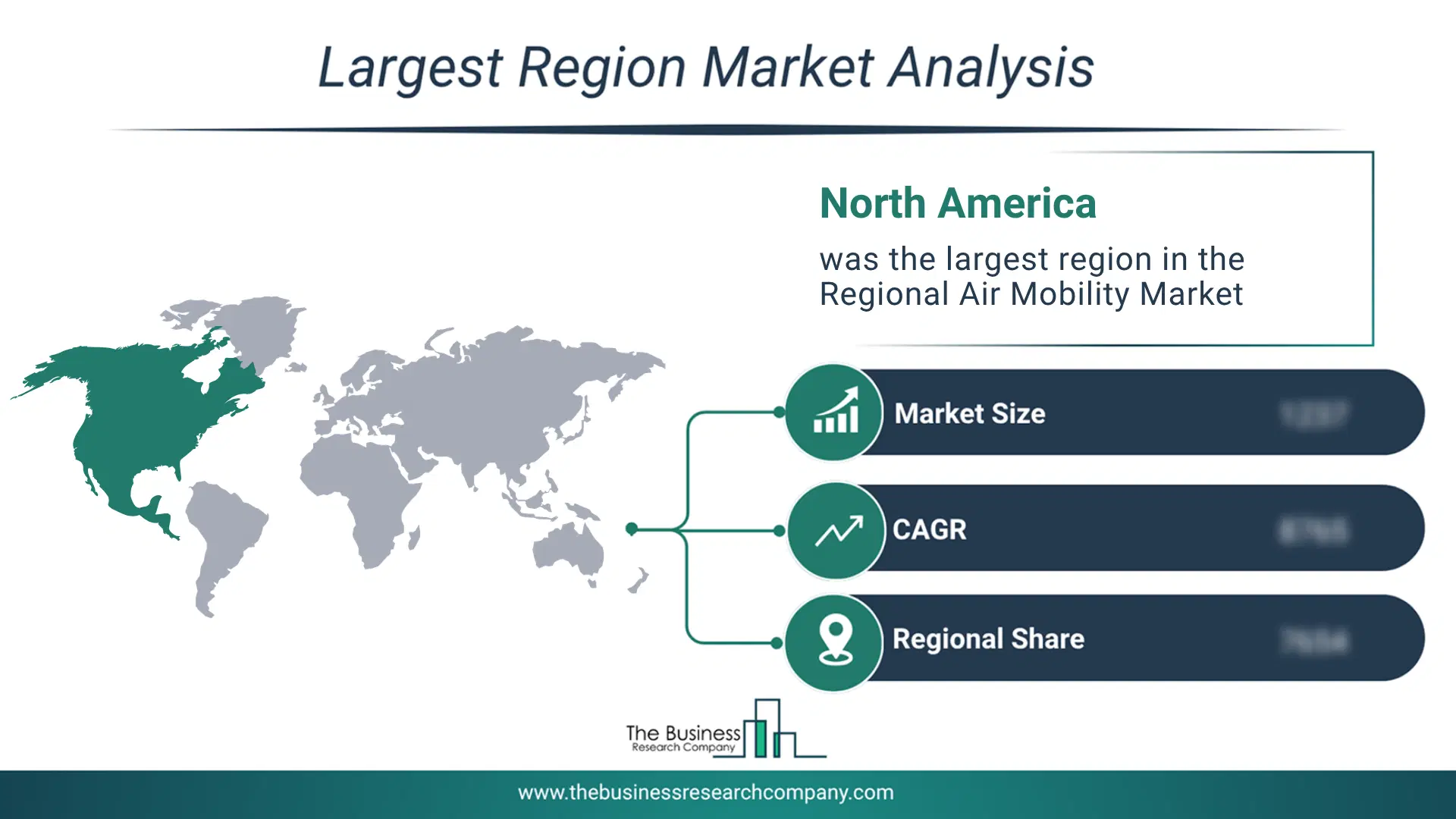
Regional Outlook/Insights
North America was the largest region in the regional air mobility market in 2025. Asia-Pacific is expected to be the fastest-growing region in the forecast period. The regions covered in this market report are Asia-Pacific, South East Asia, Western Europe, Eastern Europe, North America, South America, Middle East, Africa. The countries covered in this market report are Australia, Brazil, China, France, Germany, India, Indonesia, Japan, Taiwan, Russia, South Korea, UK, USA, Canada, Italy, Spain.What Defines the Regional Air Mobility Market?
The regional air mobility market consists of revenues earned by entities by providing services such as aircraft fleet management, aviation infrastructure support, route planning, air traffic management, maintenance and repair services, flight operations support, aviation software and digital mobility platform services, navigation support, and aviation consulting services. The market value includes the value of related goods sold by the service provider or included within the service offering. The regional air mobility market also includes sales of avionics systems, navigation equipment, communication systems, flight control systems, air traffic management solutions, charging infrastructure, aviation software platforms, monitoring systems, and supporting aviation technologies. Values in this market are ‘factory gate’ values, that is, the value of goods sold by the manufacturers or creators of the goods, whether to other entities (including downstream manufacturers, wholesalers, distributors, operators, and retailers) or directly to end customers. The value of goods in this market includes related services sold by the creators of the goods.How is Market Value Defined and Measured?
The market value is defined as the revenues that enterprises gain from the sale of goods and/or services within the specified market and geography through sales, grants, or donations in terms of the currency (in USD unless otherwise specified). The revenues for a specified geography are consumption values that are revenues generated by organizations in the specified geography within the market, irrespective of where they are produced. It does not include revenues from resales along the supply chain, either further along the supply chain or as part of other products.
This chart presents market attractiveness based on a quantitative evaluation of growth, competition, strategic alignment, and risk, offering a clear view of opportunity areas for decision-making. This chart is for illustrative purposes; the full report contains the complete analysis.

This chart highlights the Total Addressable Market (TAM) by estimating the maximum revenue opportunity using an assumption-driven approach, supporting strategic planning and opportunity sizing across markets. The chart is illustrative; the full report provides a more comprehensive analysis.
What Key Data and Analysis Are Included in the Regional Air Mobility Market Report 2026?
The regional air mobility market research report is one of a series of new reports from The Business Research Company that provides regional air mobility market statistics, including regional air mobility industry global market size, regional shares, competitors with a regional air mobility market share, detailed regional air mobility market segments, market trends and opportunities, and any further data you may need to thrive in the regional air mobility industry. This regional air mobility market research report delivers a complete perspective of everything you need, with an in-depth analysis of the current and future scenario of the industry.Regional Air Mobility Market Report Forecast Analysis
| Report Attribute | Details |
|---|---|
| Market Size Value In 2026 | $24.38 billion |
| Revenue Forecast In 2030 | $36.19 billion |
| Growth Rate | CAGR of 10.4% from 2026 to 2030 |
| Base Year For Estimation | 2025 |
| Actual Estimates/Historical Data | 2020-2025 |
| Forecast Period | 2026 - 2030 |
| Market Representation | Revenue in USD Billion and CAGR from 2026 to 2030 |
| Segments Covered | Vehicle Type, Propulsion Type, Range, End User |
| Regional Scope | Asia-Pacific, Western Europe, Eastern Europe, North America, South America, Middle East, Africa |
| Country Scope | The countries covered in the report are Australia, Brazil, China, France, Germany, India, Indonesia, Japan, Taiwan, Russia, South Korea, UK, USA, Canada, Italy, Spain. |
| Key Companies Profiled | AURA AERO SAS, Airbus SE, Archer Aviation Inc., BETA Technologies Inc., Cranfield Aerospace Solutions Ltd., Costruzioni Aeronautiche Tecnam S.p.A., Daher Aerospace SAS, EHang Holding, Embraer S.A., Eve Air Mobility, Horizon Aircraft Ltd., Joby Aviation Inc., Lilium Jet, Odys Aviation Inc., Pilatus Aircraft Ltd., SkyDrive Inc., Vertical Aerospace Ltd., Volocopter GmbH, Boeing, Textron Inc., Heart Aerospace, Electra.aero, Supernal |
| Customization Scope | Request for Customization |
| Pricing And Purchase Options | Explore Purchase Options |