
Regulatory Compliance Market Report 2026
Global Outlook – By Type (Service, Software), By Application (Large Enterprises, Small And Medium Enterprises (SMEs)), By End Users (Information And Communication Technology (ICT), Construction And Engineering, Mining, Retail, Healthcare, Transportation And Logistics, General Manufacturing, Banking, Financial Services, And Insurance (BFSI), Other End Users) – Market Size, Trends, Strategies, and Forecast to 2030
Regulatory Compliance Market Overview
• Regulatory Compliance market size has reached to $23.08 billion in 2025 • Expected to grow to $34.62 billion in 2030 at a compound annual growth rate (CAGR) of 8.3% • Growth Driver: Fraudulent Activities Fueling Regulatory Compliance Market Growth • Market Trend: Increasing Focus On Technological Advancements In The Regulatory Compliance Market • North America was the largest region in 2025 and Asia-Pacific is the fastest growing region.Market Gains By 2030 – Top Opportunities By Segment
Market Gain identifies the most promising market opportunities by highlighting the segments or products expected to generate the highest incremental revenue growth over the next five years.
What Is Covered Under Regulatory Compliance Market?
Regulatory compliance refers to an organization’s adherence to laws, regulations, guidelines, and specifications relevant to its business processes. Regulatory compliance is useful in ensuring that organizations operate within legal boundaries, mitigate risks associated with non-compliance, and uphold ethical standards in their business practices. The main regulatory compliance types are service and software. Regulatory compliance services encompass professional assistance and guidance provided by experts to ensure businesses adhere to the laws and regulations governing their industry. It is applied by both large enterprises and small and medium enterprises (SMEs). It is used by several end-user industries such as information and communication technology (ICT), construction and engineering, mining, retail, healthcare, transportation and logistics, general manufacturing, banking, financial services, and insurance (BFSI) and others.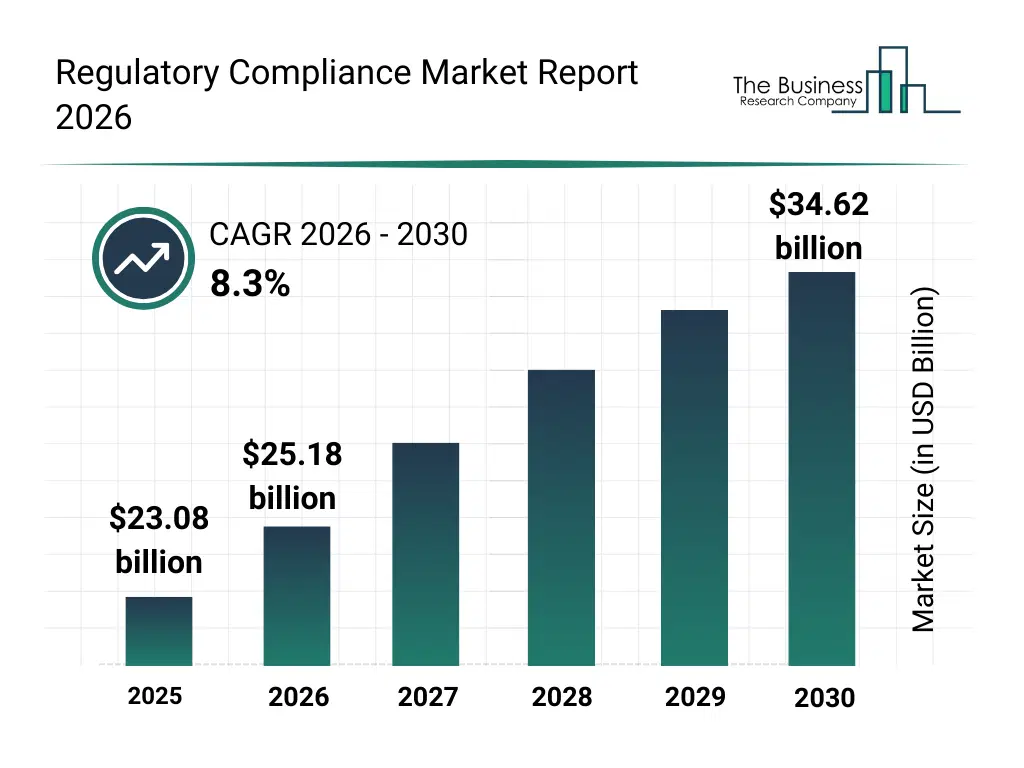
What Is The Regulatory Compliance Market Size and Share 2026?
The regulatory compliance market size has grown strongly in recent years. It will grow from $23.08 billion in 2025 to $25.18 billion in 2026 at a compound annual growth rate (CAGR) of 9.1%. The growth in the historic period can be attributed to increasing regulatory enforcement actions, rising penalties for non-compliance, expansion of multinational business operations, adoption of compliance management software, growth in industry-specific regulations.What Is The Regulatory Compliance Market Growth Forecast?
The regulatory compliance market size is expected to see strong growth in the next few years. It will grow to $34.62 billion in 2030 at a compound annual growth rate (CAGR) of 8.3%. The growth in the forecast period can be attributed to increasing demand for continuous compliance monitoring, rising investments in digital governance tools, expansion of global regulatory harmonization efforts, growing focus on cybersecurity compliance, increasing integration of compliance with enterprise risk management. Major trends in the forecast period include increasing adoption of enterprise-wide compliance frameworks, rising demand for automated risk assessment tools, growing integration of compliance analytics platforms, expansion of cross-industry regulatory standards, enhanced focus on data privacy and governance.
Global Regulatory Compliance Market Segmentation
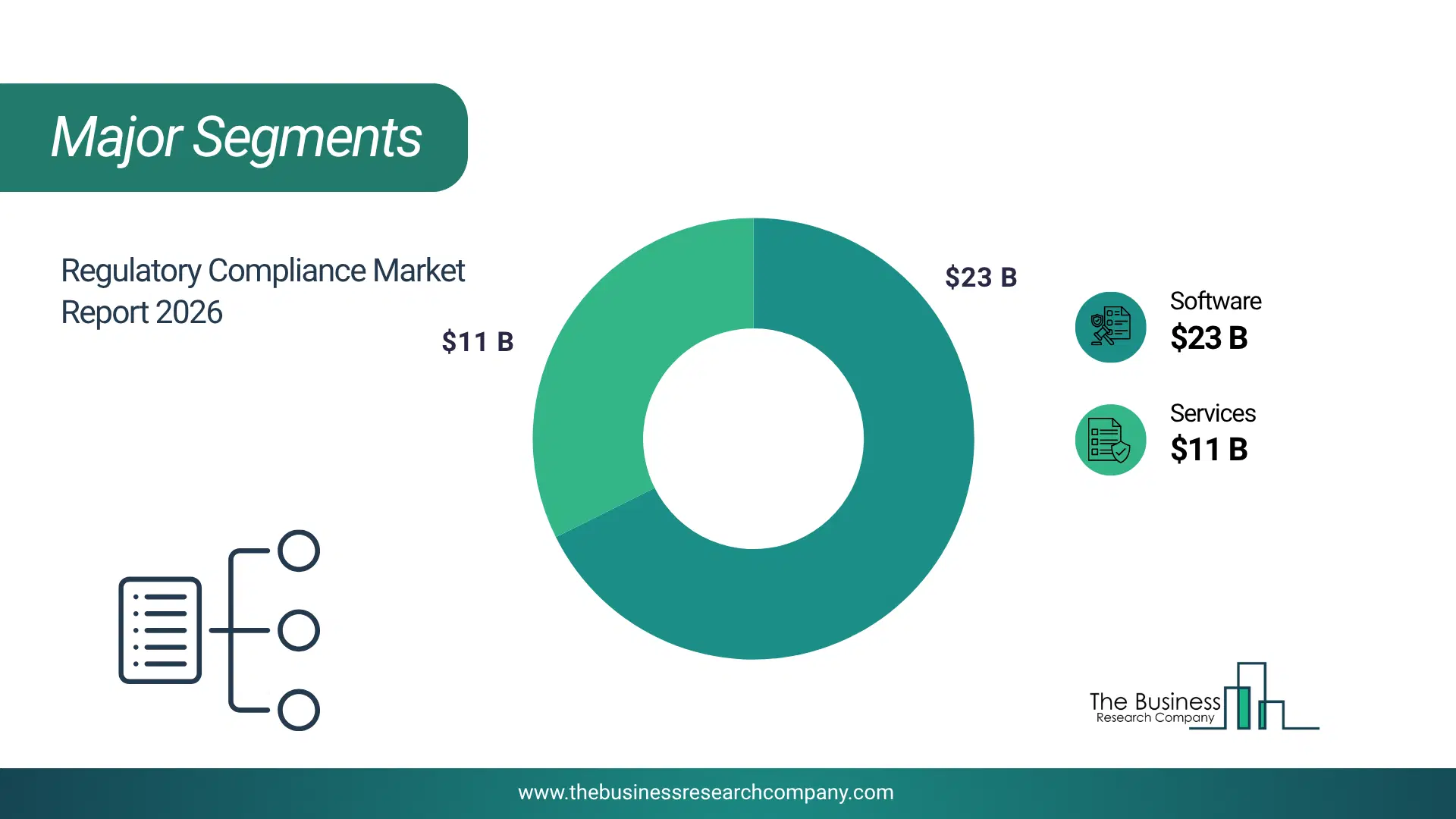
1) By Type: Service, Software 2) By Application: Large Enterprises, Small And Medium Enterprises (SMEs) 3) By End Users: Information And Communication Technology (ICT), Construction And Engineering, Mining, Retail, Healthcare, Transportation And Logistics, General Manufacturing, Banking, Financial Services, And Insurance (BFSI), Other End Users Subsegments: 1) By Service: Consulting Services, Audit And Assessment Services, Training And Certification Services, Risk And Compliance Management Services, Implementation Services, Managed Services 2) By Software: Compliance Management Software, Regulatory Reporting Software, Risk And Audit Management Software, Document Management Software, Governance, Risk, And Compliance (GRC) Software, Data Privacy And Security Compliance Software, Automated Compliance Monitoring Software The top segments in the regulatory compliance market will be: • Software will reach $23.46 Billion by 2030. • Services will reach $11.04 Billion by 2030.What Is The Driver Of The Regulatory Compliance Market?
The increasing number of fraudulent activities is expected to propel the growth of the regulatory compliance market going forward. Fraudulent activities refer to deliberate deceptive actions taken with the intent to secure unfair or unlawful gain or to deprive a victim of a legal right. Fraudulent activities are growing due to increased reliance on digital technologies, evolving criminal tactics, and gaps in regulatory enforcement. Regulatory compliance is essential for preventing fraudulent activities because it establishes standards, guidelines, and oversight mechanisms that help identify and deter illicit behavior, ensuring accountability and transparency in financial transactions. For instance, in January 2024, according to a report published by the Identity Theft Resource Center (ITRC), a US-based non-profit organization, there were 3,205 data compromises publicly reported in 2023, affecting an estimated 353,027,892 individuals. This represents a 72% increase compared to the previous highest recorded level and a 78% rise over the incidents reported in 2022. Therefore, the increasing number of fraudulent activities is driving the growth of the regulatory compliance industry.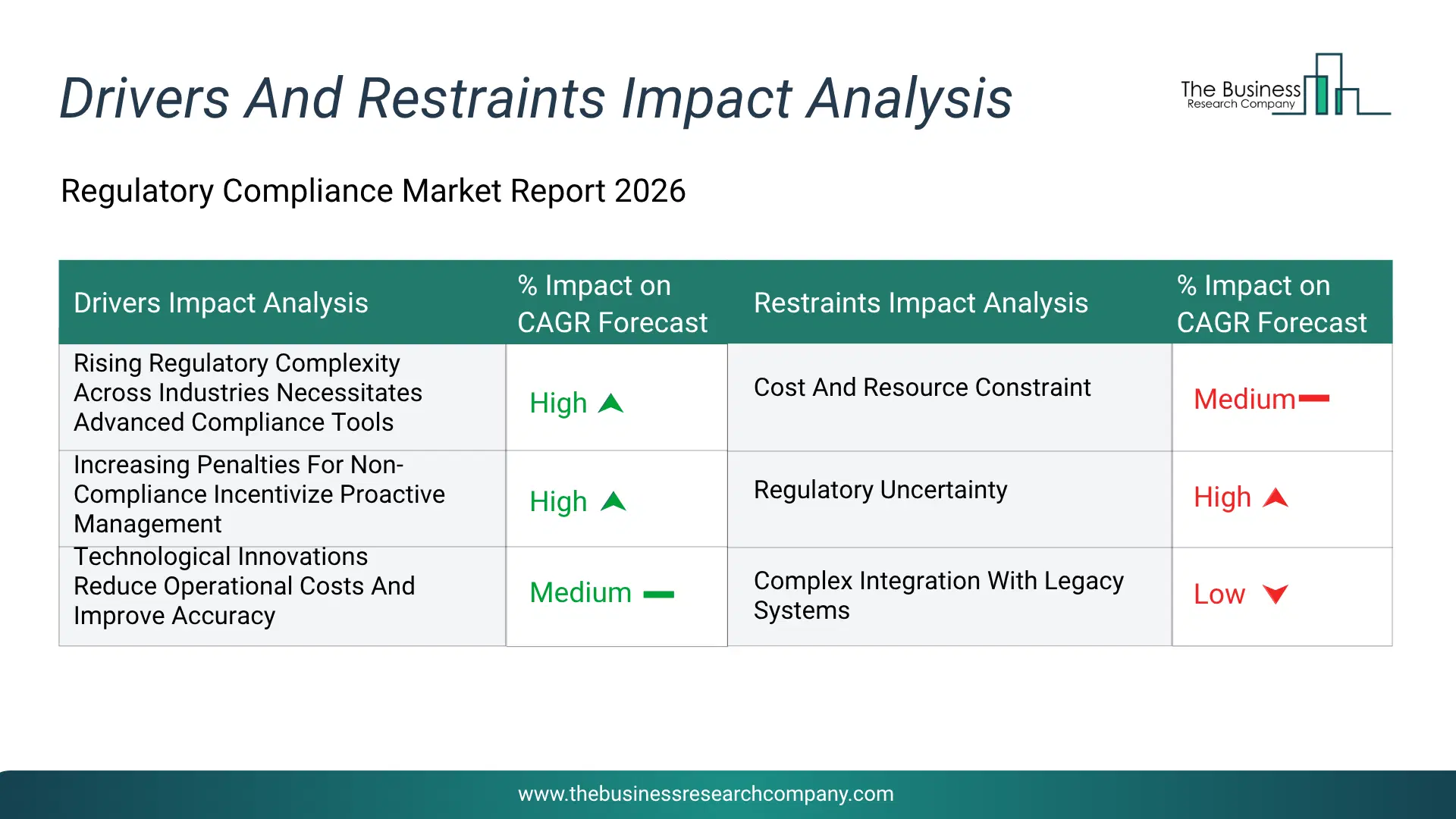
Infographic Chart Showing Key Market Drivers Analysis And Restraints For Regulatory Compliance Market
The chart presents an impact analysis of key drivers and restraints, quantifying their relative influence on the market's growth rate and helping assess the balance between growth enablers and limiting factors. This chart offers a high-level perspective; the full report contains more detailed insights.
How Will The Drivers Impact Growth In The Global Regulatory Compliance Market?
• Rising Regulatory Complexity Across Industries Necessitates Advanced Compliance Tools (High) – During the forecast period, the rising regulatory complexity across industries necessitates advanced compliance tools is expected to become a key growth driver for the regulatory compliance market by 2030. Rising regulatory complexity across industries is a major driver for the Regulatory Compliance market as organizations must comply with an expanding range of laws, standards, and reporting requirements. Businesses operating in sectors such as finance, healthcare, manufacturing, and energy face frequent regulatory updates that increase compliance burdens. Manual compliance management becomes inefficient and prone to errors when dealing with multiple jurisdictions and evolving regulations. As a result, enterprises invest in advanced compliance software and automated monitoring solutions to streamline regulatory processes. These tools help track regulatory changes, maintain documentation, and ensure adherence to industry-specific requirements. The growing need for real-time compliance visibility further boosts demand for integrated compliance platforms. • Increasing Penalties For Non-Compliance Incentivize Proactive Management (High) – During the forecast period, the increasing penalties for non-compliance incentivize proactive management is expected to emerge as a major factor driving the expansion of the regulatory compliance market by 2030. Increasing penalties for non-compliance act as a significant driver for the Regulatory Compliance market by raising the financial and reputational risks associated with regulatory violations. Governments and regulatory authorities are imposing stricter enforcement measures, larger fines, and stronger accountability standards across industries. Organizations are therefore prioritizing proactive compliance management to avoid costly legal actions and operational disruptions. Compliance solutions enable businesses to identify risks early, monitor adherence continuously, and generate accurate audit trails. The ability to prevent violations before they occur makes compliance technologies a strategic investment rather than a regulatory obligation. Growing board-level focus on risk management further supports the adoption of compliance platforms. This heightened emphasis on avoiding penalties drives sustained demand for regulatory compliance solutions. • Technological Innovations Reduce Operational Costs And Improve Accuracy (Medium) – During the forecast period, the technological innovations reduce operational costs and improve accuracy is expected to act as a key growth catalyst for the regulatory compliance market by 2030. Technological innovations reduce operational costs and improve accuracy, making them a powerful growth driver for the Regulatory Compliance market. Advanced technologies such as artificial intelligence, machine learning, robotic process automation, and data analytics enable organizations to automate repetitive compliance tasks. Automation minimizes human error, improves reporting precision, and enhances regulatory monitoring capabilities. These innovations allow companies to manage large volumes of compliance data efficiently while reducing administrative expenses. Real-time risk detection and predictive analytics help organizations address compliance issues before they escalate into violations. Improved operational efficiency encourages enterprises of all sizes to modernize their compliance frameworks. As technology continues to evolve, adoption of sophisticated compliance solutions is expected to increase substantially.How Will The Restraints Impact Growth In The Global Regulatory Compliance Market?
• Cost And Resource Constraint (High) – During the forecast period, the cost and resource constraint is a significant restraint for the Regulatory Compliance market because implementing and maintaining compliance solutions often requires substantial financial investment and skilled personnel. Small and medium-sized enterprises, in particular, may struggle to allocate sufficient budgets for compliance software, system integration, employee training, and ongoing regulatory monitoring. The complexity of compliance programs can also increase operational expenses and require dedicated teams to manage regulatory obligations effectively. Organizations with limited resources may prioritize core business functions over compliance technology investments, delaying adoption. Additionally, the return on investment may not be immediately visible, creating hesitation among decision-makers. High implementation and maintenance costs can therefore limit market penetration, especially in cost-sensitive industries and emerging economies. As a result, financial and resource-related challenges continue to restrain the growth of the Regulatory Compliance market. • Regulatory Uncertainty (High) – During the forecast period, the regulatory uncertainty acts as a major restraint for the Regulatory Compliance market because frequent changes in laws, policies, and enforcement approaches make compliance planning more difficult for organizations. Businesses often face challenges in predicting future regulatory requirements, which can complicate technology investments and long-term compliance strategies. Constantly evolving regulations may require repeated software updates, process modifications, and additional employee training, increasing operational complexity. Organizations may hesitate to adopt specific compliance solutions if there is uncertainty regarding future regulatory expectations or standards. This unpredictability can reduce confidence in compliance investments and delay purchasing decisions. Furthermore, varying interpretations of regulations across jurisdictions can create additional implementation challenges for multinational companies. Consequently, regulatory uncertainty can slow adoption rates and hinder the overall growth of the Regulatory Compliance market. • Complex Integration With Legacy Systems (Medium) – During the forecast period, the complex integration with legacy systems acts as a significant restraint for the regulatory compliance market because many organizations continue to rely on outdated enterprise systems that are not designed to support modern compliance platforms and automated reporting requirements. Integrating compliance solutions with existing IT infrastructure often requires extensive customization, data migration, and interoperability testing, increasing implementation costs and deployment timelines. Compatibility issues may disrupt business operations and reduce the efficiency of compliance processes. These technical challenges discourage organizations from modernizing their compliance infrastructure, thereby limiting market growth.Key Players In The Global Regulatory Compliance Market
Major companies operating in the regulatory compliance market are Microsoft Corporation, Dell Technologies Inc., International Business Machines Corporation, Deloitte Touche Tohmatsu Limited, Oracle Corporation, DNV GL AS, Grant Thornton International Ltd., Thomson Reuters Corporation, Baker Tilly International, SAS Institute Inc., Wolters Kluwer N.V., UL Solutions Inc., Norton Rose Fulbright LLP, Ramboll Group A/S, Protiviti Inc., Lloyd's Register Quality Assurance Limited, Sphera Solutions Inc., MetricStream Inc., Cority Software Inc., Sparta Systems Inc., Enablon, EtQ LLC, MasterControl Inc., Assent Compliance Inc., 3E Company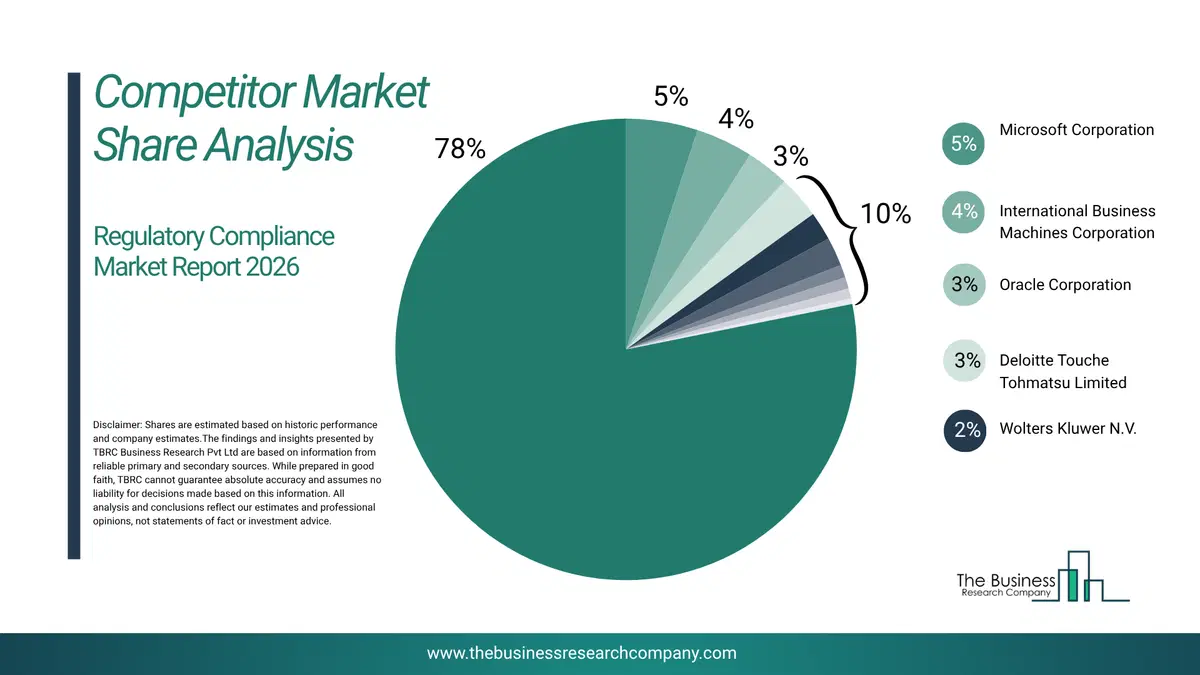
This chart is for illustrative purposes; the full report includes a detailed competitor analysis and comprehensive overview of the top 10 companies in the market.
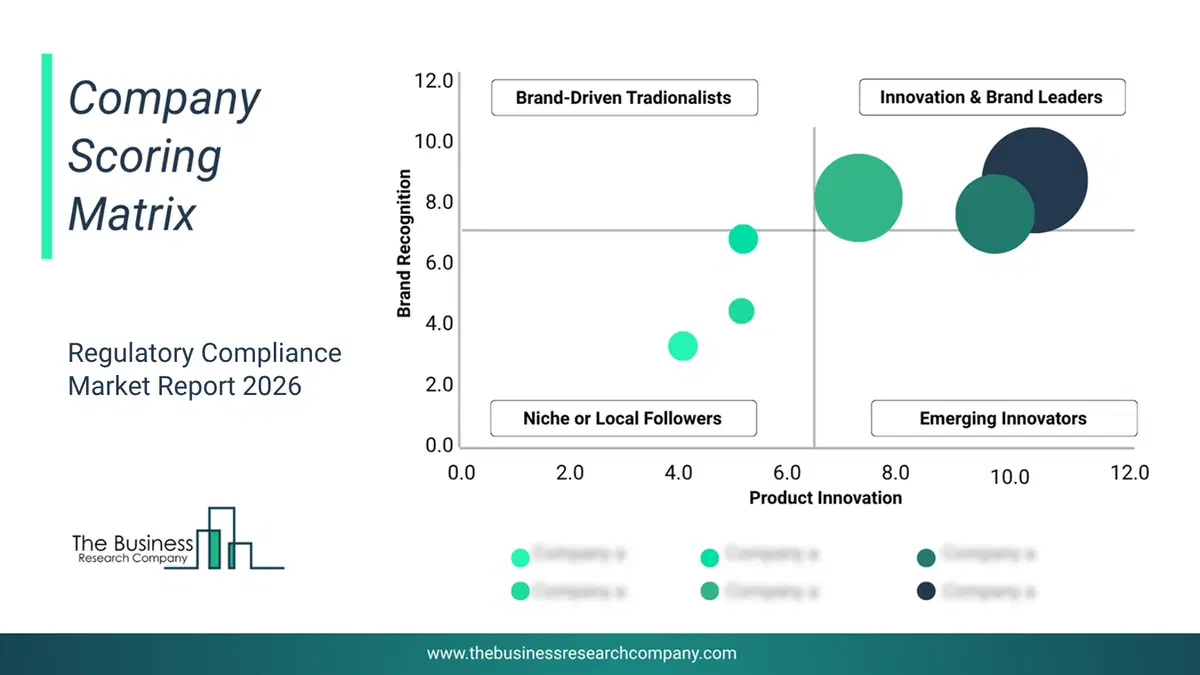
This chart maps companies by product innovation and brand strength, with bubble size indicating relative revenue, helping identify market leaders, challengers, and niche players. This is an illustrative chart; the full report provides a complete and accurate competitive analysis.
Global Regulatory Compliance Market Trends and Insights
Major companies operating in the regulatory compliance market are focusing on developing technologically advanced regulatory compliance solutions, such as supply chain software, to help clients meet regulatory compliance requirements and strengthen supply assurance. Supply Chain Management Software (SCMS) refers to a specialized software application designed to manage and optimize supply chain processes while ensuring compliance with relevant regulations, standards, and industry requirements. For instance, in April 2024, E2open Parent Holdings Inc., a US-based software company, launched the Supply Network Discovery application to empower brand owners to proactively identify potential risks in their multi-tier supply networks, enhance compliance, and strengthen supply assurance. It offers multi-tier supply relationship mapping, traceability, structured due diligence engagement, and partner impact assessment capabilities. These features help brand owners gain a comprehensive view of their supply networks, improve compliance, and enhance supply assurance. The aim of this innovative solution is to provide brand owners with a comprehensive view of their global supply ecosystems, fostering compliance, collaboration, and risk mitigation.What Are Latest Mergers And Acquisitions In The Regulatory Compliance Market?
In March 2024, Ocean Technologies Group, a Norway-based operational technology company, acquired DanDocs for an undisclosed amount. This acquisition strategically aligns with Ocean's goal of empowering maritime teams at sea and onshore by enhancing its compliance capabilities and offerings. Through this acquisition, Danish (DanDocs) seeks to strengthen its compliance offerings and provide its customers with immediate access to value-added software and services, streamlining the navigation of crucial documentation and ultimately saving time and mitigating risks. DanDocs is a Denmark-based provider of regulatory compliance services, specifically within the maritime industry.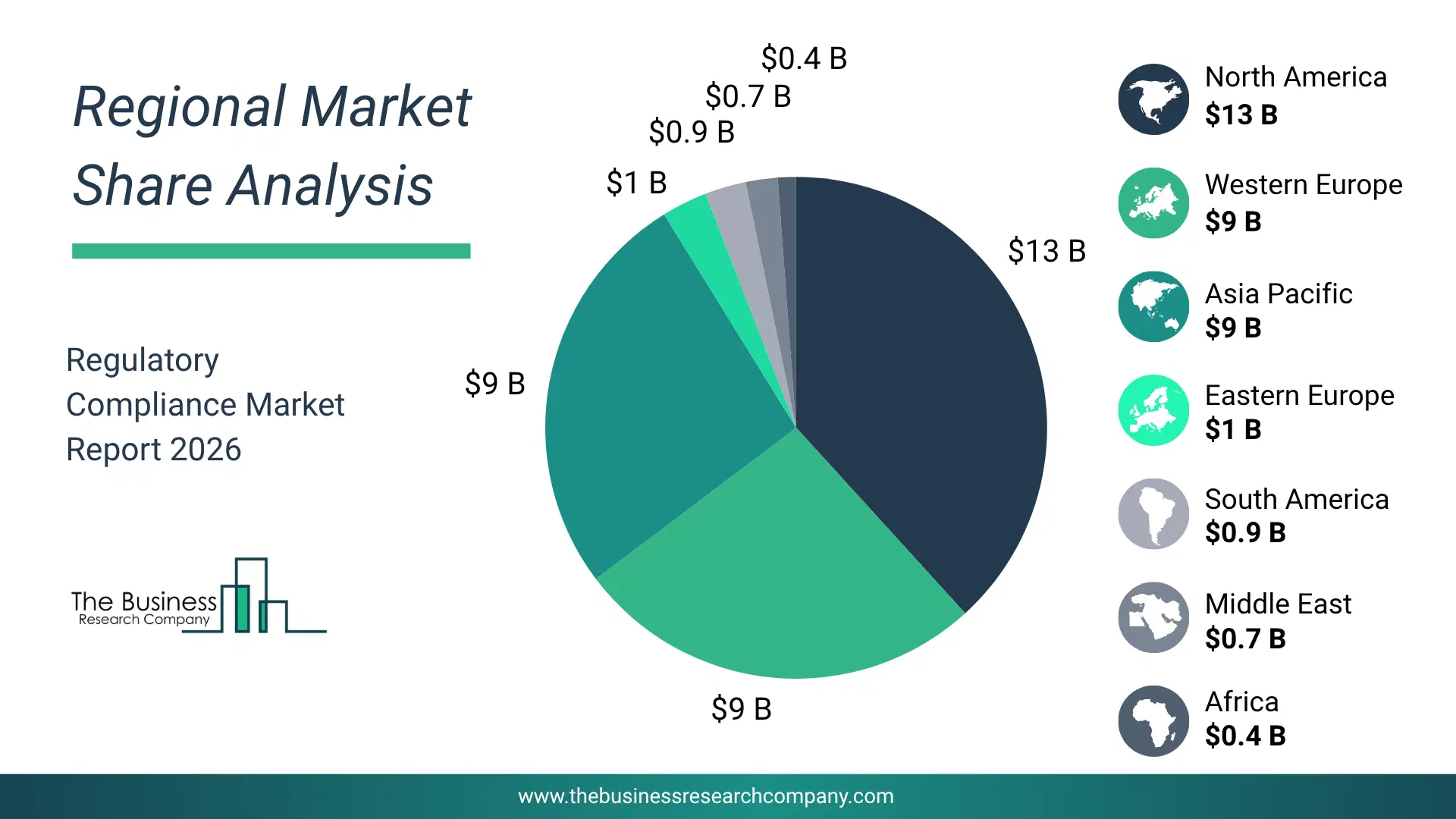
Regional Outlook
North America the largest region in the regulatory compliance market in 2025. Asia-Pacific is expected to be the fastest-growing region in the forecast period. The regions covered in this market report are Asia-Pacific, South East Asia, Western Europe, Eastern Europe, North America, South America, Middle East, Africa. The countries covered in this market report are Australia, Brazil, China, France, Germany, India, Indonesia, Japan, Taiwan, Russia, South Korea, UK, USA, Canada, Italy, Spain.What Defines the Regulatory Compliance Market?
The regulatory compliance market includes revenues earned by entities by providing services such as regulatory landscape assessment, compliance auditing, and financial crime risk management. The market value includes the value of related goods sold by the service provider or included within the service offering. Only goods and services traded between entities or sold to end consumers are included.How is Market Value Defined and Measured?
The market value is defined as the revenues that enterprises gain from the sale of goods and/or services within the specified market and geography through sales, grants, or donations in terms of the currency (in USD unless otherwise specified). The revenues for a specified geography are consumption values that are revenues generated by organizations in the specified geography within the market, irrespective of where they are produced. It does not include revenues from resales along the supply chain, either further along the supply chain or as part of other products.
This chart presents market attractiveness based on a quantitative evaluation of growth, competition, strategic alignment, and risk, offering a clear view of opportunity areas for decision-making. This chart is for illustrative purposes; the full report contains the complete analysis.

This chart highlights the Total Addressable Market (TAM) by estimating the maximum revenue opportunity using an assumption-driven approach, supporting strategic planning and opportunity sizing across markets. The chart is illustrative; the full report provides a more comprehensive analysis.
What Key Data and Analysis Are Included in the Regulatory Compliance Market Report 2026?
The regulatory compliance market research report is one of a series of new reports from The Business Research Company that provides market statistics, including Market Report 2026?global market size, regional shares, competitors with the market share, detailed market segments, market trends and opportunities, and any further data you may need to thrive in the regulatory compliance Market Report 2026? The market research report delivers a complete perspective of everything you need, with an in-depth analysis of the current and future state of the Market Report 2026?Regulatory Compliance Market Report Forecast Analysis
| Report Attribute | Details |
|---|---|
| Market Size Value In 2026 | $25.18 billion |
| Revenue Forecast In 2030 | $34.62 billion |
| Growth Rate | CAGR of 9.1% from 2026 to 2030 |
| Base Year For Estimation | 2025 |
| Actual Estimates/Historical Data | 2020-2025 |
| Forecast Period | 2026 - 2030 |
| Market Representation | Revenue in USD Billion and CAGR from 2026 to 2030 |
| Segments Covered | Type, Application, End Users |
| Regional Scope | Asia-Pacific, Western Europe, Eastern Europe, North America, South America, Middle East, Africa |
| Country Scope | The countries covered in the report are Australia, Brazil, China, France, Germany, India, ... |
| Key Companies Profiled | Microsoft Corporation, Dell Technologies Inc., International Business Machines Corporation, Deloitte Touche Tohmatsu Limited, Oracle Corporation, DNV GL AS, Grant Thornton International Ltd., Thomson Reuters Corporation, Baker Tilly International, SAS Institute Inc., Wolters Kluwer N.V., UL Solutions Inc., Norton Rose Fulbright LLP, Ramboll Group A/S, Protiviti Inc., Lloyd's Register Quality Assurance Limited, Sphera Solutions Inc., MetricStream Inc., Cority Software Inc., Sparta Systems Inc., Enablon, EtQ LLC, MasterControl Inc., Assent Compliance Inc., 3E Company |
| Customization Scope | Request for Customization |
| Pricing And Purchase Options | Explore Purchase Options |