
Remote Sensing Satellite Market Report 2026
Global Outlook – By Type (Space-Based Radars, Space-Based Electro-Optical And Infrared (EO/IR)), By Payload (Less Than 500 Kg, 500 Kg To 1,000 Kg, Above 1,000 Kg), By Application (Agricultural And Soil Studies, Natural Resources Monitoring And Conservation, Cartography, Geology And Mineral Resources Mapping, Meteorology And Oceanic Studies, Other Applications), By End Use (Civil, Military, Government, Others End Uses) – Market Size, Trends, Strategies, and Forecast to 2030
Remote Sensing Satellite Market Overview
• Remote Sensing Satellite market size has reached to $14.9 billion in 2025 • Expected to grow to $24.77 billion in 2030 at a compound annual growth rate (CAGR) of 10.7% • Growth Driver: Earth Observation Projects Propel Remote Sensing Satellite Market Growth • Market Trend: Advancements in Remote Sensing Satellite Technology Revolutionize Earth Observation • North America was the largest region in 2025 and Asia-Pacific is the fastest growing region.What Is Covered Under Remote Sensing Satellite Market?
A remote sensing satellite is an artificial satellite specifically designed to observe and gather information about Earth's surface from space using various sensing instruments. These satellites have sensors that can detect and record electromagnetic radiation across different wavelengths, ranging from visible light to microwaves. The main types of the remote sensing satellite include space-based radars and space-based electro-optical and infrared (EO/IR) systems. Space-based radars refer to satellite-mounted active sensing systems that transmit microwave signals toward the Earth and analyze the reflected signals to generate high-resolution data regardless of weather conditions or lighting, making them especially suitable for continuous monitoring, terrain mapping, and surveillance applications. The payload categories include less than 500 kg, 500 kg to 1,000 kg, and above 1,000 kg. The applications include agricultural and soil studies, natural resources monitoring and conservation, cartography, geology and mineral resources mapping, meteorology and oceanic studies, and other applications, and they are used by several end uses such as civil, military, government, and other end-use sectors.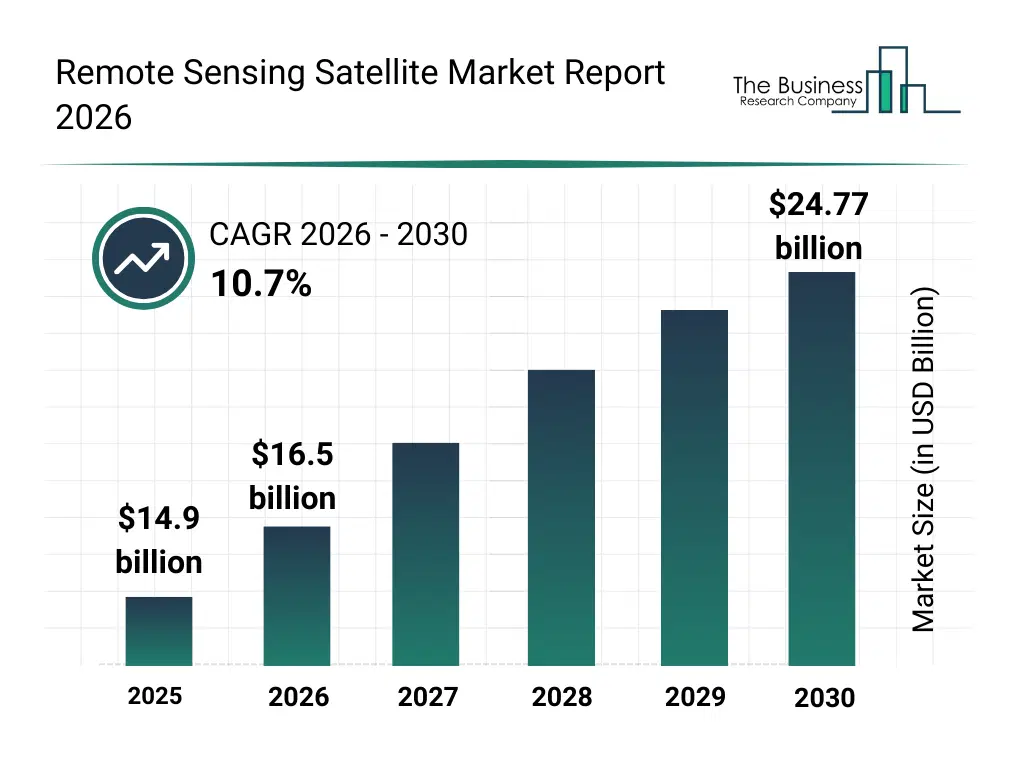
What Is The Remote Sensing Satellite Market Size and Share 2026?
The remote sensing satellite market size has grown rapidly in recent years. It will grow from $14.9 billion in 2025 to $16.5 billion in 2026 at a compound annual growth rate (CAGR) of 10.8%. The growth in the historic period can be attributed to increasing demand for earth observation and environmental monitoring, technological advancements in multispectral and hyperspectral sensors, government investments in space programs and satellite launches, rising adoption of lidar and electromagnetic sensors for detailed mapping, growth in agricultural and forestry monitoring applications using remote sensing data.What Is The Remote Sensing Satellite Market Growth Forecast?
The remote sensing satellite market size is expected to see rapid growth in the next few years. It will grow to $24.77 billion in 2030 at a compound annual growth rate (CAGR) of 10.7%. The growth in the forecast period can be attributed to expansion of high-resolution and constellation remote sensing satellites, integration of ai and machine learning for data analysis and predictive modeling, increasing commercial demand for geospatial intelligence and analytics, development of cost-effective small and medium satellites for remote sensing, rising use of remote sensing satellites for climate change monitoring and disaster management. Major trends in the forecast period include miniaturization of satellite sensors, high-resolution imaging demand, increased government space programs, expansion of private space companies, integration of multi-sensor payloads.
Global Remote Sensing Satellite Market Segmentation
1) By Type: Space-Based Radars, Space-Based Electro-Optical And Infrared (EO/IR) 2) By Payload: Less Than 500 Kg, 500 Kg To 1,000 Kg, Above 1,000 Kg 3) By Application: Agricultural And Soil Studies, Natural Resources Monitoring And Conservation, Cartography, Geology And Mineral Resources Mapping, Meteorology And Oceanic Studies, Other Applications 4) By End Use: Civil, Military, Government, Others End Uses Subsegments: 1) By Space-Based Radars: Synthetic Aperture Radar (SAR), Ground Penetrating Radar (GPR), Weather and Environmental Monitoring Radars, Earth Observation and Surveillance Radars 2) By Space-Based Electro-Optical and Infrared (EO/IR): Electro-Optical Imaging Satellites, Infrared Sensing Satellites, Thermal and Multispectral Imaging SatellitesWhat Is Driver Of The Remote Sensing Satellite Market?
Rising earth observation projects are expected to propel the remote sensing satellite market going forward. Earth observation projects refer to initiatives or programs involving various technologies, including satellites, aircraft, or ground-based sensors, to collect data and information about Earth's surface, atmosphere, and oceans. Remote sensing satellites monitor and assess natural disasters such as hurricanes, floods, wildfires, earthquakes, and tsunamis. They provide real-time or near-real-time imagery and data to aid disaster response, evacuation planning, damage assessment, and recovery efforts. For instance, in January 2024, according to the Science of The Total Environment, a Netherland-based Peer-reviewed journal, the number of Earth Observation (EO) satellites has grown exponentially over the past decade, reaching a total of 1,193 as of January 2023. Therefore, rising earth observation projects are driving the growth of the remote sensing satellite industry.Key Players In The Global Remote Sensing Satellite Market
Major companies operating in the remote sensing satellite market are Raytheon Technologies Corporation, The Boeing Company, Lockheed Martin Corporation, Airbus SE, Northrop Grumman, Mitsubishi Electric Corporation, Thales Group, L3Harris Technologies Inc., BALL CORPORATION, Hexagon AB, General Dynamics Mission Systems Inc., Maxar Technologies Inc., Environmental Systems Research Institute Inc.(Esri), AABSyS IT Pvt. Ltd, Planet Labs Inc., Orbital Insight, BlackSky Global LLC, Satellite Imaging Corporation, Mallon Technology, Antrix Corporation, Geo Sense, Remote Sensing Solutions GmbH, ImageSat International N.V.
This chart is for illustrative purposes; the full report includes a detailed competitor analysis and comprehensive overview of the top 10 companies in the market.
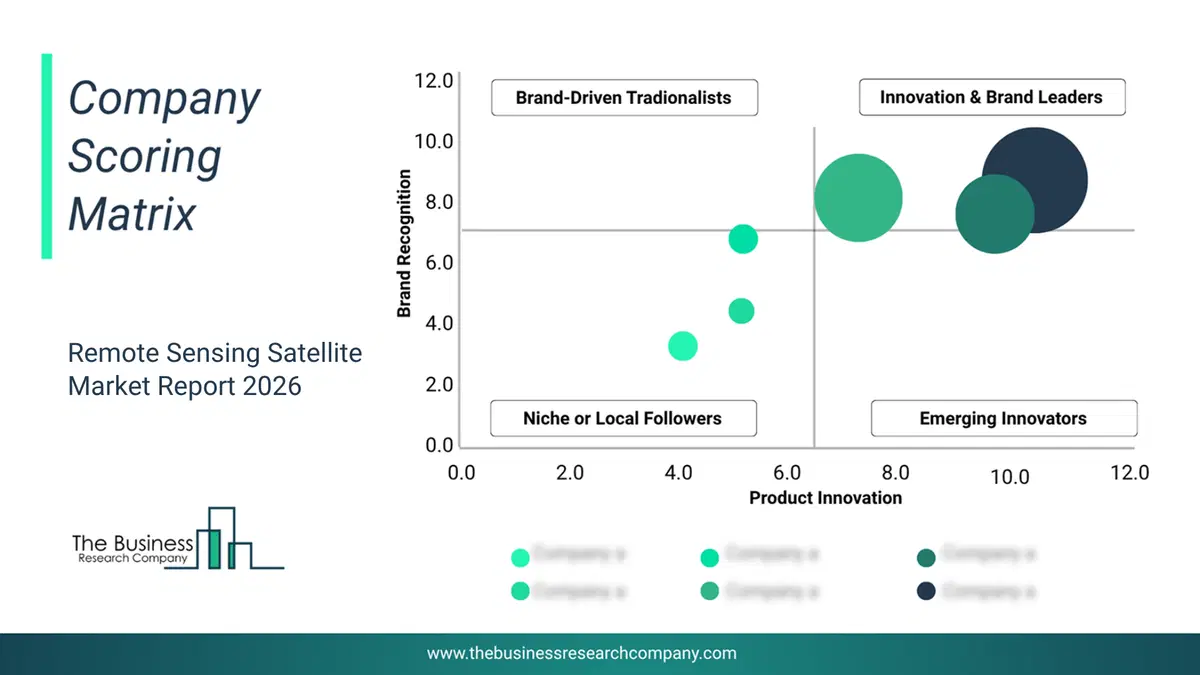
This chart maps companies by product innovation and brand strength, with bubble size indicating relative revenue, helping identify market leaders, challengers, and niche players. This is an illustrative chart; the full report provides a complete and accurate competitive analysis.
Global Remote Sensing Satellite Market Trends and Insights
Major companies operating in the remote sensing satellite market are increasing their focus on developing innovative products, such as earth observation nanosatellites, to gain a competitive edge in the market. Earth observation nanosatellites are small-sized satellites designed for monitoring and collecting data about Earth's surface, atmosphere, and oceans. For instance, in June 2023, Azista BST Aerospace Pvt. Ltd., an India-based aerospace company, launched the ABA First Runner (AFR), a remote sensing satellite designed to capture panchromatic images with a 5-meter resolution and a 70-kilometer swath. Weighing 80 kg, it aims to supply remote sensing data to clients primarily in Southeast Asia and India, focusing on strategic and agricultural sectors. The acquired data will support agriculture, forestry, water management, mining, maritime operations, and defense applications. These technological upgrades enhance satellite performance, enabling more precise and comprehensive data collection, thus amplifying its utility across various industries and applications.What Are Latest Mergers And Acquisitions In The Remote Sensing Satellite Market? MBRSC And Yahsat Collaborate To Commercialize Remote Sensing Data And Earth Observation Images
In February 2023, Mohammed Bin Rashid Space Centre (MBRSC), a UAE-based research institute, partnered with Al Yah Satellite Communications Company (Yahsat) to commercialize remote sensing data and earth observation images for commercial and government clients. This partnership involves MBRSC's fleet of satellites providing Yahsat with earth observation imagery and remote sensing data, which will be integrated into Yahsat's solutions portfolio through its government arm, Yahsat Government Solutions (YGS). Al Yah Satellite Communications is a UAE-based satellite telecommunications company specializing in remote sensing satellite services.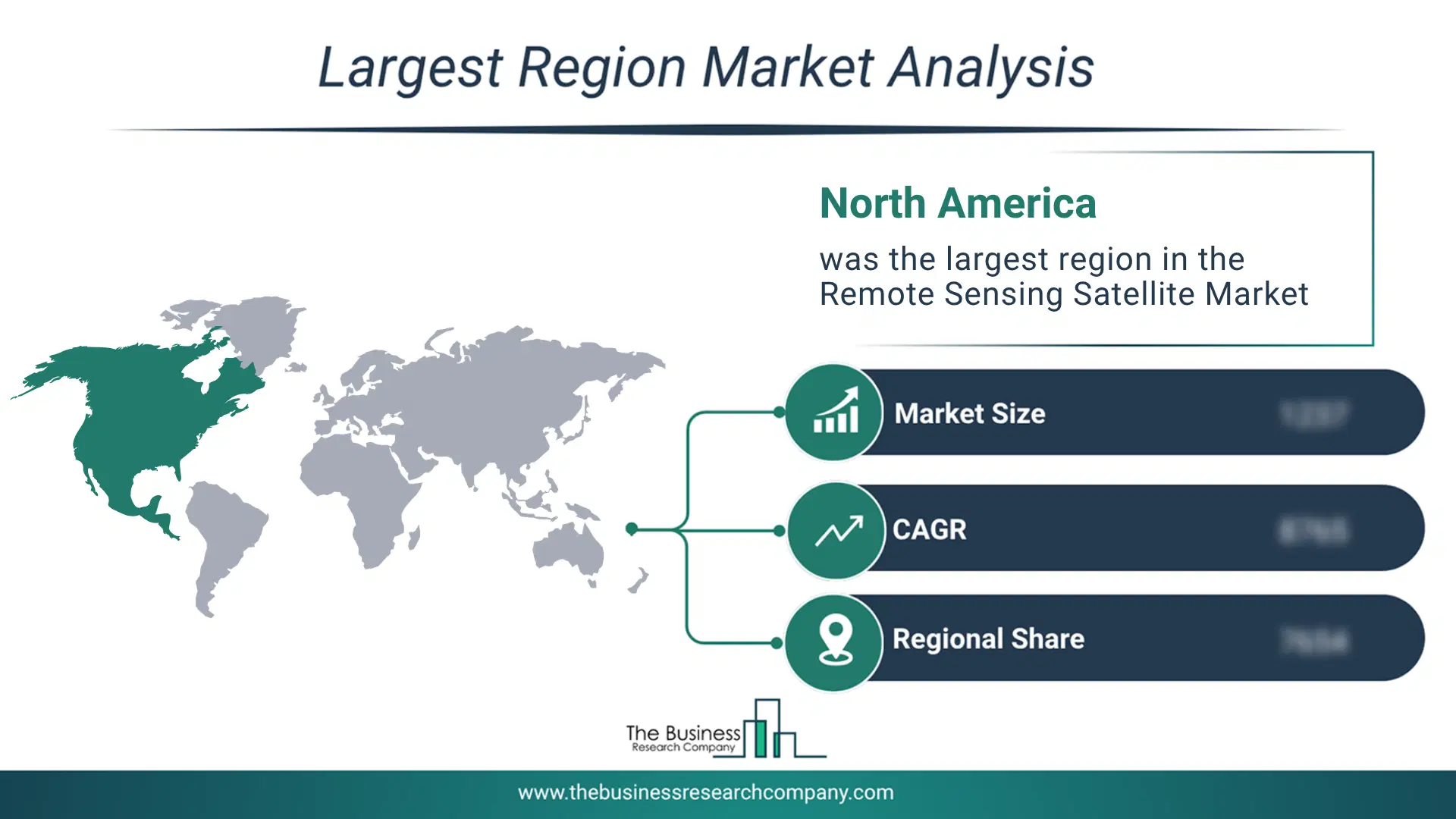
Regional Insights
North America was the largest region in the remote sensing satellite market in 2025. Asia-Pacific is expected to be the fastest-growing region in the forecast period. The regions covered in this market report are Asia-Pacific, South East Asia, Western Europe, Eastern Europe, North America, South America, Middle East, Africa. The countries covered in this market report are Australia, Brazil, China, France, Germany, India, Indonesia, Japan, Taiwan, Russia, South Korea, UK, USA, Canada, Italy, SpainWhat Defines the Remote Sensing Satellite Market?
The remote sensing satellite market consists of sales of active remote sensing satellites, passive remote sensing satellites, lidar sensors and electromagnetic sensors. Values in this market are ‘factory gate’ values, that is the value of goods sold by the manufacturers or creators of the goods, whether to other entities (including downstream manufacturers, wholesalers, distributors and retailers) or directly to end customers. The value of goods in this market includes related services sold by the creators of the goods.How is Market Value Defined and Measured?
The market value is defined as the revenues that enterprises gain from the sale of goods and/or services within the specified market and geography through sales, grants, or donations in terms of the currency (in USD unless otherwise specified). The revenues for a specified geography are consumption values that are revenues generated by organizations in the specified geography within the market, irrespective of where they are produced. It does not include revenues from resales along the supply chain, either further along the supply chain or as part of other products.
This chart presents market attractiveness based on a quantitative evaluation of growth, competition, strategic alignment, and risk, offering a clear view of opportunity areas for decision-making. This chart is for illustrative purposes; the full report contains the complete analysis.

This chart highlights the Total Addressable Market (TAM) by estimating the maximum revenue opportunity using an assumption-driven approach, supporting strategic planning and opportunity sizing across markets. The chart is illustrative; the full report provides a more comprehensive analysis.
What Key Data and Analysis Are Included in the Remote Sensing Satellite Market Report 2026?
The remote sensing satellite market research report is one of a series of new reports from The Business Research Company that provides market statistics, including industry global market size, regional shares, competitors with the market share, detailed market segments, market trends and opportunities, and any further data you may need to thrive in the remote sensing satellite industry. The market research report delivers a complete perspective of everything you need, with an in-depth analysis of the current and future state of the industry.Remote Sensing Satellite Market Report Forecast Analysis
| Report Attribute | Details |
|---|---|
| Market Size Value In 2026 | $16.5 billion |
| Revenue Forecast In 2030 | $24.77 billion |
| Growth Rate | CAGR of 10.7% from 2026 to 2030 |
| Base Year For Estimation | 2025 |
| Actual Estimates/Historical Data | 2020-2025 |
| Forecast Period | 2026 - 2030 |
| Market Representation | Revenue in USD Billion and CAGR from 2026 to 2030 |
| Segments Covered | Type, Payload, Application, End Use |
| Regional Scope | Asia-Pacific, Western Europe, Eastern Europe, North America, South America, Middle East, Africa |
| Country Scope | The countries covered in the remote sensing satellite market report are Australia, Brazil, China, France, Germany, India, Indonesia, Japan, Taiwan, Russia, South Korea, UK, USA, Canada, Italy, Spain |
| Key Companies Profiled | Raytheon Technologies Corporation, The Boeing Company, Lockheed Martin Corporation, Airbus SE, Northrop Grumman, Mitsubishi Electric Corporation, Thales Group, L3Harris Technologies Inc., BALL CORPORATION, Hexagon AB, General Dynamics Mission Systems Inc., Maxar Technologies Inc., Environmental Systems Research Institute Inc.(Esri), AABSyS IT Pvt. Ltd, Planet Labs Inc., Orbital Insight, BlackSky Global LLC, Satellite Imaging Corporation, Mallon Technology, Antrix Corporation, Geo Sense, Remote Sensing Solutions GmbH, ImageSat International N.V. |
| Customization Scope | Request for Customization |
| Pricing And Purchase Options | Explore Purchase Options |