
Remote Vehicle Exhaust Sensor Market Report 2026
Global Outlook – By Product Type (Portable, Fixed), By Component (Concentration Sensors, Flow Sensors, Temperature Sensors, Data Processing Units), By Technology (Infrared, Electrochemical, Laser, Other Technologies), By Application (Passenger Vehicles, Commercial Vehicles), By End-User (Automotive Manufacturers, Environmental Agencies, Research Institutions, Other End-Users) – Market Size, Trends, Strategies, and Forecast to 2030
Remote Vehicle Exhaust Sensor Market Overview
• Remote Vehicle Exhaust Sensor market size has reached to $1.23 billion in 2025 • Expected to grow to $1.8 billion in 2030 at a compound annual growth rate (CAGR) of 7.8% • Growth Driver: Rising Demand For Eco-friendly Transport Solutions Fueling The Growth Of The Market Due To The Need For Emission Monitoring And Regulation Support • Market Trend: Advancements In Pressure Sensor Applications For Vehicle Compliance • North America was the largest region in 2025 and Asia-Pacific is the fastest growing region.What Is Covered Under Remote Vehicle Exhaust Sensor Market?
Remote vehicle exhaust sensors refer to non-intrusive devices designed to measure and analyze the emissions from a vehicle’s exhaust while it is in motion or under real-world driving conditions. They are used for monitoring air quality, detecting high-emitting vehicles, and supporting environmental compliance and enforcement programs. The main product types of remote vehicle exhaust sensors are portable and fixed. A portable remote vehicle exhaust sensor is a mobile, non-contact device used to measure and analyze vehicle emissions from a distance, typically deployed roadside to assess real-world pollution levels from passing vehicles. Various components are included, such as concentration sensors, flow sensors, temperature sensors, and data processing units. They utilize technologies such as infrared, electrochemical, laser, and others. These sensors are used in applications such as passenger vehicles and commercial vehicles, catering to end-users such as automotive manufacturers, environmental agencies, research institutions, and other end-users.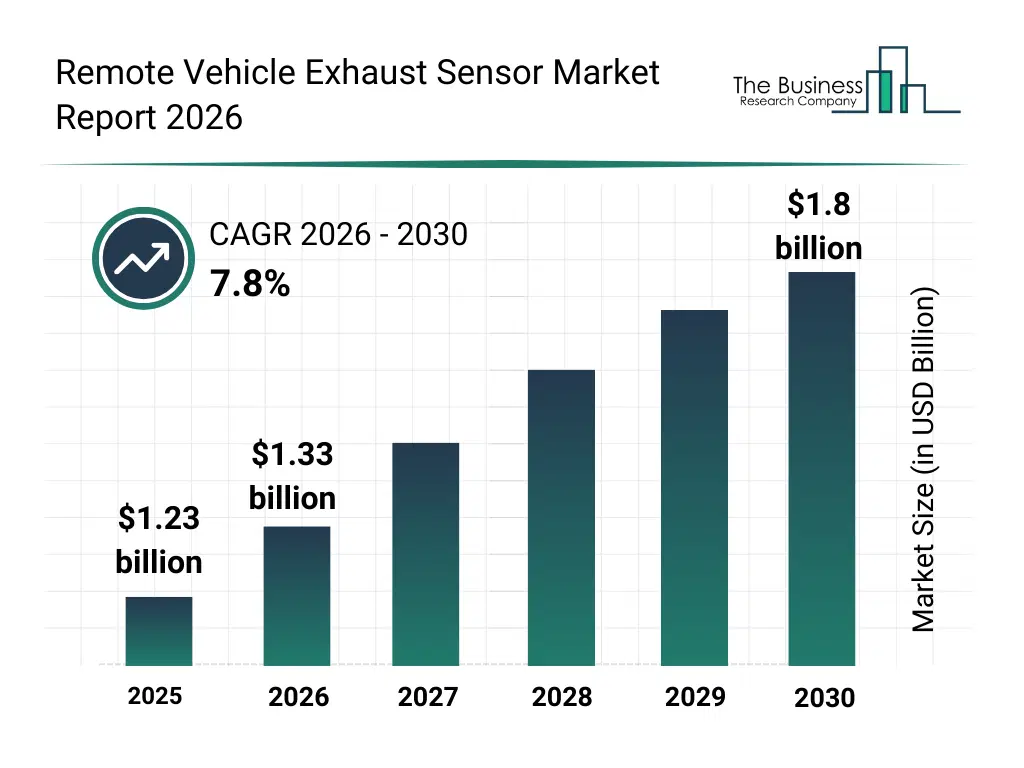
What Is The Remote Vehicle Exhaust Sensor Market Size and Share 2026?
The remote vehicle exhaust sensor market size has grown strongly in recent years. It will grow from $1.23 billion in 2025 to $1.33 billion in 2026 at a compound annual growth rate (CAGR) of 8.1%. The growth in the historic period can be attributed to air pollution concerns, vehicle emission regulations, adoption of remote sensing technologies, urban traffic growth, government monitoring initiatives.What Is The Remote Vehicle Exhaust Sensor Market Growth Forecast?
The remote vehicle exhaust sensor market size is expected to see strong growth in the next few years. It will grow to $1.8 billion in 2030 at a compound annual growth rate (CAGR) of 7.8%. The growth in the forecast period can be attributed to stricter emission norms, smart city investments, ai-based data analytics adoption, demand for real-world emission data, connected infrastructure expansion. Major trends in the forecast period include growth of real-time emission monitoring, deployment of roadside sensor networks, adoption of infrared and laser technologies, expansion of smart city air quality programs, demand for regulatory enforcement tools.
Global Remote Vehicle Exhaust Sensor Market Segmentation
1) By Product Type: Portable, Fixed 2) By Component: Concentration Sensors, Flow Sensors, Temperature Sensors, Data Processing Units 3) By Technology: Infrared, Electrochemical, Laser, Other Technologies 4) By Application: Passenger Vehicles, Commercial Vehicles 5) By End-User: Automotive Manufacturers, Environmental Agencies, Research Institutions, Other End-Users Subsegments: 1) By Portable: Handheld Emission Analyzers, Mobile Emission Detection Units, Drone-Based Emission Sensors, Portable Infrared Gas Analyzers 2) By Fixed: Roadside Emission Monitoring Systems, Tunnel Air Quality Monitoring Stations, Fixed Infrared and UV-Based Detectors, Remote Sensing LIDAR-BasedWhat Are The Drivers Of The Remote Vehicle Exhaust Sensor Market?
The rising demand for eco-friendly transport solutions is expected to propel the growth of the remote vehicle exhaust sensor market going forward. Eco-friendly transport solutions refer to modes of transportation that produce little or no harmful emissions, designed to reduce environmental impact and promote sustainable travel. The demand for eco-friendly transport solutions is increasing due to growing concerns over climate change and the need to reduce greenhouse gas emissions. Remote vehicle exhaust sensors help eco-friendly transport solutions by identifying high-emission vehicles for regulation and encouraging cleaner fleet management. For instance, in October 2024, according to the European Environment Agency (EEA), a Denmark-based organization specializing in environmental data collection, analysis, and policy support, a total of 2.4 million new electric vehicles were registered in 2023, reflecting a significant increase from 2 million in 2022. Therefore, the rising demand for eco-friendly transport solutions will drive the growth of the remote vehicle exhaust sensor industry. Increasing concerns over air quality are expected to propel the growth of the remote vehicle exhaust sensor market going forward. Concerns over air quality refer to the growing awareness and anxiety about the harmful effects of pollutants in the air on human health, the environment, and the climate. Rising concerns over air quality are largely due to the increasing levels of air pollution from industrial emissions and vehicle exhaust, which pose serious health risks. Remote vehicle exhaust sensors help address increasing concerns over air quality by detecting and measuring harmful emissions from vehicles in real-time, enabling better regulation and pollution control. For instance, in March 2024, according to the International Energy Agency (IEA), a France-based autonomous intergovernmental organization, in 2023, global energy-related carbon dioxide (CO₂) emissions rose by 1.1%, an increase of 410 million metric tons compared to 321 million metric tons in 2022, bringing total emissions to a record high of over 37.4 billion metric tons. Therefore, increasing concerns over air quality will drive the growth of the remote vehicle exhaust sensor industry.Key Players In The Global Remote Vehicle Exhaust Sensor Market
Major companies operating in the remote vehicle exhaust sensor market report include AVL List GmbH, Opus Group AB, Sensors Inc., Hager Environmental & Atmospheric Technologies LLC, Airyx GmbH, HORIBA Ltd., MKS Instruments Inc., Siemens AG, ABB Ltd., Amphenol Advanced Sensors, First Sensor AG, Sensata Technologies Holding plc, Robert Bosch GmbH, MAHLE GmbH, Hitachi Astemo Ltd., Delphi Technologies, HELLA GmbH & Co. KGaA, Valeo SE, Vitesco Technologies, Niterra Co. Ltd., California Analytical Instruments Inc., Ecotech Pty Ltd., SICK AG, Teledyne Technologies Incorporated, Aeroqual Ltd
This chart is for illustrative purposes; the full report includes a detailed competitor analysis and comprehensive overview of the top 10 companies in the market.
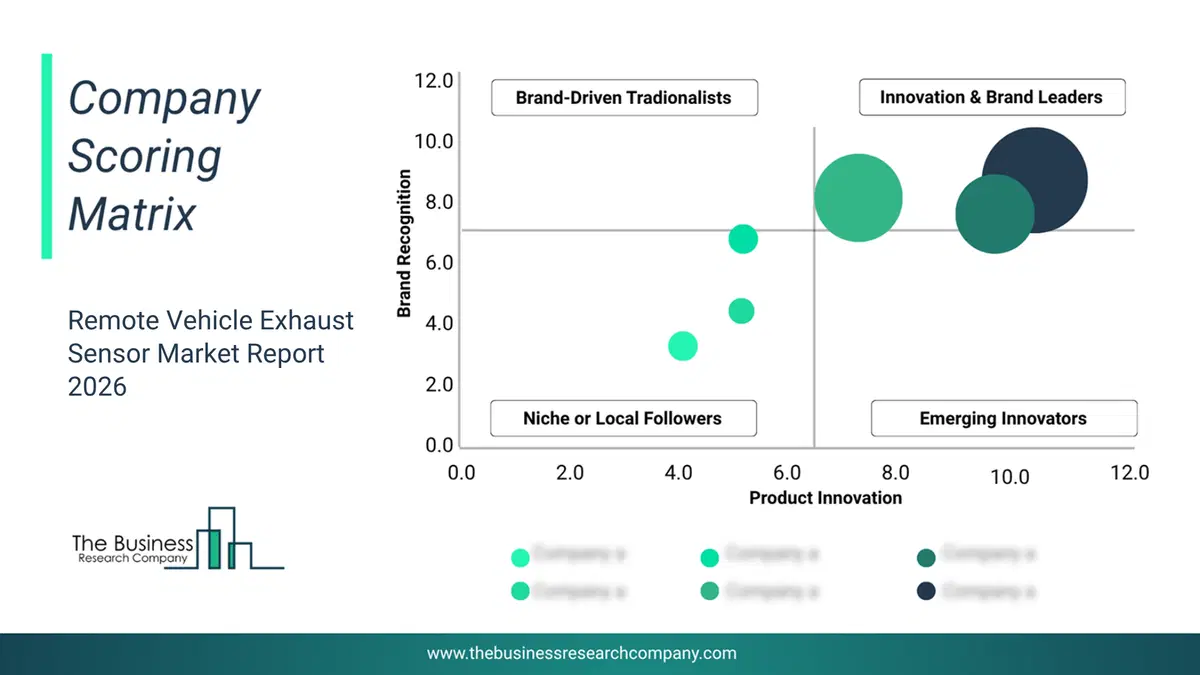
This chart maps companies by product innovation and brand strength, with bubble size indicating relative revenue, helping identify market leaders, challengers, and niche players. This is an illustrative chart; the full report provides a complete and accurate competitive analysis.
Global Remote Vehicle Exhaust Sensor Market Trends and Insights
Major companies operating in the remote vehicle exhaust sensor market are focusing on developing innovative products, such as differential pressure sensors, to enhance emission detection accuracy, improve vehicle compliance monitoring, and meet increasingly stringent environmental regulations. Differential pressure sensors measure the difference in pressure between two points and are commonly used to monitor flow, filter status, or detect blockages in systems. For instance, in June 2023, Niterra Co., Ltd., a Japan-based manufacturer of automotive components and technical ceramics, launched the new EDPS (exhaust differential pressure sensors) series, an advanced portfolio designed to enhance engine performance and emissions control. The EDPS range includes three sensor types, such as differential pressure sensors (DPS) that monitor pressure drops across key exhaust components, including the DPF and EGR cooler, to support emission regulation exhaust pressure sensors (EPS) that provide real-time exhaust pressure data to the ECU for optimized engine management; and high-pressure sensors (HPS) that safeguard turbochargers and exhaust manifolds by monitoring backpressure, ensuring compliance with stringent emissions standards.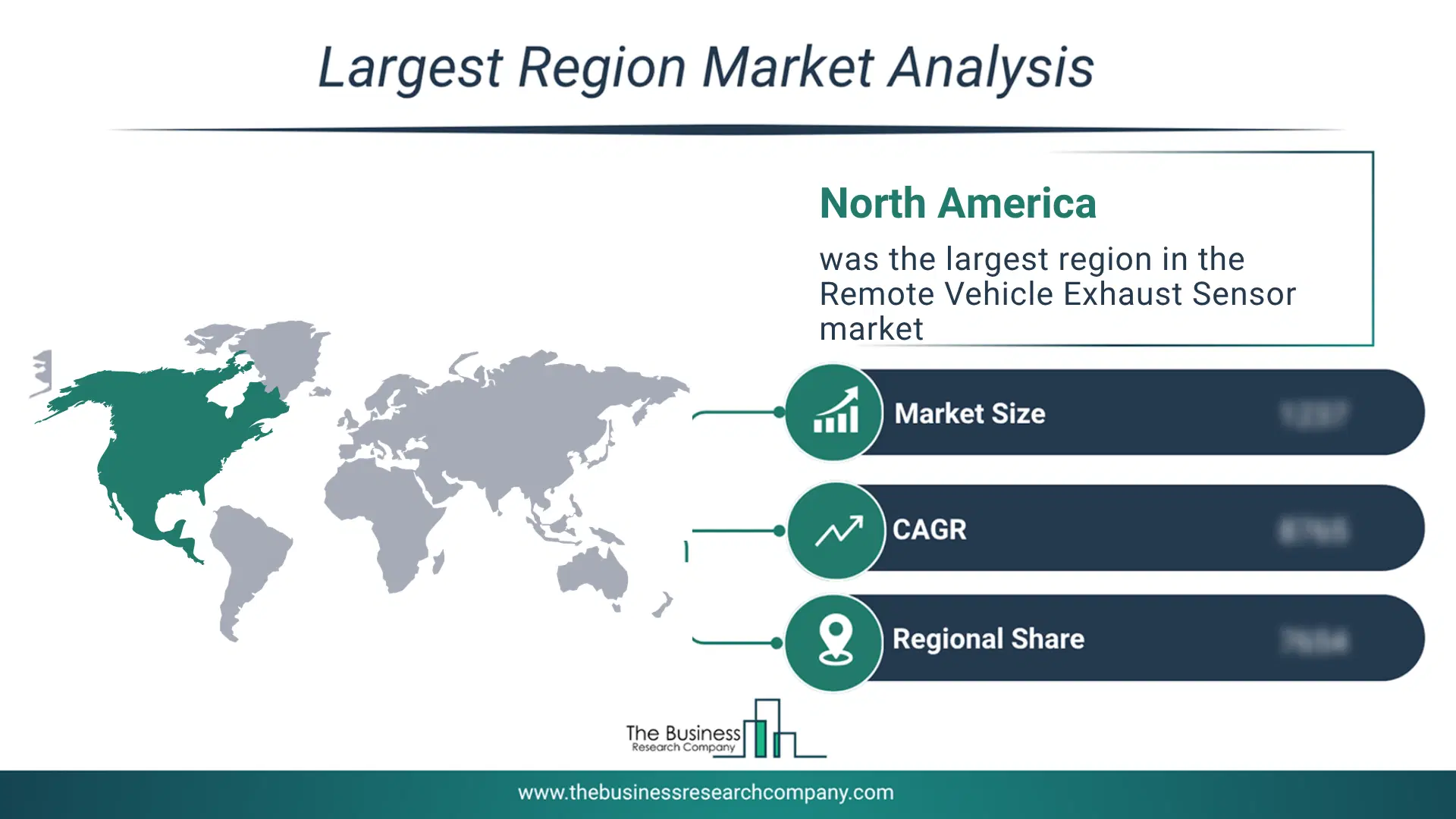
Regional Outlook
North America was the largest region in the remote vehicle exhaust sensor market in 2025. Asia-Pacific is expected to be the fastest-growing region in the forecast period. The regions covered in this market report include Asia-Pacific, South East Asia, Western Europe, Eastern Europe, North America, South America, Middle East, Africa. The countries covered in this market report include Australia, Brazil, China, France, Germany, India, Indonesia, Japan, Taiwan, Russia, South Korea, UK, USA, Canada, Italy, SpainWhat Defines the Remote Vehicle Exhaust Sensor Market?
The remote vehicle exhaust sensor market consists of sales of integrated sensors, wireless sensors, and onboard diagnostic sensors. Values in this market are ‘factory gate’ values, that is, the value of goods sold by the manufacturers or creators of the goods, whether to other entities (including downstream manufacturers, wholesalers, distributors, and retailers) or directly to end customers. The value of goods in this market includes related services sold by the creators of the goods.How is Market Value Defined and Measured?
The market value is defined as the revenues that enterprises gain from the sale of goods and/or services within the specified market and geography through sales, grants, or donations in terms of the currency (in USD unless otherwise specified). The revenues for a specified geography are consumption values that are revenues generated by organizations in the specified geography within the market, irrespective of where they are produced. It does not include revenues from resales along the supply chain, either further along the supply chain or as part of other products.
This chart presents market attractiveness based on a quantitative evaluation of growth, competition, strategic alignment, and risk, offering a clear view of opportunity areas for decision-making. This chart is for illustrative purposes; the full report contains the complete analysis.

This chart highlights the Total Addressable Market (TAM) by estimating the maximum revenue opportunity using an assumption-driven approach, supporting strategic planning and opportunity sizing across markets. The chart is illustrative; the full report provides a more comprehensive analysis.
What Key Data and Analysis Are Included in the Remote Vehicle Exhaust Sensor Market Report 2026?
The remote vehicle exhaust sensor market research report is one of a series of new reports from The Business Research Company that provides market statistics, including industry global market size, regional shares, competitors with the market share, detailed market segments, market trends and opportunities, and any further data you may need to thrive in the remote vehicle exhaust sensor industry. The market research report delivers a complete perspective of everything you need, with an in-depth analysis of the current and future state of the industry.Remote Vehicle Exhaust Sensor Market Report Forecast Analysis
| Report Attribute | Details |
|---|---|
| Market Size Value In 2026 | $1.33 billion |
| Revenue Forecast In 2030 | $1.8 billion |
| Growth Rate | CAGR of 8.1% from 2026 to 2030 |
| Base Year For Estimation | 2025 |
| Actual Estimates/Historical Data | 2020-2025 |
| Forecast Period | 2026 - 2030 - 2030 |
| Market Representation | Revenue in USD Billion and CAGR from 2026 to 2030 |
| Segments Covered | Product Type, Component, Technology, Application, End-User |
| Regional Scope | Asia-Pacific, Western Europe, Eastern Europe, North America, South America, Middle East, Africa |
| Country Scope | The countries covered in the report are Australia, Brazil, China, France, Germany, India, Indonesia, Japan, Taiwan, Russia, South Korea, UK, USA, Canada, Italy, Spain. |
| Key Companies Profiled | AVL List GmbH, Opus Group AB, Sensors Inc., Hager Environmental & Atmospheric Technologies LLC, Airyx GmbH, HORIBA Ltd., MKS Instruments Inc., Siemens AG, ABB Ltd., Amphenol Advanced Sensors, First Sensor AG, Sensata Technologies Holding plc, Robert Bosch GmbH, MAHLE GmbH, Hitachi Astemo Ltd., Delphi Technologies, HELLA GmbH & Co. KGaA, Valeo SE, Vitesco Technologies, Niterra Co. Ltd., California Analytical Instruments Inc., Ecotech Pty Ltd., SICK AG, Teledyne Technologies Incorporated, Aeroqual Ltd |
| Customization Scope | Request for Customization |
| Pricing And Purchase Options | Explore Purchase Options |